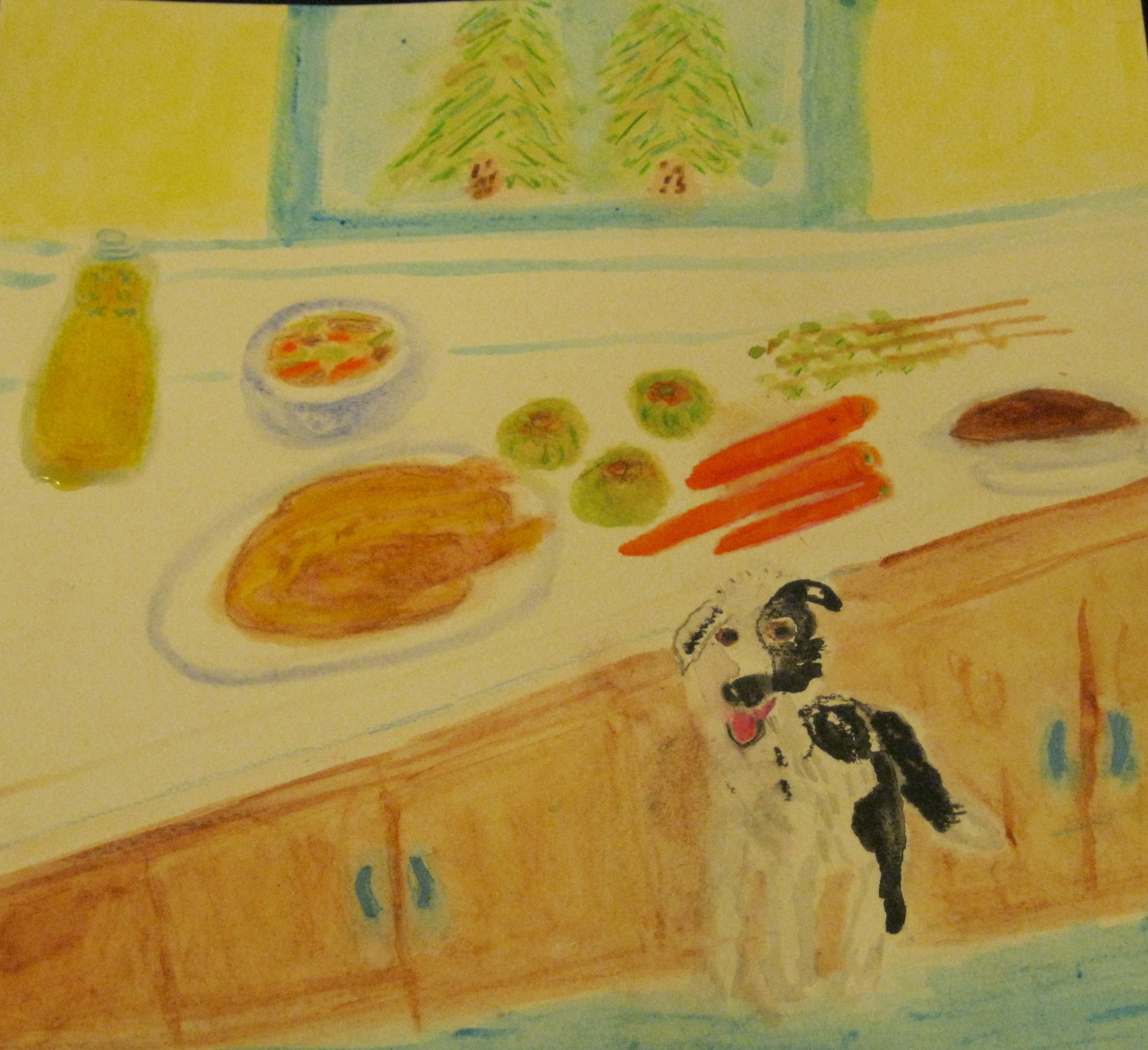
painting of kale salad

Kale Salad. 8″ x8″ gouache and watercolor pencil. Sharyn Dimmick

When I started a blog called “The Kale Chronicles,” I liked the alliteration and I felt like I was perpetually struggling with kale: Riverdog Farm put in my vegetable box frequently and I had found no truly satisfying way to eat it in three years. Then I went to Mabel Dodge Luhan House in New Mexico this November and Jane Garrett served a kale salad. I ate some. Then I went up for seconds. Then I asked for the recipe.

Jane obliged and I have made this salad twice since returning home. Every time I make it, I eat big bowls full of it and I eat it everyday until it is gone. I made it again tonight and just ate a flat soup bowl full of it.

Why do I like it so much? It could be the dressing: Meyer lemon juice, olive oil, garlic, tahini, tamari and a little bit of honey — I might eat that on shoe leather, although I doubt it. I might like it because you blanch the kale before attempting to eat it. I just like it.

I’ll give you Jane’s version as she wrote it and then I’ll explain how and why I altered it.

Jane Garrett’s Kale Salad

Blanch two bunches of kale*.

Add what you like: grated carrots, radishes, dried cherries, almonds, red potatoes, feta, mint.

Toss with the following dressing:

1/2 cup lemon juice with zest

1/3 cup olive oil

2 Tbsp tahini

2 Tbsp Braggs’  OR 1 Tbsp tamari

3 cloves garlic (I pressed mine)

1/4 tsp agave OR  1/4 tsp honey

*If you are going to eat kale, you need to remove the stems and ribs. Jane didn’t tell you this because she thinks everyone knows it. So, before you blanch the kale, remove the stems and ribs and compost them.

My alterations: I don’t have any Braggs’, which I believe is Braggs’ amino acid, or some such thing, and I haven’t been inclined to go out and get any. I deduced that it was contributing the salty flavor, so I substituted 1 Tbsp tamari for the 2 Tbsp of Braggs’. I used Meyer lemons because we have them growing in our front yard — they are sweeter and less sharp than Eureka lemons, the ones you usually find in the supermarket. I used 1/4 tsp honey for the agave because, once again, I don’t keep agave in the house — I don’t object to it or its flavor — it’s just not something I have around the house. Lastly, I don’t measure my olive oil: take Jane’s measurement if you want to be precise — I just dress the kale with some olive oil, mix together the other ingredients and toss the salad.

I haven’t been adventuresome in mixing things into this yet because I actually like the taste of the kale smothered in this dressing. I did put in half a handful of dried sour cherries tonight, but I couldn’t really taste them — the dressing is pretty powerful.

What I hope is that this salad helps some of you eat kale who have found it hard to enjoy in other preparations, especially those of you who are at your wits’ end when kale shows up in your farm box (Someone removed a bunch of kale from his box today and set it on top of the stack for someone else to take home!). It works for me.

Now, the award: Jen aka Zestybeandog kindly awarded me The Versatile Blogger Award. This pleases me because 1) Who doesn’t like an award and some recognition 2) Versatility in the kitchen is one of the hallmarks of my cooking style and 3) I get to pass the award on to several other bloggers whose blogs I enjoy. I am also to reveal seven things about myself

1) I love to sing. I sang in school choirs and church choirs. I have one CD, “Paris,” featuring traditional ballads, original songs and covers.

2) I started a ballad-singing group in Berkeley many years ago. It’s still going.

3) Besides painting food subjects I like to paint flowers, song illustrations and occasional landscapes. Animal portraits have been creeping in lately…

4) I used to work as a Recreation Leader in a program that brought together children with disabilities and able-bodied, neurotypical children.

5) I used to be a psychotherapist (MFT)

6) I love open-water swimming and swim in the Berkeley Marina, weather-permitting, from May through October.

7) I sell paintings. Just thought I’d throw that in because I do sell my original watercolors. I am happy to sell them. I am working on developing related products, including cards, trivets, canvas bags, etc. with images from “The Kale Chronicles.” If you want something, please ask.

Where to start? I have just been in the blogosphere for a little over four months, In that time I have come to enjoy the following blogs:

Bitsandbreadcrumbs by Betsy — Betsy cooks stuff I want to cook myself.

Kitchen Inspirations by Eva Taylor. Can’t tell you why exactly — that’s the nature of inspiration — I just like Eva’s blog.

Angry Cherry — the baking blog with personality and many original ideas. She makes things I want to try someday.

JustaSmidgen — lovely photos and some stunning recipes: malted milk meringues anybody? Or pomegranate salad?

From the Bartolini Kitchens — John chronicles his family’s Italian recipes, tells great stories and is one of the kindest people in the blogosphere that I have run across

Lauren is baking her way around the world, making things from every country she can think of. She is particularly honest, which makes her fun to read.

Linda, at Savoring Every Bite makes lovely cheesecakes, attends to decor as much as to food, is generous with her comments and posts a variety of recipes. Pumpkin fans must subscribe to her blog in the fall.

Bewitching Kitchen. Sally has a not-so-secret love of baking bread. In this, we are sisters. She just posted a wonderful-sounding caramelized carrot soup.

SmittenKitchen. This is a big, well-known blog. You may already read it. If you don’t, go there now: Deb has it all: recipes, photos, stories.

As you can see, those are food blogs.

I also read art blogs, or art and food blogs.

The first art and food blog I found was Jane Robinson’s Art Epicurean. Jane paints lovely abstracts and publishes a wide variety of recipes

My latest food and art blog discovery is The Hungry Artist by Melissa. I look forward to seeing more of her work (she just posted some wonderfully-shaped fig cookies on FoodBuzz)

And, somewhere in between, I found Dichotomyof. She makes colorful patchwork cushions, raises children and cooks, too.

For pure art (without food), go to

Bees ATC. Nancy posts a drawing everyday around midnight central time. They are usually colored pencil drawings.

Saltworkstudio: Suzanne has developed quite a following for her abstract acrylic work and collages. She teaches in Sonoma County, but she has gone to Rome for the holidays. I’m sure she’ll have stories to tell when she gets back

And, last, but not least, there is Donna Louise, neither a food nor art blog, but a modern serial by a funny, offbeat writer who shall remain nameless for the time being (at the writer’s request).
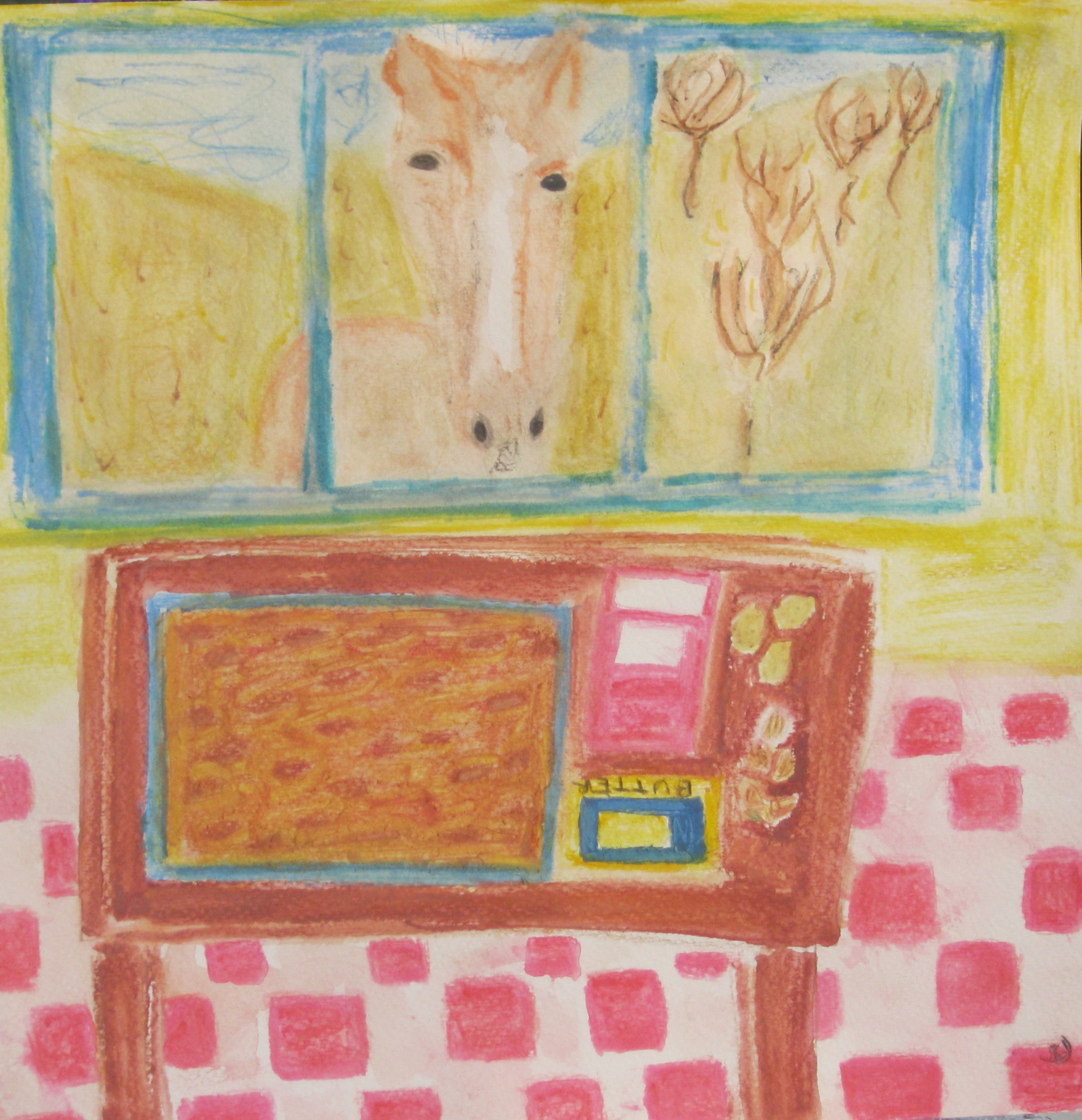
painting of English toffee and ingredients as seen by a horse.

Sebastian and the English Toffee. 12″ x 12″ watercolor pencil. Sharyn Dimmick

Last week Susan Darm showed up to show you how to make her delicious caramels. This week she is back with her English Toffee recipe. The basic recipe has only three ingredients — shouldn’t you be making some? Think of how nice it will be standing over a warm, fragrant pot of caramel on these cold days.

Susan says:

I did not get this recipe from a book. It may have been given to me by a neighbor, Mrs. Steel, who was from England. I never wrote it down because the recipe was simple, consisting of only three ingredients. These were cooked together carefully then poured out, cooled and broken into pieces which could be covered or dipped in chocolate and robed in chopped almonds. I made English Toffee at the holidays for years. So far I have not found any commercial toffee that tastes as good.

English Toffee

One pound granulated sugar

One pound butter (I have used salted and un-salted. Salted works better for me).

One cup raw almonds

Prepare a buttered cookie sheet. I use a buttered silicon cooking mat on a cookie sheet but it works just as well without the silicon. In a good quality saucepan about 10 inch diameter, place the sugar and butter. Melt these together stirring continuously until they are completely melted and start to bubble. Add the raw almonds. Continue to cook at a slow boil while stirring constantly never lifting the spoon from the mixture. If you are using a candy thermometer you will do this until it reads 290-300 degrees f (between soft crack and hard crack stage). If not using a thermometer, cook until the candy starts to turn a beautiful toffee color and pulls away from the sides of the pan as you stir. Remove the pan from the heat. Carefully remove the stirrer from the pan. Do not allow any candy on the stirrer to drip back in to the pan, it could taint your candy and ruin the texture. Pour the candy on to the baking sheet or silicon mat. I let it cool just a little then use a silicon spatula to smooth the surface and spread the nuts uniformly. I sometimes score the candy lightly with a knife just before it hardens so I get uniform sized pieces when I break the cooled candy. Once the candy has cooled you can do what you want, break it in to pieces to dip in chocolate, crumble it, or chocolate coat the whole big piece to give as a gift along with a little hammer. Have fun and be creative!

Food Notes (from Sharyn): We pour our candy into buttered Pyrex oblong pans. It works for us.

Painting note: Today’s painting features Susan’s horse, Sebastian, who says, “Western tack, please, but English toffee!”

Susan promises to come back next fall and teach us how to cure olives.

painting shows loaf of Swedish bread

e

While I was away for the weekend my Mom bought some oranges. I wrote about eating my first orange of the fall and winter in Taos, New Mexico in November, but these were the first oranges we have had in the house since spring. Suddenly oranges are calling to both of us. I planned to stir up a lunch of bread and soup to warm us up this cold day. Plenty of beets, turnips, carrots and half a head of cabbage dictated borscht, brought together with chicken broth from the freezer, the last few cherry tomatoes on the vines and a package of dried mushrooms (my sister-in-law likes Ukranian borscht with mushrooms in it).

When I asked Mom if she wanted Swedish rye or whole wheat bread to go with the soup, she said, “Swedish rye. We haven’t had that in a long time.” Indeed we haven’t — I only make it when I can get fresh oranges. Now, I know you can buy oranges any old day at the grocery store and that they come from Florida, Israel, Mexico, goodness knows where. Since I live in California, I eat and cook with California oranges in season and one of the first things I make when they come in in the winter is this sweet rye bread, flavored with orange juice and zest, anise seeds and raisins.

I learned to bake this from my childhood friend, Lori Johnson. I’ve tweaked it a bit over the years, substituting orange juice for some of the water in the original recipe. This makes wonderful toast and dynamite peanut butter sandwiches.

Into a large mixing bowl, measure

1 Tbsp shortening

1/3 cup molasses

1/2 cup packed brown sugar

1 scant Tbsp kosher salt

1/4 tsp anise seed

In the 1-cup liquid measuring cup that you used to measure the molasses, place 1/4 cup warm water and 1 package active dry yeast (2 and 1/4 tsp).

Beat yeast and water with a fork. Let yeast proof while you

Zest one orange into the mixing bowl.

Then cut the orange in half and squeeze the juice into a 2 cup measuring cup. Add water to reach 1 and 1/2 cups total liquid. Add this to mixing bowl.

Add 1 cup sifted unbleached flour.

Check temperature. If contents of mixing bowl is now lukewarm or cooler, add proofed yeast and stir.

Next add 2 cups rye flour and beat until smooth (I use a large wooden spoon). There will be flour clumps. That’s okay — you are beating to develop gluten in the rye flour and the lumps will vanish if you beat hard and long enough. The batter should turn glossy.

Stir in 1 cup raisins, a few at a time, incorporating each batch before adding more (Exposed raisins will burn in the oven’s heat).

Add 3 to 3 and 1/2 cups unbleached flour until you have a soft dough.

Let dough rest 10 minutes.

Knead dough until smooth — at least ten minutes. Form into ball. Grease your mixing bowl and place dough in it. Cover with a damp warm towel and put in a warm place to rise until double (I check it in about an hour: rye flour slows the rising time of bread). Punch it down. Let it rise again until double. Grease loaf pans, or round pans or baking sheets. Divide dough in half and shape into two standard loaves, round loaves or free-hand braids. Preheat oven to 375. Let rise again. If you wish, you may slash the tops of the loaves ten minutes before putting them into the oven.

Bake 25 to 35 minutes or until crust sounds hollow when thumped. For best texture, let the bread cool on a rack before cutting.

Food notes: If you must have an additional holiday touch, you might substitute dried cranberries for the raisins. I have not done this myself. Heidi of 101 Cookbooks has a link to some rye flour shortbread cookies on her recent sticky gingerbread post: I am thinking of making them with anise seed and orange zest to duplicate the flavors of this bread in cookie form.

All you candy-makers please visit again on Wednesday December 14 for another recipe by Susan Darm, featuring English toffee.

painting shows miniature horse looking through window at caramels.

Scamp and the Christmas Caramels 12″ x 12″ watercolor pencil. Sharyn Dimmick.

Today The Kale Chronicles presents a holiday confection from Susan Darm: at our house candy and certain cookies are seasonal foods, made only in December.  In November 2011, Susan brought some of her caramels to a writing retreat in New Mexico and we all swooned. Susan lives in Brentwood in eastern Contra Costa County, an area formerly known as the Horn of Plenty. My favorite peach farm, Frog Hollow Farm, is still out there, although much of the fertile land has been paved over for housing. When Susan is not making candy she is an equine enthusiast, physical therapist and aspiring writer. Here’s Susan:.

I have always loved candy. As a child in grade school, I figured out that if I was going to eat as many sweets as I liked, I would have to learn to make them. I started out simply with a snack of bread, butter and white sugar. This was a respectable after school snack in my mother’s eyes, something she herself ate as a child. When I got bored with this snack I began experimenting with sugar, butter and/or syrup boiled in a sauce pan, cooled then either eaten plain or poured over nuts. I got the idea of cooking sugar from my father. He made pecan rolls at Christmas and I loved the gooey topping made of brown sugar, butter and pecans.

By the time I reached high school I had graduated to more complex concoctions. The first real winner, a candy that was good enough to share with others, was English Toffee. After 10 or 15 years of English Toffee, I got burned out on making the same candy over and over. I started searching for new recipes. I experimented heavily with both caramel and fudge. I was better suited to making caramel; it has similar properties to toffee. The recipe I ended up using as a base for my caramels is common and can be found with minor variations anywhere on the internet. Once you get the knack of making basic caramels, there are endless variations as far as using nuts, chocolate, salt for salted caramels, constructing layered candies (like Turtles) or shortening the cooking time and making caramel sauce instead of candy. I have even incorporated marshmallows, walnuts and chocolate in to the caramel with sweet results kind of like a caramel rocky road. It was good for me to make these candies. Over the years I began to eat less myself and enjoyed giving it away more than eating it.

The key to caramel making is attention to these details:

  1. Once you get to the actual cooking stage (after the ingredients have melted together), the spoon must not be removed from the pot and you must stir continuously without scraping the sides of the pot. I use a bamboo paddle and envision the paddle moving the candy in a pattern around the pot so no area is left unstirred.
  2. Manage the temperature of the stove to keep the pot at a slow boil.
  3. When you pour the candy out, do not scrape the pan. You may scrape the pan later and eat the scrapings.
  4. I no longer use a candy thermometer because I am able to eyeball the proper cooking stage. I suggest you start with a candy thermometer then estimate the time it takes to achieve the desired ball stage on your stove and quit the thermometer. I find the thermometer cumbersome and by the time I read the proper temperature my candy is overcooked.
  5. Every stove is different. On my old stove, the caramel took about 18 minutes to cook. On my new stove it is always ready in 12 to 15 minutes. This is why I use my eyes.

Easy Basic Caramels

Prepare a buttered 9 by 9 inch pan. Silicon works the best. You may fill the bottom of the pan with nuts. I use raw walnuts or toasted salted almonds or pecans. I have also used macadamias and Brazil nuts. Any nut tastes great with caramel! The caramels also taste good plain.

1 cup granulated sugar

1 cup dark corn syrup

1 cup butter

Put these ingredients in to a 10 inch heavy bottomed sauce pan, melt together and while stirring constantly bring to a slow boil. Turn the heat down and maintain a slow boil uncovered for 4 minutes without stirring. Keep the bamboo spatula in a cup of warm water while the concoction is boiling. After 4 minutes of slow boil, remove the pan from the heat and add:

One can of sweetened condensed milk

Put the pan back on the stove and over low/medium heat boil the concoction while stirring constantly without removing the spoon. If you use a thermometer you will cook it to 238 degrees f. If you use your eyes, the caramel will turn a warm brown caramel color and start to pull away from the sides of the pan. Once they have reached the desired temperature or color, remove the pan from the heat. At this point you may stir in any flavoring you would like. Most people like to add vanilla. I do not. Then pour the caramel in to the 9 by 9 buttered pan. Let the pan cool completely. I refrigerate them overnight. Once you have the basic caramel you can dress it any way you like. I remove the slab of caramel from the pan and cut it into small rectangles. I dip the bottoms of the rectangles in chocolate then wrap them individually in waxed paper (like my grandma used to do). You can also press salt in a decorative pattern on to the top of each piece or mold them in to balls, push nuts around the ball and dip it in chocolate. These caramels are very forgiving. Slightly undercooked they make a soft melt in your mouth caramel. Slightly overcooked they are firmer and must be served at room temperature.

These caramels keep well for several weeks in the refrigerator.

I try to put love in to everything I make. I believe we can taste when food is cooked with love. I also try to use local ingredients as much as possible. I am trying to find healthier candy to make and share. For next year I will work on making nougat with local honey, almonds from our orchard and egg whites from my mother in law’s chickens. This will be a lower fat candy made with ingredients from close to home. Wish me luck and I hope to share my results.

Food Notes: Sharyn here.I grew up making caramels at Christmas with cream, but have never made them with condensed milk (it won’t be long now!). My mother remembers boiling cans of condensed milk as a child to make caramel, so it is a tried and true method.  I also agree with Susan about candy thermometers: I learned to make candy the old-fashioned way by dropping samples into cool water or across plates and looking for textures: soft ball, hard ball, hard crack, etc. Next week, I’ll post Susan’s English toffee recipe for you.

Painting of Christmas cookies on green and red tablecloth.

Christmas Eve. 8″ x 8″ watercolor pencil and white gouache. Sharyn Dimmick

A few years back, Mom had a hankering to make pfefferneusse, a cookie she remembered buying in her childhood in Illinois. Pfefferneusse are small round spicy cookies frosted with royal icing flavored with anise. They are not everyone’s cup of tea, but if you like gingerbread or chai and you eat Good ‘N’ Plenty or black licorice, these are for you.

Mom had a basic recipe for pfefferneusse, typed on an index card. The only problem I saw with it is that it called for candied peel — can you say “yuck?” I pictured the multi-colored tubs of peels and fruit that Mom kept around for fruitcakes. And then I had an inspiration: what if we substituted candied ginger for the nasty candied fruit? It wasn’t hard to talk Mom into the recipe alteration.

The first year we made them, these cookies were okay, but Mom said there was something missing. Thinking about the name, she combed around through other cookbooks and found that pfefferneusse used to contain pepper, in addition to mace, cinnamon and allspice. The second time we made them we ground some fresh white pepper in the coffee grinder and added that to the cookie dough. Now you are talking. This year I added back just a touch of my home-candied non-yucky orange peel, picking the last orange peels from the jar of mixed lemon, orange and tangerine peels that I made last March.

I present to you our version of pfefferneusse, a non-rich, spicy cookie that is a good foil for butter cookies and shortbread on the holiday cookie buffet. Pfefferneusse are cookies that get better as they sit around: the flavors mellow and blend and the icing keeps them from getting too hard. Make them ahead of when you want to eat them: the dough benefits from chilling for at least a day before you bake the cookies. I made my first batch of the season on Wednesday morning, baked them on Thursday afternoon, frosted them Thursday night and served them to guests on Friday.

The first day:

Beat 4 eggs (I use an electric mixer for this job, but you can beat by hand if you are a hardy type)

Gradually incorporate 2 cups of white sugar.

Add

1 tsp baking powder

1/2 tsp cloves

1/2 tsp mace

1 tsp nutmeg

1/2 tsp  ground ginger

1/2 tsp cinnamon

1 tsp ground white pepper

a dash of minced, candied orange peel OR a grating of fresh orange zest (optional)

Add 4 cups of flour — it will make a stiff dough.

Fold in 1/2 cup minced candied ginger.

Cover the mixing bowl with something (a tea towel, waxed paper, or plastic wrap) and set in the refrigerator to chill for a couple of hours.

After a couple of hours, remove the dough from the refrigerator and knead it for awhile, in the bowl or on a board. If you use a board, try not to incorporate further flour. Return the dough to the refrigerator overnight.

On Day 2 (or 3 or 4):

Preheat oven to 300 degrees.

Lightly grease a couple of baking sheets.

Form dough into balls the size of a small walnut and place them on prepared cookie sheets.

Bake each tray for twenty to twenty-five minutes. Cookies should firm up but not brown much if at all.

Remove cookies from baking sheets and let cool completely before frosting with your royal icing

If you have a favorite recipe for royal icing, go ahead and use that except substitute anise flavoring for any vanilla, lemon extract or almond flavoring you usually use — if these don’t have anisette frosting they are not really pfefferneusse.

If you don’t have a recipe for royal icing, you can do what I do:

I separate 2 eggs, put the yolks in a jar covered with water in the refrigerator for another use, and beat the whites. When the whites are opaque, but not yet stiff, I start adding powdered sugar while continuing to beat them. When the icing is somewhat thick and glossy I stop and stir in some anise flavoring: you have to taste it to do this step — too much and it will remind you of toothpaste, not enough and what’s the point? If you are timid, you can add it drop by drop and stand there tasting it forever. I would recommend with beginning with 1/2 tsp and increasing the extract according to your tastes.

Frosting things is not my forte: I usually do it the quickest way, which is to pick up each cookie, dip it in the icing, twirl it to get rid of any drips and set it on brown paper. One further note: you need a dry day to frost them or your icing may turn tacky, even if it hardens initially. Let them dry fully before storing them in an air-tight container.

Painting shows lunch buffet at Mabel Dodge Luhan House, Taos, NM.

Lunch at Mabel’s. 12″ x 12″ Gouache and watercolor pencil. Sharyn Dimmick.

One of ways I become a better cook is to learn from cooks with greater skill and different repertoires than I have: once such cook is Jane Garrett who cooks at Mabel Dodge Luhan House in Taos, New Mexico. On my most recent visit there on a snowy November afternoon Jane served a lunch that struck me as perfect for the season and the weather: marsala mushrooms over polenta served with fresh figs in a balsamic reduction. She accompanied this richness with a simple pan of roasted root vegetables and a lemony salad made of raw baby chard and radicchio. I no longer remember what we ate for dessert because it was the lunch dishes that captivated me.

I begged Jane for the recipes to share with you. She graciously obliged. I brought them home with me. I went out and bought a bottle of dry Marsala. Alas, fresh figs had disappeared from my Farmers’ Market: I bought some dried figs from Trader Joe’s and contented myself with mushrooms from the mushroom vendor. We keep polenta. The Riverdog Farm box yields plenty of leeks. I had all of the spices and herbs on hand.

I made three of the four lunch dishes for dinner tonight (We had no salad ingredients but romaine lettuce).

Because I was using dried figs, I began with the balsamic syrup, using the only balsamic vinegar I had on hand, a blackberry-vanilla blend I couldn’t resist a few years back: the small bottle sat at the back of our cooler cabinet, waiting for a compelling recipe. To make the syrup, combine

1 and 1/2 cups sugar

1/2 cup water

When sugar has dissolved, add

1/2 cup dark balsamic vinegar

1 cinnamon stick

1 piece of star anise

2 black peppercorns

1 allspice berry (I used about 1/2 tsp of ground allspice, being out of fresh)

rind of one orange, with juice (again, I faked it here, substituting some candied orange peel)

a few branches of dried thyme.

Jane says to simmer this for five minutes: since I was using dried figs I popped them into the syrup and let them simmer at very low heat while I cooked everything else.

I should have prepared the roasted vegetables next, but I chose to wipe about 3/4 of a pound of brown mushrooms first and clean 1 leek.

I sliced the leek into thin rings, put them through two changes of water, and skimmed them off to saute them in a skillet with olive oil and butter. While they cooked, I sliced the mushrooms, tossing any broken pieces into a stock pot with the trimmings from the leeks for vegetable stock.

When the leeks were browned, I transferred most of them into a bowl, added more oil and butter to the skillet and sauteed my mushrooms in two batches. I put one batch in with the leeks and left the other in the skillet on low heat. I splashed in some marsala and it all evaporated, so I waited and then added some more (Jane says to add it to taste and then thicken your sauce with cornstarch and vegetable stock). Then I put the other mushrooms back into it with just a few of the sauteed leeks and set the skillet aside so that I could prepare the vegetables I should have done earlier.

The vegetable compartment yielded parsnips, rutabaga and turnips. I peeled them, cut them bite-sized, more or less, poured a little olive oil in the palm of my hand and rubbed the vegetables with that on a sheet of foil in a roasting pan. I seasoned them with only a little black pepper — the other components are highly seasoned and I wanted the vegetables to contrast with the other elements. I put the parsnip tops and tails into my stock pot. As an afterthought I cut open a delicata squash and scooped  the innards into my stock pot, added water and a few branches of thyme and started simmering the stock. I put the squash cut side down in a loaf pan I had rubbed with oil and put all of the vegetables into a 375-degree oven.

Then I made polenta: 1 cup of polenta to 4 cups of water and 1 tsp salt. Bring to a boil, stir regularly, and cook until thick.

All this time, my figs were simmering and my stock boiling, then simmering.

When the vegetables were almost done, I pulled them out of the oven and nuked them for two minutes in the microwave with a quarter cup of the unfinished stock — I did this because the rutabaga had been large and tough.

Then I heated up the mushrooms, made some liquid cornstarch by shaking cornstarch, stock and a bit of marsala in a small jar, scooped in a couple of teaspoons of the fig syrup and cooked the mixture for a few minutes.

Jane mounded her polenta in a serving dish, put the mushrooms on top and the balsamic figs around the sides. I kept the figs separate and instructed Mom to dish herself a pile of polenta, top it with mushrooms and eat the figs on the side if she wanted any. She did.

We both agreed that this dish would be better with the fresh figs that Jane had used, but it is the other end of November from when Jane made it — if you live in the Southern hemisphere, please make this with fresh figs, as I will earlier next fall. On the other hand, the balsamic syrup has a future on bowls of oatmeal and coffee ice cream, maybe on polenta pancakes!

Food Notes: Use fresh figs in this dish if they are available. Use any roastable vegetables you have on hand: carrots would be good, sweet potatoes, celery root. Use any kind of mushrooms you like, or a mixture of varieties. The Kensington Wine Shop says to buy “the good stuff,” dry marsala from Italy — apparently we don’t know how to make good marsala in California yet. Serve this with an acidic green salad if you possibly can — it takes the meal up a notch — but if you are fresh out of salad makings, make it anyway. You won’t be sorry. And if you get to Mabel’s, stop in and say “Hi” to Jane.

P.S. There was a little polenta left after the mushrooms were gone. This morning I mixed in an egg, some flour, some milk, a little sugar, 1 tsp of baking powder and a bit of vanilla and had some polenta pancake batter — apparently, I know how to do this without a recipe now. I ate the pancakes with some of the fig syrup — delicious!

Painting of turkey, noodles and ingredients.

Turkey and Noodles. 12″ x 12″ gouache and watercolor pencil. Sharyn Dimmick.

My Grandma Carroll, who contributed the rolls to so many of our holiday dinners, was famous for her chicken and noodles — it was probably the best dish she made and the one everybody wanted the recipe for — but she didn’t want anyone to best her at her star food. When my mother asked her how she made them, she said, “Oh, you just take an egg and a cup of flour.” She neglected to mention the other two eggs or extra egg yolks she always added. So Mom went home and made them and they were impossibly dry.

The next time we went over to Grandma’s house, my Mom said, “Mother, do you only put one egg in your noodles?”

Grandma turned her head to the side and started giggling.

“Well, if you have another egg…,” she said.

My mother finally figured out that the correct ratio was three eggs to one cup of flour, or an egg and as many extra egg yolks as you had from some other cooking project.

You add the flour (seasoned with 1/4 tsp of salt and 1/2 tsp of paprika) to your eggs or egg and yolks and knead it for awhile until it is spongy. Then you roll it out as thinly as possible on a floured cloth.

Now you have a choice. You can cut your noodles and have them “soft,” or you can let the rolled out sheet of dough dry out for a day, depending on how much advance planning you have done. Our family prefers noodles that have dried for a day — that’s what Grandma made.

I watched Mom make these yesterday. She cut the dough in half before she rolled it out, so, one cup of flour and three eggs make two sheets of noodles. Then she set them on a tea towel to dry with a sheet of paper over them. Several hours later she replaced the paper with another tea towel. Grandma used to hang sheets of noodles over the top of her swinging door and I have seen Mom hang them in ingenious ways in the past, but she doesn’t do that anymore — now she dries them flat (If you hang your noodles they may dry better because they’ll get better air circulation). This time we let them dry overnight.

Whenever you cut them, roll each sheet of dough up like a jelly roll and cut them in thin strips: remember that noodles expand in the broth that you cook them in, so cut them thin.

Grandma most often made chicken and noodles cooked in chicken stock: she would cook a chicken in water, bones and all, remove the chicken, take some of the meat off the bones, boil down the cooking stock and cook her noodles in it. But if she had turkey leftovers, she would boil up the turkey carcass, neck and giblets for stock, reserving some turkey meat, and cook her noodles in that. When we make stock, we add in ends of carrots and celery for extra flavor. We strain the stock and remove some of the fat.

Mom says it is important to leave some fat in the stock so that you will not have a flat flavor. I say you have to have some salt in the stock to avoid the same flat flavor — if the noodles taste flat I either add salt at the table, or eat them with Tabasco sauce. Mom says that Grandma also added some butter to her stock before adding the noodles. For best results, heat the strained stock to a full rolling boil, drop noodles into it a few at a time and cook the noodles in the turkey (or chicken) stock until they are soft (from fifteen minutes to half an hour. At this point, season with salt and pepper to taste, add 1 Tbsp of butter and then add your reserved meat until it is just heated through in the noodles.

These noodles improve over the next few days: you might consider them to be second generation leftovers.

Painting shows ingredients for turkey-apple stew, plus a border collie.

Turkey-Apple Stew. 12″ x 12″ gouache and watercolor pencil. Sharyn Dimmick

The day after Thanksgiving we are happy campers: we camp in our house. We have leftover rolls. We have leftover pie. We have leftover roast turkey, cranberry sauce and a few extra baked yams. Sometimes we have mashed potatoes and brown turkey gravy. When we get hungry, we grab a roll, heat up a slice of pie, filch some sliced  turkey off the platter. But when we get tired of grazing, sometime in the next day or two I make turkey-apple stew, employing leftover turkey, gravy and stock, with the additions of carrots, apple cider and fresh apples. I have to keep an eye on the gravy supply and make sure I make the stew before my brother feeds the gravy to Ozzy, the border collie. We make a rich, dark brown gravy from the drippings in the roasting pan, flour and water, and Ozzy loves to come for Thanksgiving.

What I use to make the stew is mostly dark meat. I strip it from the thighs and drumsticks, throwing the bones and sinews into the stock we started Thanksgiving day with the giblets, odd pieces of celery, any unwanted skin. Eventually, we will strip the entire carcass and throw it in our biggest pot for stock. We will probably make turkey and noodles with that, but stew comes first in the post-Thanksgiving rotation.

I begin by slicing apples and cutting carrots into batons. I use four apples and three carrots, usually, but you can adapt this to your own tastes. I don’t peel the apples. Because my Mom does not like eating pieces of onion, I will cook a small, peeled onion whole in the stew and remove it before serving. If you like pieces of onion, go ahead and add a cut -up onion or two to your stew.

Saute 3 carrots, cut into batons and

4 sliced apples (and optional onions) in a few Tbsp of olive oil and butter.

Sprinkle vegetables with dried thyme (stripped from five or six stalks)

When vegetables begin to brown,

Add some turkey stock and 1 cup or so of apple cider (I saute the vegetables in a standard skillet and add stock and cider until it is full). If you want it more savory, use more stock and less cider. For a sweeter stew, reverse the ratio.

While vegetables simmer, strip your turkey and cut it into pieces you can put in your mouth.

Put turkey pieces in your pot of leftover gravy (If you don’t have leftover gravy, you’re screwed as far as this recipe goes unless you can scrounge up some brown drippings and make some more. In a pinch, you can thicken stock  with flour, but it will be a pale imitation of the real thing).

Heat the turkey in the gravy, as you would for hot turkey sandwiches. When vegetables are tender, add vegetables to turkey and gravy. Taste and season. I like to add Tabasco at this point — just a little. You might prefer salt and pepper. Nutmeg is a nice addition, too, and I can imagine that ginger might be good. The original recipe (published years ago in the San Francisco Chronicle’s magazine) calls for adding cream. Sometimes I throw in just a splash of half and half to round it out, but it is not strictly necessary.

I have served this plain in a bowl to eat with leftover rolls. I have served it over rice. I have served it over soft polenta. You could even eat it over mashed potatoes.

Food notes: You can, of course, make this stew with white meat if that floats your boat. For goodness’ sake, please don’t make it with cream gravy — even gravy mix is better than that. In our house when the gravy supply is low, we extend it with brown fluids: coffee has been used, or Kitchen Bouquet, or meat drippings from some other meal.

You can gussy this up by adding cream or half and half to your taste. If I have brandy, cognac, applejack or hard cider I’ll toss a jigger in with the apple cider and stock. If your sauce is thinner than you like, you can make a quick roux of flour and butter to thicken it — we usually reduce our gravy to save it so mine doesn’t need any additional thickening. If you have parsley on hand, chop some finely for a beautiful and flavorful garnish. If you want to be the next Martha Stewart, carve some crab apples into fancy faces, roast them and garnish with that. Don’t tell Martha I said that.

Happy Thanksgiving, everybody! See you next week.

Painting of ingredients for improvised gumbo -- Davis pepper spray incident in background.

Mumbo Jumbo Gumbo. 12″ x 12″ gouache and watercolor pencil. Sharyn Dimmick

Yesterday in the farm box from Riverdog Farm I got four green peppers. Green peppers are not my favorite peppers by a long shot — I love red, yellow, orange and even purple peppers, but green ones? I think someone made a mistake….

The only way I can think of to get excited about green peppers is to cook Cajun food. In Cajun country, they call green peppers, onions and celery the holy trinity (capitalizing it would be blasphemous) and put them in everything except dessert. Mom expressed a wish to have a little more room in the freezer before Thanksgiving so we decided to have a look at what was in there. Don’t you hate it when you read that someone has whipping cream and brandy lying around? Not around here: I found the shrimp shells that I had been saving for stock, along with one small piece of cooked fish for future bouillabaise. The only other meat in there was sausage. O.K. We’d have sausage gumbo.

First up I roasted the last three small tomatoes sitting on the counter. The farm had a frost this week so there will not be anymore fresh tomatoes unless my Sun Golds ripen on the vine before it rains or freezes here. Tomatoes were late this year and have compensated by lasting into mid-November. Goodbye fresh tomatoes. See you next June or July.

As the tomatoes roasted in the oven where I was baking Krista and Jess’ gingerbread baked oatmeal, I diced

2 green peppers

2 small onions

2 stalks of celery and

1 bulb of fennel (just because I had it)

Before I sauteed the vegetables I chopped

fennel stalks and leaves

and put them in a big pot of water with

shrimp shells and leftover fish fillet.

Then I sauteed the vegetables in olive oil. When they began to brown I added most of

1 small can tomato paste (also a refugee from the freezer) and

1 pint frozen chicken stock.

I strained the shrimp and fennel stock into the vegetables, tomatoes and chicken stock and considered Cajun seasoning. While I thought about it I added

1 Tbsp hot paprika

dried thyme (I stripped several branches)

a few grinds of black pepper,

Then I set to making a roux:

I cut 3 sausages into coins and browned them in the former stock pot, before adding them to the gumbo. To the sausage drippings, I added

1/2 cup flour

3-4  Tbsp olive oil

I patiently cooked the roux to the color of peanut butter, adding some water, liquid from the gumbo, or chicken stock when it stuck, scraping the pan as best I could. I probably added another 3 Tbsp of chicken stock all told.I added the roasted tomatoes to the gumbo and squeezed the juice from half a lemon. I let the roux cook in the gumbo for a few minutes while I started rice — white rice because it was almost lunch time. My picky brother Bryan came through the kitchen about then and said, “Do I smell lasagna?” I said, “Gumbo, but it has a lot of the same ingredients as lasagna” (sausage, onion, tomato).

When the rice was done I got Bryan a tiny bowl of gumbo to try.

He said, “It tastes kind of like beef stew.”

Huh. Well, it has onions, celery and a touch of tomato paste, I guess. Anyway, he ate it and we ate it and it is good.

This gumbo is a fine example of how I cook most of the time, inspired by an ingredient I don’t like much to create a dish from a cuisine I do like. Green peppers compel me to cook Cajun food. What was in the freezer (shrimp shells, chicken stock, leftover cooked fish, tomato paste  and sausage), in the refrigerator (fennel and celery) and on the counter (tomatoes and onions, half a lemon) provided the other ingredients. Karen of Carolina Locavore recently referred to this as “vegetable triage.” I didn’t use a recipe except to check the oil and flour ratio for the roux (which I then did not follow: it said 1:1 for flour and oil). I let my memory guide me in terms of what goes into gumbo: many fancy cooks make gumbo, but the people I worked with at Berkeley Rec would make gumbo with turkey backs and neck bones if that is what they had — a lot of gumbo comes about because you are using this and that. You can’t go wrong with a fish or chicken stock, a good dark roux and the holy trinity.

Food notes: If I had had a can of clams in the pantry that would have gone into the gumbo. If I had had shrimp in the freezer, or chicken, it would have made it into the pot, too. I drew the line at cooked bacon — Mom said I would have to taste it and I decided to pass. I didn’t add bay leaf or Tabasco (but I could have if I weren’t too lazy to go pick a bay leaf from the backyard). Gumbo gets hotter as it sits, so I kept the spicing moderate — if you like it hotter, go for it, use andouille sausage, or pass the Tabasco at the table.

Political Note: Like many other people I watched the videos of Officer Pike using pepper spray on demonstrators at U.C. Davis. The spray was a fierce orange-red, fired at point-blank range on nonviolent people. I was shocked to see this. I commend officers who did not engage in or condone such behavior and the protesters who remained nonviolent. Save the peppers for Tabasco, which should only be eaten voluntarily, not sprayed down people’s throats as they participate in peaceful assembly.

Photo note: If any of you artistic types out there know how to square up a photo of a painting, I’d surely appreciate some tips.

painting of my Grandmother's Kitchen

Grandma’s Kitchen, El Cerrito, CA. 8″ by 8″ Watercolor pencil and gouache. Sharyn Dimmick.

My Grandma was not a great cook — maybe not even a good cook: she was a home cook who fed threshing crews, a husband and seven children on very little money. But she could make bread: my Mom remembers her making bread in a huge dishpan, four loaves at a time. She made jam, too, and I am sorry not to have her recipe for berry jam (she died before I got interested in canning) — I don’t know what kind of berries she used. Not strawberries, but maybe blackberries and raspberries together? I don’t know. She made excellent chicken and noodles and a nice cocoa cake. On holidays she brought the rolls.

Mom made rolls, too, but not for Thanksgiving or Christmas. She liked to make “bread rolls,” a less rich roll dough. She liked to use dried milk. Grandma always used fresh milk and scalded it. She warmed the flour and the eggs. She used oil rather than shortening or butter.

After Grandma died at ninety-six, I took over her roll-making job: I make yeast-risen oil rolls. I make cloverleaf rolls in a muffin tin greased with Crisco because that is what my Mom always did. The recipe comes from Grandma. The shape comes from Mom. My contribution is sometimes to sneak in a little whole wheat flour, but everybody else likes it better if I don’t: the consensus is that we should be allowed to eat white flour on holidays, along with pie and gravy and stuffing and whipped cream. “It’s only for one day,” Mom says. Two, if we’re counting Christmas, but hey, why be literal-minded?

Here is my grandmother’s recipe for rolls.

Scald 1 cup of milk and pull off burner to cool.

Dissolve 4 and 1/2 tsp of yeast (two packets) in 1/2 cup lukewarm water by sprinkling the yeast into the water in a one-cup liquid measuring cup and beating it with a fork

To the scalded milk, add:

1/4 cup sugar

1/2 tsp salt

1/3 cup corn oil. You can add this stuff while the milk is still warm — it will speed the cooling.

While the milk is cooling to lukewarm, if you want to imitate my grandmother you need to warm the flour and eggs. This is how you do it.

Turn on your oven to warm or low. Measure 5 cups sifted flour into a glass, metal or ceramic bowl. Bury 2 large whole eggs in the shell in the flour. Turn off the oven. Set the bowl in the oven for a few minutes until the flour is warm to the touch. This is a good trick for cold kitchens: the warmed flour gives the yeast a little boost.

Remove eggs from flour (or just take 2 eggs out of your fridge) Beat the eggs until blended and whisk them into your milk-oil-sugar mixture. Pour liquids, including eggs over flour. Add dissolved yeast.

Knead until dough is uniform, soft and spongy — about ten minutes by hand. The dough should be soft and light, but not sticky. If it is a humid day, you might have to add more flour, but you only want to do that if it is impossible to knead.

Cover your bread bowl with a warm, damp tea towel (I like linen and find that dampening it and microwaving it for twenty seconds gets it warm enough).

Set bowl in warm oven (warm from before — your oven should not be on at this point) or other warm draft-free spot. We have been known to run our clothes dryer for awhile before turning it off and setting the covered bowl of dough inside to rise. Let dough rise until double — I’m going to say an hour, but you need to go by volume rather than time.

Punch dough down and let it rise again. This will take half the time of the first rise.

While dough is rising the second time, get out your Crisco vegetable shortening that you bought to make pie crust. Grease two normal-size 12 cup muffin tins or 1 12-cup muffin tin and one 6-cup one. This recipe will yield eighteen to twenty-four cloverleaf dinner rolls, depending on how big you make them. If you have extra dough, plop it in a small greased bowl and make a bun.

When dough has doubled again, punch it down and form cloverleaf rolls by pinching off three balls of dough. They should be about the size of the circle you make with your thumb and forefinger, unless you have huge hands, in which case they can be a little smaller. Place three balls of dough in each greased muffin cup: as the dough rises and spreads it will fill the muffin tin and leave you with rolls.

While your rolls complete their last rise, go ahead and preheat the oven to 425 degrees. Do not put the rolls in it yet. The rolls are ready to go in when they have risen above the edge of the muffin cups.

Bake rolls in 425 degree oven for 10 to 12 minutes. Serve hot — or at least warm. You can eat them cold later — and you will, if there are any left. We eye them jealously and fight for our share. Sometimes we make more during the holiday weekend if we feel we have been shorted.

Food Notes: These rolls are simple and good. You can add a touch of butter to the milk mixture if you like. You can also substitute up to 1 cup of whole wheat flour for unbleached flour or bread flour — add more than that and you will lose their marvelous lightness and beautiful creamy color. My brother would say just lose the whole wheat flour altogether and my Mom would say to hold it to a quarter cup. You can, of course, use only one packet of yeast or 2 and 1/4 teaspoons — if you do, things will just take a little longer: these rolls take me about two and a half to three hours total time.