Today is truly my last day of residence in California unless the future holds something I don’t know about (certainly possible). I was born here and have lived here for most of my life with time off for a junior year in Ireland and grad school in North Carolina. As I took BART to the San Francisco Airport this morning we passed stops near where I used to live (24th St = Guerrero St), where a past love lives (Glen Park), where I went to therapy (Glen Park). As I rode the train, memories washed over me.

There was blue sky this morning as well as fog rolling over the hills: I could see both from the window.

I spent last night at a friend’s house on Eighth St. in Berkeley. D has a lovely house with hardwood floors, a deep bathtub, octagonal floor tiles, a friendly dog who was surprised to have a visitor. I slept on a loveseat and then on a couch when I wanted to stretch my legs.

D is a fine hostess, Midwestern style. She went out and bought a new set of sheets for me to sleep on, if only for one night, and broke out some new towels in the bargain. She fed me coffee and oatmeal this morning (She had offered a trip to Lavender Bakery for pastries, but when I am traveling I like to start with healthy food, knowing that I will end up grabbing pick-up meals and eating crap sooner or later).

I lucked out at SFO though. My gate was close to Drake’s Brewing Co. I read the menu, which featured both Caesar salad and pizza, two of my favorite things. Which to get? I ordered pepperoni and chile pizza and asked for a side salad, which was a Caesar. Yes! Everything was delicious and I saved enough pizza for my next meal. It wasn’t crowded and there was plenty of space for my bags and cane at my feet.

I don’t usually travel with a cane. I have cerebral palsy and mostly walk unassisted, but I brought a cane in case my six weeks of travels include any challenging walks or hikes — I am going several places I have never been before. The cane also helps to balance extra luggage: I tried to travel light and got rid of everything I reasonably could, but I travel with a large backpack and a small day pack and there is no great way to carry that combination since you can’t put both of them your back (my preferred mode of portage). Before I left D’s this morning I jettisoned a couple pounds of coffee beans, filters, a coffee grinder, a jar of honey, a singleton sock and a Leonard Cohen T-shirt. I love Leonard, but I don’t need souvenirs on this trip.

I’m spending my last resident hours in California at LAX waiting for my flight to Dublin, Ireland. From thence I go to Leeds on Monday morning. My afternoon has been filled with jitney rides, currency exchanges and gate changes, plus online chatting with my good friend Neola, one of my biggest supports through the past year.

I am doing my best to put myself on Irish/British time: because it is now the middle of the night in those countries I will try to put myself to sleep as soon as I board the plane. I have ear plugs and a sleep mask, which should help. It will be mask on mask since the lower part of my face is masked against Covid and the upper will be masked against light. I should probably have someone take a photo of this unusual sight since I will look like some kind of alien, or maybe Bug Rogers.

The gate is getting really crowded and the hallway, too, with the most people I have seen all day. Almost no one is wearing a mask — I estimate 1-2%, which makes me more determined to keep mine on. I had a barrier of empty disabled seats for awhile, but now I am seated next to a small child and an Irish woman with a cane. Who is from Limerick, where I am going in two and a half weeks. Small world.

My friend S. is a late riser. I live a whole life before she gets up in the morning. I check email. I charge up a computer and a phone. I re-pack my luggage. I make coffee. I say hello to S’s husband G. who gets up even earlier than I do.

This morning I found a bowl of Bosc pears on the kitchen counter. That was the signal to make a baked pear pancake: after preheating a 425 F oven I sliced pears and caramelized them in a cast iron skillet with sugar and butter. While they were cooking I made a batter of flour, melted butter, eggs, milk, vanilla and raw sugar. I poured the batter over the fruit and popped it in the oven for twenty-five minutes. Voila.

After eating I went out to sketch. I’m supposedly taking a sketching class on Zoom, but I tried for twenty minutes to get in. No dice. I had assembled my sketching materials, filled my watercolor pen, sharpened some aquarelles, so I opened my sketchbook and began to sketch the bonsai tree out on the deck. I hate bonsai and feel sorry for them, so I made it a real, non-stunted tree and started filling in the colors and shapes of the trees in the landscape behind it. I used too much water trying to make the colors blend — I tore the bottom of the paper and my pigment bled through onto the next page or so. I left the sketchbook outside to dry and rinsed my brushes in the sink, checked email again and sat down to write. S. is still sound asleep.

I am getting used to S.’s kitchen: the rack of cast iron pans hanging above the stove, the baking sheets stashed next to the piano, the refrigerator door that requires slamming to stay shut. But sometimes I find the unexpected.

After lunch on Monday I was craving a sweet. I asked Sadie what she had. She offered me a chocolate bar and mentioned baking mixes. Nah. I had brought a container of rolled oats from the house I left in July. “I could make cookies,” I said. “I brought oatmeal. Do you have flour?” I knew there was butter and I had sugar.

“I have flour. I have eggs. Do you know where everything is?”

“I think so. I took a tour when you-all weren’t around.”

I found the flour in a low cupboard with other baking supplies and packages of pasta. While I was looking for it, I found a jar of bright white powder. I read the label pasted on the jar lid: “Powdered sugar, pretty much ant-free.” I laughed out loud and have been telling the story ever since.

S. got up. I procured a basket and picked blackberries in the garden. She was having breakfast when I got back. When I got hungry I made a peanut butter and blackberry sandwich: ripe blackberries — nature’s jam.

I had a second one of those the next day for lunch before we went to the river to swim. I swam. S. waded into the water a few times and sat on a towel reading. It was lovely: hot day, cool water, negligible current. The water is lower than I have ever seen it at the river, but I have only been here half a dozen times in my life. I would come back. There are hotels here and everything as well as S’s inimitable hospitality.

Dear Readers,

Cecilia over at The Kitchen’s Garden writes a daily blog about her sustainable life on her Illinois farm. Fun fact: my mother grew up on farms and small towns in Manitoba and Illinois. Celie writes about crops and animals and food and trees and takes gorgeous photographs. But this month she asked several guests to write about writing. Pop over there to see what I had to say (and sing).

I am up in Monte Rio, California, one of the towns on the Russian River in Sonoma County, lesser known than its counterpart Guerneville. My friend S. lives there with her husband G. in a ramshackle house by the side of the road right above the river. I love it up here in the redwood forest, although I love it best when the sun is out and we can swim in the river or kayak.

I arrived here on Friday evening after 6 PM. My friend Lorelei, like me, loves to be surrounded by water and trees and jumped at the chance to drive me up to my friend’s house. We arrived with my travel backpack, my day pack and a couple of boxes of food I have been hauling around since I left my former home in Kensington. Lorelei snapped a few nice photos of me out on S’s deck. I call the one above “Sharyn and the Paycock.”

S. had spent the day clearing a space for me to sleep and making up a bed for me. I am sleeping on another high bed under a window with another window behind me: when it is dark I can see a spray of stars. There is enough room for my travel gear and a wide ledge for a lamp, my laptop, pens and my glasses. In daylight I look out into the trees and a purple buddleia growing up from the garden.

I have been down into the garden to sketch, to test out the almost-ripe blackberries and to sit in the sun. I drew the blackberries with watercolor pencils on watercolor paper and then saw a weathered white statue or mannequin leaning against the weathered white boards of the house. She was festooned with duct tape around her neck and speckled with mossy green. I had a postcard that I had painted over that had kind of a basket-weave pattern of gray and white, the perfect background to recreate the mannequin with leaves growing where her thighs ended.

Yesterday I asked S. if the mannequin had a name. She didn’t. “You can name her,” S. said.

“Penelope,” I said. It’s what came into my head because she looks like she has been waiting awhile down there in the garden.

S. and I have got up to no end of fun already. On Saturday we went out to a library sale where I replenished my supply of books. I had mailed a box of books off to my storage facility in Port Angeles on Friday before I left Martinez, but I can’t stand having nothing to read and books are cheap at library sales and they had such good books: I will be mailing off another box of books before I leave Monte Rio. For now I have the pleasure of reading essays by Ann Patchett.

After the library sale, S. suggested we go to a cafe. There I had a Mexican mocha and she had a latte and we sat and talked. When we got back to her house we rehearsed and performed at an online singing session and played a couple of games of Jotto.

Sunday we went to the Sonoma County Fair, but that is another story…

Dear Readers,

I have moved three times in the last month. I spent two nights at the home of Peg and Joe Healy in Albany, settling Onyx the cat into her temporary home. Then I moved to a twenty-day house-sit on Howe Street in Oakland. And last night I settled into a three-night stay with friends in Martinez.

D&D are very kind. D.J. came and picked me up at Howe Street, waited patiently while I loaded her car with my travel backpack, my day pack, two bags of food, one bin of food, assorted shoes and a box of tea. Despite reading about how to travel light, I am finding it more difficult than expected here in my home country — I am used to having kitchen items, a certain stock of food, more choices of clothing and I am not used to carrying around a bag of files from my filing cabinet. I’m currently carrying more books than I can carry overseas — I found it hard to give up the option of reading some things, although at Howe Street I read novels that L. had recommended and didn’t crack open any of my own books.

D&D provided me with towels and a laundry hamper, showed me the pantry and the electric kettle, told me to help myself to food for breakfast. I had to ask for a step-stool to get into bed because the bed is much higher than anything I’ve ever slept in (The Victorians had stools or ladders to get into their high beds). I found a plug for my laptop and, after ransacking my just-repacked luggage, found the charger and cord — I usually leave it in a specific location in a dedicated laptop bag, but I had stuffed it elsewhere in my day pack.

I still need to lighten my load before leaving the country. I will store my files here in Martinez, mail my books to myself at my temporary forwarding address and consider jettisoning at least one pair of shoes and some clothing. Despite the fact that I am carrying more weight and bulk than I want to, I find I want more things, not less: I want things that I do not have: after several weeks in my black and blue travel clothes I am sick of my “blue period” and long for purple, red and green.

Friday I go up to Monte Rio at the Russian River for at least one night and maybe more. After Friday night I have seven more nights to sleep somewhere before I get on a series of planes to Leeds, England. Rather than finding it exciting not knowing how long I will be anywhere, reveling in open-ended possibilities, I feel anxious, wishing things were nailed down.

“Nomadic life” is a kind phrase for the life I am living now. Technically, I am transient, without a permanent home base. Also, technically, I am unhoused or homeless, although I have a few friends who like to dispute this. “You’re not homeless,” one says, “You’re buying a house.”

Not now I’m not: there is no money for a house until the family home sells and I am not in charge of the sale myself.

Another friend, a good friend, says “Homeless people don’t go to Europe.” Yes, in fact, some of them do — we have to go somewhere — and I had paid for three of these trips and most of a fourth before the latest round of trouble and financial stress started. “Homeless people” aren’t all the same. Some of them look just like you. They used to have money, secure places to live. A lot of us work — you don’t necessarily become homeless because you don’t work, can’t work, or refuse to work: I have worked for pay through the entire transition of my mother’s illness and death, sorting through her belongings, packing up my belongings for moving and storage and bouncing around from house to house. I happen to own my own business. One of my friends who is also unhoused survives by pet-sitting. Please check your assumptions about what it means to be homeless unless you are living that life yourself.

As 12-step programs like to remind people, right now I am okay. I had a bed to sleep in last night and breakfast food this morning. I am currently in a house where I can use the WiFi, take a shower, do the laundry. And I will have all of those things for two more nights. I have a place to go for the third night and, after that, I need to have conversations, make arrangements, find or pay for further temporary lodging.

July 31, 2024

I am in my last week on Howe Street. I have finished the first of the two novels L. lent me to read and am working my way through History of the Rain, slowly because the Paris Olympics are on and I spend late nights and early mornings watching gymnastics on my laptop.

I have checked out the closest pizza place and the Chinese takeout joint, had breakfast with a friend at Mama’s Royal Cafe and dinner with another at Teni East Kitchen. Dinner out or takeout provide me with food for at least another meal.

A breakfast out is an exception though: morning usually finds me feeding cats, grinding coffee beans and cooking something for breakfast: today it was an egg and two slices of sesame bread with honey. My leftover Chinese lunch is heating in the oven (brown rice, string beans and spicy eggplant).

I am becoming adept at bathtub laundry, tossing like-colored clothes in with me when I bathe or wash my hair, leaving them to soak for awhile, wringing the water out and carrying them to the drying rack on the front porch. The secret is to do laundry every few days so that I do not have more than I can hang out. We are having typical Bay Area summer weather with cool, overcast mornings and warmer afternoons.

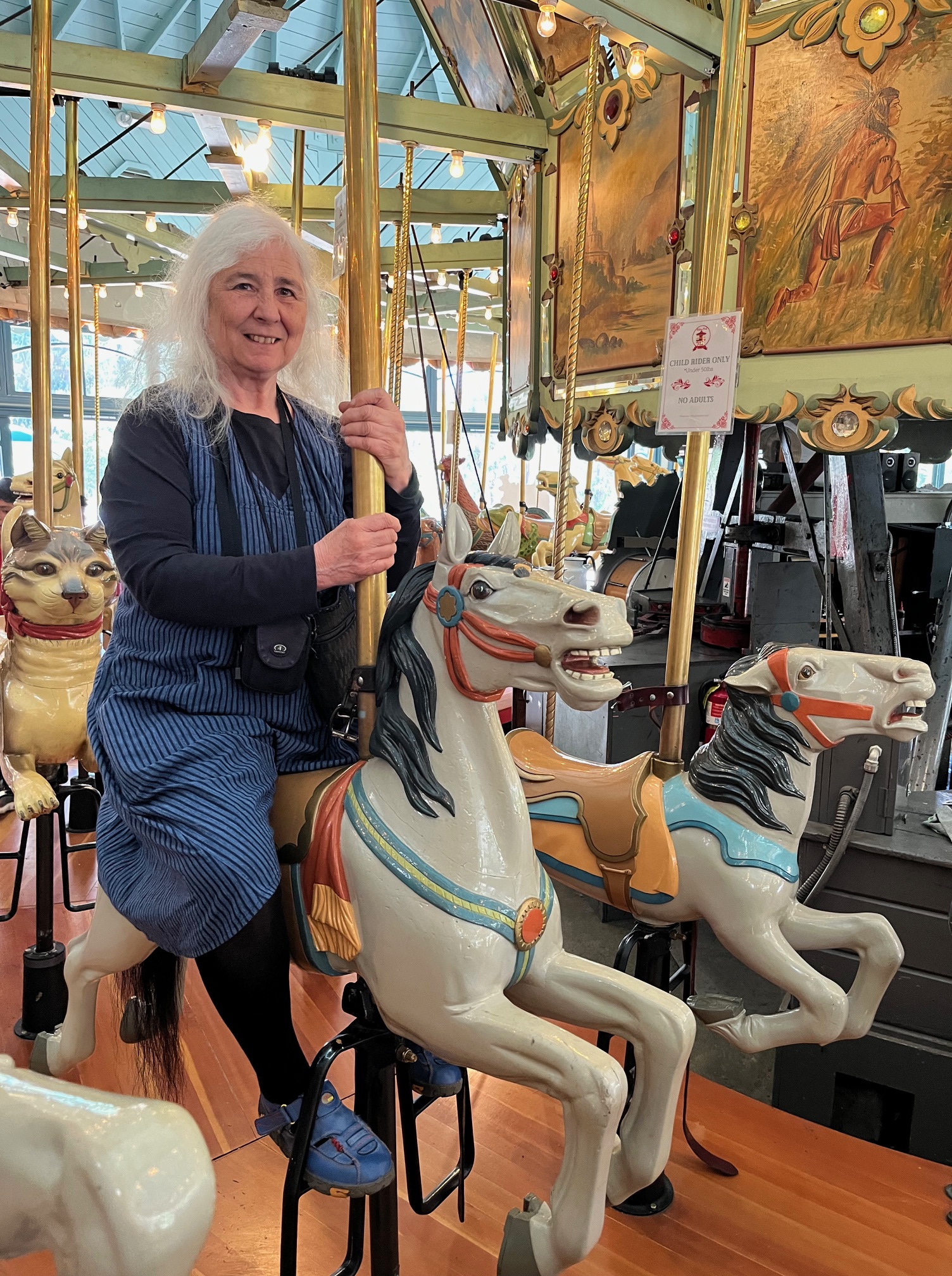
Yesterday I took the afternoon off from a vexing situation. My friend J. spirited me off to Tilden Park in her little red car. We rode the Merry-Go-Round (my choice) and the Steam Train (hers) and capped our day off with ice cream at iScream on Solano Ave. I had a coffee malt (no dinner necessary) and J. ate chocolate and blueberry ice creams.

Pandora, the chunky cat, stays close to me, almost always in the same room. Cassandra, the skinny one, remains aloof, although she did give me slow blinks from afar the other day. She is not ready to be friends.

It has been a lovely stay in a lovely neighborhood. The house is quiet and cool. My hosts sent me a postcard of Yeats from Ireland. I have a new favorite cafe and a couple of restaurants I like here, having found them just before I leave California. I still have some food to use up — sauerkraut and sausages, cheese, ramen noodles, frozen blueberries and maple syrup and more coffee than I can drink.

Dear Readers,

I am in the house-sitting, couch surfing phase of my travels before I take off for England on August 17, 2024, although I am still clearing items out of my childhood home in Kensington, CA. Today I began a diary of my house-sitting experiences in North Oakland.

The Howe Street Diaries

July 21, 2024

I am staying in the home of S&L, whom I met through a mutual friend. On Thursday July 18 they flew off to Ireland, leaving me in their beautiful house in North Oakland.

It is the kind of house I like, all wooden floors and windows, perched above the street with a front deck shaded by bottle brush and a backyard. In the last four days I have made a tour of comfortable sitting spots: the front porch chair where I ate lunch yesterday after a three-hour online sesshin with Natalie Goldberg, the living room couch where I sat for the sesshin and lay to read more of Kevin Barry’s Night Boat to Tangier, which L. lent me, reading about the adventures and inner states of two Irish middle-aged drug smugglers.

Now I sit at the kitchen table, plain plank, having eaten a bowl of Irish oats cooked in milk with salt, maple syrup and walnuts. To my right sits a cooling mug of coffee with cream (I must go out and hunt more half and half today at the Piedmont Grocery).

Late in my sixty-some year sojourn in California I discovered the pleasures of Straus half and half. It comes in a glass deposit bottle. It is far fresher and more flavorful than any other brand of half and half I have tasted. L&S left behind a partial bottle of Straus whole milk — I used the last of it to soak my Irish oats for breakfast.

Yesterday I had planned to make Irish oats for breakfast. I found a small saucepan in the rotating pot cupboard. What I could not find was a measuring cup. While I was searching for measuring cups I found a few slices of buttermilk bread tucked in a drawer. “I’d better use this,” I thought, and switched my breakfast plan to French toast.

I went on a hunt for vanilla extract, nutmeg or cinnamon. I found four bottles of orange blossom water. But S&L had left a few juice oranges on the table, so I made French toast batter from eggs and orange juice, fried the toast in butter and ate it with some frozen blueberries and maple syrup I brought from Kensington. I heated them in the small saucepan because there doesn’t seem to be a microwave: there is a mysterious black box on the kitchen counter to the right of the six burner gas stove, but I am not sure what it is and I am not sure how to open it.

S&L left me with two cats to care for. Pandora is neurologically challenged, fat, and friendly. Cassandra, her litter mate, can leap from the top of the high platform bed to the floor. She startled me the other morning by doing just that. She seems afraid of me: I have to put her food down and back away. They are both black cats. Pandora has soft fur; Cassandra is a touch-me-not.

The end of the afternoon finds me sitting on the living room couch again writing to my constant readers. Thank you for reading. Stay tuned for further adventures and an August guest post on https://thekitchensgarden.com

Dear Kale Chronicles Readers,

I have not posted in a long time. I had been the primary caretaker for my elderly mother for many months. She died at the end of March and I swung into post-death tasks (in case some of you don’t know, there are many, from arranging the disposition of the body to contacting friends, relatives and banks, responding to condolence notes, gathering and distributing death certificates).

I also inherited 95% of the contents of my mother’s house where I have been living, so I have been sorting through her possessions, dispersing a few things to people we know and packing up items I want to take with me when I go.

In a matter of months I will be leaving my home in the Bay Area and my home state of California, so not only am I sorting through my mother’s things, I am sorting through and packing my own possessions every single day. I will eventually be moving to a coastal city in Washington State.

But before I move, while the family home is on the market, I am going to travel. I was stuck here during Covid, stuck here while my mother’s care demanded that I be here 24/7, stuck here hiding from process servers. I am about to become majorly unstuck and I will be celebrating by traveling to see friends, traveling to revisit my ancestral homeland of Ireland after forty-seven years, traveling for a study trip with Natalie Goldberg in Montgomery, Alabama and taking a fall color cruise from Boston to points north. I will be on the road for a minimum of six weeks, but possibly for twelve weeks or more before I make my way to my new home town.

I may or may not be inclined to write to you from the road. If I feel like it and my schedule permits I’ll send you a postcard. Eventually I’ll fetch up in a permanent location and take up blogging again.

Cheers!

Sharyn

No one makes Christmas cookies like we do.

My mother baked a lot of cookies when I was growing up: Toll House chocolate chip cookies with walnuts, oatmeal cookies with raisins or coconut, peanut butter cookies marked by the criss-cross tines of a fork, snickerdoodles, butterscotch refrigerator cookies, brownies. She had a cookie press and I remember a few experiments with spritz.

When November came each year she chopped pounds of dried and candied fruit and nuts for homemade fruitcake, soaking the baked loaves in brandy. And in December she began holiday cookie production. Her specialty was thin, crisp cookies, rolled, cut and decorated with colored sugar. She made Moravian ginger cookies. She made butter cookies flavored with lemon and vanilla. She rolled her cookies out on flour-sack dishtowels on a wooden cutting board with a wooden rolling pin. The recipes made at least six dozen each.

I don’t know how she did it. I began apprenticing with her as a Christmas cookie baker when I was perhaps twelve years old. The floured cloth would wrinkle. The dough would stick to the rolling pin and tear. Some of the cookie cutters would not pick up the cut cookies and if I forgot to flour a cutter between each use the dough would crumple. The thin cookies had to be watched in the oven, pulled at the first sign of browning. Moravians burned really fast.

My first efforts were lackluster. I would use too much flour to try to control the sticky dough. The room would be too warm. I would not roll the dough thinly enough — usually Mom would take another pass or two with the rolling pin, or even take over, stretching the dough further than I could.

When I was in my thirties, I bought Mom a marble slab and a marble rolling pin to make cookie-making easier. I had read somewhere that working on chilled marble helped keep cookie dough at the correct temperature. She didn’t use the marble much, not liking to pick up the heavy slab. I used it at her house, clearing a shelf in the refrigerator to hold it, putting the metal bowls of cookie dough on top of it. I found it easier to roll cookie dough on marble than on cloth and when a construction crew was demolishing the old Cogswell College building in San Francisco I carted home a piece of marble from the walls. My boyfriend at the time cut it into a baking slab for me.

By the time Mom was eighty, she had ceded thin, crisp Christmas cookies to me. She still made dream bars and Russian teacakes, Rice Krispie candy, poppy seed bread baked in old coffee cans, and fudge. I spent long hours in the breakfast room rolling, cutting, decorating with colored sugar, ferrying finished trays to the oven and then to cooling racks.

One Christmas a friend gave me a silicone baking mat, a tool which made it possible for me to master Mom’s thin, crisp pie crust (Mine had always been too thick). A floured silicone mat will not stick, allowing you to roll thin sheets of pie dough, cookie dough, noodles. I acquired a bench scraper, which I had seen on some cooking show, and a microplane zester. My baking life got easier, although Christmas cookies still required long hours of work.

Somewhere along the line, I invented a third rolled and cut cookie: cocoa shortbread. I had the thought to swap one half cup of cocoa powder for one half cup of flour in a classic shortbread cookie. Those joined the roll and cut Christmas cookie line-up, but did not have to be rolled as thinly as butter cookies and Moravians. Then I read about Deb Perelman’s butter cookies made with maple syrup and nutmeg. I made them one year instead of our traditional butter cookies. My brother and I preferred them, so I swapped the maple recipe for the older one and never looked back.

I added one more cookie to our permanent Christmas cookie repertoire. One day twenty-some years ago, my mother was reminiscing about pfefferneuesse, a cookie they bought from the store during her childhood. Pfefferneusse are traditionally made with ginger, cloves, mace, cinnamon and allspice and candied orange peel. I remembered those tubs of commercial candied mixed peels from the days of fruitcake and shuddered. But both of us like candied ginger, so I decided to substitute that for the candied peel. Later, I started candying my own orange peel and made the cookies with a combination of the two ingredients.

The first time we made pfefferneusse they lacked something. Mom thumbed through some old cookbooks and discovered that the cookies used to contain ground white pepper. I threw some white peppercorns in the coffee grinder and added the fragrant powder to my next batch of dough. That was it — the “pfeffer” in “pfefferneusse.”

Most of our cookies are plain, not frosted, topped only with a sprinkle of colored sugar, but pfefferneusse require a coat of royal icing flavored with anise. I still struggle with getting the icing to set properly and watch for a dry day to make it.


* * *

Fast forward to 2023. My mother is ninety-three and has severe dementia and terminal cancer. I became her primary caretaker some months ago and do not have the time to bake Christmas cookies. I bought some chocolate stars she wanted from Trader Joe’s. We’ve eaten a few, but we don’t really like them: we miss our traditional cookies.

I put out a plea on Facebook, describing our Christmas cookie traditions. A friend offered to send us some cookies, to order them from a local bakery. I began to look at bakery menus. No one made the right things: there was too much chocolate, too many year-round cookies. My friend Kate offered to bake us some cookies if I could come up with something simple. I assigned her Russian teacakes, sending her the recipe that Mom had used for years. She brought them by a few days before Christmas with a small bag of her traditional homemade Christmas cookies. The teacakes were almost right, but a bit underdone and sporting only a thin and mottled powdered sugar coating (What we would consider the first of two required coats). Someone else dropped off first a bag of gingerbread cookies and then a bag of cut out cookies and rocky road fudge. A third friend, an experienced baker, volunteered to bake a batch of cookies for us. I sent her the pfefferneusse recipe and the maple sugar cookie recipe. When no one chose the pfefferneusse, I candied a batch of orange peel, hoping to make just that one cookie before Christmas Day (That is as far as I got with that project, but several of the twelve days of Christmas remain).

Alice chose the maple cookies and brought them by on the evening of Boxing Day, along with lemon biscotti, anise biscotti and stamped gingerbread that she had made. After she had gone, I opened the boxes to look. I found small maple stars, at least a quarter-inch thick, bearing marks of flour, sans decorative sugar. You could stack four of our cookies in the space of one of hers.

The flavor of the maple cookies was good, but, alas, they were not our cookies, rolled so thin as to be almost translucent. The lemon biscotti, however, were delicious. I might ask Alice for the recipe.

After sampling Alice’s cookies and Peg’s cookies and Kate’s cookies, I realized that our Christmas cookies, which I have always loved, are truly special. Other people make thick cookies, doughy cookies, under-baked cookies, when they make cookies with cookie cutters. Some of them apply white icing. I have not tasted a single cookie this season like our cookies.

In the past, only two people have come to bake Christmas cookies with me. The woman who is now my brother’s wife came to learn to bake them, spent a long afternoon with me in San Leandro cutting and decorating one year. She never came again. And an old friend came to take part in the holiday cookie marathon. She enjoyed decorating cookies with colored sugar, but soon suggested we abandon the project and walk to the mall instead. “This is a lot of work,” she said.

Indeed. A more recent friend suggested that I develop a sideline in baking cookies. “I would buy them,” she said.

“Too much work,” I responded, “I would never do production baking.”

At my current age of sixty-five, it probably takes me two days to make the four main cookie doughs and perhaps another two or three days to roll, cut, decorate and bake three kinds of cookies, plus a half-day to ice the pfefferneusse. It is a lot of work, special to the Christmas season: I only make these cookies once a year in a year when I have time to bake. I enjoy baking them and baking them tires me: once a year is enough, but I miss them in years when I don’t make them. Sometimes I pack up tins of them to send to friends or send them home with Christmas dinner guests.

I don’t know whether I’ll get even the pfefferneusse made this year. Yesterday I made homemade noodles and cloverleaf yeast rolls. I have not made any Christmas pie yet (twelve days remember) and I still have to bake my Mom an elaborate lemon-filled coconut cake for her 94th birthday. I’ll make Christmas cookies again though in some less busy year because their absence has taught me how unique and wonderful they are.

While we were out buying melons on Sauvie Island I asked Carol if we could stop at a grocery store for train food: I bought a sourdough baguette to make a sandwich with and a couple of yogurts.

Back at Carol’s farmhouse we got out the slow cooker and I proceeded to chop the leaf lard into small pieces. I usually buy lard already rendered, but a homesteading website said to chop it up and cook it slowly for two hours.

“Shall I read all of the instructions, or shall we wing it?”

“Let’s wing it,” said the genuine Washington-born farm girl.

She thought we should use a basket to hold the lard above the melted lard, so we did. This resulted in the project taking four hours instead of two and gratuitously greasing up her steamer basket. You want the pieces of lard cooking in the rendered fat, which causes them to render faster. We didn’t know. I pulled the pieces out and chopped them more finely.

We also didn’t know I should have trimmed off the few visible bits of meat before rendering. Oh well. I hoped the lard wouldn’t taste porky.

Hours later, Carol got out a large and a small mason jar for me and I poured the rendered lard into them to cool. While it cooled, I talked politics with Spike, Carol showed me some of her recent artwork and we watched a few episodes of a home-buying show because, you know, real estate.

“Look at how beautiful it is. It’s so white,” Carol said.

I read about how you could fry the unrendered bits for cracklings.

Meanwhile I had been in correspondence with one of my Zoom writing students who lived on the Oregon Coast a couple of hours from Carol’s house. We invited her to come to class in person the next morning. We would supply coffee and snacks if she would arrive by 8:45 for a 9:00 o’clock class.

On Monday morning I got up and packed my luggage. I dressed and poured a cup of coffee: Carol sets it up before she goes to bed so that all I had to do was push a button. I ate something — leftovers? fruit salad? — before making a salami and cheese sandwich for the train with lettuce, mustard and Carol’s homemade bread and butter pickles. The sandwich, the yogurts and two jars of lard fit perfectly into my frozen lunch box.

Mary Bess arrived early and she and Carol hit it off, immediately finding an acquaintance in common. Carol poured coffee and offered fruit and cookies before it was time to pop into my Zoom frame to show the rest of the class that we were actually in the same physical location. We then separated to avoid multi-device-induced feedback. Mary Bess took the back porch. Carol went upstairs to her office and I conducted class from the dining room table while Spike rested in the bedroom.

After class Carol shooed me out to talk with Mary Bess. We sat at the table on the back deck and discussed real estate, my reasons for my eventual move, M.B.’s life in Seaside running a health clinic. Mary Bess invited me to stay in Seaside if I came through Oregon again and asked if she could take my picture

Then it was time to say goodbye. Spike carried my bags to the car. Carol drove to Portland. I checked in at the historic Portland train depot, all high ceilings, marble and wooden benches with high backs.

I spent another 22 hours on the train, eating my sandwich for dinner, my yogurts for breakfast and trying to sleep in the uncomfortable chairs. When I got back to the Bay Area we had WiFi so I spent the last leg of my train journey chatting with a writing buddy about my adventures before catching a bus from Emeryville to Kensington and resuming my regular life, which is not so regular anymore, but that is another story.