Archives for category: seasonal recipes
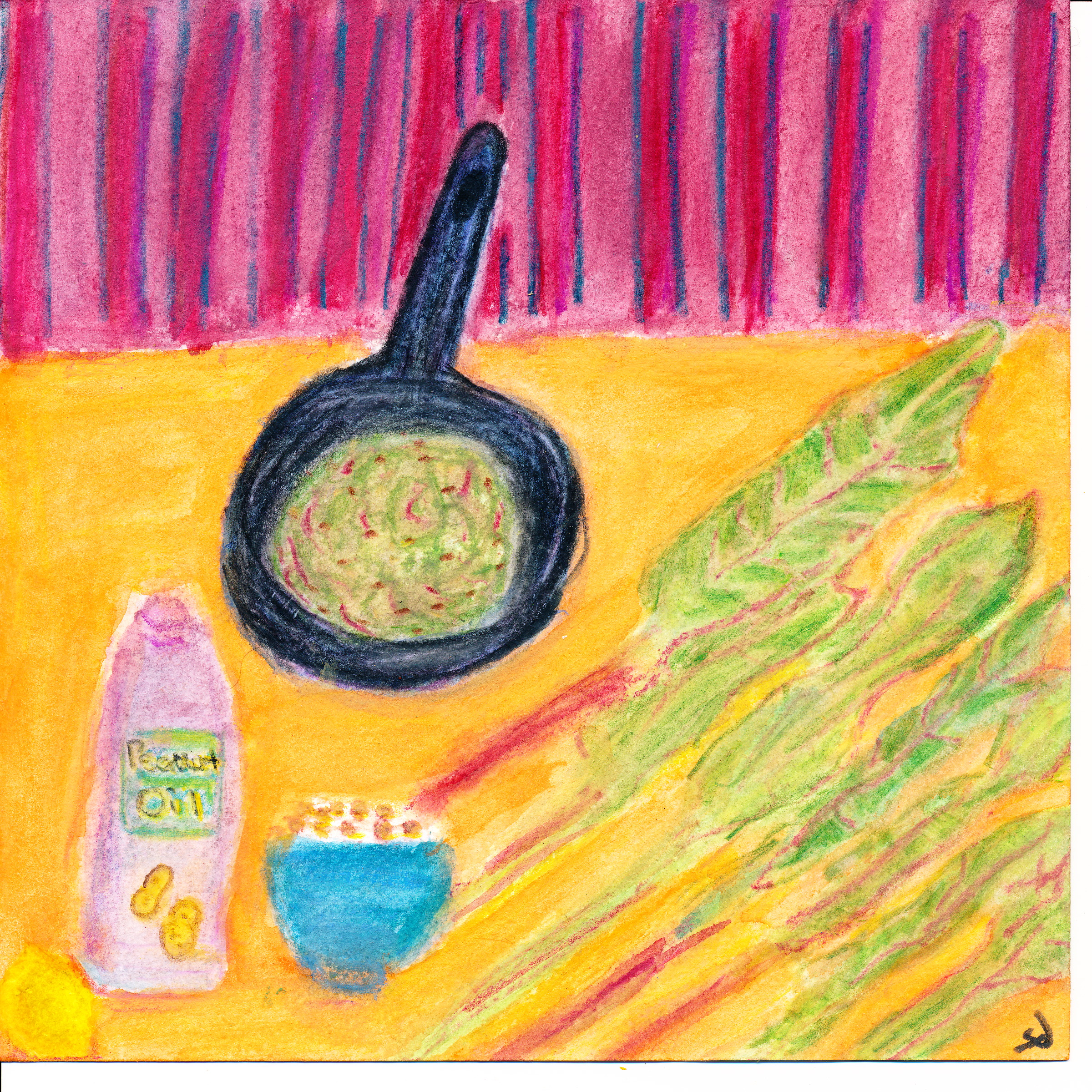
Painting of beet greens, cumin seeds, peanut oil.

Beet Greens with Cumin 8″x8″ gouache and watercolor pencil. Sharyn DImmick

Wednesday I was reminded of why I like to eat fresh and seasonal food. Wednesday is vegetable box day for me and I went down to Berkeley in the rain to pick up my vegetables. Among the other things I got were bunches of turnips and beets with their greens attached. I twisted the greens free and bagged them separately since I have been told that otherwise the greens draw nutrition from the roots. I knew I was going to cook some kind of oven dinner — I had leftover delicata squash to eat, for one thing. On the way home I decided we would eat mixed turnip and beet greens tonight to get them at their freshest and most nutritious. I also decided to cook the beets, remembering a wonderful sauce in my Joyce Goldstein Kitchen Conversations cookbook made from butter, honey, dry mustard, cinnamon and black pepper.

I consulted Mom about what else we could have. She suggested baking two large red potatoes and serving them with sour cream. Fine. We would have squash with brown sugar and butter, the potatoes, beets in a hot and sweet sauce. I would put in a rice pudding for a high protein dessert so that we did not get hungry after all those vegetables for dinner, utilizing some cooked brown rice we already had.

That left the greens. Because two of the vegetables had a sweet profile I knew the greens needed to be savory, so I discarded the idea of making them with raisins and walnuts  or with peanut sauce: these would have to be greens as greens. As I chopped the beet and turnip stems I suddenly thought, “What if I cook them with roasted cumin seeds?” Maybe that would tame the bitterness.

I pricked the potatoes and put them in a 350 oven with the whole kabocha squash (the farm newsletter recommended roasting it whole before splitting it open to remove the seeds and strings) and a Pyrex bowl of brown rice pudding, made with raisins, milk, sugar, a couple of eggs and enough butter to keep it from sticking. Then I peeled beets and put them in a saucepan on the stove (the oven was crowded, due to the giant squash, or I could have roasted them). While they cooked I made Goldstein’s marvelous sauce.

Then I got out the peanut oil and filmed a hot skillet with just a touch (under a tablespoon). After a minute, I added a couple teaspoonfuls of cumin seeds and let them pop before bringing the skillet to my cutting board for the beet and turnip stems. While they began to cook over medium heat I chopped the greens and put them into the skillet with all of the water that clung to them and popped a lid on. When they were done, I assembled a plate of one potato, half a delicata squash, one beet and a large serving of greens, to which I added a small squeeze of Meyer lemon.

I am happy to report that these were the best greens I ever tasted. The cumin worked its magic, giving off its fragrance and mellowing the greens’ strong flavors. If you are not a greens lover but are fond of cumin, I urge you to try it. It is beyond simple and yet the results are sublime. Yes, I did say sublime — the acid test will be tomorrow when I see how they are reheated.* There’s got to be something to eating your greens the day they are picked — but the cumin didn’t hurt either.

Non-Recipe Greens Recipe: Greens with Cumin Seeds

Wash whatever greens you’ve got — I used turnip and beet greens.

Separate stems from leaves.

Chop stems into small pieces. Chop greens separately.

Heat a skillet over medium high heat.

Add 2 tsp to 1 Tablespoon of peanut oil, depending on your oil tolerance.

When oil shimmers, add 2 tsp cumin seeds and let them pop.

Remove skillet from heat long enough to add chopped stems.

Return skillet to heat. Add chopped greens.

Cover and cook over medium heat to desired done-ness — I cook them until the liquid has evaporated — about five minutes.

Add a squeeze of lemon and eat while hot.

* I ate the leftover greens for dinner Thursday night. They were still wonderful, tasting of cumin.

P.S Forgot to say: I’m heading up to Portland for a long weekend and I, unlike most modern people, have no mobile devices. This may cause a delay in my approving comments, but I want to hear from you and I’ll approve them all when I get back. — Sharyn

Painting Note: For information about Beet Greens with Cumin or any other painting, please contact me here.
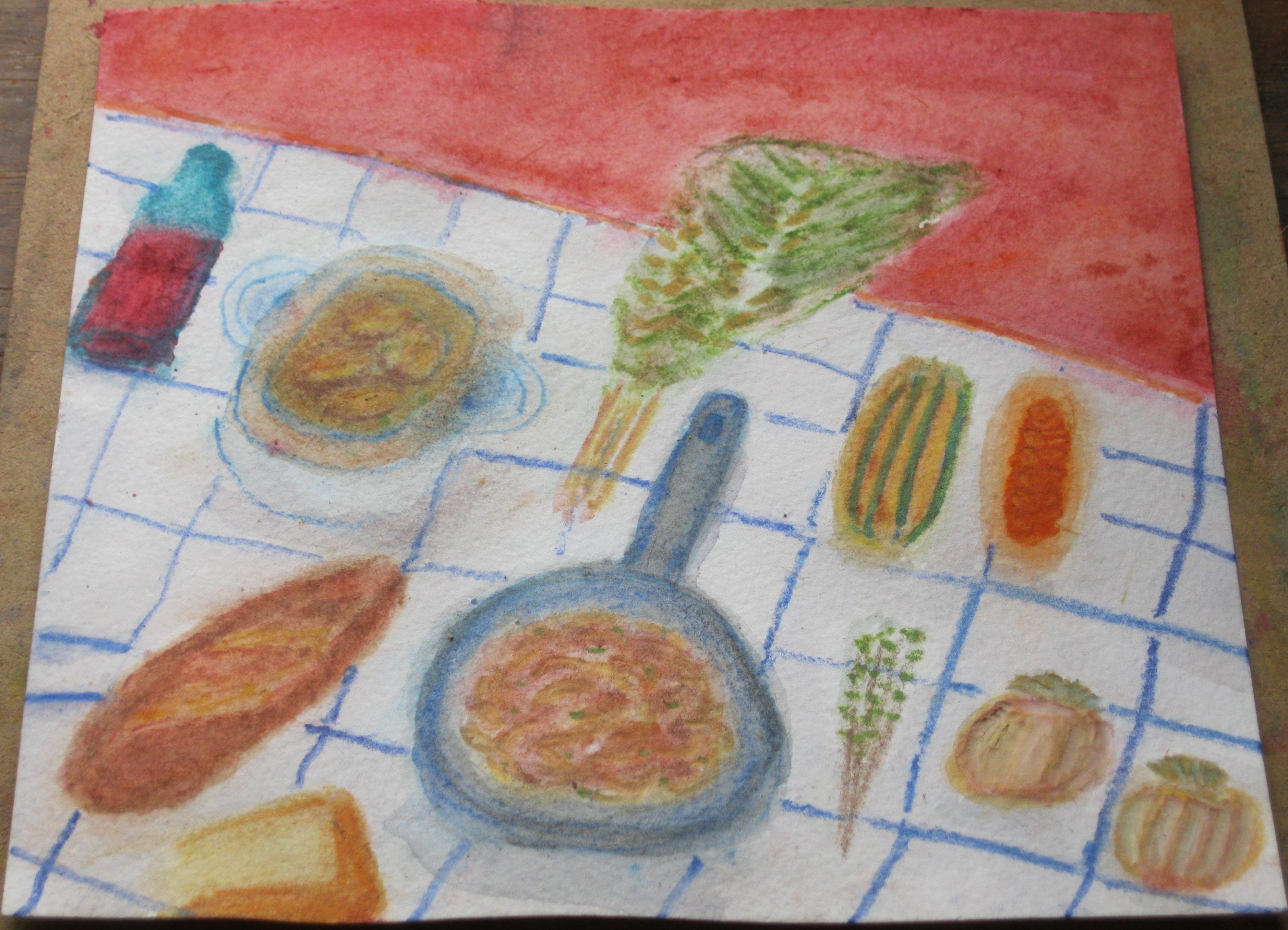
painting depicts onion soup and fall vegetables

Onion Soup, 8″ x8″ watercolor pencil and gouache. Sharyn Dimmick

Today we had our first real fall day: when it dawned with blue sky and white clouds there was a distinct chill in the air, a crispness. By 11:30 I was digging cashmere sweaters and long underwear out of my camphor chest. When I went down to the kitchen for lunch, I grabbed the last bowl of vegetable soup from the refrigerator.

Because I have been gone for three days I looked around the counter and into all of the covered pots in the fridge. First I found a pan of meat brownings. Then my eye fell on two large onions from last week’s farm box and a half-loaf of crusty sourdough. The butter plate with a smidge of unsalted butter clinched it: we would have French onion soup for dinner and because I would need to brown the croutons in the oven we would have another Gravenstein apple pie. I’ll roast delicata squash while I’m at it and there is some Swiss chard with our name on it. Dinner will come together in a snap.

I began by peeling and slicing the two large onions as thinly as I could, while I heated a skillet and added a little olive oil and all of the butter I could scrape off the butter plate. After I put them in the pan I cleaned the cutting board, composted the onion scraps and took four large apples from fridge, checking to make sure we still had pie crust. By this time, Mom was back from errands and made tea so I turned off the browning onions and retreated upstairs for a cup of tea. By then it was raining, making me glad to be inside cooking and puttering.

Tea finished, I peeled apples for the pie and cut the squash open. I started scooping seeds into the compost and then realized I could start a vegetable stock with apple peels and squash innards, not to mention the tough ends of Swiss chard, so I covered the seeds and strings from the second squash with some water in a saucepan and set it to simmer with the apple peelings and trimmings.

Classic onion soup uses Gruyere. Gruyere is rare in our house, as is any kind of French or Swiss cheese. What we have is Parmesan, since throwing the lemon Stilton in the tomato tart last week, so I will shave Parmesan onto croutons to top the soup. Browned Parmesan is delicious (sometimes I eat it on buttered whole wheat toast) so I don’t see this as a problem.

French Onion Soup

Put on a skillet to heat over medium heat.

While skillet heats, peel and slice thinly:

2 large onions

Add about 1 Tbsp olive oil to skillet, plus a little butter — maybe 1 tsp

Brown onions slowly over medium heat — if you don’t stir them much they will brown faster.

While onions brown, slice

4 slices of crusty bread and

Slice cheese to taste (I used an ounce or two of Parmesan, but you can use anything you like)

Add 1 tsp thyme to onions

Season with black pepper and salt to taste.

Put browned onions in oven-proof casserole with a broad opening.

De-glaze onion pan with 2 Tbsp of wine and add to onions in casserole.

Add 1 pint chicken stock. If you have brownings from another project, add them too.

Preheat oven to 375 degrees.

Place slices of bread on top of onions and broth. Add cheese. Bake until cheese browns.

Serves four, or two very hungry people.

If you want to emulate my style of cooking, consider what else you can bake in a 375-degree oven. In my case, it was apple pie and two delicata squash, which I baked cut side down in a Pyrex pan. When they were done, I flipped them cavity side up, added a dot of butter, a tsp of homemade syrup (brown sugar, honey, water and the dregs from a bottle of maple syrup) and black pepper and let them bake for five more minutes. You could also add ginger jam or chutney to season the squash instead of syrup, or just use brown sugar and butter.

While everything baked, I cleaned and chopped a bunch of Swiss chard, separating the stems from the leaves. Using the onion skillet, I heated about 1 tsp of olive oil and cooked the stems first for a minute or two, then added the shredded leaves, covered and steamed for five minutes in the water that was clinging to the leaves.

After we ate the squash I added the roasted skins to the stock pot — I’ll boil it again tomorrow. Eventually, I’ll reduce it, strain it and freeze it and have it on hand for the first batch of butternut squash soup later in the fall.

Painting Note: For information on “Onion Soup” or any watercolor painting, please go here.

original watercolor of tomato tart and ingredients

Tomato Tart 8″ x 8″ gouache and watercolor pencil Sharyn Dimmick

When I started blogging five weeks ago, the first food blog I found that I subscribed to was KristaandJess. Their posts have been arriving regularly in my email box. I always read them. Sometimes I comment. I’ve sighed for their watermelon chips after the end of watermelon season and longed for a juicer to make a variation on their carrot-nectarine smoothie (sans bananas).

Then they posted a link to David Lebovitz’s French Tomato Tart. I looked at it. I posted a question about it. I suggested a crust variation (my Mom’s own pie crust, which you will find in my Gravenstein Apple Pie post).  I looked at Lebovitz’s tart again. I read his recipe carefully. And then I went to work.

Mom had made a recipe of pie crust because I was going to make another Gravenstein apple pie. I did that, pulling a paper bag of apples from the back of the fridge and peeling four large apples. But before I put the apple pie in a 400 degree oven, I rolled out a single crust for my fluted porcelain tart pan. I spread the crust with honey mustard, stopping to combine two partly-used jars of honey mustard by adding a little white vinegar to the lighter jar and pouring it through a funnel into the other jar. Then I sliced the huge tomato waiting on the counter — this recipe is an excellent thing to do with a monster-sized tomato — and laid it into the mustard-slathered crust. I added just a touch of olive oil and went out to pick herbs from the front yard, bringing in basil and Thai basil and a handful of chives. I snipped chives over the tomatoes with scissors and tore basil leaves over the top.

Then I went back to the refrigerator for the only cheese remaining in the house besides cream cheese and Parmesan: a chunk of lemon Stiiton that was too sweet to eat in sandwiches. I crumbled the whole thing with my fingers over the top of the tart.

That’s it. No salt. No pepper. Just pastry, sliced tomatoes, the barest whisper of olive oil, some fresh herbs and cheese. Lebovitz uses goat cheese. Krista and Jess used whole wheat cream cheese pastry. I used Madge’s trusty pie crust recipe and the Stilton, but I encourage you to do what I did and use whatever cheese you have on hand as long as it’s not Velveeta or other processed cheese.

It was so good that Mom and I both went back for seconds immediately. It was so good that I started painting a picture of it because I knew I had to post it for you. The tart took all of fifteen minutes to assemble since Mom had already made the crust (I did have to roll it out myself). The only thing that stopped us from eating more of it is that we had apple pie baking in the same oven.

The only thing I have to say besides thank you to Krista and Jess and David Lebovitz for the basic recipe is to say to you, “Make this recipe.” You have to eat this tart during tomato season — it’s that simple. And those of you who live where the tomatoes are not ripe yet, wait and make this when you do have fresh tomatoes.

Simple Tomato Tart

Preheat oven to 400.

Prepare a single pie crust for a tart pan or regular pie tin (I used one of the four crusts produced by my standard pie crust recipe).

Spread prepared mustard of your choice upon the unbaked pastry.

Slice one 1-lb tomato or 2-3 smaller ones. The tomato should cover the bottom crust completely.

Add a very small amount of olive oil.

Season with fresh herbs of your choice.

Top with crumbled cheese or sliced goat cheese or grated Parmesan or whatever you’ve got. (I pretty much covered the top with Stiton and could just see small bits of tomato).

Bake for 45 minutes. Check for browning at around 30 minutes. Remember to turn the oven down 25 degrees if you are using a Pyrex pan. I started my tart at the full 400 degrees for twenty minutes and reduced the temperature to 375 when I put in the apple pie. This produced quite a bit of browning, which we like.

Painting note: for information about “Tomato Tart” or any other original painting, please contact me here.

painting of zucchini-gingerbread muffin ingredients.

Zucchini-Gingerbread Muffins. 8″ x 8″ gouache and watercolor pencil. Sharyn Dimmick.

Sarah O. mentioned overgrown garden zucchini in her comment on Zucchini-Feta Pancakes and I thought, “It’s time to get out the other zucchini recipe,” useful for times when you are drowning in zucchini or your zucchini is not of the best or you have zucchini-haters in the household. The solution? Zucchini-Gingerbread Muffins, another example of camouflage cooking.

You’ve heard of zucchini bread, I’m sure. But what if we made it healthier? And what if we took occasion to use up the sour milk, buttermilk, blinky half and half, or old canned milk hanging out in the fridge? If you are shuddering, just stick with buttermilk or plain yogurt when you get to the recipe, but otherwise, stay with me and, as my friend Bob says, you may never pour sour milk down the sink again.

In the old days, when milk used to sour, when ice houses were common and farm wives could not afford to throw things away, they made use of what they had: if the milk went sour, you cooked with it. Good cooks knew that you could “sweeten” milk with soda and sour it with lemon juice or vinegar to adapt it to your recipe.

I developed this recipe to use sour(ed) dairy products and zucchini. The soda takes care of any off-flavors — I am not advocating that you drink soured milk, just that you cook with it — and the oven heat kills any organisms you might otherwise worry about. Gingerbread contains multiple assets in camouflage cooking: cloves, mustard, ginger, cinnamon, molasses and brown sugar. Chocolate is the other great camouflage flavor in desserts but we won’t go there today (unless you want to).

My jumping-off point was the Multigrain Muffins recipe in “Moosewood Restaurant Cooks at Home.” I have used Moosewood’s muffin recipe so many times that the spine of the paperback book is broken at that page and the page itself is spotted. Need I say more?

The first thing I do is check the end of the  recipe for suggested additions to see how much zucchini I can get away with using. Since it says 1 and 1/2 cups of apples or blueberries, I know I can use 1 and 1/2 cups of zucchini, plus a little more. I go to work with a grater.

Next, I look at the volume of liquids, Because I want to introduce molasses for a gingerbread flavor, I reduce the buttermilk  (or soured milk or soured cream or sour cream or yogurt) to 3/4 cup to allow for 1/4 cup molasses. Now I will follow the recipe pretty much, except for adding gingerbread spices: ginger, cloves, cinnamon, nutmeg and dry mustard.

Zucchini-Gingerbread Muffins

Preheat oven to 400.

Grease a twelve cup (standard sized) muffin tin with corn oil, vegetable shortening or butter. Use plenty so the muffins won’t stick and your tin cleans easily.

In a large mixing bowl, whisk together:

1 cup unbleached flour

1 cup whole wheat pastry flour

1/4 tsp salt

1 tsp each baking soda and baking powder (You must use both).

2 tsp ginger, 1 tsp cinnamon, 1 tsp dry mustard, 1 tsp nutmeg and 1/4 tsp ground cloves.

In a small mixing bowl, beat with the same whisk

1 egg

Add:

1/4 cup vegetable oil (I use corn oil)

3/4 cup buttermilk or sour milk

1/4 cup molasses (or honey, if you like things lighter in flavor)

1/3 cup packed brown sugar

1/2 cup quick cooking oats

grated zucchini (you can get away with up to two cups — say two small or one large zucchini)

Whisk together and set aside.

Make a well in dry ingredients. Pour in wet ingredients and fold or stir just until blended. Transfer batter to muffin cups.

Bake at 400 for twenty minutes. Test centers with a toothpick or knife if you want — it should come out clean. Let cool on rack for a few minutes.

Food notes:

I like baked goods and desserts less sweet than many Americans. If you like things very sweet, you might want to increase the sugar, or eat the muffins slathered with honey or sweetened cream cheese: you’ll figure it out.

As long as you watch the liquid to dry ingredient ratio you can add other things you like: nuts, coconut, grated apple or carrot, chocolate chips, a teaspoon of espresso powder, lemon zest. If you invent a wonderful variation, frost the muffins with something unique or have a great serving suggestion, by all means write in and share it.

Cornmeal variation: One recent day I ran out of whole wheat pastry flour. I replaced it with another half cup unbleached flour and half a cup of yellow cornmeal. The result was delicious, maybe even better than the original recipe above — if you like cornmeal and molasses, be sure to try it.

Painting Note: For more information about “Zucchini-Gingerbread Muffins” or any other original painting, please contact me here.
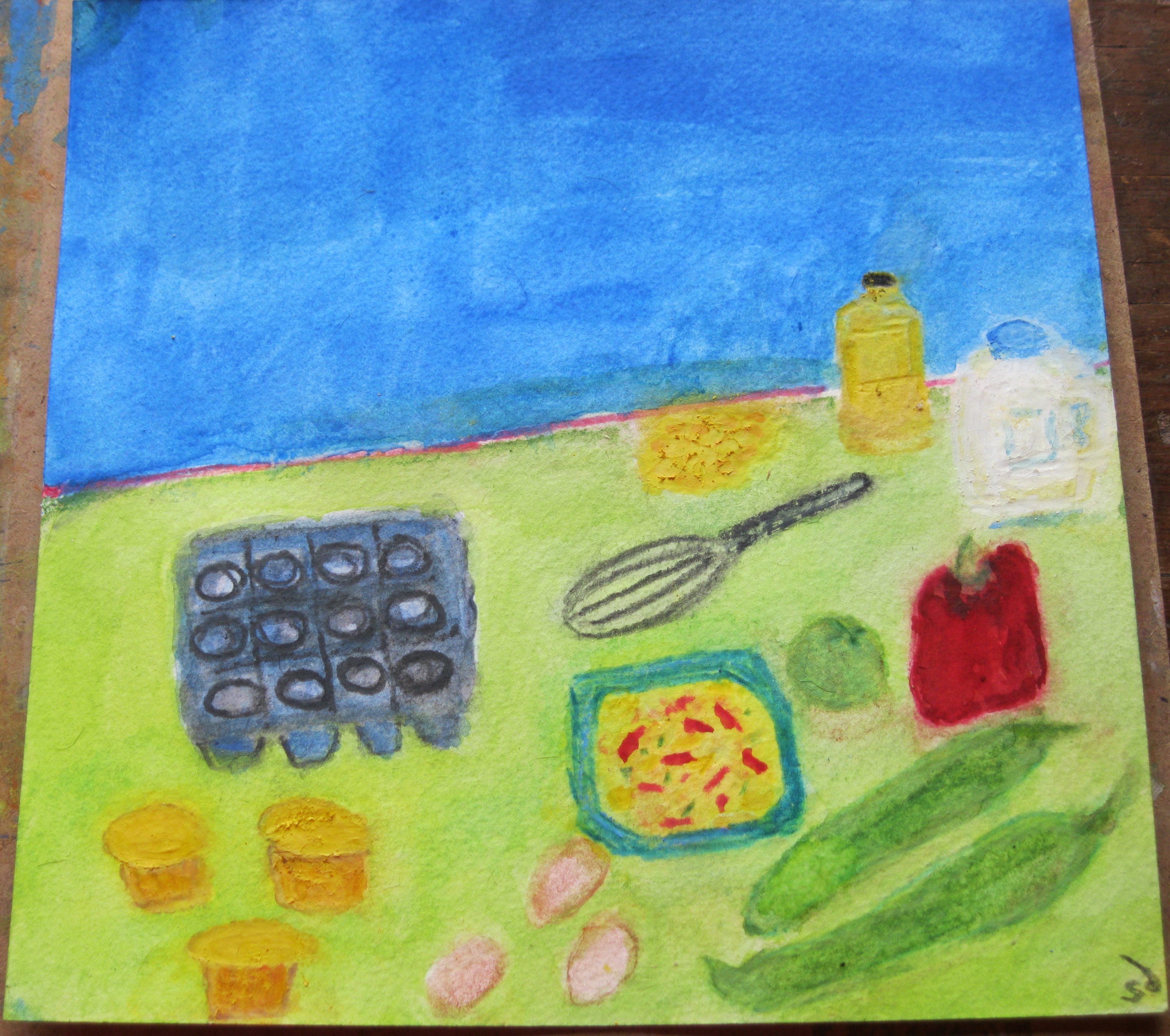
When I saw the list of vegetables from Riverdog Farm today I knew what I would be cooking soon: it is what I cook when zucchini first swings into season, along with corn and the first tomatoes — pancakes made of grated zucchini and fresh corn, bound with egg and a little flour, seasoned with fresh herbs, fried in butter and olive oil and topped with halved cherry tomatoes and a spoonful of sour cream. Can you say summer? Even late summer, as it turns out., or early fall. The seasons are wacko in California this year, with long spring rains and chilly weather, so all of our crops are later than usual.

Painting of Zucchini-Feta Pancakes and ingredients.

Zucchini-Feta Pancakes with Fresh Corn. 8″ x 8″ gouache and watercolor pencil. Sharyn Dimmick.

I first saw a recipe like this in Mollie Katzen’s Moosewood cookbook. As a non-lover of zucchini, I immediately saw the camouflage possibilities (My other go-to zucchini recipe is gingerbread muffins with grated zucchini). The first time I made it, I made it by the book. The next time I added fresh corn kernels and began topping it with tomatoes and sour cream, I love feta cheese — it is one of the cheeses I prefer to keep on hand, along with Parmesan, extra sharp cheddar and Gorgonzola — if I could only have four cheeses, those would be the four.

Why don’t I like zucchini? Does anybody care? I find the skin is often bitter and the flesh either bitter or insipid. I’m always disappointed when some Chinese restaurant fills their kung pau chicken with zucchini. I grew up eating zucchini baked in tomato sauce and topped with cheese and didn’t like that much either, but I am happy to make these pancakes whenever zucchini appears in the veggie box.

Here goes:

Zucchini-Feta Pancakes with Fresh Corn and Cherry Tomatoes

Grate 4 cups of zucchini. Salt it lightly and leave to drain in a colander for fifteen minutes.

While zucchini drains, separate 4 eggs, yolks into large bowl, whites into a small one.

Beat the egg whites until opaque and fluffy.

Add to egg yolks:

1 cup crumbled feta cheese (You can buy a block and crumble it with a fork or your fingers)

1/3 cup whole wheat pastry flour

chopped fresh herbs to taste — I like mint and dill. Basil is also good, or chives if you like an onion-y presence.

drained zucchini

kernels cut from 2 or 3 ears of fresh corn.

Fold in reserved egg whites.

Heat a skillet over medium-low heat. Fry cakes in a mixture of butter and olive oil (I usually scoop 1/4 to 1/3 cup of batter out with a measuring cup for each pancake).

Serve with halved fresh cherry tomatoes and a spoonful of sour cream or yogurt, or top with applesauce for a latke nouveau.

Notes: I often make just half a recipe, using two eggs and two cups of zucchini. And you don’t have to have zucchini — you can make this with crookneck squash, patty pan, or whatever summer squash comes your way, including mixtures of varieties.

If you don’t like feta, improvise with some soft cheese that you do like.

I haven’t tried this with grated winter squash or sweet potatoes yet, but it’s only a matter of time: you could even use summer and winter squash together as their seasons cross if you like both of them. And, of course, you can grate other things into them, but this is the way I like them.

Painting Note: I just updated the About page to include some notes on my painting media and process. If you are curious about the paintings, take a look. For information about “Zucchini-Feta Pancakes” or any other original painting please contact me here.

Painting of melons, agua fresca and limes.

Melon Liquada 8″x 8″ Gouache and Watercolor Pencil. Sharyn Dimmick

Our heat wave has hit, the one we have been expecting since the end of July, bringing our typical Indian summer weather. I spent part of the weekend in a park in downtown Berkeley listening to an old-time string band contest, part of it at a hostel down the coast at Montara and part of it sitting on the outdoor patio of Jupiter alehouse back in Berkeley listening to more old-time music.

Before I left for the weekend, I had to prepare food for the overnight at the hostel. I had been asked to bring salad and juice. The abundant peppers and tomatoes made Greek salad a no-brainer, with the last of the Armenian cukes. so I packed tomatoes, red peppers and quartered cucumber into a small beverage cooler with some blue ice, adding a small jar of olive oil, a clove of garlic, two small Meyer lemons and a pre-mixed jar of red wine vinegar, dry mustard and black pepper. plus a package of feta in brine.

Juice presented a problem: I don’t drink juice and don’t keep it around and I don’t go out and buy things for potlucks — I use what I have. But I had two large melons from the veggie box, problematic in themselves since neither of us in this house enjoy orange melons, so I decided to make liquada or agua fresca.

Saturday morning found me seeding a large muskmelon and an even larger orange honeydew, paring away the rinds and dropping chunks of the flesh into the blender with a little water in the first batch. I squeezed in one lime and blended several batches, straining the pulp over a large mixing bowl. I have never made proper agua fresca before and was surprised by the amount of time that it took to force the liquid from the melon pulp through a strainer, perhaps half an hour for the two melons. Because I tasted the flesh of the melons beforehand and they were very sweet I didn’t add any sugar. After a taste test I threw in a dash of salt — less than a quarter teaspoon — to intensify the flavor, squeezed in one more lime and added a little crushed cardamom because I can’t resist messing with things. I poured the strained liquada into a five gallon jar and added two trays of ice cubes to keep it cold on its journey southward along the coast.

When I arrived at the hostel, I put the liquada in the refrigerator for Sunday’s breakfast and made a quick Greek salad. I had forgotten the kalamata olives. Oh well. All of the salad was eaten anyway. As for the liquada, or agua fresca, when there was still a cup or two of it in the jar I announced that I was ready to pour it down the sink and a couple of people said, “Oh no. Don’t do that” and rushed to get empty yogurt containers to take it home. Apparently liquified melon is popular with my friends.

You can, of course, make liquada out of other things — cucumbers, watermelon, berries, stone fruits. The important steps are to taste the fruit before and after liquefying it, to strain the pulp, to add lime for piquancy, and to serve it well-chilled, If I had not added two trays of ice cubes to mine I could have diluted it with plain water or served it cut with sparkling water. This is a hands-on, low-to-no-measurement recipe where you have to taste and adjust, taste and adjust, to get something you like.

I was tempted to add some juice from crushed ginger to the melon version, but the hostess of the potluck suggested that I make two batches if I wanted to do that. There are limits to what I will do and I didn’t want to carry two five gallon jars, along with my sleeping bag, backpack and cooler. I could have brought some ginger juice to spike the melon with in the cooler, but I didn’t think of that.

Melon Liquada or Agua Fresca

Seed melon or melons and remove rind. Chop flesh into pieces.

Taste melon flesh — if it is very sweet you will not need to add sugar.

Fill blender jar with melon chunks. Add a couple of tablespoons of water.

Blend until liquid. Season with juice of one lime and a dash of salt (1/8 tsp, perhaps).

Pour through large metal strainer set over a large mixing bowl. Push on solids to extract liquid (Try using a potato masher to push with).

Repeat until all melon has been blended and strained.

Taste and adjust seasoning with lime, salt, or sugar. It should be full-flavored because you are going to dilute it with ice or water.

Add optional flavorings — chopped mint, basil, crushed cardamom, juice extracted from fresh ginger, dark rum, etc. Taste again.

Pour into five gallon glass jar. Add two trays of ice and set jar in refrigerator to chill. The ice will melt and dilute the liquid. Or skip the ice and dilute to taste with water or sparkling water.

Agua fresca is best drunk on a hot day when you will appreciate it, perhaps outside on a patio in the shade. Please write in to comment if you invent some splendid variation.

Painting of Bengan Bharta and Ingredients.

Bengan Bharta. 8″ by 8″ gouache and watercolor pencil. Sharyn DImmick

When I was in my last year of college at U.C. Santa Barbara I lived in an apartment on Pardall Road with a roommate from Thailand and one from India. I had just come from a year as an exchange student in Ireland and was happy to serve as a cultural interpreter as necessary for Karuna and Padma. I also reveled in the exposure I got to Thai and Indian foods and recipes. I ate my first dosa and raita, my first green papaya salad, and got hooked on both cuisines, so, keeping a seasonal and local focus, I sometimes make forays into Thai and Indian cooking.

For me, that requires cookbooks, although I can fake Thai soups and noodle dishes by now (some of you may have seen the peanut sauce recipe recently). I own Charmaine Solomon’s “The Complete Asian Cookbook” and Shanta Sacharoff’s “Flavors of India,” but my favorite Indian cookbook comes from Berkeley’s own Ajanta restaurant: it’s called “Ajanta: Regional Feasts of India” by Lachu Moorjani. Ajanta is simply the best Indian restaurant I have ever eaten at (I have never been to India). Moorjani cooks with what’s in season, rotating regional dishes through his menu each month. If you can go once a month, go, but take other people with you so that you can sample each monthly special.

This week the CSA from Riverdog Farm contained about three pounds of tomatoes, a pound of bell peppers and two purple and white speckled eggplants. When tomatoes and eggplants come together in the fall, I like to make baingan bharta or bengan bharta, an Indian dish of chopped roasted eggplant simmered in a sauce with fresh tomatoes, ginger, onions, a green chile, paprika, turmeric, cumin seeds, coriander and cayenne. I loved this dish the first time I tasted it, right out of the Tasty Bites package, but thanks to Moorjani I now know how to make my own from scratch.

Without further ado, Moorjani’s recipe, followed by food notes from me where I explain a few minor adjustments I’ve made and give some procedural information.

Baingan Bartha (Pureed Roasted Eggplant with Onions, Tomatoes and Spices)

2 large round eggplants, about 1 pound each.

6 Tbsp oil (I used between 2 and 3  of peanut oil — more on that later)

2 tsp cumin seeds

2-inch piece of fresh ginger, peeled and finely chopped ( I mince mine and don’t bother to peel it)

1 hot green chile (serrano or jalapeno), chopped

3 medium onions, peeled and chopped

6 medium tomatoes, chopped

4 tsp paprika

1/2 to 1 tsp cayenne

2 tsp turmeric

2 tsp coriander

2 tsp salt (I cut it down to one)

1/4 cup chopped cilantro

I began by turning on the oven to 400 degrees, pricked my two eggplants with a fork and let them roast while I had a cup of tea and checked my email. When I pulled them out of the oven and set them on the stove to cool I peeled and chopped my onions and pulled my ginger out of the freezer where I store it. I hacked a slit in it and let it thaw slightly while I chopped a previously roasted green chile (just because I had it — if I hadn’t I would have used a raw one, but I have made this before). By the time I had chopped all of those onions, I could get the knife through the ginger and minced it while I heated 2-3 Tbsp of peanut oil in a big skillet over medium heat. When the oil shimmered, I measured out my cumin seeds and threw them in, quickly adding the ginger and chile, then the chopped onions. I cooked all that over medium heat for about 10 minutes while I chopped a monstrous 1 and 1/2 pound tomato, green in color, not in ripeness, and a smaller red tomato. I threw in another tomato I had roasted yesterday (waste not, want not, and this is a cooked dish). It was lovely to see the soft green, bright red and reddish violet of the vegetables before they cooked down. I cooked the tomatoes for five minutes.

While my tomatoes cooked I measured my salt and spices, scanting the salt and using the smaller amount of cayenne specified. Then I stirred the spices into the tomato mixture and turned to my now-cooled eggplant, stripping off the skin and chopping it finely.

If at any time my onions, eggplant, or tomatoes had begun to stick to the pan, I would have added a little more oil and turned down the heat a notch. This time I didn’t need to do either. Tomatoes, onions and eggplants vary in their water content, so you never know. Also, many cooks use more oil than I do, so I never accept oil measurements at face value unless they are in cake recipes and in cake recipes I might substitute  yogurt for some or all of the oil.

About this time I put on a pot of water for brown rice — I can’t tell you how much water because we measure it by sticking our index fingers into the rice pot and measuring water to the first joint. I can tell you that I have large hands and long fingers, as does my mother, who originated this technique and that we have cooked rice in the same pot since I can remember. The finger measurement is good for one cup of rice, brown or white: I used brown basmati. When the rice was in the pot I scooped the chopped eggplant into the skillet, scraping the bottom with a spatula to check for browning, It was fine, so I left it to go upstairs and ask Mom what she wanted instead of cilantro, which I was out of. I then went out to the garden and picked a combination of Thai basil and mint. I stirred the Thai basil into the eggplant and left the mint minced on the cutting board in case Mom didn’t want any. The recipe is good with cilantro, but one of the house rules here is that we do not go to the store for one ingredient: instead we make do, substitute, cook something else if necessary.

While the rice cooked and the baingan bharta finished cooking, I made a smoothie out of a nectarine, some buttermilk and a small handful of almonds. Because I was eating it with Indian food, I crushed a few cardamom seeds in a mortar and pestle and added them. Had I been at Ajanta I would have finished the meal with cardamom gelato and a pot of chai — and we would have gotten kabuli naan (flat bread with cashews) because my Mom is addicted to it. She would have ordered lamb and I would have browsed through the specials before making my decision.

If you are local, or visiting Berkeley, or, really, anywhere in the Bay Area, you should eat at Ajanta at least once. You will find it on the internet at http://www.ajantarestaurant.com. Moorjani sells his cookbook there, as well as a box of Indian spices, including some hard to find ingredients. This duo makes a fabulous present for the would-be Indian cook and the winter holidays will be here before you know it.

Painting Note: For more information about “Bengan Bharta” or any other original painting, please contact me here.

 Painting shows New Mexican green chiles with eggs, peppers and corn muffins

California-New Mexico Lunch Date 8″x 8″ gouache and watercolor pencil. Sharyn Dimmick

I have just returned from Taos, New Mexico. I have been going there for eleven years to study with Natalie Goldberg of “Writing Down the Bones” fame, to meditate in silence, to hang out with my writer pals and to eat. I stay at Mabel Dodge Luhan House, a house built by a renegade New York heiress who married Tony Luhan from Taos Pueblo. Mabel’s house became a gathering place for writers and painters: D.H. Lawrence stayed there, and Georgia O’Keefe.

Most of us like Mabel’s for its retreat-style accommodations: no T.V.s or phones in the rooms. If we didn’t come there for Natalie, we might come there for the food — once you have tasted New Mexican green chilies there is no going back: it is said that eating green chilies produces an endorphin rush like a runner’s high without the exertion. Because of the climate and soil conditions in the high desert, New Mexican chilies taste different than the ones we grow here in California. The classic New Mexican chile pepper is a long, green pepper, similar in shape to an Anaheim chile, but more piquant. You see people roasting them in metal roasters with a rotating drum but you can roast them in your oven or char them over a gas burner. Roasted and peeled, they can be frozen for use outside of chile season.

The best thing I had to eat this trip did not come from Mabel’s kitchen though: my first night in town some of us went to dinner at The Love Apple, a restaurant that serves food made with local, seasonal ingredients, their sources listed on a blackboard on the patio.  I ate some complex and intriguing tacos of chicken cooked in a dark mole with a slightly cooked red cabbage slaw and green chile crema — they were so good I told my friend Saundra “I could skip the retreat and just come here every night and eat tacos”– but the most wonderful dish was a plate of gluten-free  blue and yellow corn muffins served with chokecherry butter and lime-basil butter. I rarely make composed butters, but I may re-think that decision.

I do not restrict gluten and usually make corn muffins with cornmeal and flour, but these muffins, without flour, were light in texture — I don’t know how they did it, but I plan to ask if I can ferret out who baked them (I’ll write a fan letter). Blue corn is more finely ground than yellow cornmeal, has a lighter texture and a higher protein content. You can buy blue corn from Arrowhead Mills if you want to try it — that’s what they have at the grocery store in Taos — but the yellow corn muffins had the same light texture.

My mother is gone, gallivanting with hikers up north, so I am cooking for myself again. My friend Carol scored a big bag of New Mexican chilies in Taos and kindly gave me eight of them. Last night I roasted three of them in the oven at 400 degrees, along with a large red bell pepper, seeded and cut in half. For lunch today I scrambled two eggs with the roasted peppers, quick-roasting a green-skinned tomato that had seen better days — I cut off the brown spots, removed the core and threw it in an oven in which I was baking experimental gluten-free corn muffins (I have been unable to reach anyone at The Love Apple and commence begging for their recipe).

I invented my own recipe for wheat-free corn muffins by poking around on the internet, searching for “gluten-free corn muffins.” When that turned up things I didn’t want, such as muffin mixes, I typed a question into Google about substitutes for wheat flour. I had to eliminate proposals about xanthan gum as a binder because I cook from what is in the house and we don’t have any xanthan gum. We have rice flour and masa harina and cornmeal and … cornstarch! When I saw cornstarch I started thinking about reuniting various parts of the corn plant — I could use corn oil as the main fat with a little butter for flavor. I could use cornstarch for wheat flour.

I brought out our old Betty Crocker picture cookbook, the most-used reference volume in our house, turned to quick breads and reviewed the cornbread recipes. Cornbread generates controversy here: Mom grew up on Southern cornbread — she likes sour cornbread made with buttermilk and bacon grease and just a teaspoon of sugar. I like what she calls “corn cake,” which is lighter, sweeter, often made with sweet milk and butter. Starting from the “Kentucky Corn Cake” recipe, I greased a muffin tin with vegetable shortening and then added a tiny dot of butter in each cup for flavor. I measured out a cup and a quarter of cornmeal and a quarter cup of cornstarch. I used one tablespoon of evaporated cane juice and one of white sugar. I used three tablespoons of corn oil instead of shortening and added about a tablespoon of soft butter for richness and flavor. Then I followed the recipe as written, except for reducing the oven temperature from a horrendous 450 degrees to 400.

While my corn muffins baked I roasted my tomato, beat two eggs and chopped my roasted bell pepper and chilies. I skinned them, but ate the removed skins while I was cooking (tough, but tasty). I put a little olive oil and a smidgen of butter into a hot skillet over medium heat, added the peppers, poured in the eggs and cooked the mixture until browned. I added my hot roasted tomato, breaking it up with a spatula and turned off the heat, put a couple of corn muffins on my plate and sat to eat. The first bite reminded me why I like seasonal food: the California red bell pepper and its spicy New Mexican cousins got along beautifully, mingling heat and sweetness with a little acid from the tomato. The corn muffins were slightly flatter than I wanted, but they were a beautiful yellow with browned tops, and I must have liked them because I ate three with lunch! I might experiment with adding another quarter cup of cornstarch and reducing the cornmeal to one cup. If I ever get the muffin recipe from The Love Apple, I’ll post it for you.

Gluten-Free Corn Muffins

Preheat oven to 400.

Grease a 12-cup muffin tin with vegetable shortening. Add a tiny dot of butter to each muffin cup.

Into a small mixing bowl, crack 1 egg.

Add 1 cup milk, plus 2 Tbsp additional milk and 3 Tbsp corn oil, plus 1 Tbsp butter (I melted it in the microwave).

In a larger bowl, combine 1 and 1/4 cups cornmeal, 1/4 cup cornstarch, 2 Tbsp sugar, 1 Tbsp baking powder, 1/2 tsp salt. Whisk together (I didn’t sift the cornstarch, but you might want to — less whisking that way).

Put muffin tin in hot oven to heat while you stir the wet ingredients into the dry just to combine.

Carefully remove hot muffin tin from oven and pour batter into muffin cups. This step gives you crusty brown outsides to the muffins as the batter hits the hot fat. Return muffin tin to oven and bake for 15 minutes.

Tangential story: on the plane home from Albuquerque, I slipped into a middle seat. After we were in the air the young woman in the window seat took out a glazed brown paper box. opened it up, and started to eat kale. No lie.

Painting Note: For more information on “California-New Mexico Lunch Date” or any other original painting, please contact me here.

Painting depicts apple pie ingredients: flour, butter, apples, cinnamon, nutmeg.

Gravenstein Apple Pie 8″x8″ gouache and watercolor pencil Sharyn Dimmick

2023 Recipe Update: Some years ago the manufacturers changed the formula for Crisco, which changed the texture. Now I use 1/3 cup butter, 1/3 cup Crisco and 1/3 cup lard for the shortening in pie crust.

Sometime in August Gravenstein apples come to the Berkeley Farmers’ Market. By early September they are gone. As soon as I see them I start buying them, buying no fewer than ten pounds at a time and stashing them at the back of our very cold refrigerator to make Gravenstein apple pie.

Gravensteins are an early apple here. They come in before Pippins, before Pink Ladies. They are perfect pie apples, tart and crisp with an intensely apple flavor. I grew up eating green Gravensteins from my grandmother’s tree in El Cerrito, climbing into the crotch to pick them, picking up windfalls to trim for pies and apple sauce. When the crop was bountiful, Mom would peel and quarter apples and save them in the freezer for later in the year.

Gravenstein apple pie initiates apple pie season at our house. The season will finish when we pick the last apples from the dwarf tree in our backyard, when the market moves to winter citrus, when I can no longer scavenge fallen apples in the streets of Berkeley (It’s amazing to me how many people have apple trees and let the fruit fall where it is smushed under the wheels of cars — we seem to have forgotten what food is and where we can get it as well as how to cook).

To make apple pie you need two things: good cooking apples and flaky, tender pie crust. If you do not live where Gravensteins grow, consult farmers at your local farmers’ market for recommendations for local apples. Let them know you will be making pies with them. Pippins also make fine apple pies.

To make pie crust, follow my mother’s recipe, given below. Do not deviate from it if you want good results. It may look a little different than other recipes you have seen or tried: for one thing, it does not start with two sticks of butter and does not include ice water. It is a Swedish pie crust and includes an egg and vinegar — don’t ask me why, just trust me on this one.

What does it use instead of butter? Vegetable shortening — you know that stuff that comes in a can. You are worried about transfats. I know. You have never had Crisco in your house. Well, you need it to make Madge’s pie crust. The only acceptable substitute is lard: if you use butter instead you will get a heavy, greasy pie crust, so don’t do it — just follow the recipe. You don’t eat pie everyday and a little vegetable shortening isn’t going to kill you, so use Crisco or use lard and get on with it.

Measure into a large mixing bowl:

3 cups unbleached flour
1 tsp salt

Cut in :

1 cup shortening, comprised of 1/3 cup butter, 1/3 cup Crisco vegetable shortening and 1/3 cup lard

Stop when the shortening is in pieces the size of small peas.

Into a one-cup measuring cup, break

1  large egg

Whisk it with a fork until blended. Then add:

1 Tbsp cider vinegar and
Water until mixture measures a little more than 1/2 cup.

Whisk liquids to blend. Add to flour-shortening mixture. Stir just until blended, then work with your hands to shape crust into a large patty. Wrap the patty in waxed paper and refrigerate it while you make the filling. Do not wash the mixing bowl yet — you are not done with it.

For a standard two-crust apple pie, peel and core 4-5 large apples, cutting them into quarters and slicing them crosswise. If you want your apples to stay white, keep a cut lemon handy and squeeze it periodically onto your sliced apples. Taste your apples though — if they are quite tart you may not want to add lemon: just let them darken.

Put the sliced apples in your mixing bowl (the one that you didn’t wash). Toss them with:

1/3 to 1/2 cup sugar, depending on sweetness of apples.
1 tsp cinnamon
1 tsp nutmeg.

Preheat your oven to 375 ( 350 if using Pyrex).

Now roll out your crusts. Remove pie dough from the refrigerator and cut it into quarters. Wrap two quarters back up and store them in the refrigerator for another pie (They’ll keep more than a week if wrapped well).

Flour a bread board, table, or other work surface, or place a thin linen or cotton kitchen towel on a surface and flour that. Or flour a new-fangled Silicone mat, which makes rolling out thin crust a lot easier. Flour a rolling pin.

Take your first quarter of dough and round it into a circle with your hands, smashing it slightly. Now pick it up and turn it over. Take the rolling pin to it, rolling in all directions, trying to keep it circular and making sure to roll out any thick edges. Do not be afraid — use a firm, light hand. Roll it thin. When you think it is large enough, take out your pie tin and set it on top of the dough: the bottom crust has to be larger than the pie plate because it has to cover the sides and make the edge crust. When you are satisfied, fold the crust in half and again into quarters. Pick it up, plunk it in the pie tin and unfold it again. If it tears, don’t worry you can patch it with more crust glued in place with a little water. If you guessed wrong, you can patch in crust above where yours ends and roll out a rim crust with your fingers by rolling scraps into a rope.

Now add the apple mixture to your bottom crust. Dot apples with a little butter. Roll out the top crust and place on top of the apples. Make sure to attach the top crust at the edge of the pan. Slash the top several times with a knife, prick holes with a fork or channel Martha Stewart and make cut-outs (Guess which of these things I don’t do?).

Bake pie for 45  minutes. Serve warm. Top with ice cream if desired.

Food notes: this recipe makes a tart pie. We like them that way: the taste of the fruit comes through. We scant the sugar in every pie we make and we always taste the fruit as a guide to how much sugar to add. Our pies do not have the gluey sweetness and texture of commercial pies you may have eaten.

Madge’s recipe makes four crusts: we have never cut it down. We either make two pies at once, or save the crust for another day and another pie — lemon? Quiche? Chicken pot pie? Tomato tart!

While you are enjoying your apple pie I will be traveling to New Mexico on September 4 for a writing retreat with Natalie Goldberg. I will be in silence for five days, unable to check my email or read and respond to your comments. I will attempt setting my blog robot to send you a recipe while I am gone and I will respond to all questions and comments upon my return on September 12. I’ll miss you, believe it or not. I leave you with an unfair question for pie fans: What is your favorite pie?

— Sharyn

Painting Note: For information on “Gravenstein Apple Pie” or any other original painting, please contact me here.

original watercolor of kale, tomatoes, onions, pen and ink bottle.

The Kale Chronicles. 8″x8″ watercolor pencil and gouache by Sharyn Dimmick

Few things reliably capture my interest more than messing with food and telling stories, whether in song, in images or on the page. I subscribe to a community-supported agriculture program each week, receiving a box of organically grown fruits and vegetables from Riverdog Farm in Guinda, CA. I began subscribing in 2007 and remember rhapsodizing over the taste of iceberg lettuce, green and fresh, picked that morning.

I also remember that first June when kale showed up in the box. I had never eaten kale. I had never seen kale. My friend Elaine loves it, steams it in the microwave and gets out her fork, but I did not fall in love with minimalist kale. I pored over cookbooks, learning to remove the ribs and stems before cooking it. I tamed it with acids: tomato sauce and lemon, vinegar. I added Indian spices and raisins. I chopped it into red lentil soup with plenty of garlic and fresh ginger (It gave my Mom gas and I had to eat it all myself. Ahem).

I do not hate kale. I have aversions to avocado and asparagus, tuna, mayonnaise, hard-cooked eggs and okra. Instead I consider kale to be a worthy adversary, something to be struggled with and mastered. I strike up conversations about it: “Do you eat kale?” “How do you cook it?” Kale keeps me on the lookout for new preparations, new techniques.

I have eaten red Russian kale, dino kale, curly kale in the last four years. I have combined it with spinach in lasagna. Two weeks ago I made an African peanut soup featuring onions, peanut butter, tomatoes, carrots, sweet potatoes, fresh green beans, garbanzo beans, kale, cilantro and lime. Everything but the peanut butter, lime, garbanzo beans and sweet potatoes came from the farm box — the sweet potatoes came from a farm stand in Suisun near where my sister-in-law lives. The soup was so good that I took it to a music potluck and when they ate it all I made another batch with the last of the ingredients. Here’s to Africa where they know how to cook kale!

African Peanut Soup (adapted from a recipe from yummly.com)

Saute 1 chopped onion, 3 minced garlic cloves, 1 Tbsp fresh ginger, 1 minced chile pepper in 1 Tbsp peanut oil. While that cooks, chop 4 fresh tomatoes. Add 1 Tbsp curry powder to saute mixture and stir to toast it. Add tomatoes, plus 1/2 cup peanut butter, 8 cups water or stock, 1 Tbsp tamari. Stir well and bring to boil.

While the soup cooks, chop 2 carrots and 2 large sweet potatoes. Add them, plus 1 can of garbanzo beans. Cook until tender while stemming and chopping a large handful of green beans and half a bunch of kale. Add green beans. Cook for 10 minutes. Add chopped kale and juice of 1 lime. Cook 10 minutes more. Garnish with chopped cilantro.