Archives for category: Uncategorized
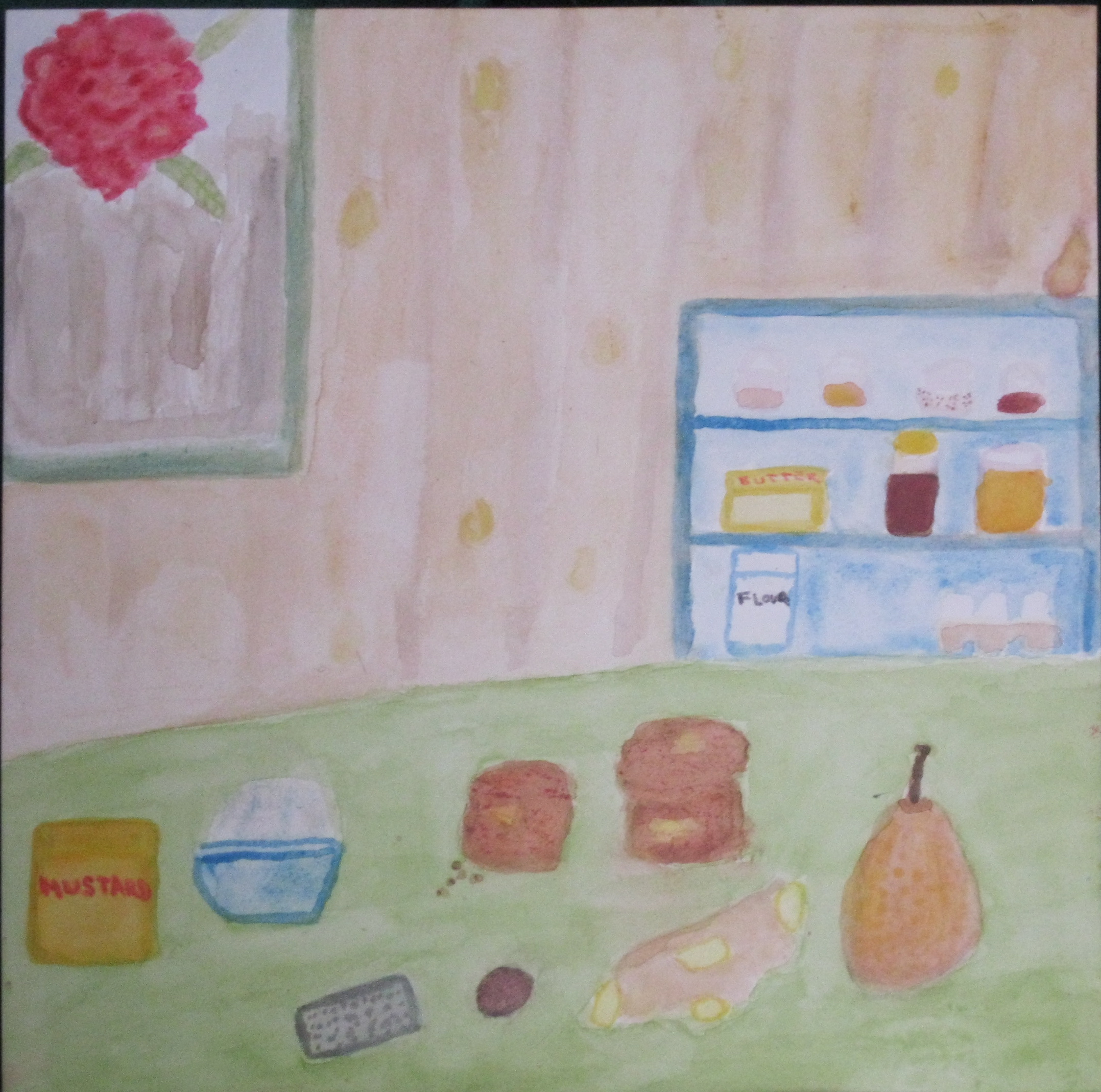
Painting shows ingredients for rice cakes

Rice Cakes. 6″ x 6″ gouache and watercolor pencil. Sharyn Dimmick

Most mornings I eat oatmeal cooked in milk to jump start my calcium intake for the day. Our house is cold and warm breakfasts are usually welcome. But because we shop just once a week, there are occasionally mornings when the milk is gone and hot cereal is not an option. Heaven forbid that I would cook my oats in water, converting them to standard gruel.

These are some of our options for mornings we are out of milk.

1) Rice cakes: take some leftover rice. Crack an egg or two into it. Add some sugar, vanilla, nutmeg. Beat for a few minutes with a fork. Scoop out by 1/4 cup measures and fry in butter.

2) French toast: take the last few slices of bread. Toast them lightly if they are not already stale. Cut them in half. Beat a couple of eggs in a shallow bowl. Add juice and zest of one orange if you like, or just add sugar, vanilla and nutmeg as for rice cakes above. Soak the bread briefly in the egg batter. Fry in butter. Serve with powdered sugar, maple syrup, fresh fruit or fruit puree

If we have sour milk, buttermilk or yogurt on hand we can just make waffles, cornbread or biscuits.

Painting shows bread for French toast, eggs, orange.

French Toast. 6″ x 6″ gouache and watercolor pencil. Sharyn Dimmick.

If we have no milk products, sour or otherwise, we can get out our sourdough starter and make  sourdough biscuits with that, using a cup of starter, 1/4 cup of vegetable shortening, 1/2 tsp each of sugar, salt and baking soda, 1 cup of plain flour and 1 Tbsp baking powder. Mix them. Roll them. Cut them. Brush the tops with melted butter and let them sit for fifteen minutes while you preheat the oven to 425. Bake for 10-12 minutes

If I am feeling more ambitious than making biscuits and I have gotten up very early, I might return to my breakfast oatmeal and make it into some delicious oatmeal yeast bread, flavored with maple syrup. I have adapted this recipe slightly from an old cookbook called Coffee by Charles and Violet Schafer published in 1976 and now living in tatters on my bookshelf. This bread uses the sponge method, which will save you some time on the first rise (but you will have to knead it before the second rise after you add the remaining flour and salt).

Oatmeal Bread

Pour 2 cups of boiling water over 1 cup of rolled oats in a mixing bowl.

Measure 1 Tbsp of vegetable oil into a Pyrex measuring cup. Swirl oil to coat glass to the 1/2 cup mark.

Add oil to cooling oat mixture.

Into oiled cup, measure 1/2 cup maple syrup.

Add syrup to oat-water-oil mixture

Take that same old  Pyrex cup and add 1/4 cup lukewarm water.

Dissolve 1 Tbsp active dry yeast in the lukewarm water and stir with a fork.

While the yeast proofs, add 2 cups unbleached flour to your mixing bowl and stir. When mixture is lukewarm, add yeast and stir again. Cover with damp cloth and place in warm place to rise. Check in 30 minutes.

After your sponge has risen and fallen slightly, add 1/2 cup whole wheat flour, 2 and 1/2 cups unbleached flour and 1 tsp kosher salt to it.

This is when you knead it. I like to knead on a lightly floured bread board for at least ten minutes. If your dough is too sticky, add flour by the tablespoon until it is workable: dough will vary by the amount of moisture in the air, the temperature of your kitchen, the particular grind of the flour. Please add a little flour to the board, to your hands, or to the dough itself if you are having a lot of trouble with it: doughs containing honey, syrup or molasses are stickier than those that don’t, but you are going to love the flavor of this bread, so persevere.

After at least ten full minutes of kneading, you may want to add a little butter or oil to your mixing bowl. Rub it all over so that the dough won’t stick. Then plunk the dough back into the bowl, dampen your tea towel with warm water, wring it out and set it on the bowl again, placing the dough in a warm place for its second rise. Check it again in 30 minutes (or forty if you are reading a great novel). When it has doubled, take the time to grease two loaf pans or one loaf pan and a pie or tart pan if you want to make a round loaf. Using butter to grease the pans will add to the flavor of the finished bread.

Take the bread dough out of the bowl and set it again on your lightly floured bread board. Cut it with your dough cutter or bench scraper into two equal portions. Roll the first one up like a jelly roll and tuck in the ends: with any luck it will fit your loaf pan. Take the second piece of dough and roll it into a ball, continually tucking any edges under and smoothing the top. Place this ball in your pie or tart pan. Return shaped loaves to the oven to rise for fifteen minutes, then move them somewhere else while you preheat your oven to 375, making sure a rack is in the middle position with no rack above it (You should have already moved it when you were using it for the rising dough, but if you didn’t, do it now).

Painting shows loaves of oatmeal bread.

Oatmeal Bread. 6″ x 6″ gouache and watercolor pencil. Sharyn Dimmick

When your oven is hot, set the loaves inside and putter around for ten minutes, doing dishes or having a cup of tea. After ten minutes, reduce the oven temperature to 350 and go back to reading your novel. Resurface in 30 minutes to check your bread: when you thump it, it should make a good solid thumping sound and the crust should have some brown color. When it thumps satisfactorily, remove it to a cooling rack. Mom taught be to remove the bread from the pans so that the crust does not steam in the hot pans: if you do this, you will get a crustier, chewier crust.

Now go away again: if you cut the bread hot you will ruin the texture. It’s best just to forget about it for awhile. When it is cool or almost cool, you can slice it and savor the beautiful bouquet of maple syrup. Whatever you do not eat immediately makes lovely toast tomorrow and the next day.

Food notes: On rice cakes: these rice cakes are not Asian rice cakes. They are the kind of rice cakes some people make in Louisiana: a fried cake made of sweetened rice bound with eggs. On oatmeal bread: for its most wonderful qualities, this bread requires maple syrup. None of the other ingredients are expensive, so splurge every now and then and make it. Can you make it with honey or golden syrup or malt syrup or brown rice syrup? Yes, you can, but it will not be the same and not yield the same deliciousness. Can you make it with more whole wheat flour? Of course you can, but, once again, you will not get the same bread: whole wheat flour will make it browner and heavier and wheatier. I keep the whole wheat flour to a half cup for the nod to health, replacing a little nutrition in that unbleached flour, but oats are good for you, too. Happy breakfast.

Equipment notes: Few things make me happier than having a dough cutter. I baked for many years without one, but it is the easiest thing to use when you need to divide yeast dough.

Okay, so you know that Riverdog Farm keeps me well-supplied with winter and spring citrus: if you read The Kale Chronicles frequently, you will notice that lemons, tangerines and oranges show up in a lot of my recipes from November on. I’ve given you Swedish rye bread with orange and anise, orange-sesame vinaigrette, tahini-citrus salad dressing, orange-fennel salad, orange-cumin bread, tangerine curd, orange muffins, lemon sponge pie and Shaker lemon pie, lemon bars with a coconut brown sugar crust, a recipe for home-candied citrus peel. And then there is all of the stuff I don’t blog about: the orange zest and juice stirred into French toast, the lemon squeezed onto roast vegetables and greens and stuffed into chicken cavities. And still the tangerines roll on.

original watercolor painting of clementine bundt cake

Clementine Cake. 12″ x 12″ gouache and watercolor pencil. Sharyn Dimmick

A pound of Murcott tangerines rolled in last week and coincidentally I ran across a recipe for a clementine cake on Smitten Kitchen. Now, Deb can cook, and she got the recipe from Nigella Lawson, who makes her living as a cook. Separately, they insisted that I could boil my pound of tangerines for a couple of hours and then incorporate them into a gluten-free cake. Deb voiced the doubts anyone would surely have about this recipe. Would it be bitter? Would it rise? Would anybody eat it?

I needed to try this because it would use a whole pound of tangerines at one fell swoop and because I was going to a singing party at the home of a gluten-free friend yesterday and because it was such an odd method of making a cake, particularly the part about boiling a pound of whole tangerines. Deb had suggested that this cake got better as it sat and Mom suggested that I make it on Friday afternoon for the Saturday afternoon party.

I put my pound of tangerines into a saucepan, covered them with water and brought them to a boil and then let them cook for two hours. No, I did not peel them or seed them. I didn’t even wash them since they were organically grown and I would be using the nicely acidulated cooking water for some lucky outdoor plants.

While the tangerines cooked, I had plenty of time to prepare the other ingredients. I started with whole, skin-on almonds because I needed 2 and 1/3 cups of ground almonds. I tried running them through the meat grinder, but they only gummed up the works and ground unevenly as well. Then I realized I had a large Vietnamese mortar and pestle and started pounding away — after all I had two hours to wait for the tangerines (You modern types could use your food processors or buy ground almonds at the store: I enjoy knowing I can get ground almonds and some exercise at the same time). I scooped the first batch up with a 1/3 cup measure and put them in a small mixing bowl and started another batch. When I got tired of pounding, I took a break to take six large eggs out to sit at room temperature. While the eggs warmed, I went back to my mortar and pestle. When I had measured out enough pounded almonds, I set them aside in the small mixing bowl and turned my attention to the eggs.

I made a genoise once: it took me two tries to get it right. What I learned from making genoise is that you can get eggs or egg yolks to incorporate a lot of air and triple in volume like egg whites — you just have to beat them for a long time. I turned on my electric mixer at cake-mixing speed and eventually cranked it up higher and watched the volume of the eggs increase and the color get paler. When the eggs were three-quarters of the way up the bowl I started adding sugar, about a tablespoon at a time, until I had incorporated 1 cup and 2 tablespoons of sugar. I did not even think about scanting the sugar because this cake was going to contain tangerine skin and pith — all of it.

About now, the tangerines in the pot hit the two-hour mark so I used a cooking fork to remove them from the water and set them on my cutting board. While they cooled, I added my ground almonds slowly to the egg sugar mixture with the 1 heaping teaspoon of baking powder. I then preheated the oven to 375 with a rack in the central position and took out my precious bottle of Mosaic blood orange oil to grease a bundt pan. Hedging my bets, I sprinkled a generous tablespoon full of sugar over the oiled pan.

Then, as instructed, I sliced my tangerines in half and extracted all of the seeds. You must do this because citrus seeds are excessively bitter. I then used a chef’s knife to chop all of the tangerines as finely as I could, catching the juice in a bowl (the one the almonds had been in earlier), When they were chopped pretty evenly with just a few larger pieces of peel here and there I put them into the mixer with the other ingredients and let it run for two or three minutes.

The resulting batter was a beautiful thing — foamy, pale orange, flecked with bits of bright orange and brown. I tasted it cautiously. It had a slight bitter edge, but would be edible. The recipe made enough for me to make a small test cake in a rice bowl in addition to the big bundt so I was able to sample the finished cake without disturbing the party edition.

I baked my small cake for thirty minutes, at which point a toothpick came out dry. I left the big one in for ten more minutes and it, too, passed the toothpick test. We ate the rice bowl cake warm, only noting that it had a tendency to fall apart.

Saturday I took the other cake to the party. I ran a knife around the edges (which had pulled away from the pan) and upended it on a plate: it came out cleanly. The hostess, who eats gluten-free, liked it. One man asked for the recipe. The woman who has a baking contract with me asked if I would make her one next time she was in town. They sent me home with perhaps one small serving.

What did I think? I thought it was good. Perhaps not great. You have to excuse me for not being a big cake fan in any case. Other people like cake. People who liked cake liked this. One man asked for the recipe. One woman mentioned liking the bitter marmalade-like tang, although she wondered if she would like it with a tangerine juice and powdered sugar glaze. I did find it a bit hard to slice — it was rather soft and moist. I offer it to my gluten-free friends as a possible cake, not too hard to make, not too many ingredients and another use for the rolling river of tangerines.

Food notes: if this cake interests you, be sure to check out the comments on Nigella Lawson’s site: people have done some creative things with spices, made it into a Christmas cake, etc.

Things may be a little different around here at The Kale Chronicles for awhile. I’ll have some guest posts. I’ll continue to paint. Mom and I will figure out some kind of cooking collaboration eventually. But, in the mean time, in case any of you have ever wondered what it is like to use a walker, I wrote a description as my morning’s writing practice. Enjoy.

painting of coffee in mug, filter cone, place mat.

Morning Coffee. 6″ x 6″ watercolor pencil. Sharyn Dimmick

The Walker Routine

I crawl or scoot to the edge of my bed to grab the walker from the foot where I left it. I stand up on my right foot and stomp-hop over to my bureau by the light from the window to pull out some thick socks. Because there is not enough light to see the socks’ color, I turn back to press the mouse: the light from my computer screen is enough to see by. I choose two red socks.

I turn and lean toward a chest, a plastic storage container where a few clothes currently rest, grabbing my holey cashmere sweater turned pajama top (I have enough worn-out cashmere for a lifetime of p.j.s). I turn again and take two steps back to the bed, where I sit and put on the socks.

Lifting the walker over a gap too narrow for it to transit, I then stand again and make my way down the hall to the head of the stairs. Using the window ledge and the banister as handholds, I lower myself down onto the top stair, left foot extended in front of me. I fold the walker and begin propelling myself down the stairs using my hands and my right foot, taking the walker with me. At the foot of the stairs I lower myself onto the narrow landing, scoot across to the last two stairs to the kitchen, unfold the walker and use my right leg and two walls to stand again.

I enter the kitchen, flipping on the light. The kettle is on the stove, but its lid is missing. I scan for the lid, feeling frustrated for a moment, until I see it sitting in the dish drainer. I stomp-hop over to the sink and fill the kettle half-full of cold water, pivoting to set it on the burner and turn the burner on. I tuck the red plastic filter cone and metal cup under my arm. Then it is back to the far counter, stomp, stomp, stomp, stomp, pushing the step ladder out of the way once, twice, three times to free access to the coffee and cereal cabinet. Leaning on the counter with my left elbow, I take out my coffee canister and a metal coffee measure. Then I stretch up as straight as I can to pull a coffee filter from the box on the second shelf.

Leaning on the counter again, I use two hands to open my coffee canister — it has a ring-pull mechanism that takes considerable strength to break the air lock. I measure two scoops of coffee beans into the grinder, plug it in and press on the lid to grind the beans. One-handed doesn’t work so well, so I lean both hands on the grinder. I fold out the paper cone into the red filter and aim the ground coffee into the cone, first from the grinder, then from the lid.

The easiest way to move objects when using a walker is to set them on a surface and then pivot to set them on another surface. I am able to set the filter cone on the edge of the stove. Then I stomp, stomp, stomp to the cupboard for a coffee mug and a Pyrex measuring cup: if I’m going to go through this for coffee it is going to be a perfectly-made cup of coffee.

By now the water is boiling. I turn it off and pour one cup over my coffee grounds, then one-quarter cup. Ten ounces of decaf is my daily ration. While the coffee drips. I take the long way around to the refrigerator: it is just steps from the stove, but the walker will not go through on that side, so I walk all the way around the stove island to get the half and half, in a carton, thankfully, not a pitcher. Using the pivoting transfer technique I move the half and half from the refrigerator to the counter to the stove to the opposite counter.

I stomp, stomp, stomp back to the first counter to get a muffin out of the dish cupboard, stomp, stomp, stomp to the microwave to heat it. I am getting tired and pull it out and put it on a saucer after twenty-five seconds. Pivot-transfer to stove. Pivot-transfer to counter. Pivot-transfer to edge of breakfast room credenza. Pivot-transfer to table. Remove filter cone from coffee mug and place on metal cup. Pivot-transfer coffee-mug to counter. Pivot-transfer to credenza. Pivot-transfer to table. Stomp back for half and half. Pivot-transfer, pivot-transfer, pivot-transfer.

Sit down. Ah. Prop left foot over rung of walker. Pour half and half in coffee. Take bite of muffin. Chew. Drink more coffee. Consider getting cut grapefruit from fridge. Decide it is too much work. Take saucer and mug back to kitchen: if I am careful and dishes are empty I can hold one item between each thumb and some fingers and still grasp the walker firmly. Stomp, stomp, stomp. Reverse stomp. Retrieve half and half by pivot-transfer method and return it to fridge.

Stomp over to sink. Open cabinet. Bend down over top of walker, balancing to get compost can. Set compost can on edge of sink. Stomp back for used coffee filter. Place in compost. Replace compost under sink. Dabble hand in dishwater.

Grab clean water bottle for return trip upstairs. Stomp to foot of stairs. Sit. Fold walker. The easiest way to climb is to use a cross-wise technique: use left hand to grab a few stairs behind you. Use right foot to push off lower stair. Use right hand to hold folded walker steady against wall. Move water bottle up a few steps with right hand. Move walker with right hand. Move self with right foot and left hand. By the time I reach the landing I am sweating.

I gain the upstairs hallway, set my water bottle on the banister, unfold the walker, kneel and stand. I hook my thumb through the plastic loop on the water bottle lid and head for the bathroom. I don’t bother with closing the door: it is enough to set the water bottle on the counter, stomp across the floor to the commode and use the window ledge and sink edge to balance to pull down my pajama pants and pull my robe out of the way. Stand again.Yank pajamas up, first one side, then the other, while leaning on opposite side. Flush toilet. Wash hands. Lean against sink counter to brush teeth, which takes two hands. By now my right hip is cramping. I shift positions a bit while singing songs in my head to see that I brush long enough. Rinse toothbrush. Fill water bottle. Tuck thumb through loop. Turn and leave. Stomp, stomp, stomp, stomp. Stomp, stomp, stomp, stomp.

Painting shows pear-ginger muffins and ingredients

Pear Ginger Muffins aka “Brown Study” 12″ x 12″ gouache and watercolor pencil. Sharyn Dimmick

The Daring Bakers’ February 2012 host was – Lis! Lisa stepped in last minute and challenged us to create a quick bread we could call our own. She supplied us with a base recipe and shared some recipes she loves from various websites and encouraged us to build upon them and create new flavor profiles

Neither Lisa nor I had any idea just how challenging the Daring Bakers’ Challenge would be for me on my maiden voyage. The parameters were simple enough: make a quick bread, either in muffin or loaf shape. Post paragraph one above to begin the blog post.

I have cerebral palsy, which may or may not give me altered bone density. I have had all month to think about the baking challenge and to fantasize about what I would make. Should I make a coconut bread with fresh coconut and coconut milk? Should I concoct some kind of Nutella swirl thing in honor of Margit’s birthday month? Should I make something with limes, having scored a bag from the rotting rack at Canned Foods?

I mulled these choices over while I walked along Franciscan Way, going to Margit’s to feed her cats on Thursday morning. My left foot began to hurt insistently. I sat down on the verge to take off my shoe, thinking that my two-day old shoes were not fitting well. I ran my hand inside my shoe and straightened my sock, found nothing and resumed walking in some pain. Franciscan is a lonely stretch of roadway, abutting the Sunset Cemetery where my grandparents are buried. I fed the cats, cleaned their box, walked uphill to the Kensington Library, returned books, looked for job listings and went home for lunch.

My mother and I often have tea together in the afternoon in the upstairs library. She sits on the love seat and I sit on the matching dark red leather armchair with my feet on a black leather ottoman. When I removed my shoes, owing to the warm day, I saw that my little toe was blue and there was a bruise on the heavily calloused outside section of my left foot where the pain was. Uh-oh. The last time I had bruising like that I had broken my hand in two places.

By Friday I had called my foot doctor and requested an appointment and started to minimize any weight-bearing and to sit with my left foot elevated whenever possible. I brought a cutting board into the breakfast room and did all the chopping, slicing and peeling for soup that I could do sitting. By Sunday morning, I felt ready to tackle the muffin challenge. I pushed a light chair into the kitchen to encourage me to stay off my feet, maneuvered myself around as much as possible using the edges of counters and hopping carefully on my shod right foot. When I had to put my left foot down, I did my best to put my weight on the heel and avoid the front part of the foot.

I decided to make a variation on Mollie Katzen’s Spicy Gingerbread from The Enchanted Broccoli Forest, incorporating some finely diced pears with the sauteed butter and grated fresh ginger, and making the resulting batter in a standard 12-muffin tin. I began by whisking my dry ingredients together in a large mixing bowl:

1 cup unbleached flour

1/2 cup whole wheat pastry flour

1/2 cup whole wheat flour

1 and 1/2 tsp baking soda

1/2 tsp ground cloves

1/2 tsp dry mustard

1/2 tsp ground cinnamon

1/4 tsp kosher salt

generous grating of fresh nutmeg

Then I microwaved about 1 Tbsp of butter in a glass liquid measuring cup, swirling it in the cup to coat the sides to the 1/2 cup mark, before pouring it off into the muffin tin, a few drops in each cup. I then measured

1/2 cup honey

1/2 cup molasses into the pre-buttered measuring cup and poured them into a small bowl, to which I added

1/2 cup plain yogurt and

1 large egg.

I preheated my oven to 375 and put the butter-smeared tin into it to heat.

I whisked that together as I began melting 1/4 cup butter on very low heat in a small skillet. While the butter melted I peeled and chopped

2 small Bosc pears into a small dice

I then took a hand of fresh ginger from the freezer where we store it and grated three small knobs into the melted butter (about 3 Tbsp), added the diced pears and cooked it for awhile and turned off the heat while I rescued the tin from the hot oven.

I was all set to combine the ginger-butter-pear mixture with the honey, molasses, yogurt and butter and moved toward it, managing to knock both the bowl of wet ingredients, the whisk, the measuring cup and a rubber scraper onto the flour. I let out a cry, though not a swear-word, and righted the bowl to save what I could. The cry brought Mom from the upstairs to tackle the floor while I measured out another half cup of yogurt and a half cup of honey to replace what had been lost,  and added them to what remained in the bowl. I then moved my chair out of the mess, combined the pears, butter and ginger with the remaining molasses, honey, egg and yogurt, stirred the wet ingredients into the dry, swiped the now-cooled muffin tin with some Crisco that Mom got down from the cupboard for me and hoped for the best as I filled the tin and set it in the oven. I then stalked off  on my heels to make some coffee and set down morosely to let the muffins bake and the coffee water boil.

I needn’t have worried. The muffins came out gingery and delicious with small, soft chunks of pear glistening like jewels. They rose well. They browned well. I can now say that Mollie Katzen’s spicy gingerbread recipe is well-nigh indestructible, even if you drop the wet ingredients on the floor and spill half of them before incorporating your butter and ginger. Thank goodness. Now I will wait to see what the good doctor has to say this afternoon* while I consider the wisdom of taking on any further challenges than the ones I am already equipped with naturally.

* Sad to say my doctor’s visit was aborted by a sudden attack of norovirus. Today I switched to a walker until such time as I am allowed to darken his doorway. Projected visit: Friday morning.

Dear Readers,

I had a new post in the making for you today. I just needed to finish the painting. Alas, I was stricken early this morning with norovirus and my only activities do not belong on a food blog. I apologize for the delayed post, which I will get up when I am able. Thanks for your understanding — Sharyn aka The Kale Chronicler

Painting shows lemon bars.

Lemon Bars. 8″ x 8″ watercolor pencil. Sharyn Dimmick.

Two of my mother’s favorite flavors are brown sugar and coconut: when she was a child she mixed up a big jar of coconut and brown sugar, planning to eat it. Not only did her mother punish her for “wasting food,” she also threw out the mixture. Now, I ask you, who wasted that particular food?

Anyway, I arrived home yesterday from several days in the foothills of Amador County. In my absence, Mom had made a pot pie and roasted a pork loin and some vegetables. As we ate the pot pie for lunch, Mom said, a little sadly, that there were no sweets except chocolate and that she might have to just eat oranges.

My Mom is a hard worker and she has a sweet tooth. Plus, she had been given some Meyer lemons by our next door neighbor. I offered to make something since it was blogging day. I had just seen a recipe for lemon bars from Sawsan at Chef in Disguise this morning, which had sent me running to my Alice Medrich Pure Dessert cookbook and my binder of recipes to compare ratios for lemon bar base ingredients. I like lemon bars and will eat anything that even looks like one, but Mom and I agree that the crust on lemon bars is often too thick, too rich and too sweet. I asked if there was pie crust left from the pot pie. Negative. That meant I would be starting from scratch. Mom asked if I would want to make a lemon pudding instead. I naturally thought she meant our favorite lemon pudding which has lemon filling trapped between two layers of a rich mixture of Wheaties, butter, coconut and brown sugar. And then I thought, “Why not combine them? What if I made a base of butter, brown sugar, crushed Wheaties, flour and coconut and then put lemon filling on top of that?”

Down to the kitchen I went, taking the Medrich cookbook with me: I would use her recipe as a guideline for my lemon filling because she likes a tart lemon bar. I dug out the recipe for lemon pudding from a file box in the cabinet and studied the crust ratios for three recipes. I decided I would use 1/3 cup butter, 1/3 cup whole wheat pastry flour, 1/3 cup crushed Wheaties and 1/3 cup flaked coconut, plus 1/4 cup brown sugar for the pastry base, which I combined with a pastry blender and baked for twenty minutes in a 350 degree oven. I then turned the oven down to 300.

I meant to use Medrich’s measurements for the lemon filling, but I couldn’t bear the thought of 1 cup plus 2 tablespoons of white sugar, so I decided to use 1 scant cup instead. I was aiming for her 1/2 cup of lemon juice, but after I zested and squeezed five small Meyer lemons and one stray tangerine that some cat had batted under the sideboard (it resurfaced last week and had seen better days, looking a little battered), I had 1/3 cup juice plus a little and decided to go with that. I used 1 Tbsp of whole wheat pastry flour and 2 Tbsp of all-purpose flour, whisked that with the 1 cup sugar, whisked in three eggs, added the lemon juice and zest, and poured the result onto the hot crust.

I baked the bars at 300 for nearly half an hour until the filling no longer jiggled when I tapped the pan. I cooled the pan on a rack while I went to Berkeley to pick up my vegetables. It was a bad day for bus service: I returned three hours later, put the vegetables away and cut the first square from the pan. I cut it in half and brought half to Mom who was watching T.V. She approved of the strong lemon flavor, but wondered why there was no topping. I said that lemon bars usually don’t have a topping and if I had made crumb topping for the top it would have taken twice as much butter. She asked why I hadn’t dusted them with powdered sugar and I said I was afraid that they would be too sweet.

These lemon bars came out buttery and lemony with a delicious brown sugar and coconut crust. Despite the scant cup of sugar they were not too sweet. Many lemon bar recipes call for shortbread crusts that take an entire stick of butter: with 1/3 cup of butter, the flavor of butter comes through beautifully.

Food notes: To get a generous 1/3 cup of juice I used five small Meyer lemons and one small battered tangerine. If you use Eureka lemons, you may not need more than two. Meyer lemons are sweeter and less acidic than ordinary lemons, so you may need to increase the sugar to a generous cup and add a dusting of powdered sugar. If you have access to Meyer lemons, you can follow my measurements exactly, if that is your style. I was afraid to use all whole wheat pastry flour in the filling, but it worked fine in the crust. If you do not have Wheaties, you can substitute ground oatmeal (put rolled oats or quick oats in a blender for a few seconds), crushed wheatmeal biscuits, or a dry cereal of your choice.

photo shows Mosaic blood orange oil, cookbook, oranges and muffins

Oops — no painting. Had to substitute a photograph

It is now February and the tangerines have stopped arriving, but the oranges are still in full swing. This morning was cold and we needed a hot breakfast. Because I am preparing for a trip to New Mexico I picked up my copy of Moosewood Restaurant Cooks at Home on my way down to the kitchen. This book falls open on its own to Multigrain Muffins on page 56, the recipe I use most often (For a zucchini season variation, those of you in the southern hemisphere might want to check out zucchini gingerbread muffins, adapted from the same basic recipe). The muffin is a good, plain, not-too-sweet muffin containing oats, whole wheat pastry flour, buttermilk and vegetable oil.

Because there were fourteen oranges sitting on the counter we were going to have orange muffins. Grab a large one and begin zesting it with the microplane into a small mixing bowl. All of your liquid ingredients, plus some brown sugar and quick-cooking oats are going to go in with the zest. Got all the zest? Now juice the orange into a one-cup measuring cup. I got somewhere between 1/4 cup and 1/3 cup. Since the Moosewood recipe calls for one cup of buttermilk, I pour buttermilk into the orange juice until I reach the 1-cup mark. See? I have just made my first substitution: 1/4 plus cup fresh orange juice plus zest for 1/4 cup plus of buttermilk. Both buttermilk and fresh orange juice are acid and will be reacting with the baking soda in the recipe to rise. Now I turn on my oven to 400.

Having substituted orange juice for part of the buttermilk I followed the recipe as written for awhile, adding to my orange-buttermilk mixture, one egg, 1/3 cup packed brown sugar and 1/2 cup quick-cooking oats.  I whisk all that together. Quick cooking oats feature smaller pieces than rolled oats. Soaking in liquids helps them break down and blend with the other ingredients — you won’t know they are in the finished product, which is useful if you have suspicious children or significant others who are dismissive of “health foods.”

The recipe calls for 1/4 cup vegetable oil. I usually use corn oil, but I have a secret ingredient for citrus recipes, a wonderful product by Mosaic, a blood orange olive oil. In case you don’t know yet that I am not a high-income gourmand who goes out and buys everything under the sun, let me tell you that this oil showed up at my local Canned Foods Grocery Outlet. My friend Elaine gave me some as a gift and I went down and snapped up another bottle of my own. If money is no object, order yourself some. If you find it on sale, stock up. This morning I was wondering if I could buy some blood oranges and whomp up some of my own for less than the cost of a new bottle (my supply is getting low), so I read the label. They make this stuff by pressing olives and blood oranges together. Oh. Too bad — I don’t have access to olives.

Anyway, back to the recipe. In the same measuring cup I used before I poured about 1 Tbsp blood orange oil. Then I filled it with corn oil to reach 1/4 cup. This was my second substitution and there is a theme here: with each substitution I am building orange flavor. I’ve added zest, juice and now oil made from olives and oranges. Just for the heck of it, I added 1 tsp of vanilla and a grating of nutmeg because I like them.

Okay. Now I’m almost done substituting. I docilely mix the 1 cup unbleached flour, 1 cup whole wheat pastry flour, 1/4 tsp salt, 1 tsp baking soda and 1 tsp baking powder called for in the book, whisking them together in a large mixing bowl. Before I stir them into the liquid ingredients I get out my standard 12-muffin muffin tin. I am too old to eat jumbo muffins — if I want more, I’ll just have two.

Oops. Substitution number three coming up: Moosewood says to oil the muffin tins: if I do, they will stick — I need something greasier than oil. I dig out the greasy margarine from the butter compartment (this is the kind of thing we use margarine for — if I didn’t use margarine I’d lube the tin up with good old Crisco or another vegetable shortening. Or if I had a butter wrapper handy I’d swipe it through the muffin cups). For insurance I melt the tiny half pat of butter on the butter plate and swab that in with my fingers. It will add flavor.

Time to mix the liquid with the dry ingredients. I made a well in the dry, poured the liquids in and mixed with a rubber scraper just until I saw no flour clumps, hauled the batter into the tin quickly with the same scraper and popped the muffins into the oven. While they baked for twenty minutes I had time to do all of the dishes and put stray ingredients away, plus get out a cooling rack.

The muffins were good. That’s why I’m telling you about them. I made myself a cup of decaf coffee with half and half and ate two of them slowly. They have a subtle sweetness, best noticed if you chew them thoughtfully rather than wolf them down. I know from experience that Moosewood’s Multigrain Muffins taste sweeter and stronger after they have cooled, but it is lovely to eat them hot on a cold morning and know that the ones you don’t eat will taste better later.

Food Notes: The Mosaic blood orange oil is a lovely thing. I said that already. I would try any oil of theirs that I came across. No, they do not pay me, and I have no affiliation with the company. Could you make lemon muffins instead? You certainly could. Tassajara Bakery used to make a killer lemon-ginger muffin. You could do that, too. Could you use all white flour? Sigh. Yes, you could, although it pains me to admit it. In the privacy of your kitchen you can pile on the white flour and white sugar, too. I do that in desserts sometimes, but I don’t like gummy, white muffins. Could you use a different oil? Sure. If you keep to the amounts given in the recipe you can make any reasonable substitution. Out of buttermilk? Use yogurt or sour milk. Have only regular milk in the house? Sour it with a little vinegar or lemon juice OR eliminate the baking soda and add an additional teaspoon of baking powder. Enjoy

Painting Note: There is no painting this week. I thought there would be — let’s just say time management is not my forte. I did take a few photos to prove that I actually made these muffins and didn’t make them up, so, just this once, I substituted a photograph for a painting.

By the time you read this I will be en route to Taos, New Mexico sans mobile devices for eight days. I will not be able to read and respond to comments until my return on February 12, but I love it when you comment. If I can, I will bring you back something good from the land of green chile and pine nuts.

painting shows January fruit, vegetables and tulips from the farmers' market

January Bounty. 12″ x 12″ gouache, watercolor and watercolor pencil. Sharyn Dimmick

One of my Saturday habits is to journey to the Berkeley Farmers’ Market — I go if I can at all justify a trip because I like walking through the market and seeing what is there. I usually go with my friend Margit. We walk up one side of the market and down another. Today I stopped to buy black trumpet mushrooms, cilantro, small red grapefruit, a couple of jumbo artichokes, carrots, fresh lemongrass and a bouquet of orange tulips because January is a month of orange and green, fueled by greens and citrus. Then I found a twenty dollar bill on the ground and promptly bought a bottle of vanilla palm syrup (I had tasted it months before). I saw many things that I did not buy today: attractive displays of tiny red kabocha squashes that would make adorable soup bowls, tulips in purple, hot pink and a variety of reds. I could stare at the tulip stand for ten minutes and not get my fill.

You can walk through the market tasting things. At one stand the vendor handed me a slice of raw milk cheddar cheese. At Frog Hollow Farm, they had a whole row of preserves with tasting spoons: my favorite was a mild Meyer lemon marmalade. The artichoke farmer had tiny squeeze bottles of his preserves so I was able to taste the Tayberry jam that I had bought on a previous visit but have not opened yet.

I have no idea what I will cook this weekend: I have blogged about things I am still eating, such as romanesco with gorgonzola, and black bread. I have cooked some things that were edible but not worth writing about. In my refrigerator I have several celery roots, parsnips, green garlic, baby bok choy, braising greens, eggs, milk and cheeses and sourdough starter. On the counter I have winter squash  (delicata and buttercup), seven tangerines and eleven oranges. We have potatoes in our potato bin and a couple of yams. Shall I make soup from one of the recipes I’ve saved, a celeriac version of Five Euro Foods’ Jerusalem artichoke soup or a sweet potato and carrot concoction inspired by Kat at Sensible Lessons? If I simply cook the artichokes in water with lemon and a garlic clove and we eat them with lemon and butter, what is there to blog about? We eat three meals a day. Sometimes I cook three meals a day. Sometimes we eat all leftovers for a few days: I shred cabbage on the mandoline and serve it with the last of my orange-tahini dressing and a couple of helpings of leftover romanesco with gorgonzola. My freezer is full of citrus peel to candy. There is plenty to cook and plenty to eat and yet…

The blues are still dogging me around, but January doesn’t care. Tulips bloom in profusion and a grower hauls them to market. The sun shines again although the morning temperatures require long underwear. I paint a picture of my tulips and most of my other Farmers’ Market finds. I acknowledge that January in the Bay Area is easier than January many places: we have no snow, no ice. This year we have little mud and rain. I have fingerless gloves and silk long underwear and cashmere sweaters for when the temperature dips. I have the radio for company, the Saturday folk music shows, my cat on the love seat, my mother in the next room watching T.V. I am healthy. I am counting my blessings for you and for me, but I am not convinced that I am blessed in the moment. Count the miracle of electricity that powers my computer and the wondrous WordPress templates that let me drop things into them. Count ears to hear. Count fingers to type. Count eyes to see the glorious colors at the market.

Try something. Okay. I made polenta croutons, which I have been wanting to make since I first saw them. I thought, “Make something fun.” I put in extra Parmesan because I like Parmesan and wanted to make sure I could taste it. I used polenta instead of cornmeal because they were called “polenta croutons.” Alas, the 1 tsp of cayenne overwhelmed the other flavors even with the extra cheese. I was not happy with them. I think I might have the kitchen equivalent of a “black thumb” today: if I had started with 1/4 tsp of cayenne I could have always bumped it up in a future batch, but I followed the recipe for the spice level.

I have run out of flour. Well, not exactly. “We” have run out of flour: I have some that I bought for a baking contract that I am carrying out for a friend, but we have run out of shared “household” flour. This morning I made sourdough waffles with the last 1/3 cup of all-purpose flour — I had to use cake flour and whole wheat flour to make the batter, which tasted frighteningly sour. I added another tablespoon of sugar. The waffles were fine once I had folded in the egg whites and baked them — just fine, though, not outstanding.

I make lemongrass tea. Not much of a recipe to that: cut up some fresh lemongrass. I slice it in rings from the root up toward the top of the stalk. One stalk makes a couple of large mugs of tea, plus a little more. I use one stalk of lemongrass to 3 cups of water. I put in a little minced fresh ginger for a little sweetness and a little kick. I let it simmer for awhile while I go do other things. Technically a tisane rather than a tea (there’s no “tea” in it) it is nice to drink when you want more hot fluids and can’t take anymore caffeine. I store what I don’t drink in a glass jar in the refrigerator. It’s good hot in the winter and cold in the summer. If you want it sweet, put a little honey in it or make simple syrup. Lemongrass is in season in northern California right now, part of the January bounty: it freezes well if you want to save some for later. January will pass. The food in the fridge will be eaten. Meanwhile, enjoy the tulips and make yourself a cup of tea or a lemongrass tisane.

Painting shows loaf of black bread and a few ingredients

Winter Bread. 12″ x 12″ gouache, watercolor and pencil. Sharyn DImmick

I am a water sign and a watercolor painter. I think about water. I love to swim in open water. I like to take hot baths. And I conserve water. On a blog which shall remain nameless I ran across the suggestion that leaving your sink faucet running while you chop onions will cause you to cry less. I ran to the comments field to beg all who read the post not to leave their water running. My friends in New Mexico and Colorado know not to waste water. People in Africa know not to waste water. Some of us don’t understand that potable water is a limited resource and we need to treat it as a limited resource. When you turn on the faucet, water comes out. For now. If you or your landlord or your parents or your roommates have paid the water bill. If you are lucky, you live in a place where the water is good, drinkable, not polluted. Where I live we have good water: it is soft. It tastes good right out of the tap.

Recently, I read another blog post, a wonderful round up of all the things you can do with citrus peel. You can candy it — I knew that. You can zest it. I knew that, too. You can compost it. Check. You can make it into cleaning products. But some people make citrus salts. And some people make liquor. And some people make flavored sugars. You should read the wonderful post yourself.

One of the reasons I loved this post so much is that it was full of lovely things to do with something that we often waste. And one of the reasons I like learning things people did in the past is that some people had some good ideas about how to use things fully. Citrus peel is a lovely thing, quite edible and useful. Water is a lovely thing, drinkable, useful and quite versatile. Please don’t waste it.

Now, it’s winter in the Northern hemisphere and winter has got me thinking about Northern people, perhaps some of your ancestors and mine. People who lived where it was cold. People who lived where crops were limited. Many of those people grew rye. Do you know where this is going? I am offering you some northern winter bread to go with your water. Perhaps you will make some citrus marmalade to spread on your bread where it will look like trapped sunshine. Just saying. Perhaps you will eat winter bread with summer’s blackberries or raspberries preserved in a jar, or your friend Carol’s boysenberry jam.

Anyway, this is winter bread. It is dark. It is hearty. It contains yeast and all manner of dark things: coffee, molasses, cocoa. Don’t get excited — it’s not sweet: it is winter bread and the holidays are over for now. You can eat chocolate bread on Valentine’s Day if you want to, but it is January and Heidi Swanson across the bay aka 101 Cookbooks posted a recipe for black bread, the stuff I call winter bread. Her recipe is even darker than mine because it includes the dark, bitter flavor of caraway seeds. Caraway is bitter enough that it should have made it into the bitter herbs for the Passover table. I passed on the caraway. Her recipe also has golden flecks of carrot in it. You might like that. I might like it, too, but I made winter bread without carrots or caraway this time around. You can make it, too.

Winter Bread, inspired by and adapted from Heidi Swanson’s Black Bread

Get out a 1 cup  glass liquid measuring cup. Put 3 Tbsp butter in it and microwave for about fifteen seconds. Empty butter into a large mixing bowl. It doesn’t have to be melted, but should be soft enough to slip out.

Now, measure 1/3 cup molasses into the same cup.

Pour it into the mixing bowl. It should slide right out. If it is recalcitrant, use a rubber scraper or a clean finger to help it along.

Take the greasy, sticky measuring cup and add 1/2 cup lukewarm water to it.

Dissolve 1 packet or 2 and 1/4 tsp active dry yeast in the water by whisking it with a fork. Set aside for now.

Add to your bowl of butter and molasses:

2 Tbsp unsweetened cocoa powder

1 Tbsp instant espresso powder diluted in 1/4 cup warm water

2 tsp kosher salt

Now add your proofed yeast to the bowl. Get it all: use a utensil or finger — fingers are truly useful in the kitchen.

Measure  1 and 1/3 cups rye flour. Add to your bowl

Measure 3 cups unbleached flour or bread flour into your bowl.

Have a cup of cool water at the ready, plus 1/4 cup flour for work surface, plus additional flour.

You can make this with a mixer with a dough hook. I do sometimes. But this time I hand-kneaded it: it was a new recipe. Rye flour takes a lot of kneading to make good bread and hand-kneading made it easier for me to make adjustments and keep track of how it was going.

First I stirred it. Then I mushed it with my hands. It was still pretty dry and shaggy with wet bits. Finally, I filled a cup with water like I’ve told you to do and spread 1/4 cup of flour on my bread board. Then I dumped the not-quite-bread-mass out on the board, added a little water with my fingers and started kneading. Do you know how to knead? It’s really folding the dough on itself and pushing it forward, letting the weight of the dough work on the dough, then repeating. Endlessly — it will seem that way the first time you knead a loaf of rye or whole wheat or sourdough: it can take awhile to work the proper amount of flour and water into your dough. If the dough will not pick up the flour from the board after several minutes, it is too dry — add some more water. If the dough is super-sticky and gloms onto the board, add flour by the tablespoon and work it after each addition: as you knead bread it tends to get drier and less sticky. You want it neither dry nor wet. It should feel sort of like your ear lobe. Touch it. Like that. Rye bread can take ten or twenty minutes to knead. It’s winter. Slow down. You can sing to yourself as you work: rhythmic songs are good: “I’m gonna WASH that MAN right OUTta my HAIR…”

When it’s done, butter or oil your mixing bowl, put the bread in it, cover with a warmed, dampened linen or smooth cotton dish towel and set it in a warm place to rise, for instance an oven that has been on “Warm” for a few minutes and then turned off. Or an oven with a pilot light. Or a pre-warmed clothes dryer.  Go away for at least an hour, maybe an hour and a half. When it has doubled in size, reward it by deflating it: push on it to let the air out. Form it into a rustic round and put it in a tart pan or on a baking sheet to rise again. Check it in half an hour. Preheat your oven to 425. Take a sharp knife and cut an “X” or cross in the top of your bread. Bake for 15 minutes. Reduce temperature to 350. Check again in 25 minutes. Bread is done when it makes a nice sound when you thump it. No thump? Bake it some more.

Then you have to let it cool. I know, but if you cut it hot, the middle gets icky and soggy. So wait awhile. You have my permission to cut it warm — barely warm. Eat with unsalted butter. Or jam. Or marmalade. Dunk it in your soup. Get out the cheese. You know what to do.

Food Notes: Oh yeah — I added just a touch of orange juice and zest — I had half an orange sitting on the counter. You can use brewed coffee instead of instant espresso. Use whatever salt you like and adjust accordingly. For a completely different, lighter, sweeter rye that incorporates more citrus, try Swedish Rye Bread.

Painting Note: I’ve had the blues lately, so I decided to inventory my paints. I found I had a lot of ultramarine blue. As in four tubes. I had some other blues, too, so I made a tablecloth of blue stripes with blues straight out of the tube: starting at the left, the stripes go cerulean, cobalt, ultramarine, violet and then repeat. The window frame is mostly cobalt. The glass has mauve pencil underneath the blue created by all of the pigments in the water.

painting depicts ingredients for Romanesco with Gorgonzola Over Pasta recipe

Romanesco. 12″ x 12″ gouache and watercolor pencil. Sharyn Dimmick

This week’s farm box included romanesco. Romanesco looks like cauliflower invented by Martians: it has points, spirals, triangular formations and it is often a stunning shade of neon green. You may not have eaten it: I would not have eaten it if I had not subscribed to Riverdog Farm in 2007.

Now, I’ll just tell you that I grew up eating cauliflower smothered with cheese sauce. I would have grown up not eating cauliflower smothered with cheese sauce if I could have managed it, but our family had rules, one of which is that you ate everything you were served. I did not make up this rule, but I had to live with it.

Part of my journey as a cook and as an adult has been to revisit foods I did not care for in my childhood. Some of them stay on the “Do not eat” list: avocado and asparagus have not made it to edible, much less pleasurable, and English peas require careful and judicious camouflage. I still will not eat cauliflower in pale orange cheese sauce, but I will eat it with a sauce featuring two of my favorite things: gorgonzola and cumin seeds.

The same farm that brought romanesco into my life brought me the recipe with which to cook it from the RiverNene CSA in England. I modified their ingredients list and then I modified their cooking method: what I have kept are a little butter, the cumin seeds, some milk and some gorgonzola, although not the quantities of each that I first saw. To get the most out of the creamy, cheesy sauce I like to serve it with pasta. I like whole wheat penne because the darker-colored pasta looks nice with the pale vegetable and sauce and has a nice chewy texture. That said, you could serve it on spinach pasta or tomato pasta for some color and you can eat it without pasta if you are counting carbs.

Romanesco with Gorgonzola over Pasta

Put your pasta water on to boil.

Cut or break your romanesco into florets.

Melt a little butter in a saucepan, perhaps 1 or 2 tablespoons

Fry 1 Tbsp cumin seeds in the butter until aromatic.

Stop the cooking by whisking in 2 Tbsp of flour

Then add some milk — start with 1/2 cup and have more at the ready.

Alternate stirring the sauce and breaking up some Gorgonzola to melt into the sauce. The cheese will help thicken the sauce. If it gets too thick, add a little more milk. If it is too thin, cook it down for awhile or add more cheese.

When your pasta water boils, throw in 1/2 pound of whole wheat penne.

After the pasta has cooked for ten minutes, add your broken or chopped romanesco to the pasta water. Cook for one minute and drain, letting the pasta water fall into a serving bowl to preheat it.

Transfer the sauce, pasta and romanesco to your (drained) serving bowl and stir so that everything gets coated with sauce. Eat while it is warm.

Food Notes: If you don’t have romanesco, you can make this with cauliflower, or even broccoli — it just won’t have the Martian atmosphere. Sometimes I add a few snipped sundried tomatoes into the sauce for the bright taste and the flecks of color: it is winter, after all. Regular pasta works, too. Sigh. The original recipe called for 2 Tbsp of brandy — if you are a brandy-swiller, go ahead and add it to the sauce: I’m sure it tastes delightful.

I like to serve this with a winter salad of raw spinach and sliced oranges. Sometimes I dress it with Orange-Sesame Vinaigrette. However, I had recently read about an orange-tahini dressing and wanted to see if I could put one together (I love tahini and January is a big citrus month). I started by juicing one orange, one Eureka lemon and two Meyer lemons. That yielded one half cup of juice, which I poured into my old Good Seasons cruet (Remember those? They are handy for salad dressings that don’t come in packets!) I added 3 Tbsp Tahini. I tasted it. Now what? I had on the counter some olive oil that I had used to cover roasted red bell peppers. The peppers went onto last night’s pizza, but the oil. I measured 2 Tbsp of the roasted red bell pepper oil. Mmm. That gave a nice roasty flavor. Gotta have salt: I put in 1/2 tsp Kosher salt. And garlic: I pressed 1 small clove of garlic. A little sweetness: in went 1 tsp honey. I thought about putting some cumin in it, but I kept it simple this time — there’s cumin in the romanesco sauce after all.

For a little more heft, I kneaded up a batch of black rye bread, basing it on a recipe by Heidi Swanson of 101 Cookbooks. But I left out the carrots and the caraway and threw in a little orange juice and zest. It’s rising now: I’ll report on it on Wednesday (or not, if it is not worth writing about).

It’s still January, so they are still doing citrus recipes over at #citruslove. They are worth checking out if you like citrus or have a seasonal glut of it like we do.