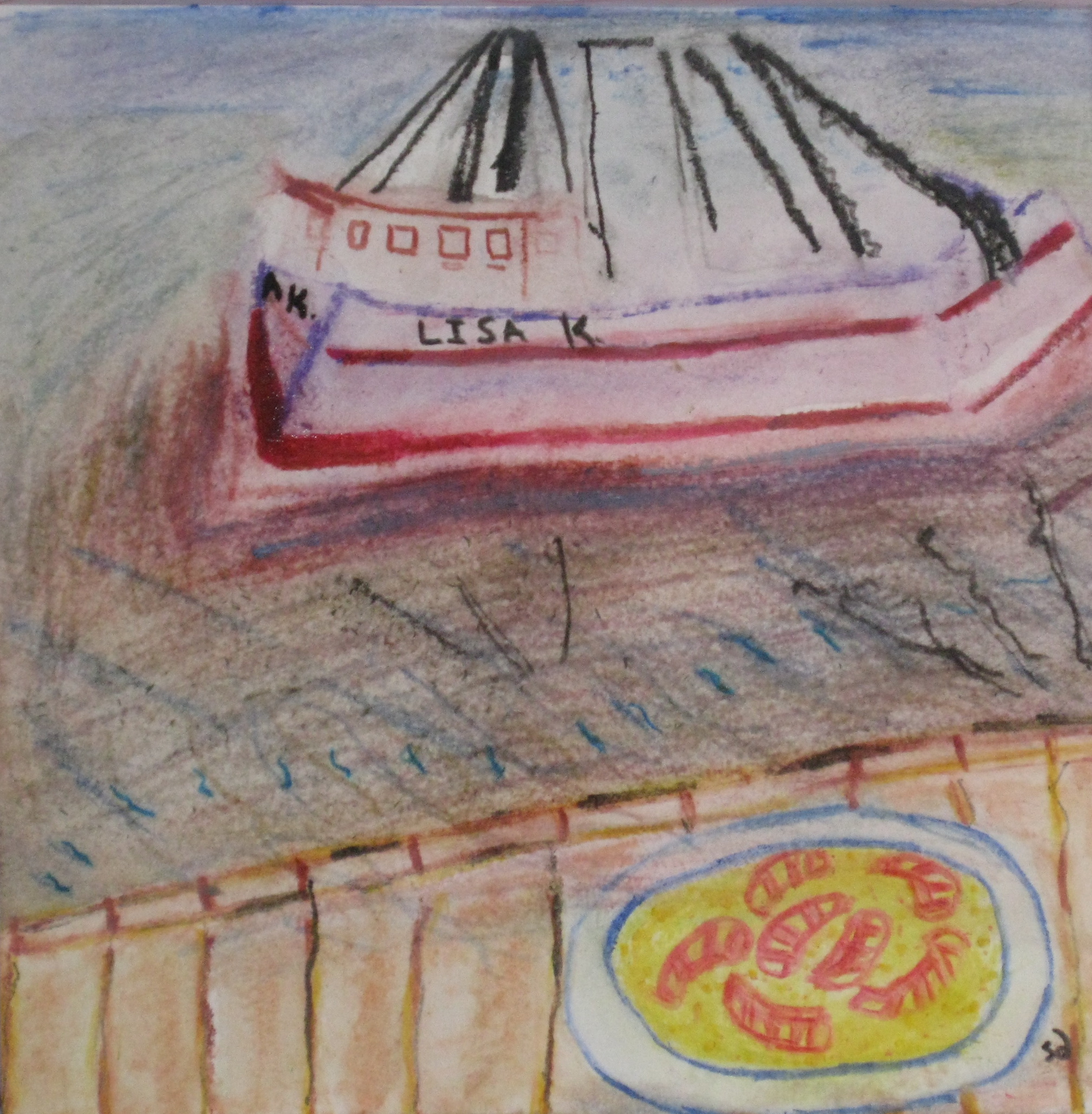
All of my friends like to write and eat. Well, some of them like to sing and eat and some of them like to talk and eat, but all of them like to eat. Lisa Knighton, whom I met at a retreat with Natalie Goldberg, is a fitness trainer who likes to eat healthy, fresh, local food, to bake cakes and to tell stories. Just see how many stories she starts to tell you in this post. Lisa hales from Athens, Georgia, and has come to “The Kale Chronicles” to teach you how use wild-caught shrimp and that Southern staple grits in the entree shrimp and grits. By the time you read this, you’ll be wanting to make them for supper (Let me just apologize in advance for the funky spacing in Lisa’s post — even re-typing it won’t fix it — I tried).
In 1997 and 1998 I was sculpting large dolls — three feet high — out of porcelain clay and painting their heads, hands and feet. It was then that I acquired my painting palette, a cheap round plastic palette with a clear plastic top. This morning as I passed my desk I checked to see whether I had closed the palette properly and a large piece of brittle plastic broke off in my hand. I slapped some masking tape on the top and went on about my business, but the incident reminded me that I wanted to write about plastic.
Now, some of you will already be wondering why I didn’t immediately throw the broken plastic in the trash and go out and buy another palette, perhaps even a better one. The answer is two-fold: the lid that broke serves only the purpose of covering the paint so that it will stay moist and, with tape, still serves that purpose, but also plastic is problematic to dispose of properly and I feel it is best to limit plastic acquisitions whenever possible. The bottom of the palette where the paints sit is undamaged and I do not often have guests in my painting room, aka my bedroom. I also prefer to reserve what money I have for travel and other treats instead of using it to replace shabby possessions. If I did a self-portrait in the house jeans I am wearing right now it would tell you a lot about me: they have frayed hems and a side seam that is about to go on the inner thigh. I cannot remember when I bought them or at what thrift store but I can assure you that I have had them for more than five years.
Ahem. Why do I want to talk about plastic? Well, first of all, I read Beth Terry’s blog, My Plastic-Free Life, and follow her attempts to live free from plastic. She lives not far from me and does more than I will ever do to eradicate plastic from her life. I believe she is like a canary in a mine or a Cassandra we do not want to listen to as she chronicles the evils of plastic and its ubiquitousness. She goes to extremes that you might not want to go to — but you might: have a look at her blog and see what you think. She was talking about the amount of plastic packaging at Trader Joe’s the other day. Coincidentally, I had just stopped at Trader Joe’s for a couple of things (coconut milk, limes, dried apricots) and had had to make the unfortunate choice between limes coated with “edible wax” without packaging and organic limes in plastic netting. Which would you choose? Beth would tell me that the cans of coconut milk I bought are lined with plastic and frown that I would even consider buying apricots in a plastic bag. All I can say is that my Mom prefers apricots from Turkey to California-grown and Trader Joe’s meets her price point.
I believe that people want to do the right thing and that the right thing varies according to person and situation. I also believe that many of us are wanton in our use of plastic, that we use it unthinkingly and discard it unthinkingly. Many a young person has probably seen little at the store that is devoid of plastic packaging: it is in my lifetime that we got plastic tamper-proof seals on every bottle of pills, plastic film on cottage cheese and yogurt cartons, plastic bottles of soft drinks, plastic bottles of drinking water. It is in my lifetime that Quaker Oats went from selling rolled oats in a cardboard carton with a string you pulled to open it to the current carton topped with two plastic lids (one you remove to open it, the other reseals the carton). In my lifetime, the Ziploc bag went from something that did not exist to a required item at airports.
I am fortunate to have learned some of the old ways: my grandmother taught me to place a dampened tea towel over rising bread dough and my mother to store leftover pie crust in waxed paper. Plastic wrap often seals poorly anyway, so you will see me rubber-banding paper, wicker plates, cardboard or tea towels over the top of bowls to bring dishes to potlucks. You will see me washing plastic bags and drying them on the line so that we can continue to use them to store food. Like many of you I carry a backpack and canvas totes to pack my food at the grocery store and farmers’ market. I have a marked preference for buying food in glass, which I can re-use, and cans, which I can at least recycle. We use ancient Tupperware around the house, which seems to have the virtue of lasting forever with little degradation. We do our best to re-use those yogurt containers, bought mostly in quart-size, handy for storing soup or taking it on the road. And I carry a quart-sized water bottle with me, which I refill from taps and water fountains everywhere.
I reserve the worst of my spleen for single-use plastic: since I am not going to wash and re-use plastic wrap it is better not to use it in the first place if I can possibly avoid it. I can store food in cooking pots. I can cover a bowl with a plate or a clean cloth. Some foods, for example, cucumbers and mushrooms, keep better if they are not stored in plastic.
How many of you work to minimize the use of plastic in your kitchens? Please raise your hands and share your tips with me and with Beth. The world will thank you for it, although not the plastic-producing corporations.
Five years ago I cast my lot with Riverdog Farm in Guinda, CA, subscribing to receive their weekly vegetable box. I had been shopping at Farmers’ Markets since I lived in San Francisco, going to Saturday and Sunday markets to buy the bulk of what I cooked. When I moved back to the East Bay I took to frequenting the Berkeley Farmers’ Market. Although I love going to the market I had been interested in vegetables by subscription for a long time and when a friend recommended Riverdog’s program I signed up, initially splitting a box with my friend Elaine who lives in Berkeley.
My reading influenced me. I had read Barbara Kingsolver’s Animal, Vegetable, Miracle about how she and her family had endeavored to raise most of their food on their Virginia farm and to buy locally what they couldn’t grow themselves. This afternoon I refreshed my memory of Kingsolver’s first locavore spring as I contemplated what to write about today.
Spring has sprung by the calendar. The days are longer. Plane trees have leafed out. A few native freesias push themselves up in the yard. A full moon lit the mild, clear night on Friday as I walked the last two miles home from a Passover seder at Elaine’s, where we ate broccoli, roasted potatoes, duck, carrots in the matzo ball soup, charoset made of dried apricots and dates. Sun shone on the Berkeley market on Holy Saturday where people stood in line for green strawberries (I tasted one), berries with white shoulders, asparagus and globe artichokes. One patron snapped up the only box of snow peas. Spring produce is late this year in northern California, not as late as last year where unexpected ongoing rain slowed all of the crops, but this was a slim market on the day before Easter. I brought home a bottle of plum vinegar, two pounds of walnuts in the shell, a grapefruit for another round of Shrimp Diablo. I considered buying a large basil plant and plucking every leaf to make pesto.
This is the time of year when I wish I had preserved more during the summer and fall, roasted more red peppers and frozen them, dried more tomatoes and raisins, canned more dilly beans, made more pesto. I break out stores of canned tomatoes, jars of roasted peppers and chutney, condiments to lend flavor to our spring diet. We use frozen mozzarella, fresh spinach, cottage cheese, diced tomatoes and Prego marinara to make lasagna. I pile peach chutney, roasted peppers and fresh arugula on a broiled Portobello burger marinated in salad dressing. We make pies out of frozen peaches and canned cherries.
What I can rely on in March and April is an abundant supply of alliums: spring onions and leeks. Every week Riverdog sends us a pound or two. I use leeks instead of onions in carrot soup and find I do not care for the substitution: note to self — only white parts of leeks, which will not give the green tinge and the strong flavor. I slice one leek into rings in a bowl of water, separating each ring to let the sandy grit sink to the bottom. I heat a few teaspoonfuls of olive oil mixed with butter in a skillet, lift the leeks from the water, pat them dry and saute them. I preheat the oven to 325. I roll out pie crust, sprinkle the bottom with crumbled feta cheese, add the sauteed leeks. I cut a jarred roasted red pepper into squares and scatter them on top of the leeks and cheese. I add a few cubes of marinated feta, just enough to create a pleasant design on the red and green. I grate a few tablespoons of Pecorino over that.
Then I beat three eggs in a metal bowl and add a splash of milk, eyeball it and add a little more, whisking the custard together. I pour the custard over the vegetables and cheese and pop the quiche in the oven.
This is a rough recipe: I have made it many times and feel no need to make more than the roughest of measures. I’m going to guess slightly on the amounts I recommend (Sometimes I measure backwards, pouring out what I think I will need and then checking the amount for you by pouring liquid back into a measuring cup, for example). If you need to know exact amounts you might want to look up another recipe for that. I will refer you to my Mom’s recipe for pie crust because I can recommend it wholeheartedly as the pastry we use most often.
Make 1 recipe pie crust. Chill crust while you prepare the leeks.
Clean 1 leek by slicing it into thin rings and teasing each ring apart in a large bowl of water. Lift rings out with a slotted spoon or small sieve and pat them dry.
Heat 2 tsp olive oil and 2 tsp butter in a skillet. When combined, add leeks and saute.
While the leeks saute, you should have time to roll out your crust. Take 1/4 of your pie crust, flatten slightly and roll out on a floured board into a 10 inch circle. Fold and place in a 9-inch pie tin or tart pan.
Scatter feta cheese to taste on crust — I use enough to almost cover the bottom. Add sauteed leeks.
Slice 1 roasted red pepper into small squares. Scatter on top of leeks.
Sprinkle vegetables with additional feta, plus 2 Tbsp grated Pecorino or Parmesan cheese.
Beat 3 eggs. Add a splash of milk. Whisk. Pour custard over vegetables. if necessary, add milk to fill crust.
Bake quiche until top puffs and browns, at least half an hour.
Food Notes: You may, of course, substitute cheeses if you prefer something else to feta, substitute scallions or sauteed onions for leeks, substitute sun-dried tomatoes for the roasted red peppers. Quiche is, by nature, a flexible recipe. Because I was using feta, a salty cheese, I didn’t add any salt — if you choose a mild, sweet cheese, you might want to add some. If you want to eat this during Passover week, you could make it without crust.
The weather swings from mackerel skies to overcast, from sun to rain. The farm box remains remarkably constant in content: spring onions, leeks, carrots, cabbage, cauliflower, tangerines. Today we got cilantro and asparagus as well. My mother has been under the weather for days, following a diet of toast, toast and toast. What can I possibly make for dinner?
I settle on an old favorite, a spin on Thai chicken-coconut soup with plenty of winter vegetables: carrots, cabbage, spinach and leeks.
I begin by making coconut milk. I measure two cups of unsweetened coconut into the blender while I heat 2 and 1/2 cups of skim milk on the stove. (The richness of the milk does not matter: we are using it to extract the coconut flavor from the coconut — I’ve used everything from whole milk to skim and water in a pinch). Blend the warmed milk and the dry coconut for a minute or two and then strain out the coconut. Throw that same coconut back in the blender with two cups of warm water and make a second batch, straining the coconut out. Now you may throw the coconut meat out, or compost it: all of the flavor has gone into the bowl of thick and thin coconut milk.
I heat two pints of homemade chicken stock on the stove and add the coconut milk and most of a boned and skinned chicken that we roasted earlier in the week. I add 1 Tbsp. fish sauce and the juice of one lime and about 1/2 tsp of chili paste with garlic. I let the meat simmer in the broth while I cut up two root ends of lemongrass and slice about 1 Tbsp of frozen fresh ginger into thick coins. Leaving the lemongrass and ginger large means we will be able to spot them in the soup. I add a bowl of leek rings that I cleaned and cut a couple of days ago.
Mom slices carrots into irregular pieces — like making carrot sticks — and washes spinach leaves. I wash and chop the roots of today’s cilantro and add them to the simmering pot. I slice cabbage thinly.
Then we go upstairs and watch an episode of “The Rockford Files.”
When we return to the kitchen, Mom turns up the pot to high and adds the carrots. In three minutes the carrots are almost cooked and I turn the burner down to medium and add the cabbage. Oops. I have underestimated the volume of the soup, so instead of cooking spinach in the soup we put spinach leaves in our bowls and ladle the hot soup on top of them, turning off the soup pot. I garnish my bowl with fresh cilantro. There is plenty of soup for future meals: we will reheat it and add fresh spinach and cilantro to our bowls again.
Food Notes: As you can see, this is not a precise recipe. The basics include a blend of chicken broth and coconut milk and the classic Thai seasonings of ginger or galangal, lemongrass, fish sauce, and chilies. You can vary the amounts of fish sauce, lime juice, chili paste, lemongrass and ginger to taste. If you like your soup sweet, you can add brown sugar. You can make it with canned coconut milk, either regular or light, which is what I do when I am not out of canned coconut milk. Tonight’s version was mild, rather than spicy, to accommodate Mom’s indisposition, but you can amp it up with loads of chili paste or fresh chilies. You can make it traditional Thai style with no vegetables at all. You can add rice noodles or rice. You can use leeks, spring onions, or scallions. You can include sweet potatoes or broccoli, as long as you do not cook them too long in the soup. If you like crunchy broccoli, you might want to put it in your bowl and pour the soup over it like we did with the spinach: by the time you get to the bottom of your bowl the broccoli will be nicely cooked. This is a nice soup to eat when you have a cold or when you are trying to tempt someone with a low appetite: packing it full of vegetables adds vitamins and minerals to the broth.
Painting Notes: The quickest of paintings to meet a deadline.
Although my family is half-Irish, we are not big on St. Patrick’s Day food here. I should say I am not big on St. Patrick’s Day food, having suffered through a few childhood years of corned beef and cabbage. I lived in Ireland for a year when I was in college and remember the big food groups being potatoes, Swedes (rutabaga) as big as your head, bacon, butter and cheese with sides of oatmeal, biscuits and “puddings” covered with custard which came out of a tin. I also ate prawn sandwiches from a sandwich shop near Trinity College and gyros from carts off the street. In Dublin, I bought groceries daily and set my milk in a bowl of water on a window ledge: when the rare sun came out, the milk spoiled and it was time to make soda bread.
Yesterday, however, I came across a potato knish recipe on Smitten Kitchen (two, actually). Her knishes were so beautiful that I decided to make some, substituting the classic Irish vegetable, cabbage, where she had used kale. As I peeled and cleaned potatoes, I thought of my Irish grandmother, Grandmother Carroll, and was vigilant about removing every spot and blemish from each spud. Then, as I was sweating leeks and boiling the red potatoes, I realized that I could make the knish into a complete meal by adding some finely diced Canadian bacon to my leek mixture, giving the nod to my mother’s birthplace in Manitoba and the bacon of Ireland at the same time. Ye who eat kosher may recoil in horror here, but I imagine that many an Irish housewife in New York tried a knish or learned to make one from a neighbor and sweetened the recipe with bacon or ham in her own kitchen. I will not be offended if you leave out the Canadian bacon or if you only make knishes from your grandmother’s recipe.
I had never made a knish at all before this and I’m not even sure that I have eaten one. Certainly, no one has ever made them for me. I was up against a new dough. The filling of leeks, potatoes, cabbage and Canadian bacon was not unlike soups I have made this winter, although knishes require no broth and Deb added cream cheese to the potatoes. I followed suit with that: when I tasted the potato filling before making the knishes, the potatoes had a lovely sweet taste, coming from the cheese and the barely sauteed shredded cabbage. The tablespoon of butter in the saute pan came through, too.
I followed the unfamiliar directions: divide the dough. Roll half of it into a 12″ x 12″ rectangle (Hey! I know what those look like from painting). Put half the filling across the bottom of the dough, making it about two inches wide and roll it up like a cigar, twice around with the dough. Mark off dough at around 3 and 1/2 inches (basically cut it into three equal parts). I did not fully understand the instructions for twisting the dough, but I managed to close one end of each piece, converting that to a knish base. Nor did I trim the excess dough as suggested: I just let it wrap part-way around and “glued” it with a finger dipped in water. There never was a Dimmick that did not like extra crust or extra dough.
I even made egg wash because I had seen the beautiful browning on Deb’s knishes and coveted it: in fact it was the browning and the cunning round shape with a little filling showing that made me want to make these knishes in the first place. Brushing things with egg wash is the kind of step I am often tempted to skip because then you have that lonely egg white sitting in the fridge and have to start thinking of what to do with it (it may go into the next batch of waffles or pancakes to make them extra light). I dutifully applied egg wash with a pastry brush.
I am pleased to say that the knishes came out beautifully. They looked something like Deb’s with their browned exterior and a little window of creamy potato peeking out of the tops. The crust was thin and crisp, the filling soft and warm and savory. I served them with some warmed applesauce and a pot of Irish breakfast tea, a warming lunch on a soft gray day.
Food notes: For detailed instructions, please read Deb’s second knish recipe on Smitten Kitchen. I used olive oil for the vegetable oil she calls for and it worked fine. I substituted 1 cup of finely shredded cabbage for the kale. I folded 1/4 cup diced Canadian bacon into the leeks when they were almost done cooking, stirred, and put the lid back on. When the leeks were done, I put the cabbage in with them and cooked the mixture for two minutes more. I saved the potato water from boiling the potatoes because my grandmother taught me to use that in yeast bread. If I had been thinking, I might have cooked extra potatoes and used them to make potato bread. Next time: if you are Irish, you cannot eat too many potatoes, or too much bread either. Happy St. Patrick’s Day!
Last week I checked Riverdog Farm’s weekly online newsletter to see what vegetables we were going to get: tangerines, navel oranges, spring onions, cauliflower, carrots, dandelions. Dandelions! Oh, they didn’t! I read on to see that what they were really giving us was young leaves of chicory. The only thing I know about chicory is that you can make coffee substitute from it or add it to coffee for that New Orleans flavor. I Googled it. The coffee substitute is made from chicory roots. Shucks.
My mind goes back to salads we ate in Italy where they dug every bitter shoot out of the ground and dressed it in olive oil. But before I start whining in earnest I realize that a limited palette of ingredients is a test of cooking skill and creativity and that with a cabinet full of spices and a refrigerator containing milk, butter and cheeses I have more to work with than many people have had. What needs adjusting beyond the seasonings is my attitude.
This week I sufficiently adjusted my attitude to cook the chicory. I tasted it raw the day I got it: bitter. Before I cooked it I checked to see what will be in Wednesday’s box. The contents are not much different. For twenty dollars a week I am getting three pounds of fruit (oranges and tangerines) and six pounds of vegetables, including leeks, arugula, spinach, cauliflower, carrots and potatoes. That is the basic early spring produce palette here in Northern California.
This morning I went with my mother on her weekly shopping foray. This week we went to Food Maxx for canned cat food for our three cats and coffee beans for Mom. While we were there, we picked up two boxes of rolled oats, a bag of raisin bran, four boxes of whole wheat rotini, a jar of molasses, a box of Mexican chocolate, a small jar of Prego and a number ten can of hominy for posole. The food for humans in that came to $26.28 and we got a dime back for bringing our own canvas bags. Total: $26.18
We went on to Canned Foods Grocery Outlet, variously known to our friends as “Half Foods” and “Groc. Out” (before you turn up your nose, let me remind you that it was there I first found a bottle of Mosaic blood orange olive oil). There we picked up our dairy products for the week: half and half, buttermilk, sour cream and cheeses: jalapeno cheddar, a two-pound block of mozzarella for pizza-making, and a jar of marinated feta. We added in meat protein with a package of turkey sausage and one of Canadian bacon. Mom scored a 2 lb. bag of organic frozen green beans for $3.00 and a big bag of fresh red potatoes for $2.00. I treated myself to a three-pound bag of Bosc pears from Washington State for $1.50 because the annual citrus glut is getting to me again — I will use the pears in desserts and soups and eat them as snacks. We bought a couple of cans of diced tomatoes for our winter-spring pantry, some flaked coconut and maple syrup for baking, a large package of English muffins and two different brands of commercial ginger snaps. Total for Canned Foods food: 44.83.
Adding up the food we purchased this week from all sources, I get $91.01. We will not shop again until next week and with all of this in the house we may not buy much next week beyond bread, milk and more cat food.
Now, we never start from a house empty of food. We keep a running pantry of baking supplies from butter and eggs to flour and cornmeal. We usually have walnuts and almonds and some dried fruit: right now we have dried peaches and apricots, sour cherries, raisins and home-dried apples and pears. When I get around to it, we will have home-candied citrus peels as well. We also stock rice, both brown and white, polenta and pasta. We make our own chicken stock, which we store in the freezer, and keep condiments such as mustard and red wine vinegar, soy sauce and sesame oil. We try to replace all of these items during sales to keep our costs down.
The chicory? I cooked it for dinner, after trimming all of the stems. I pulled out all of the stops. First I boiled it for fifteen minutes. Then I poured off the water, hoping to have leached out some of the bitterness. I tasted it again: still bitter and not quite dull in color. I put in a little more water and cooked it for ten more minutes. Then I pulled out a skillet, heated some olive oil and sliced up half a sausage into half-coins. I browned those while I microwaved about a quarter cup of raisins in some water (This green is seriously bitter and needed the help from the dried grapes). I added the drained chicory and some pressed garlic, then the raisins and soaking water. Even with the raisins, oil, garlic, sausage and blanching the chicory remained bitter — not slightly bitter, but majorly bitter. It is the kind of thing that gives vegetables a bad name. We ate it alongside some bland Kabocha squash gnocchi in (not bland) gorgonzola sauce. My first attempt at winter squash gnocchi lacked lightness as I had to work in extra flour to handle the dough: if I revisit gnocchi more successfully I will post the recipe later. We were grateful to have the Mexican chocolate as an after dinner treat: I prepared that with a square of bittersweet chocolate, an extra tablespoon of cocoa powder and a dash of vanilla extract in each cup, perfect for the rainy March night.
P.S. Mom, trooper that she is, reheated and ate the remaining chicory for breakfast. She said it was better after sitting overnight. I said I would never complain about kale again, knowing we could get chicory instead. We both shuddered.
Most mornings I eat oatmeal cooked in milk to jump start my calcium intake for the day. Our house is cold and warm breakfasts are usually welcome. But because we shop just once a week, there are occasionally mornings when the milk is gone and hot cereal is not an option. Heaven forbid that I would cook my oats in water, converting them to standard gruel.
These are some of our options for mornings we are out of milk.
1) Rice cakes: take some leftover rice. Crack an egg or two into it. Add some sugar, vanilla, nutmeg. Beat for a few minutes with a fork. Scoop out by 1/4 cup measures and fry in butter.
2) French toast: take the last few slices of bread. Toast them lightly if they are not already stale. Cut them in half. Beat a couple of eggs in a shallow bowl. Add juice and zest of one orange if you like, or just add sugar, vanilla and nutmeg as for rice cakes above. Soak the bread briefly in the egg batter. Fry in butter. Serve with powdered sugar, maple syrup, fresh fruit or fruit puree
If we have sour milk, buttermilk or yogurt on hand we can just make waffles, cornbread or biscuits.
If we have no milk products, sour or otherwise, we can get out our sourdough starter and make sourdough biscuits with that, using a cup of starter, 1/4 cup of vegetable shortening, 1/2 tsp each of sugar, salt and baking soda, 1 cup of plain flour and 1 Tbsp baking powder. Mix them. Roll them. Cut them. Brush the tops with melted butter and let them sit for fifteen minutes while you preheat the oven to 425. Bake for 10-12 minutes
If I am feeling more ambitious than making biscuits and I have gotten up very early, I might return to my breakfast oatmeal and make it into some delicious oatmeal yeast bread, flavored with maple syrup. I have adapted this recipe slightly from an old cookbook called Coffee by Charles and Violet Schafer published in 1976 and now living in tatters on my bookshelf. This bread uses the sponge method, which will save you some time on the first rise (but you will have to knead it before the second rise after you add the remaining flour and salt).
Oatmeal Bread
Pour 2 cups of boiling water over 1 cup of rolled oats in a mixing bowl.
Measure 1 Tbsp of vegetable oil into a Pyrex measuring cup. Swirl oil to coat glass to the 1/2 cup mark.
Add oil to cooling oat mixture.
Into oiled cup, measure 1/2 cup maple syrup.
Add syrup to oat-water-oil mixture
Take that same old Pyrex cup and add 1/4 cup lukewarm water.
Dissolve 1 Tbsp active dry yeast in the lukewarm water and stir with a fork.
While the yeast proofs, add 2 cups unbleached flour to your mixing bowl and stir. When mixture is lukewarm, add yeast and stir again. Cover with damp cloth and place in warm place to rise. Check in 30 minutes.
After your sponge has risen and fallen slightly, add 1/2 cup whole wheat flour, 2 and 1/2 cups unbleached flour and 1 tsp kosher salt to it.
This is when you knead it. I like to knead on a lightly floured bread board for at least ten minutes. If your dough is too sticky, add flour by the tablespoon until it is workable: dough will vary by the amount of moisture in the air, the temperature of your kitchen, the particular grind of the flour. Please add a little flour to the board, to your hands, or to the dough itself if you are having a lot of trouble with it: doughs containing honey, syrup or molasses are stickier than those that don’t, but you are going to love the flavor of this bread, so persevere.
After at least ten full minutes of kneading, you may want to add a little butter or oil to your mixing bowl. Rub it all over so that the dough won’t stick. Then plunk the dough back into the bowl, dampen your tea towel with warm water, wring it out and set it on the bowl again, placing the dough in a warm place for its second rise. Check it again in 30 minutes (or forty if you are reading a great novel). When it has doubled, take the time to grease two loaf pans or one loaf pan and a pie or tart pan if you want to make a round loaf. Using butter to grease the pans will add to the flavor of the finished bread.
Take the bread dough out of the bowl and set it again on your lightly floured bread board. Cut it with your dough cutter or bench scraper into two equal portions. Roll the first one up like a jelly roll and tuck in the ends: with any luck it will fit your loaf pan. Take the second piece of dough and roll it into a ball, continually tucking any edges under and smoothing the top. Place this ball in your pie or tart pan. Return shaped loaves to the oven to rise for fifteen minutes, then move them somewhere else while you preheat your oven to 375, making sure a rack is in the middle position with no rack above it (You should have already moved it when you were using it for the rising dough, but if you didn’t, do it now).
When your oven is hot, set the loaves inside and putter around for ten minutes, doing dishes or having a cup of tea. After ten minutes, reduce the oven temperature to 350 and go back to reading your novel. Resurface in 30 minutes to check your bread: when you thump it, it should make a good solid thumping sound and the crust should have some brown color. When it thumps satisfactorily, remove it to a cooling rack. Mom taught be to remove the bread from the pans so that the crust does not steam in the hot pans: if you do this, you will get a crustier, chewier crust.
Now go away again: if you cut the bread hot you will ruin the texture. It’s best just to forget about it for awhile. When it is cool or almost cool, you can slice it and savor the beautiful bouquet of maple syrup. Whatever you do not eat immediately makes lovely toast tomorrow and the next day.
Food notes: On rice cakes: these rice cakes are not Asian rice cakes. They are the kind of rice cakes some people make in Louisiana: a fried cake made of sweetened rice bound with eggs. On oatmeal bread: for its most wonderful qualities, this bread requires maple syrup. None of the other ingredients are expensive, so splurge every now and then and make it. Can you make it with honey or golden syrup or malt syrup or brown rice syrup? Yes, you can, but it will not be the same and not yield the same deliciousness. Can you make it with more whole wheat flour? Of course you can, but, once again, you will not get the same bread: whole wheat flour will make it browner and heavier and wheatier. I keep the whole wheat flour to a half cup for the nod to health, replacing a little nutrition in that unbleached flour, but oats are good for you, too. Happy breakfast.
Equipment notes: Few things make me happier than having a dough cutter. I baked for many years without one, but it is the easiest thing to use when you need to divide yeast dough.
Okay, so you know that Riverdog Farm keeps me well-supplied with winter and spring citrus: if you read The Kale Chronicles frequently, you will notice that lemons, tangerines and oranges show up in a lot of my recipes from November on. I’ve given you Swedish rye bread with orange and anise, orange-sesame vinaigrette, tahini-citrus salad dressing, orange-fennel salad, orange-cumin bread, tangerine curd, orange muffins, lemon sponge pie and Shaker lemon pie, lemon bars with a coconut brown sugar crust, a recipe for home-candied citrus peel. And then there is all of the stuff I don’t blog about: the orange zest and juice stirred into French toast, the lemon squeezed onto roast vegetables and greens and stuffed into chicken cavities. And still the tangerines roll on.
A pound of Murcott tangerines rolled in last week and coincidentally I ran across a recipe for a clementine cake on Smitten Kitchen. Now, Deb can cook, and she got the recipe from Nigella Lawson, who makes her living as a cook. Separately, they insisted that I could boil my pound of tangerines for a couple of hours and then incorporate them into a gluten-free cake. Deb voiced the doubts anyone would surely have about this recipe. Would it be bitter? Would it rise? Would anybody eat it?
I needed to try this because it would use a whole pound of tangerines at one fell swoop and because I was going to a singing party at the home of a gluten-free friend yesterday and because it was such an odd method of making a cake, particularly the part about boiling a pound of whole tangerines. Deb had suggested that this cake got better as it sat and Mom suggested that I make it on Friday afternoon for the Saturday afternoon party.
I put my pound of tangerines into a saucepan, covered them with water and brought them to a boil and then let them cook for two hours. No, I did not peel them or seed them. I didn’t even wash them since they were organically grown and I would be using the nicely acidulated cooking water for some lucky outdoor plants.
While the tangerines cooked, I had plenty of time to prepare the other ingredients. I started with whole, skin-on almonds because I needed 2 and 1/3 cups of ground almonds. I tried running them through the meat grinder, but they only gummed up the works and ground unevenly as well. Then I realized I had a large Vietnamese mortar and pestle and started pounding away — after all I had two hours to wait for the tangerines (You modern types could use your food processors or buy ground almonds at the store: I enjoy knowing I can get ground almonds and some exercise at the same time). I scooped the first batch up with a 1/3 cup measure and put them in a small mixing bowl and started another batch. When I got tired of pounding, I took a break to take six large eggs out to sit at room temperature. While the eggs warmed, I went back to my mortar and pestle. When I had measured out enough pounded almonds, I set them aside in the small mixing bowl and turned my attention to the eggs.
I made a genoise once: it took me two tries to get it right. What I learned from making genoise is that you can get eggs or egg yolks to incorporate a lot of air and triple in volume like egg whites — you just have to beat them for a long time. I turned on my electric mixer at cake-mixing speed and eventually cranked it up higher and watched the volume of the eggs increase and the color get paler. When the eggs were three-quarters of the way up the bowl I started adding sugar, about a tablespoon at a time, until I had incorporated 1 cup and 2 tablespoons of sugar. I did not even think about scanting the sugar because this cake was going to contain tangerine skin and pith — all of it.
About now, the tangerines in the pot hit the two-hour mark so I used a cooking fork to remove them from the water and set them on my cutting board. While they cooled, I added my ground almonds slowly to the egg sugar mixture with the 1 heaping teaspoon of baking powder. I then preheated the oven to 375 with a rack in the central position and took out my precious bottle of Mosaic blood orange oil to grease a bundt pan. Hedging my bets, I sprinkled a generous tablespoon full of sugar over the oiled pan.
Then, as instructed, I sliced my tangerines in half and extracted all of the seeds. You must do this because citrus seeds are excessively bitter. I then used a chef’s knife to chop all of the tangerines as finely as I could, catching the juice in a bowl (the one the almonds had been in earlier), When they were chopped pretty evenly with just a few larger pieces of peel here and there I put them into the mixer with the other ingredients and let it run for two or three minutes.
The resulting batter was a beautiful thing — foamy, pale orange, flecked with bits of bright orange and brown. I tasted it cautiously. It had a slight bitter edge, but would be edible. The recipe made enough for me to make a small test cake in a rice bowl in addition to the big bundt so I was able to sample the finished cake without disturbing the party edition.
I baked my small cake for thirty minutes, at which point a toothpick came out dry. I left the big one in for ten more minutes and it, too, passed the toothpick test. We ate the rice bowl cake warm, only noting that it had a tendency to fall apart.
Saturday I took the other cake to the party. I ran a knife around the edges (which had pulled away from the pan) and upended it on a plate: it came out cleanly. The hostess, who eats gluten-free, liked it. One man asked for the recipe. The woman who has a baking contract with me asked if I would make her one next time she was in town. They sent me home with perhaps one small serving.
What did I think? I thought it was good. Perhaps not great. You have to excuse me for not being a big cake fan in any case. Other people like cake. People who liked cake liked this. One man asked for the recipe. One woman mentioned liking the bitter marmalade-like tang, although she wondered if she would like it with a tangerine juice and powdered sugar glaze. I did find it a bit hard to slice — it was rather soft and moist. I offer it to my gluten-free friends as a possible cake, not too hard to make, not too many ingredients and another use for the rolling river of tangerines.
Food notes: if this cake interests you, be sure to check out the comments on Nigella Lawson’s site: people have done some creative things with spices, made it into a Christmas cake, etc.
Things may be a little different around here at The Kale Chronicles for awhile. I’ll have some guest posts. I’ll continue to paint. Mom and I will figure out some kind of cooking collaboration eventually. But, in the mean time, in case any of you have ever wondered what it is like to use a walker, I wrote a description as my morning’s writing practice. Enjoy.
The Walker Routine
I crawl or scoot to the edge of my bed to grab the walker from the foot where I left it. I stand up on my right foot and stomp-hop over to my bureau by the light from the window to pull out some thick socks. Because there is not enough light to see the socks’ color, I turn back to press the mouse: the light from my computer screen is enough to see by. I choose two red socks.
I turn and lean toward a chest, a plastic storage container where a few clothes currently rest, grabbing my holey cashmere sweater turned pajama top (I have enough worn-out cashmere for a lifetime of p.j.s). I turn again and take two steps back to the bed, where I sit and put on the socks.
Lifting the walker over a gap too narrow for it to transit, I then stand again and make my way down the hall to the head of the stairs. Using the window ledge and the banister as handholds, I lower myself down onto the top stair, left foot extended in front of me. I fold the walker and begin propelling myself down the stairs using my hands and my right foot, taking the walker with me. At the foot of the stairs I lower myself onto the narrow landing, scoot across to the last two stairs to the kitchen, unfold the walker and use my right leg and two walls to stand again.
I enter the kitchen, flipping on the light. The kettle is on the stove, but its lid is missing. I scan for the lid, feeling frustrated for a moment, until I see it sitting in the dish drainer. I stomp-hop over to the sink and fill the kettle half-full of cold water, pivoting to set it on the burner and turn the burner on. I tuck the red plastic filter cone and metal cup under my arm. Then it is back to the far counter, stomp, stomp, stomp, stomp, pushing the step ladder out of the way once, twice, three times to free access to the coffee and cereal cabinet. Leaning on the counter with my left elbow, I take out my coffee canister and a metal coffee measure. Then I stretch up as straight as I can to pull a coffee filter from the box on the second shelf.
Leaning on the counter again, I use two hands to open my coffee canister — it has a ring-pull mechanism that takes considerable strength to break the air lock. I measure two scoops of coffee beans into the grinder, plug it in and press on the lid to grind the beans. One-handed doesn’t work so well, so I lean both hands on the grinder. I fold out the paper cone into the red filter and aim the ground coffee into the cone, first from the grinder, then from the lid.
The easiest way to move objects when using a walker is to set them on a surface and then pivot to set them on another surface. I am able to set the filter cone on the edge of the stove. Then I stomp, stomp, stomp to the cupboard for a coffee mug and a Pyrex measuring cup: if I’m going to go through this for coffee it is going to be a perfectly-made cup of coffee.
By now the water is boiling. I turn it off and pour one cup over my coffee grounds, then one-quarter cup. Ten ounces of decaf is my daily ration. While the coffee drips. I take the long way around to the refrigerator: it is just steps from the stove, but the walker will not go through on that side, so I walk all the way around the stove island to get the half and half, in a carton, thankfully, not a pitcher. Using the pivoting transfer technique I move the half and half from the refrigerator to the counter to the stove to the opposite counter.
I stomp, stomp, stomp back to the first counter to get a muffin out of the dish cupboard, stomp, stomp, stomp to the microwave to heat it. I am getting tired and pull it out and put it on a saucer after twenty-five seconds. Pivot-transfer to stove. Pivot-transfer to counter. Pivot-transfer to edge of breakfast room credenza. Pivot-transfer to table. Remove filter cone from coffee mug and place on metal cup. Pivot-transfer coffee-mug to counter. Pivot-transfer to credenza. Pivot-transfer to table. Stomp back for half and half. Pivot-transfer, pivot-transfer, pivot-transfer.
Sit down. Ah. Prop left foot over rung of walker. Pour half and half in coffee. Take bite of muffin. Chew. Drink more coffee. Consider getting cut grapefruit from fridge. Decide it is too much work. Take saucer and mug back to kitchen: if I am careful and dishes are empty I can hold one item between each thumb and some fingers and still grasp the walker firmly. Stomp, stomp, stomp. Reverse stomp. Retrieve half and half by pivot-transfer method and return it to fridge.
Stomp over to sink. Open cabinet. Bend down over top of walker, balancing to get compost can. Set compost can on edge of sink. Stomp back for used coffee filter. Place in compost. Replace compost under sink. Dabble hand in dishwater.
Grab clean water bottle for return trip upstairs. Stomp to foot of stairs. Sit. Fold walker. The easiest way to climb is to use a cross-wise technique: use left hand to grab a few stairs behind you. Use right foot to push off lower stair. Use right hand to hold folded walker steady against wall. Move water bottle up a few steps with right hand. Move walker with right hand. Move self with right foot and left hand. By the time I reach the landing I am sweating.
I gain the upstairs hallway, set my water bottle on the banister, unfold the walker, kneel and stand. I hook my thumb through the plastic loop on the water bottle lid and head for the bathroom. I don’t bother with closing the door: it is enough to set the water bottle on the counter, stomp across the floor to the commode and use the window ledge and sink edge to balance to pull down my pajama pants and pull my robe out of the way. Stand again.Yank pajamas up, first one side, then the other, while leaning on opposite side. Flush toilet. Wash hands. Lean against sink counter to brush teeth, which takes two hands. By now my right hip is cramping. I shift positions a bit while singing songs in my head to see that I brush long enough. Rinse toothbrush. Fill water bottle. Tuck thumb through loop. Turn and leave. Stomp, stomp, stomp, stomp. Stomp, stomp, stomp, stomp.
The Daring Bakers’ February 2012 host was – Lis! Lisa stepped in last minute and challenged us to create a quick bread we could call our own. She supplied us with a base recipe and shared some recipes she loves from various websites and encouraged us to build upon them and create new flavor profiles
Neither Lisa nor I had any idea just how challenging the Daring Bakers’ Challenge would be for me on my maiden voyage. The parameters were simple enough: make a quick bread, either in muffin or loaf shape. Post paragraph one above to begin the blog post.
I have cerebral palsy, which may or may not give me altered bone density. I have had all month to think about the baking challenge and to fantasize about what I would make. Should I make a coconut bread with fresh coconut and coconut milk? Should I concoct some kind of Nutella swirl thing in honor of Margit’s birthday month? Should I make something with limes, having scored a bag from the rotting rack at Canned Foods?
I mulled these choices over while I walked along Franciscan Way, going to Margit’s to feed her cats on Thursday morning. My left foot began to hurt insistently. I sat down on the verge to take off my shoe, thinking that my two-day old shoes were not fitting well. I ran my hand inside my shoe and straightened my sock, found nothing and resumed walking in some pain. Franciscan is a lonely stretch of roadway, abutting the Sunset Cemetery where my grandparents are buried. I fed the cats, cleaned their box, walked uphill to the Kensington Library, returned books, looked for job listings and went home for lunch.
My mother and I often have tea together in the afternoon in the upstairs library. She sits on the love seat and I sit on the matching dark red leather armchair with my feet on a black leather ottoman. When I removed my shoes, owing to the warm day, I saw that my little toe was blue and there was a bruise on the heavily calloused outside section of my left foot where the pain was. Uh-oh. The last time I had bruising like that I had broken my hand in two places.
By Friday I had called my foot doctor and requested an appointment and started to minimize any weight-bearing and to sit with my left foot elevated whenever possible. I brought a cutting board into the breakfast room and did all the chopping, slicing and peeling for soup that I could do sitting. By Sunday morning, I felt ready to tackle the muffin challenge. I pushed a light chair into the kitchen to encourage me to stay off my feet, maneuvered myself around as much as possible using the edges of counters and hopping carefully on my shod right foot. When I had to put my left foot down, I did my best to put my weight on the heel and avoid the front part of the foot.
I decided to make a variation on Mollie Katzen’s Spicy Gingerbread from The Enchanted Broccoli Forest, incorporating some finely diced pears with the sauteed butter and grated fresh ginger, and making the resulting batter in a standard 12-muffin tin. I began by whisking my dry ingredients together in a large mixing bowl:
1 cup unbleached flour
1/2 cup whole wheat pastry flour
1/2 cup whole wheat flour
1 and 1/2 tsp baking soda
1/2 tsp ground cloves
1/2 tsp dry mustard
1/2 tsp ground cinnamon
1/4 tsp kosher salt
generous grating of fresh nutmeg
Then I microwaved about 1 Tbsp of butter in a glass liquid measuring cup, swirling it in the cup to coat the sides to the 1/2 cup mark, before pouring it off into the muffin tin, a few drops in each cup. I then measured
1/2 cup honey
1/2 cup molasses into the pre-buttered measuring cup and poured them into a small bowl, to which I added
1/2 cup plain yogurt and
1 large egg.
I preheated my oven to 375 and put the butter-smeared tin into it to heat.
I whisked that together as I began melting 1/4 cup butter on very low heat in a small skillet. While the butter melted I peeled and chopped
2 small Bosc pears into a small dice
I then took a hand of fresh ginger from the freezer where we store it and grated three small knobs into the melted butter (about 3 Tbsp), added the diced pears and cooked it for awhile and turned off the heat while I rescued the tin from the hot oven.
I was all set to combine the ginger-butter-pear mixture with the honey, molasses, yogurt and butter and moved toward it, managing to knock both the bowl of wet ingredients, the whisk, the measuring cup and a rubber scraper onto the flour. I let out a cry, though not a swear-word, and righted the bowl to save what I could. The cry brought Mom from the upstairs to tackle the floor while I measured out another half cup of yogurt and a half cup of honey to replace what had been lost, and added them to what remained in the bowl. I then moved my chair out of the mess, combined the pears, butter and ginger with the remaining molasses, honey, egg and yogurt, stirred the wet ingredients into the dry, swiped the now-cooled muffin tin with some Crisco that Mom got down from the cupboard for me and hoped for the best as I filled the tin and set it in the oven. I then stalked off on my heels to make some coffee and set down morosely to let the muffins bake and the coffee water boil.
I needn’t have worried. The muffins came out gingery and delicious with small, soft chunks of pear glistening like jewels. They rose well. They browned well. I can now say that Mollie Katzen’s spicy gingerbread recipe is well-nigh indestructible, even if you drop the wet ingredients on the floor and spill half of them before incorporating your butter and ginger. Thank goodness. Now I will wait to see what the good doctor has to say this afternoon* while I consider the wisdom of taking on any further challenges than the ones I am already equipped with naturally.
* Sad to say my doctor’s visit was aborted by a sudden attack of norovirus. Today I switched to a walker until such time as I am allowed to darken his doorway. Projected visit: Friday morning.