Archives for category: Uncategorized

July 31, 2024

I am in my last week on Howe Street. I have finished the first of the two novels L. lent me to read and am working my way through History of the Rain, slowly because the Paris Olympics are on and I spend late nights and early mornings watching gymnastics on my laptop.

I have checked out the closest pizza place and the Chinese takeout joint, had breakfast with a friend at Mama’s Royal Cafe and dinner with another at Teni East Kitchen. Dinner out or takeout provide me with food for at least another meal.

A breakfast out is an exception though: morning usually finds me feeding cats, grinding coffee beans and cooking something for breakfast: today it was an egg and two slices of sesame bread with honey. My leftover Chinese lunch is heating in the oven (brown rice, string beans and spicy eggplant).

I am becoming adept at bathtub laundry, tossing like-colored clothes in with me when I bathe or wash my hair, leaving them to soak for awhile, wringing the water out and carrying them to the drying rack on the front porch. The secret is to do laundry every few days so that I do not have more than I can hang out. We are having typical Bay Area summer weather with cool, overcast mornings and warmer afternoons.

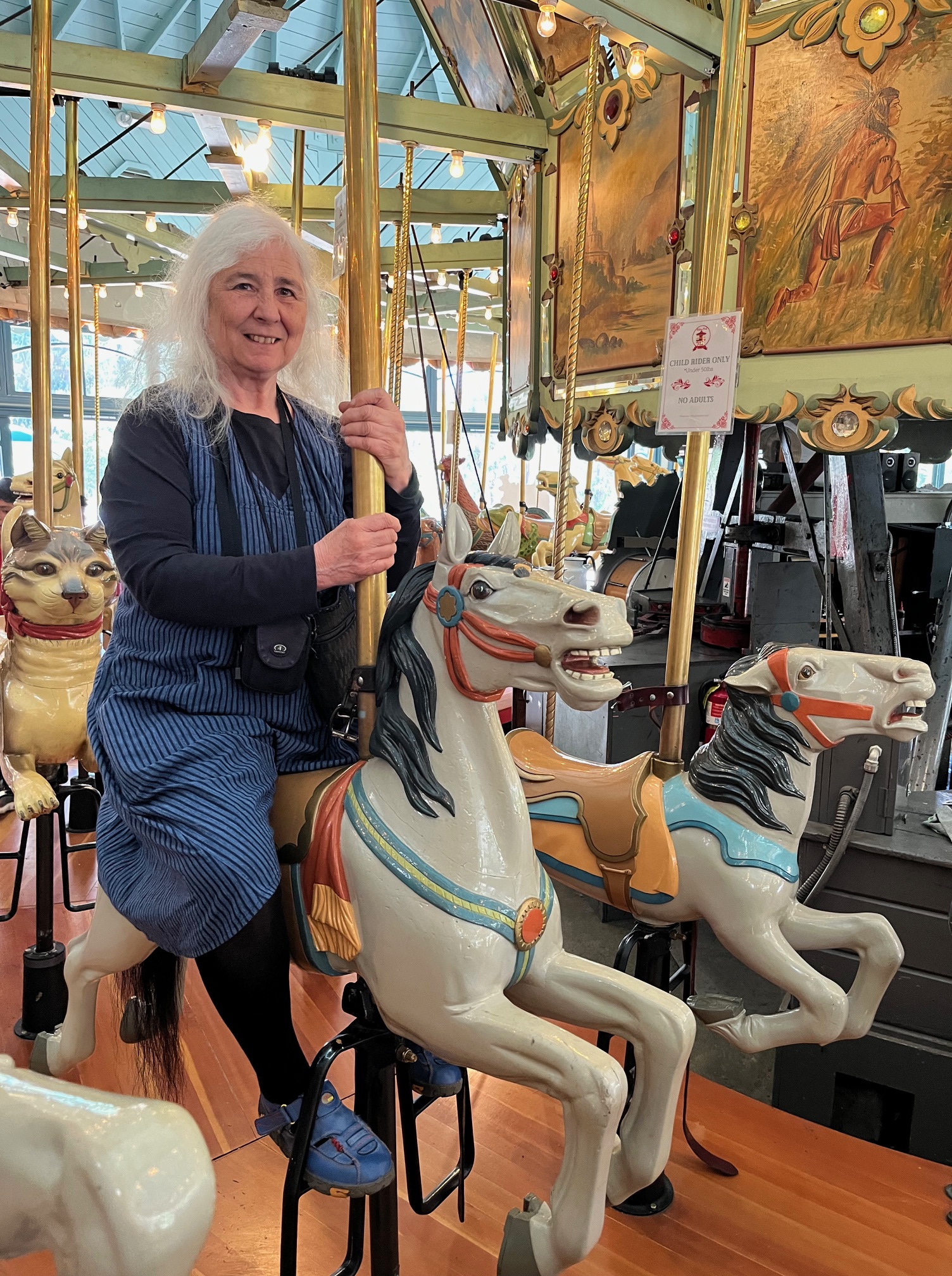
Yesterday I took the afternoon off from a vexing situation. My friend J. spirited me off to Tilden Park in her little red car. We rode the Merry-Go-Round (my choice) and the Steam Train (hers) and capped our day off with ice cream at iScream on Solano Ave. I had a coffee malt (no dinner necessary) and J. ate chocolate and blueberry ice creams.

Pandora, the chunky cat, stays close to me, almost always in the same room. Cassandra, the skinny one, remains aloof, although she did give me slow blinks from afar the other day. She is not ready to be friends.

It has been a lovely stay in a lovely neighborhood. The house is quiet and cool. My hosts sent me a postcard of Yeats from Ireland. I have a new favorite cafe and a couple of restaurants I like here, having found them just before I leave California. I still have some food to use up — sauerkraut and sausages, cheese, ramen noodles, frozen blueberries and maple syrup and more coffee than I can drink.

Dear Readers,

I am in the house-sitting, couch surfing phase of my travels before I take off for England on August 17, 2024, although I am still clearing items out of my childhood home in Kensington, CA. Today I began a diary of my house-sitting experiences in North Oakland.

The Howe Street Diaries

July 21, 2024

I am staying in the home of S&L, whom I met through a mutual friend. On Thursday July 18 they flew off to Ireland, leaving me in their beautiful house in North Oakland.

It is the kind of house I like, all wooden floors and windows, perched above the street with a front deck shaded by bottle brush and a backyard. In the last four days I have made a tour of comfortable sitting spots: the front porch chair where I ate lunch yesterday after a three-hour online sesshin with Natalie Goldberg, the living room couch where I sat for the sesshin and lay to read more of Kevin Barry’s Night Boat to Tangier, which L. lent me, reading about the adventures and inner states of two Irish middle-aged drug smugglers.

Now I sit at the kitchen table, plain plank, having eaten a bowl of Irish oats cooked in milk with salt, maple syrup and walnuts. To my right sits a cooling mug of coffee with cream (I must go out and hunt more half and half today at the Piedmont Grocery).

Late in my sixty-some year sojourn in California I discovered the pleasures of Straus half and half. It comes in a glass deposit bottle. It is far fresher and more flavorful than any other brand of half and half I have tasted. L&S left behind a partial bottle of Straus whole milk — I used the last of it to soak my Irish oats for breakfast.

Yesterday I had planned to make Irish oats for breakfast. I found a small saucepan in the rotating pot cupboard. What I could not find was a measuring cup. While I was searching for measuring cups I found a few slices of buttermilk bread tucked in a drawer. “I’d better use this,” I thought, and switched my breakfast plan to French toast.

I went on a hunt for vanilla extract, nutmeg or cinnamon. I found four bottles of orange blossom water. But S&L had left a few juice oranges on the table, so I made French toast batter from eggs and orange juice, fried the toast in butter and ate it with some frozen blueberries and maple syrup I brought from Kensington. I heated them in the small saucepan because there doesn’t seem to be a microwave: there is a mysterious black box on the kitchen counter to the right of the six burner gas stove, but I am not sure what it is and I am not sure how to open it.

S&L left me with two cats to care for. Pandora is neurologically challenged, fat, and friendly. Cassandra, her litter mate, can leap from the top of the high platform bed to the floor. She startled me the other morning by doing just that. She seems afraid of me: I have to put her food down and back away. They are both black cats. Pandora has soft fur; Cassandra is a touch-me-not.

The end of the afternoon finds me sitting on the living room couch again writing to my constant readers. Thank you for reading. Stay tuned for further adventures and an August guest post on https://thekitchensgarden.com

Dear Kale Chronicles Readers,

I have not posted in a long time. I had been the primary caretaker for my elderly mother for many months. She died at the end of March and I swung into post-death tasks (in case some of you don’t know, there are many, from arranging the disposition of the body to contacting friends, relatives and banks, responding to condolence notes, gathering and distributing death certificates).

I also inherited 95% of the contents of my mother’s house where I have been living, so I have been sorting through her possessions, dispersing a few things to people we know and packing up items I want to take with me when I go.

In a matter of months I will be leaving my home in the Bay Area and my home state of California, so not only am I sorting through my mother’s things, I am sorting through and packing my own possessions every single day. I will eventually be moving to a coastal city in Washington State.

But before I move, while the family home is on the market, I am going to travel. I was stuck here during Covid, stuck here while my mother’s care demanded that I be here 24/7, stuck here hiding from process servers. I am about to become majorly unstuck and I will be celebrating by traveling to see friends, traveling to revisit my ancestral homeland of Ireland after forty-seven years, traveling for a study trip with Natalie Goldberg in Montgomery, Alabama and taking a fall color cruise from Boston to points north. I will be on the road for a minimum of six weeks, but possibly for twelve weeks or more before I make my way to my new home town.

I may or may not be inclined to write to you from the road. If I feel like it and my schedule permits I’ll send you a postcard. Eventually I’ll fetch up in a permanent location and take up blogging again.

Cheers!

Sharyn

The plan for Sunday morning in Port Angeles was to pack up to leave, to try the second breakfast place that I had been tracking from afar, and to visit the year-round Port Angeles farmers market, one of the reasons I chose Port Angeles as a potential place to live. While packing I kept dealing with annoying texts from a Port Townsend realtor: I had been trying to book an appointment to see a Victorian cottage there. Carol and I would be able to stop in Port Townsend on our way to her home in St Helens, Oregon, if we could get an appointment in the early afternoon.

The texts asked me to declare things like was I planning to buy a house. Yes. Then they wanted to know if I planned to buy it immediately, in two months, six months, or more than a year. My honest answer, “more than a year” was the kiss of death: the next flurry of texts concerned when an agent could speak with me. I kept texting “Pls no texts” because texting is difficult for me (flip phone meets dexterity deficits due to cerebral palsy).

Carol and I did make it to breakfast. After my elaborate French toast the previous day and our gourmet dinner at the lake, I decided to go with basics: scrambled eggs, breakfast potatoes and toast. I took particular care to ask about the breakfast potatoes because I do not care for hash browns.

The restaurant was a long narrow room with tables against the wall and a long counter. One server seemed to be doing most of the work: taking orders, carrying food to customers, serving people at the bar. She took our order, returned in a few minutes with our plates and was at the other end of the restaurant before I could tell her I had been given the wrong plate: there, next to the eggs, sat a slab of hash browns. Also, neither Carol nor I had received water, although we had asked for it.

While Carol tucked into her salmon I tried to signal our server. When she approached I said, “I think I was given someone else’s order.”

She consulted her pad. “Oh, they just gave you hash browns instead of breakfast potatoes.”

She swept the plate away and brought it back moments later sans hash browns. On another pass through the room she set down a second plate containing breakfast potatoes and several packets of jam. I lucked out here: my first plate had had Smuckers strawberry, which I do not like, but the new installment included blackberry.

It’s hard to mess up scrambled eggs and toast, but the potatoes were nothing to write home about.

We returned to Carol’s car and scored a parking spot across the street from the farmers market. While we waited for it to open, I received another text, asking if the real estate agent could call me at a later time.

“Yes,” I texted, getting tired of this.

We crossed the street and entered the farmers market. Carol had been talking about wishing she could buy a share of a butchered pig and, next to a bakery stall, we walked past a stall advertising beef shares and pork shares. Continuing on, we stopped at a produce stand with glowing golden beets: Carol bought some to take home.

We browsed a mushroom stall. Across the way I saw a beautiful wool hat on a stand. “That would look good on you,” Carol said.

“Try it on if you want” said the owner of the booth, who was spinning as she spoke.

“Your work is beautiful,” I said, pausing to look at bundles of roving. “Is this purple or indigo?”

“I would say it is a dark blue.”

That was the wrong answer: had it been purple I would have bought it for a friend.

“Have we seen everything?” I asked Carol.

“I think so,” she said.

On our way out she stopped by the pork shares guy and bought something. I had a sudden inspiration: “Do you have leaf lard?”

The vendor dug through a cooler and brought out a one pound package. Leaf lard is the fat around a pig’s kidneys: it is the best kind of lard for baking. I use lard as part of the shortening in pie crust — it adds flakiness.

“Do you know how to render it?” he asked. “Put it in a slow cooker for a couple of hours.”

“I have a slow cooker,” Carol said.

“Do you mind doing a kitchen project?”

I knew Carol wouldn’t mind: she puts up her own pickles and jams.

In the mean time, the real estate agent hadn’t called back, so we decided to drive to Port Townsend ourselves, figuring we could get a look at the outside of the house and be around if an agent could show it to us.

As we were approaching Port Townsend a real estate agent called to say he could show us the house at 3:00 PM.

“Can we see it at 3:00?” I asked Carol.

“No, that’s too late,” she said.

“That’s too late,” I said. “I’m only here one day from California and we have to get back to St. Helens tonight.”

“I don’t have anyone who can show you the house.”

Fine. Carol and I drove around Port Townsend until we found the small house on a corner lot. The backyard was full of deer scat and the exterior had not been painted in some time. There was a lock box on the red-painted front door and plenty of cars on the street but no sign of real estate agents or house tours.

“I’m going to look around,” I said.

I walked all around the house, peering in windows. I could get a good view of the living room that way. I hesitated before walking up onto the back porch to peer in the kitchen window. I couldn’t see the layout of the kitchen.

I wanted to jimmy a window, but I didn’t want to get arrested in Port Townsend. All I wanted was a three-minute walk-through of the house to see what the rooms felt like: I like Victorian cottages, but this was 692 square feet. I needed to know whether I could live in a place this small.

Because I was unwilling to commit a property crime, I did not see the house, which is now pending inspection. C’est la vie. Carol and I commenced our road trip back to St Helens, making a stop at a diner en route outside of Olympia, where I had a plate of sweet potato fries and Carol had half a club sandwich. Our server kindly filled both of my water bottles for me and we were on our way again.

The next morning in St Helens, Carol made the kind of breakfast potatoes I would have made, frying up the spicy sausage she had bought in Port Angeles with potatoes, corn, fennel and onion. Carol, Spike and I ate them with an egg apiece before Carol and I drove out to the Sauvie Island farm stand for more produce.

My realtor and I drove to the first house, a more modern house than I’d prefer. I got my first look at engineered hardwood, which I had never heard of (not a fan). Other than the flooring, the first thing I noticed was an awkward angle in the living room. Why did they build it like that? I’ll never know.

The kitchen was nice: wooden cupboards, plenty of space and light, marred only by characterless modern shelving in a recessed pantry area. This motif was repeated in a bedroom closet. The bathrooms had lovely sinks mounted in beautiful wooden tables, but no closets or medicine cabinets. I do not want to display every item that belongs in a bathroom.

The backyard was large and steep, leading to an alley. I could not walk down the exit stairs, which had no railing.

The picture that house left in my mind was the awkward living room wall, with seven houses to come.

House number two looked like a contemporary house from the outside, all sharp planes and picture windows. The realtor had trouble opening the door. When he got it open, the first thing we saw was cracked yellow linoleum. The house turned out to be an older house, facade notwithstanding, with dated wallpaper, hideous carpets and the first wood-paneled bathroom I’ve ever seen. Why would you put wood paneling in a bathroom?

I tried to find some positives in house number two, but, at this remove, I can’t remember them. It required more fixing up and ripping out than I had hoped to tackle.

I think the third house I saw was the one where the layout reminded me of my maternal grandmother’s house in El Cerrito, California. The front door opened onto the living room. The steps up to the front door needed a railing — I had to put a hand down to crab-crawl up them. The house had small bedrooms without closets: I would have to buy wardrobes for clothes storage. The yards had possibilities. The house’s best feature was that it was a short walk to the public library.

I saw a small Craftsman cottage that my cousin had found on Zillow. It featured a porch swing, good windows and light and the ugliest fireplace surround I have seen to date, a white and gold geometric pattern that my realtor said dated to the 1970s. There are lots of things about the ’70s I do not care to remember. Still, if I ripped that out and replaced some flooring, this house was the most promising yet.

House #5 was a larger Craftsman with its original living room intact, all built-in cabinets, hardwood flooring and multi-paned windows, an original front door with stained glass. The yard was beautifully landscaped as well. It’s “bones” were good and I suppose I could have camped in the lovely living room while repainting, stripping wallpaper, pulling up shag carpeting. This house ended up being my second favorite.

I saw two more houses. I can’t remember the order in which I saw them. One had a nice kitchen with some wooden features and a water view. The main bedroom could be instantly improved by painting the wooden ceiling white. The owners had mulched their front yard with wood chips, which made it look better than all of the dying lawns Port Angeles features in late August.

The other house did not look promising from its photo, a bit like a fairy tale cottage with its peaked roof and arched door. When we stepped inside, however, it was in move-in condition. I liked everything from the table in the breakfast nook to the staging in the kitchen, the cabinet pulls, the flooring. It even had a water view. If I could have written a check that day, I would have wanted to buy it, even though I had doubts about its distance from downtown. Alas, others felt that way because a sale was pending within 48 hours (I had seen the house just after it was listed).

None of the houses I saw felt walkable to me, in terms of their proximity to the business district: I couldn’t have known without visiting that Port Angeles did not have housing downtown: there are expensive houses up on the bluff above the businesses, reached by a steep wooden stairway, a car, or perhaps ropes and pitons.

After touring seven houses I felt weary and discouraged. I wasn’t sure I would be able to remember the features of each house, even with the aid of photos. Which house had the narrow, steep staircase to the second floor? Which one had the bedroom turned into a comfortable office? Could I get to a grocery store from the one otherwise perfect house?

As I pondered these questions, lying on my bed in my motel room, I learned that my old friend Carol was arriving. I opened up the room and went to greet her, showed her to her room in my unit. Although she had driven from St Helens, Oregon, she was eager to drive to town to begin to tour the highlights. I directed her to the menu of the Hook and Line Pub with its Louisiana-style Po’ Boys, gumbo and fish ‘n’ chips.

“Looks good,” she said, and we drove off. She had a bowl of gumbo and I had a delicious shrimp po’ boy. I asked our waitress where to find the strongest coffee in town.

“I don’t drink coffee,” she said. What is it with the servers in this town? Fortunately, a young woman picking up a to-go order gave us the coffee scoop we needed. We ended up with very good coffee, but not before we spent some time browsing in Port Book and News where I bantered with the clerk over the Trump mug shot while he found me a copy of The Lost Journals of Sacajawea by Debra Magpie Earling. The shop had wonderful gift items, too, including stuffed Audubon bird toys that made the birds’ calls when you squeezed them. I wanted to buy the loon, but restrained myself. I bought a box of cards instead. I would be happy to have Port Book and News as my hometown bookstore.

I longed to buy art supplies: because I had focused on having adequate water for my train trips and adequate clothing for hot weather and possible rain, I had not added watercolor pencils and paper to my heavy day pack. I missed them and would have had hours to sketch woods and waterways from the train. Next time.

Carol and I flunked an assignment from our zen and writing teacher. I had promised her we would visit Raymond Carver’s Port Angeles grave, but, after our afternoon coffee, I learned that the cemetery closed at 4:30 on Friday and would be closed all weekend. Oh well. I guess we’ll have to come back.

Our next destination has me scheming to come back as soon as I can for as long as I can.

To be continued.

I am sitting at my friend Carol’s dining room table in her 90-year-old farmhouse in St. Helen’s, Oregon. I notice the broad plank stairs leading to her deck off the kitchen: broad treads, low risers. I notice that her shower in the upstairs bathroom has a seat molded into it, handy to wash between my toes, and that the vanity is large and attractive. I notice the wainscoting on the bathroom walls and wonder if Carol chose the salmon pink (I don’t think so…). The bathroom is spacious, particularly after the compact motel bathroom that I had for two nights in Port Angeles to the north. Carol’s bathroom feels like a room, not an afterthought, although I liked the small white pedestal sink in the bathroom of room six at the Travelers Motel.

In the kitchen, the paring knife I pull out to cut a pear from Carol’s tree is sharp, as it should be. I am pleased. I admire two curved wooden stools at the central island.

I have been traveling since Tuesday night, first by train, then by private car, to reach Port Angeles, Washington, which looked like somewhere I might want to move after my elderly mother dies. I was attracted by the location, the year-round farmers market, the amenities (bookstores, restaurants). It has a hospital, a post office, a courthouse. You can get in or out of there by bus, ferry or rail (I don’t drive). So I made contact with a realtor who used to live in California, persuaded my first cousin to stay with my mother for a week, and made an Amtrak reservation.

I left the train in Olympia and stayed the night with a member of a writing group I belong to on Zoom. She, her husband and I drove to Seattle the next day to pick up another writer from our group and we all made our way to Port Angeles by car ferry and highway.

After dinner — finding an open restaurant that could serve us was an adventure in itself — my friends dropped me off at my motel and departed for Sequim and Victoria, B.C.

I had chosen my motel based on some online photos and a description. It looked like I might be able to walk to town from there. Although we drove from downtown Port Angeles to the motel and back twice, that was not enough to orient me, and although I had seen nearby businesses (a bank, a furniture store) I had not seen a restaurant or a grocery store in the vicinity of the motel.

I had a 9:15 appointment with my realtor the next morning and found myself wondering where in hell I could get breakfast on foot in time to get back to the motel in time. I started to feel like I had made a mistake — the town did not seem walkable to me. Friends recommended Google maps and, after a long while, I managed to establish that I might be able to walk to Chestnut Cottage, a restaurant I had earmarked for a breakfast visit sometime during my stay. I lay my head on the pillow after 11:30 and woke at 5:00 AM after a sound, exhausted sleep.

I showered, washed my long gray hair and put on my best approximation of conventional clothing (black jeans, tank top, white gauze shirt, quilted jacket and spangled chartreuse billed cap) suitable for hot weather. I can manage to look slightly more respectable in the winter with the aid of long-sleeved T-shirts, wool berets, crew neck cashmere sweaters and fleece vests, but my summer wardrobe is sparse: I had bought two white gauze shirts the day before I left California from the Good Will and from an East Asian store in Berkeley.

I wrote down brief directions on a piece of paper: left on North Chambers Street, right on East Front, a “fifteen-minute walk.” I added some time because I am a slow walker and because I didn’t know exactly where I was going and headed out in what I thought was the right direction.

I passed a storefront selling salmon jerky, a shuttered bank, various forms of lodging. I saw fast food restaurants in the distance and hoped I wouldn’t have to settle for one before my first stint of house tours. I saw a doe and fawn in a steep grassy yard and some beautiful morning clouds in a blue sky. What I didn’t see was N. Chambers St.

After walking for at least fifteen minutes I concluded that I might have set off in the wrong direction so I turned around and started walking back the way I came. As I passed the jerky joint I saw a woman getting into her car. Hurrying my steps I asked if I could ask her a question.

“Yes,” she said.

“If I keep walking this way, will I get to North Chambers Street?”

“Yes.”

Relieved, I continued past my motel, found my turns and walked on deserted streets alongside Highway 101 aka E. Front St. I saw Chestnut Cottage, waited until all of the cars had passed and crossed the street.

The wooden door gave onto a foyer and a large dining room lined with booths with wooden tables in the center. Perhaps half a dozen people were eating or anticipating breakfast. A waitress led me to a large booth, set down a pint glass of ice water and asked if she could get me a beverage.

“Coffee, please.”

“Medium or dark roast?”

“Dark.”

I drank ice water and read the large menu. I was hungry after my early start and long walk in the beginning of the day’s heat. I ordered an extravagant meal of French toast stuffed with lemon curd. It came on a platter scattered with fresh blueberries, covered with generous mounds of whipped cream. Someone had dusted the slices with powdered sugar and an incongruous pitcher of syrup sat on the edge of the plate.

Really?

Ignoring the syrup, I cut into the most delicious French toast I have ever tasted, pushing aside some of the blanket of cream and spearing a blueberry in every bite. I ate slowly, finished my pint of water and my first cup of coffee, savoring the lemony cream, the soft bread, the tart fruit. I drank my way through another full pint of water and then asked for a box for my remaining French toast. I quizzed the waitress about the strongest coffee in town, but she was not a coffee drinker. I also established that the house-made cinnamon roll was iced with a brown sugar-butter combo and that it was yeast-risen. I bought one to go before leaving.

Back at my motel I brushed my hair, checked the time, and tried to recharge my camera, not knowing whether photos were permissible in the houses. At 9:15 I stepped outside my door, greeted my approaching agent and hoisted myself into his high-mounted truck.

“We have seven properties to see,” he said, handing me a sheaf of paper and a Port Angeles map.

To be continued.

Dear Writers,

Here is the schedule for my upcoming writing practice retreat, which will take place between 7 AM and 3 PM Pacific Time on July 15-16, 2023.

All times are given in Pacific Time.

7:00 AM – 7:30 AM Sitting Meditation

7:30 AM – 8:30 AM Break

8:30 AM – 11:00 AM Writing, Reading Aloud

11:00 – 12:00 Break

12:00 PM – 2:00 PM Walking, Writing, Reading

2:00 PM – 2:30 PM Break

2:30 PM – 3:00 PM Sitting meditation

Cost: $80.00 USD. Payable via PayPal at: PayPal.Me/yourbusker. Please make payment by 7 AM Pacific on July 14, 2023.

Questions? Please ask in the comment field.

Dear Readers,

I can’t believe it has been nearly six months since I have written to you. I’d like to offer you an explanation and an update. Remember that part of my subtitle is “transformation.”

I stopped writing Johnny Harper stories. I’m not saying I’ll never write one again. It was useful writing Johnny and Sharyn stories in the aftermath of his death. It kept me connected to his community and helped all of us grieve.

But, as I mentioned once, I am currently the sole caretaker for my elderly mother, who is undergoing cancer treatment. In the last five months she has aged about ten years and my duties have increased considerably in that time.

Ironically, The Kale Chronicles began as a recipe blog and I am now cooking up to three meals a day, but I do not have time to blog about food between shopping for it, making it, serving it and cleaning the kitchen. We eat fairly simply. I still shop at the farmers market and Grocery Outlet. Today I made these lovely lemon ricotta pancakes from the New York Times and served them with fresh raspberries. https://cooking.nytimes.com/recipes/1022931-lemon-ricotta-pancakes? For lunch we had leftover lasagna and I don’t know yet what is for dinner tonight.

Anyway, one of the things I have managed to keep doing over the last two years is teaching Natalie Goldberg’s writing practice on Zoom. My flagship group, the Monday AM Practice Group, meets Monday mornings from 9:00 AM to 10:30 AM Pacific Time. We spend our first ten minutes in silent zen-style meditation and go on to write and read aloud to each other without commenting on each other’s work.

I am a dharma heir of Natalie’s and have studied with her twenty-three years straight: I have a good grounding in writing practice, shelves of filled notebooks and two years teaching experience. I enjoy teaching, and appreciate my students and their dedication to the practice.

If you, too, would like to engage in writing practice, I have openings for two four-week sessions:

July 10, 17, 24 and 31, 2023. Registration deadline; Friday July 7, 6 PM Pacific

August 7, 14, 21, and 28, 2023. Registration deadline: Friday August 4, 6 PM Pacific

Each four-week session costs $100.00 USD. You may sign up for either or both summer sessions.

For your fees you get 1) Membership in an ongoing established writing practice group 2) My considerable experience with aspects of writing practice 3) Weekly summaries of what we did in class 4) Weekly suggested writing topics and other optional writing assignments.

If you have been writing and could use a concentrated weekend of sitting meditation, writing practice and reading aloud, you might want to sign up for a Writing Practice Retreat on July 15-16, fees and hours TBA (Watch for an announcement next Friday, June 23).

Meanwhile, stop chewing your pen. Bring it to your notebook and keep your hand moving. Write whatever comes into your head. No good. No bad. No censorship. No rules about grammar or spelling at this stage. In writing practice, we begin again every time and our goal is to record the first thoughts in our mind, to get on the page our memories, sensations, feelings, stories — whatever is foremost in our mind at the time of writing.

A writing topic (Some people call them “prompts,” but Natalie prefers the weightier and broader term “topic”) is a jumping-off point, a place to start. You might start with “I’m looking at…” or “A day in June” or “My mother’s purse.” Then go wherever your mind goes, trusting and accepting that writing will get you where you need to go.

Do you have questions? Comment away and I will answer them. I will also be glad to send you extensive information about the Monday AM Practice Group. Just email me at sharyndimmick@att.net. And if you are ready to sign up for July or August, send me an email to do that.

Thank you for reading. I’m sure I’ll have more stories someday…

Sharyn

Note to readers who follow the Johnny and Sharyn stories: This episode follows chronologically after the episode called “Johnny and Sharyn: Quite the Pair” where we learn that Johnny has injured his feet and I, Sharyn, have fallen and injured my right wrist. It might be helpful for you to reread this to refresh your memory before reading “Medical Appointment.”

After a few weeks of antibiotic cream and a regular soaking regime, Johnny’s feet were still swollen and tender and his skin itched. Despite home treatment and prescribed painkillers, the pain in his feet could keep him awake at night. His friend, Dr. Jeff, recommended that Johnny consult a podiatrist for further treatment. Johnny does not want to go to the doctor, partly because doctor visits are expensive, partly because Johnny prefers to live his life free from the advice of others, and partly because Johnny has a fear of medical procedures. I will come to learn that Johnny, smart and dextrous as he is, is incapable of changing a dressing, or even inserting eye drops in his own eyes. Luckily, he has been blessed with general good health and vigor for most of his sixty-seven years.

I trust Dr. Jeff and so I encourage Johnny to make an appointment with my podiatrist.


“Dr. Hiatt’s a good guy,” I say to Johnny. “He knows what he is doing. He fixed my ankle when no one else could. If you need to see a podiatrist, he’s the one to see. I always tell people with foot problems to go see him.”


“I don’t have insurance.”


“Neither do I, Johnny. He’ll see you anyway. You’ll have to pay out of pocket and there’s a prompt pay discount. You can pay in cash if you want.”


That suited Johnny, who operated with cash as much as possible and often carried lots of bills, meticulously arranged by denomination in his wallet.


“How much will it cost?”

“The initial consultation will be about $100.00, I think.”

“I can pay that,” Johnny says.

“Yes, you can. And you need your feet to get better.”

This is how I met Dr. Hiatt. I had been working as a substitute recreation leader at Willard Park, assigned to help integrate children with disabilities into after school recreational activities. I was supervising an active little girl who loved to run and to climb trees. One day, as I ran across the grass chasing her, I caught my left foot in a hole in the lawn and wrenched the entire foot inward, spraining my left ankle. I hobbled into the Willard Park Clubhouse, sat to fill out an incident report and went home on the bus.

The next time Carl at Willard Park called me for a substitute shift I explained that I could not do it, that my ankle would not permit me to be on my feet for a three-or-four hour shift, that it was still swollen and painful. Carl told me I could still go see a doctor through the City of Berkeley’s Workers’ Comp contractor.

I went down to Alta Bates where I received an x-ray (no fracture) and saw a nurse practitioner. She taught me the basics of sprain care — rest, ice, elevation and compression — and encouraged me to draw the letters of the alphabet with the toes of my left foot. I was dubious about this, given that I have little ability to move my left toes (My entire left foot is affected by cerebral palsy).

“I’ll try,” I said.

Furrowing my brow and looking at my toes, willing them to move, I did my best to draw a capital “A,” “B,” “C.” After I completed the tiny movements I looked at the nurse practitioner.

“Go ahead,” she said.

“I just did it,” I said. “That’s as much as I can do. I have cerebral palsy.”

She blinked.

“I’m not familiar with cerebral palsy,” she said.

Long story short, for the next six years I iced and elevated my left ankle frequently, and often wore an ace bandage wrapped around it. I consulted an orthopedist and got a custom-made brace for it, a plastic orthosis whose edge dug into the back of my calf while the my sore ankle banged against the rigid device whenever I made a movement it was meant to prevent. The swelling went down when I wore the orthosis, but, as soon as I stopped wearing it for any length of time my left ankle swelled to the size of a tangerine. I went through courses of physical therapy and acupuncture as well. I popped ibuprofen tablets like Chiclets, hoping to reduce the inflammation and swelling. Nothing worked: six years after the accident my ankle hurt whenever I walked and was especially painful when I had to walk on a slanted surface or stand for more than half an hour at a time. By this time I had acquired a permanent half-time position as a recreation leader and was required to be on my feet a lot, going on field trips, pushing children in wheelchairs, supervising art projects and taking part in sports. The medical professionals who could not bring me relief said things like “Well, you are getting older” and “Well, you have cerebral palsy.”

I would say in response, “I’ve had cerebral palsy all of my life, but it doesn’t cause pain or swelling. Before I had this accident I could hike, dance, walk four miles. Now I can’t do any of that.”

Eventually I decided I needed to see a sports medicine specialist because sports medicine doctors are dedicated to getting their patients back to their pre-injury condition. A receptionist at a Berkeley acupuncture clinic gave me the number for the Center for Sports Medicine in Walnut Creek. I called and explained that I had an unresolved Workers’ Comp injury, an ankle sprain, and the appointment clerk gave me an appointment to see their foot doc.

Doctor Hiatt was a former basketball player, young, friendly and an excellent listener. I sat on an examination table, telling him the sad tale of my ankle sprain, enumerating all of the things I could not do anymore and all of the things that caused pain. When I finished my recitation, Dr. Hiatt examined both of my feet and ankles, and gently worked my left foot through its limited range of motion. Then he looked up, watching my face as he said, “What if I told you I could make your pain go away and stabilize your ankle?”

I had pursued every treatment anyone suggested while waiting six years to hear those words: when I heard them I started to cry.

Dr. Hiatt had made my left ankle better. After prescribing custom-made orthotics for my shoes, enrolling me in a program of physical therapy and electronic stimulation, after having my nerves tested (all viable), and after an MRI that showed a “mangled and shredded” tendon, Dr. Hiatt received approval for a tendon transfer surgery. He split the tendon that runs by the inside of the foot into three sections, leaving one third of it in place, running another third across the top of my foot and wrapping the last third around the outside of my ankle. After surgery and follow-up physical therapy to restore my strength my ankle was back to normal strength and stability.

Johnny gave me permission to make an appointment for him to see my foot doc at the Center for Sports Medicine in Walnut Creek, a city to the east of San Leandro with a per capita income of $69,000. I usually take public transit to medical appointments, involving a combination of buses, trains, shuttle buses and walking, but Johnny cannot walk at all without pain, so he gets a guitar student to drive him to his appointment. I will meet them at Johnny’s house and go along to provide encouragement and moral support. It is the third week of September and I have not seen Johnny since making a surprise visit to his house in July to check to see if he was still alive after no one had seen him since the end of June.

I watch Johnny hobble down his front step, down the walkway. At the driveway, he supports his weight with an arm on the cyclone fence, crosses slowly to the curb. When I open the car door for him he grabs the outside roof of the car to help lower himself into the passenger seat. I climb into the back seat and sit directly behind him, resting my forearm on the top of the front seat so that he can hold my hand while we drive. Rob parks in the garage beneath the medical center so that we could take an elevator up to the lobby to save Johnny as many steps as we can.

I don’t remember what Johnny wore on his feet the day of his first appointment. I think by then he had bought himself a pair of shoes in a larger size to accommodate his swollen feet, but I don’t remember if he came in wearing socks, slippers or flip-flops. I don’t think he walked in barefoot.

Johnny didn’t own any clothing beyond the basics: black jeans, black long-sleeved dress shirts, black socks, black leather shoes, a heavy black cotton sweater, a black knit watch cap, a black leather jacket and belt. He did have ties in red, green and purple, but he seldom wore a tie. To facilitate the doctor’s examination of his legs and feet, Johnny has taken a pair of scissors and cut off his oldest pair of jeans just below the knee, leaving a raggedy hem. Although he has shaved and showered and combed his silver hair, he looks tough and disreputable in the blue-chaired, carpeted suburban waiting room with his self-fringing pants. He sits as much as possible, getting to his feet only when he is called to the front counter to sign in as a self-paying patient. Today Johnny has no banter for the friendly front office staff and no energy to summon it. I don’t know what is going through his head, but I suspect it is a potent brew of hope, fear and shame, seasoned with foot pain. Johnny hates medical appointments and medical settings and medical terminology — only fear and pain would cause him to consult a doctor for any reason.

Doctor Hiatt greets Johnny with a smile and a firm handshake and introduces himself. Then he focuses on Johnny’s story, watching Johnny’s drawn face. To his credit, Johnny tells Dr. Hiatt that he had sat and slept slumped on a couch with his shoes on for the better part of several weeks before he had removed his shoes and found himself in pain. He tells him he had consulted a physician, who had prescribed an antibiotic cream and then recommended an additional consultation.

Dr. Hiatt listens. Then, as gently as he can, he examines Johnny’s swollen feet and calves.

“You have cellulitus. Your doctor gave you good treatment. He told you to do the right things. I would have done the same things. You are going to get better. What I’m going to do is wrap your legs and calves. The compression will help the swelling go down. When the swelling goes down, the pain will lessen.”

“I’ll prescribe some pain medication for you. And I’ll need to see you once a week for awhile. Do you have any questions?”

Johnny shakes his head. He does not like medical conversations. He does not want to talk about any of this. He just wants to walk pain-free the way he used to.

I listen carefully to everything the good doctor says, listening for telltale words such as “sepsis” and “necrosis.” Thankfully, I didn’t hear any of them. In true Harper fashion, Johnny has dodged a bullet.

Johnny doesn’t say much while Dr. Hiatt wraps his legs and feet, although he winces from time to time and shadows of pain cross his face. I can see that he is tired from the excursion. I do think he appreciates Dr. Hiatt’s positive attitude and he makes a follow-up appointment for the following week.
Johnny is back on email after the Cur-ville festival. He contacts his bandmates and his former students and gets a disappointing email from a sound engineer he has been working with, who says that he will not work with Johnny professionally anymore. Johnny starts catastrophizing about the end of his career: really, he is hurt because he likes the sound guy a lot and thought all would be forgiven and life would resume as before. Johnny knows — this time he knows — that the loss of work is due to his months long bender.

But work is not all Johnny has lost. On August 23rd, 2013 I ask if we can make a plan to celebrate our first anniversary, two days hence. “We’ll talk about it tomorrow,” he says. I haven’t seen him in person since early June.

The following day he tells me that he cannot walk. Why? Because he kept his shoes on during his entire drinking bout and slept slumped over on the living room love seat with his feet on the floor. Johnny is a big guy: he can’t stretch out on the love seat or elevate his feet.When he finally removes his shoes after the over two months he has been sitting and sleeping there his feet have swollen, are tender and painful. He has consulted a doctor friend who has given him an antibiotic and some cream for his feet. When they do not improve in a week, his friend prescribes a painkiller and tells him he ought to see a podiatrist. Johnny does not invite me to come see him and I do not invite myself.

We will not see each other on our anniversary, which bums me out entirely. What good is it having a sentimental boyfriend if you cannot get together on your anniversary? All we will get to do is talk on the phone, Which we do: we are talking on the eve of our anniversary and decide we will stay up until midnight to commemorate the occasion. At midnight I say “Happy Platform Day”

“Happy Anniversary” says Johnny.

I email him the next morning to request that, since he is sending me a song to listen to every day, that he send me a romantic song for our anniversary. He responds by sending me “Devoted to You” by the Everly Brothers. He suggests that I learn the high part so that we can sing it together.

I never do.

On our anniversary we have another phone conversation in which Johnny says he has been staying up all night and sleeping during the day. His solution for getting back on a daylight working schedule is to drink coffee all day after staying up all night. I suggest instead that he open the curtains to his living room, allow light to come in, and let exposure to light adjust his circadian rhythm. He does not like this idea. And I remember, belatedly, that our chief relationship rule is that we do not tell each other what to do (Like any rule, both of us break this one sometimes, but we try to be mindful of it: we are both strong-willed people, apt to bridle and dig in our heels and to charge if necessary).

Three days after our anniversary I take a fall on brick steps while I am taking out the compost at my house. I have either sprained or fractured my right wrist. I make a medical appointment to have it checked out. The hand doctor does not find a fracture, but six days later, on September 4th, I am unable to play my guitar: playing aggravates my hand, arm and wrist, so I stop playing, stop earning money and start icing, elevating, resting and wrapping my wrist on a regular basis.

Now Johnny can’t walk and I can’t work. He spends hours practicing music and sends me songs to listen to, notes on particular artists and arrangements, reviews of albums. He has moved a small amp into his office so that he can play along with things he finds on the internet. I tell him about a few songs I like as well: James Keelaghan’s “Cold Missouri Waters” and Pierce Pettis’s song “Legacy.”

Johnny’s feet are not getting better. He is soaking his feet regularly and taking ibuprofen and the pain is keeping him up at night. Meanwhile I go to see an acupuncturist about the continued pain and swelling in my right wrist. We are quite a pair.

While we are convalescing and coping with our maladies I start talking to Johnny about the great British guitarist Richard Thompson. I give him lists of songs to listen to and he likes them all. Soon he is finding Thompson documentaries for me to watch. We will revisit Richard Thompson’s music many times down the road. I am pleased that Johnny likes Thompson’s music: Johnny is basically an American roots music specialist, whereas I skew toward music from the British Isles.

Three weeks after my fall I still cannot use my right wrist normally and Johnny’s feet are still swollen, itchy and painful. His friend Jeff, the M.D. who has been advising him and prescribing antibiotic cream, tells him again he ought to see a podiatrist. I know a wonderful podiatrist and surgeon who successfully treated an unresolved ankle sprain of mine after six years of unsuccessful efforts by others. I make an appointment for Johnny to see Dr. Hiatt on Monday September 23rd. I will accompany him to the appointment. I coach Johnny on what he’ll need for the medical exam: a list of all the medications he has been taking, what dosage, how long he has been taking them. I tell him that he must tell Dr. Hiatt the truth about how long he had his shoes on and what he was or was not doing during the period of time before he injured his feet.