Archives for category: vegetables
Painting depicts food items procured in weekly grocery shopping

The Groceries. 12″ x 12″ gouache. Sharyn Dimmick.

Last week I checked Riverdog Farm’s weekly online newsletter to see what vegetables we were going to get: tangerines, navel oranges, spring onions, cauliflower, carrots, dandelions. Dandelions! Oh, they didn’t! I read on to see that what they were really giving us was young leaves of chicory. The only thing I know about chicory is that you can make coffee substitute from it or add it to coffee for that New Orleans flavor. I Googled it. The coffee substitute is made from chicory roots. Shucks.

My mind goes back to salads we ate in Italy where they dug every bitter shoot out of the ground and dressed it in olive oil. But before I start whining in earnest I realize that a limited palette of ingredients is a test of cooking skill and creativity and that with a cabinet full of spices and a refrigerator containing milk, butter and cheeses I have more to work with than many people have had. What needs adjusting beyond the seasonings is my attitude.

This week I sufficiently adjusted my attitude to cook the chicory. I tasted it raw the day I got it: bitter. Before I cooked it I checked to see what will be in Wednesday’s box. The contents are not much different. For twenty dollars a week I am getting three pounds of fruit (oranges and tangerines) and six pounds of vegetables, including leeks, arugula, spinach, cauliflower, carrots and potatoes. That is the basic early spring produce palette here in Northern California.

This morning I went with my mother on her weekly shopping foray. This week we went to Food Maxx for canned cat food for our three cats and coffee beans for Mom. While we were there, we picked up two boxes of rolled oats, a bag of raisin bran, four boxes of whole wheat rotini, a jar of molasses, a box of Mexican chocolate, a small jar of Prego and a number ten can of hominy for posole. The food for humans in that came to $26.28 and we got a dime back for bringing our own canvas bags. Total: $26.18

We went on to Canned Foods Grocery Outlet, variously known to our friends as “Half Foods” and “Groc. Out” (before you turn up your nose, let me remind you that it was there I first found a bottle of Mosaic blood orange olive oil). There we picked up our dairy products for the week: half and half, buttermilk, sour cream and cheeses: jalapeno cheddar, a two-pound block of mozzarella for pizza-making, and a jar of marinated feta. We added in meat protein with a package of turkey sausage and one of Canadian bacon. Mom scored a 2 lb. bag of organic frozen green beans for $3.00 and a big bag of  fresh red potatoes for $2.00. I treated myself to a three-pound bag of Bosc pears from Washington State for $1.50 because the annual citrus glut is getting to me again — I will use the pears in desserts and soups and eat them as snacks. We bought a couple of cans of diced tomatoes for our winter-spring pantry, some flaked coconut and maple syrup for baking, a large package of English muffins and two different brands of commercial ginger snaps. Total for Canned Foods food: 44.83.

Adding up the food we purchased this week from all sources, I get $91.01. We will not shop again until next week and with all of this in the house we may not buy much next week beyond bread, milk and more cat food.

Now, we never start from a house empty of food. We keep a running pantry of baking supplies from butter and eggs to flour and cornmeal. We usually have walnuts and almonds and some dried fruit: right now we have dried peaches and apricots, sour cherries, raisins and home-dried apples and pears. When I get around to it, we will have home-candied citrus peels as well. We also stock rice, both brown and white, polenta and pasta. We make our own chicken stock, which we store in the freezer, and keep condiments such as mustard and red wine vinegar, soy sauce and sesame oil. We try to replace all of these items during sales to keep our costs down.

The chicory? I cooked it for dinner, after trimming all of the stems. I pulled out all of the stops. First I boiled it for fifteen minutes. Then I poured off the water, hoping to have leached out some of the bitterness. I tasted it again: still bitter and not quite dull in color. I put in a little more water and cooked it for ten more minutes. Then I pulled out a skillet, heated some olive oil and sliced up half a sausage into half-coins. I browned those while I microwaved about a quarter cup of raisins in some water (This green is seriously bitter and needed the help from the dried grapes). I added the drained chicory and some pressed garlic, then the raisins and soaking water. Even with the raisins, oil, garlic, sausage and blanching the chicory remained bitter — not slightly bitter, but majorly bitter. It is the kind of thing that gives vegetables a bad name. We ate it alongside some bland Kabocha squash gnocchi in (not bland) gorgonzola sauce. My first attempt at winter squash gnocchi lacked lightness as I had to work in extra flour to handle the dough: if I revisit gnocchi more successfully I will post the recipe later. We were grateful to have the Mexican chocolate as an after dinner treat: I prepared that with a square of bittersweet chocolate, an extra tablespoon of cocoa powder and a dash of vanilla extract in each cup, perfect for the rainy March night.

P.S. Mom, trooper that she is, reheated and ate the remaining chicory for breakfast. She said it was better after sitting overnight. I said I would never complain about kale again, knowing we could get chicory instead. We both shuddered.

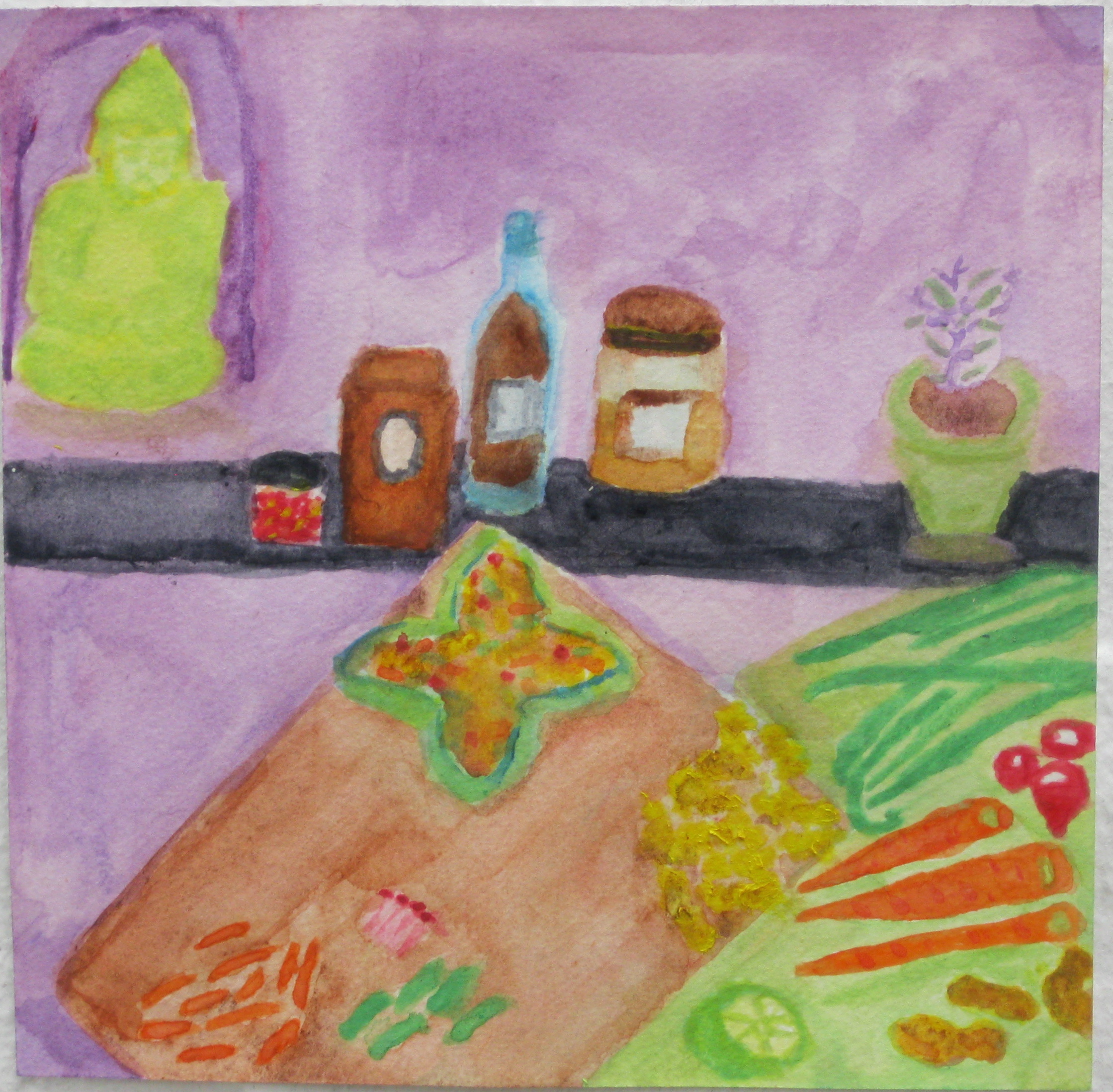
painting depicts ingredients for Romanesco with Gorgonzola Over Pasta recipe

Romanesco. 12″ x 12″ gouache and watercolor pencil. Sharyn Dimmick

This week’s farm box included romanesco. Romanesco looks like cauliflower invented by Martians: it has points, spirals, triangular formations and it is often a stunning shade of neon green. You may not have eaten it: I would not have eaten it if I had not subscribed to Riverdog Farm in 2007.

Now, I’ll just tell you that I grew up eating cauliflower smothered with cheese sauce. I would have grown up not eating cauliflower smothered with cheese sauce if I could have managed it, but our family had rules, one of which is that you ate everything you were served. I did not make up this rule, but I had to live with it.

Part of my journey as a cook and as an adult has been to revisit foods I did not care for in my childhood. Some of them stay on the “Do not eat” list: avocado and asparagus have not made it to edible, much less pleasurable, and English peas require careful and judicious camouflage. I still will not eat cauliflower in pale orange cheese sauce, but I will eat it with a sauce featuring two of my favorite things: gorgonzola and cumin seeds.

The same farm that brought romanesco into my life brought me the recipe with which to cook it from the RiverNene CSA in England. I modified their ingredients list and then I modified their cooking method: what I have kept are a little butter, the cumin seeds, some milk and some gorgonzola, although not the quantities of each that I first saw. To get the most out of the creamy, cheesy sauce I like to serve it with pasta. I like whole wheat penne because the darker-colored pasta looks nice with the pale vegetable and sauce and has a nice chewy texture. That said, you could serve it on spinach pasta or tomato pasta for some color and you can eat it without pasta if you are counting carbs.

Romanesco with Gorgonzola over Pasta

Put your pasta water on to boil.

Cut or break your romanesco into florets.

Melt a little butter in a saucepan, perhaps 1 or 2 tablespoons

Fry 1 Tbsp cumin seeds in the butter until aromatic.

Stop the cooking by whisking in 2 Tbsp of flour

Then add some milk — start with 1/2 cup and have more at the ready.

Alternate stirring the sauce and breaking up some Gorgonzola to melt into the sauce. The cheese will help thicken the sauce. If it gets too thick, add a little more milk. If it is too thin, cook it down for awhile or add more cheese.

When your pasta water boils, throw in 1/2 pound of whole wheat penne.

After the pasta has cooked for ten minutes, add your broken or chopped romanesco to the pasta water. Cook for one minute and drain, letting the pasta water fall into a serving bowl to preheat it.

Transfer the sauce, pasta and romanesco to your (drained) serving bowl and stir so that everything gets coated with sauce. Eat while it is warm.

Food Notes: If you don’t have romanesco, you can make this with cauliflower, or even broccoli — it just won’t have the Martian atmosphere. Sometimes I add a few snipped sundried tomatoes into the sauce for the bright taste and the flecks of color: it is winter, after all. Regular pasta works, too. Sigh. The original recipe called for 2 Tbsp of brandy — if you are a brandy-swiller, go ahead and add it to the sauce: I’m sure it tastes delightful.

I like to serve this with a winter salad of raw spinach and sliced oranges. Sometimes I dress it with Orange-Sesame Vinaigrette. However, I had recently read about an orange-tahini dressing and wanted to see if I could put one together (I love tahini and January is a big citrus month). I started by juicing one orange, one Eureka lemon and two Meyer lemons. That yielded one half cup of juice, which I poured into my old Good Seasons cruet (Remember those? They are handy for salad dressings that don’t come in packets!) I added 3 Tbsp Tahini. I tasted it. Now what? I had on the counter some olive oil that I had used to cover roasted red bell peppers. The peppers went onto last night’s pizza, but the oil. I measured 2 Tbsp of the roasted red bell pepper oil. Mmm. That gave a nice roasty flavor. Gotta have salt: I put in 1/2 tsp Kosher salt. And garlic: I pressed 1 small clove of garlic. A little sweetness: in went 1 tsp honey. I thought about putting some cumin in it, but I kept it simple this time — there’s cumin in the romanesco sauce after all.

For a little more heft, I kneaded up a batch of black rye bread, basing it on a recipe by Heidi Swanson of 101 Cookbooks. But I left out the carrots and the caraway and threw in a little orange juice and zest. It’s rising now: I’ll report on it on Wednesday (or not, if it is not worth writing about).

It’s still January, so they are still doing citrus recipes over at #citruslove. They are worth checking out if you like citrus or have a seasonal glut of it like we do.

painting of kale salad

Kale Salad. 8″ x8″ gouache and watercolor pencil. Sharyn Dimmick

When I started a blog called “The Kale Chronicles,” I liked the alliteration and I felt like I was perpetually struggling with kale: Riverdog Farm put in my vegetable box frequently and I had found no truly satisfying way to eat it in three years. Then I went to Mabel Dodge Luhan House in New Mexico this November and Jane Garrett served a kale salad. I ate some. Then I went up for seconds. Then I asked for the recipe.

Jane obliged and I have made this salad twice since returning home. Every time I make it, I eat big bowls full of it and I eat it everyday until it is gone. I made it again tonight and just ate a flat soup bowl full of it.

Why do I like it so much? It could be the dressing: Meyer lemon juice, olive oil, garlic, tahini, tamari and a little bit of honey — I might eat that on shoe leather, although I doubt it. I might like it because you blanch the kale before attempting to eat it. I just like it.

I’ll give you Jane’s version as she wrote it and then I’ll explain how and why I altered it.

Jane Garrett’s Kale Salad

Blanch two bunches of kale*.

Add what you like: grated carrots, radishes, dried cherries, almonds, red potatoes, feta, mint.

Toss with the following dressing:

1/2 cup lemon juice with zest

1/3 cup olive oil

2 Tbsp tahini

2 Tbsp Braggs’  OR 1 Tbsp tamari

3 cloves garlic (I pressed mine)

1/4 tsp agave OR  1/4 tsp honey

*If you are going to eat kale, you need to remove the stems and ribs. Jane didn’t tell you this because she thinks everyone knows it. So, before you blanch the kale, remove the stems and ribs and compost them.

My alterations: I don’t have any Braggs’, which I believe is Braggs’ amino acid, or some such thing, and I haven’t been inclined to go out and get any. I deduced that it was contributing the salty flavor, so I substituted 1 Tbsp tamari for the 2 Tbsp of Braggs’. I used Meyer lemons because we have them growing in our front yard — they are sweeter and less sharp than Eureka lemons, the ones you usually find in the supermarket. I used 1/4 tsp honey for the agave because, once again, I don’t keep agave in the house — I don’t object to it or its flavor — it’s just not something I have around the house. Lastly, I don’t measure my olive oil: take Jane’s measurement if you want to be precise — I just dress the kale with some olive oil, mix together the other ingredients and toss the salad.

I haven’t been adventuresome in mixing things into this yet because I actually like the taste of the kale smothered in this dressing. I did put in half a handful of dried sour cherries tonight, but I couldn’t really taste them — the dressing is pretty powerful.

What I hope is that this salad helps some of you eat kale who have found it hard to enjoy in other preparations, especially those of you who are at your wits’ end when kale shows up in your farm box (Someone removed a bunch of kale from his box today and set it on top of the stack for someone else to take home!). It works for me.

Now, the award: Jen aka Zestybeandog kindly awarded me The Versatile Blogger Award. This pleases me because 1) Who doesn’t like an award and some recognition 2) Versatility in the kitchen is one of the hallmarks of my cooking style and 3) I get to pass the award on to several other bloggers whose blogs I enjoy. I am also to reveal seven things about myself

1) I love to sing. I sang in school choirs and church choirs. I have one CD, “Paris,” featuring traditional ballads, original songs and covers.

2) I started a ballad-singing group in Berkeley many years ago. It’s still going.

3) Besides painting food subjects I like to paint flowers, song illustrations and occasional landscapes. Animal portraits have been creeping in lately…

4) I used to work as a Recreation Leader in a program that brought together children with disabilities and able-bodied, neurotypical children.

5) I used to be a psychotherapist (MFT)

6) I love open-water swimming and swim in the Berkeley Marina, weather-permitting, from May through October.

7) I sell paintings. Just thought I’d throw that in because I do sell my original watercolors. I am happy to sell them. I am working on developing related products, including cards, trivets, canvas bags, etc. with images from “The Kale Chronicles.” If you want something, please ask.

Where to start? I have just been in the blogosphere for a little over four months, In that time I have come to enjoy the following blogs:

Bitsandbreadcrumbs by Betsy — Betsy cooks stuff I want to cook myself.

Kitchen Inspirations by Eva Taylor. Can’t tell you why exactly — that’s the nature of inspiration — I just like Eva’s blog.

Angry Cherry — the baking blog with personality and many original ideas. She makes things I want to try someday.

JustaSmidgen — lovely photos and some stunning recipes: malted milk meringues anybody? Or pomegranate salad?

From the Bartolini Kitchens — John chronicles his family’s Italian recipes, tells great stories and is one of the kindest people in the blogosphere that I have run across

Lauren is baking her way around the world, making things from every country she can think of. She is particularly honest, which makes her fun to read.

Linda, at Savoring Every Bite makes lovely cheesecakes, attends to decor as much as to food, is generous with her comments and posts a variety of recipes. Pumpkin fans must subscribe to her blog in the fall.

Bewitching Kitchen. Sally has a not-so-secret love of baking bread. In this, we are sisters. She just posted a wonderful-sounding caramelized carrot soup.

SmittenKitchen. This is a big, well-known blog. You may already read it. If you don’t, go there now: Deb has it all: recipes, photos, stories.

As you can see, those are food blogs.

I also read art blogs, or art and food blogs.

The first art and food blog I found was Jane Robinson’s Art Epicurean. Jane paints lovely abstracts and publishes a wide variety of recipes

My latest food and art blog discovery is The Hungry Artist by Melissa. I look forward to seeing more of her work (she just posted some wonderfully-shaped fig cookies on FoodBuzz)

And, somewhere in between, I found Dichotomyof. She makes colorful patchwork cushions, raises children and cooks, too.

For pure art (without food), go to

Bees ATC. Nancy posts a drawing everyday around midnight central time. They are usually colored pencil drawings.

Saltworkstudio: Suzanne has developed quite a following for her abstract acrylic work and collages. She teaches in Sonoma County, but she has gone to Rome for the holidays. I’m sure she’ll have stories to tell when she gets back

And, last, but not least, there is Donna Louise, neither a food nor art blog, but a modern serial by a funny, offbeat writer who shall remain nameless for the time being (at the writer’s request).

Painting shows lunch buffet at Mabel Dodge Luhan House, Taos, NM.

Lunch at Mabel’s. 12″ x 12″ Gouache and watercolor pencil. Sharyn Dimmick.

One of ways I become a better cook is to learn from cooks with greater skill and different repertoires than I have: once such cook is Jane Garrett who cooks at Mabel Dodge Luhan House in Taos, New Mexico. On my most recent visit there on a snowy November afternoon Jane served a lunch that struck me as perfect for the season and the weather: marsala mushrooms over polenta served with fresh figs in a balsamic reduction. She accompanied this richness with a simple pan of roasted root vegetables and a lemony salad made of raw baby chard and radicchio. I no longer remember what we ate for dessert because it was the lunch dishes that captivated me.

I begged Jane for the recipes to share with you. She graciously obliged. I brought them home with me. I went out and bought a bottle of dry Marsala. Alas, fresh figs had disappeared from my Farmers’ Market: I bought some dried figs from Trader Joe’s and contented myself with mushrooms from the mushroom vendor. We keep polenta. The Riverdog Farm box yields plenty of leeks. I had all of the spices and herbs on hand.

I made three of the four lunch dishes for dinner tonight (We had no salad ingredients but romaine lettuce).

Because I was using dried figs, I began with the balsamic syrup, using the only balsamic vinegar I had on hand, a blackberry-vanilla blend I couldn’t resist a few years back: the small bottle sat at the back of our cooler cabinet, waiting for a compelling recipe. To make the syrup, combine

1 and 1/2 cups sugar

1/2 cup water

When sugar has dissolved, add

1/2 cup dark balsamic vinegar

1 cinnamon stick

1 piece of star anise

2 black peppercorns

1 allspice berry (I used about 1/2 tsp of ground allspice, being out of fresh)

rind of one orange, with juice (again, I faked it here, substituting some candied orange peel)

a few branches of dried thyme.

Jane says to simmer this for five minutes: since I was using dried figs I popped them into the syrup and let them simmer at very low heat while I cooked everything else.

I should have prepared the roasted vegetables next, but I chose to wipe about 3/4 of a pound of brown mushrooms first and clean 1 leek.

I sliced the leek into thin rings, put them through two changes of water, and skimmed them off to saute them in a skillet with olive oil and butter. While they cooked, I sliced the mushrooms, tossing any broken pieces into a stock pot with the trimmings from the leeks for vegetable stock.

When the leeks were browned, I transferred most of them into a bowl, added more oil and butter to the skillet and sauteed my mushrooms in two batches. I put one batch in with the leeks and left the other in the skillet on low heat. I splashed in some marsala and it all evaporated, so I waited and then added some more (Jane says to add it to taste and then thicken your sauce with cornstarch and vegetable stock). Then I put the other mushrooms back into it with just a few of the sauteed leeks and set the skillet aside so that I could prepare the vegetables I should have done earlier.

The vegetable compartment yielded parsnips, rutabaga and turnips. I peeled them, cut them bite-sized, more or less, poured a little olive oil in the palm of my hand and rubbed the vegetables with that on a sheet of foil in a roasting pan. I seasoned them with only a little black pepper — the other components are highly seasoned and I wanted the vegetables to contrast with the other elements. I put the parsnip tops and tails into my stock pot. As an afterthought I cut open a delicata squash and scooped  the innards into my stock pot, added water and a few branches of thyme and started simmering the stock. I put the squash cut side down in a loaf pan I had rubbed with oil and put all of the vegetables into a 375-degree oven.

Then I made polenta: 1 cup of polenta to 4 cups of water and 1 tsp salt. Bring to a boil, stir regularly, and cook until thick.

All this time, my figs were simmering and my stock boiling, then simmering.

When the vegetables were almost done, I pulled them out of the oven and nuked them for two minutes in the microwave with a quarter cup of the unfinished stock — I did this because the rutabaga had been large and tough.

Then I heated up the mushrooms, made some liquid cornstarch by shaking cornstarch, stock and a bit of marsala in a small jar, scooped in a couple of teaspoons of the fig syrup and cooked the mixture for a few minutes.

Jane mounded her polenta in a serving dish, put the mushrooms on top and the balsamic figs around the sides. I kept the figs separate and instructed Mom to dish herself a pile of polenta, top it with mushrooms and eat the figs on the side if she wanted any. She did.

We both agreed that this dish would be better with the fresh figs that Jane had used, but it is the other end of November from when Jane made it — if you live in the Southern hemisphere, please make this with fresh figs, as I will earlier next fall. On the other hand, the balsamic syrup has a future on bowls of oatmeal and coffee ice cream, maybe on polenta pancakes!

Food Notes: Use fresh figs in this dish if they are available. Use any roastable vegetables you have on hand: carrots would be good, sweet potatoes, celery root. Use any kind of mushrooms you like, or a mixture of varieties. The Kensington Wine Shop says to buy “the good stuff,” dry marsala from Italy — apparently we don’t know how to make good marsala in California yet. Serve this with an acidic green salad if you possibly can — it takes the meal up a notch — but if you are fresh out of salad makings, make it anyway. You won’t be sorry. And if you get to Mabel’s, stop in and say “Hi” to Jane.

P.S. There was a little polenta left after the mushrooms were gone. This morning I mixed in an egg, some flour, some milk, a little sugar, 1 tsp of baking powder and a bit of vanilla and had some polenta pancake batter — apparently, I know how to do this without a recipe now. I ate the pancakes with some of the fig syrup — delicious!

painting of Oregon farm yard in October

Oregon Farm Yard 8″ x 8″ watercolor pencil. Sharyn Dimmick

When I was in Oregon visiting my friend Carol F. I ate like a truck driver, a stevedore. The weather was cooler and Carol’s husband Spike cooked up thick burgers on the grill — with Safeway meat, mind you — and I ate them for three days straight: hot for dinner and cold for the next two lunches with tapenade and homemade bread-and- butter pickles and fresh tomato slices. When I wasn’t eating burgers I was eating egg and potato frittata with green chile and bacon and cheese. Seriously. Except for Sunday night when we went out and I ate a chile relleno and refried beans and chips and green salsa and a fish-bowl-sized margarita on the rocks with salt. Fortunately, I took a few strolls around the yard, inspecting the vegetables and apples and grapes and berries, went up and down the stairs several times and walked way out of my way at the convention center to get a latte from the evil Starbucks (the only decent coffee option there). Monday night we had rainbow chard and baked delicata squash and grilled chicken, but I had a small dish of boysenberry apple crisp for dessert and before dinner a neighbor brought us a warm loaf of whole-grain bread with molasses, corn meal, wheat and I don’t know what-all else and I ate that with Carol’s homemade boysenberry jam. Plus, I foraged that afternoon while I was in the yard, eating raspberries and boysenberries off the vines and blue-purple grapes.

painting of kitchen

Spike’s Kitchen 8″ x 8″ watercolor pencil. Sharyn Dimmick

And when we weren’t eating we were talking about food: Spike makes Shaker lemon pie and gingersnaps and biscuits and pumpkin pie with bourbon, any of which I would be happy to eat at least once. Saturday breakfast was a tough call: I was given a choice between green chile frittata and pancakes with homemade boysenberry syrup. Which would you choose? My addiction to green chile won out, but part of me mourns the pancakes I didn’t eat.

We talked about our food likes and dislikes. Spike drinks gin and the only white thing I will drink besides milk is tequila. He likes bourbon. I like Scotch, Laphroaig single malt Scotch, to be precise, and Jameson’s Irish Whiskey, with or without the cream and sugar and coffee, and dark rum and good-quality brandy. Not that I consume any of those things often, but I like them all. We both like hot sauce and various chile pepper and fruit combinations.

My excuse to visit Carol and Spike was the Wordstock literary festival. When I was there I took a break from food projects and listened to a lot of people read from their new books, but I did pick up a copy of A Homemade Life by Orangette‘s Molly Wizenberg and I have to say it is a charming book, full of things I will cook and a few things I won’t. The writing is lovely.

painting of kitchen interior

Carol’s Kitchen 8″ x 8″ watercolor pencil. Sharyn Dimmick

When Carol cooked the chard on Monday night she started with garlic, oil and washed and trimmed chard. We talked about eating it with vinegar, but she had some green olive tapenade with sun-dried tomatoes and wondered if it might be good. I said yes. I thought I was going to eat it just like that and then Spike said it would be good with Cholula. I had never heard of Cholula, a Mexican hot sauce from Jalisco, which apparently can be got at Safeway — look for the glass bottle with the wooden stopper. I put three large drops on my plate next to the greens.

It was delicious. The next time I get to Safeway I am buying myself a bottle of Cholula for eating with cooked greens.

Now, tapenade. Tapenade is not something I tend to have on hand unless it has been recently featured at Grocery Outlet, but I usually have Spanish olives and kalamatas. I dry my own tomatoes during tomato season and don’t usually run out until about March. So I imagine what I will do is finely chop some Spanish olives and leave some dried tomatoes to soak with them for a bit while I wash and chop my chard,

Without further ado, another stellar greens recipe,

Wash 1 bunch chard (or beet greens or turnip greens or spinach — you get the idea, don’t you?)

Trim stem ends and separate leaves from stems.

Chop the stems first while you heat a little olive oil in a skillet (You’ll need a lid later). Then chop the leaves into ribbons.

To the oil, add the chopped stems and some minced or pressed garlic to taste (I can’t tell you how much garlic Carol used. I wasn’t paying attention — two cloves? Three? Four? You know if you like garlic or not — trust yourself).

After a minute or two,  add the chard ribbons to the skillet with any water clinging to them and put a lid on it. Cook until done — maybe three to five minutes.

Add 2 Tbsp green olive tapenade or chopped green olives mixed with sun-dried tomatoes.

Serve with Cholula or your favorite bottled pepper sauce.

How good was this chard? After I had firsts, I went back to the kitchen to get a little more and had to scrape the pan to get a tablespoonful. How nice that chard is in season. How wonderful that you can use other greens for this recipe. Enjoy.

Paintings Note: I decided not to paint chard so soon after painting beet greens, so instead I offer you one partly imaginary view of Spike and Carol’s yard and two partly imaginary views of their kitchen. Many of the objects and animals depicted are real, but I used artistic license. Spike would like you to know that the black chicken on the hay bale is named “Batman” — at least that’s what he told me.

If you want some of Spike’s or Carol’s recipes, make some noise in the Comment section and I’ll bug Carol to write you a blog post. I’ll be eating lots of greens with cumin and greens with tapenade because today I got beet greens, arugula and Russian kale!

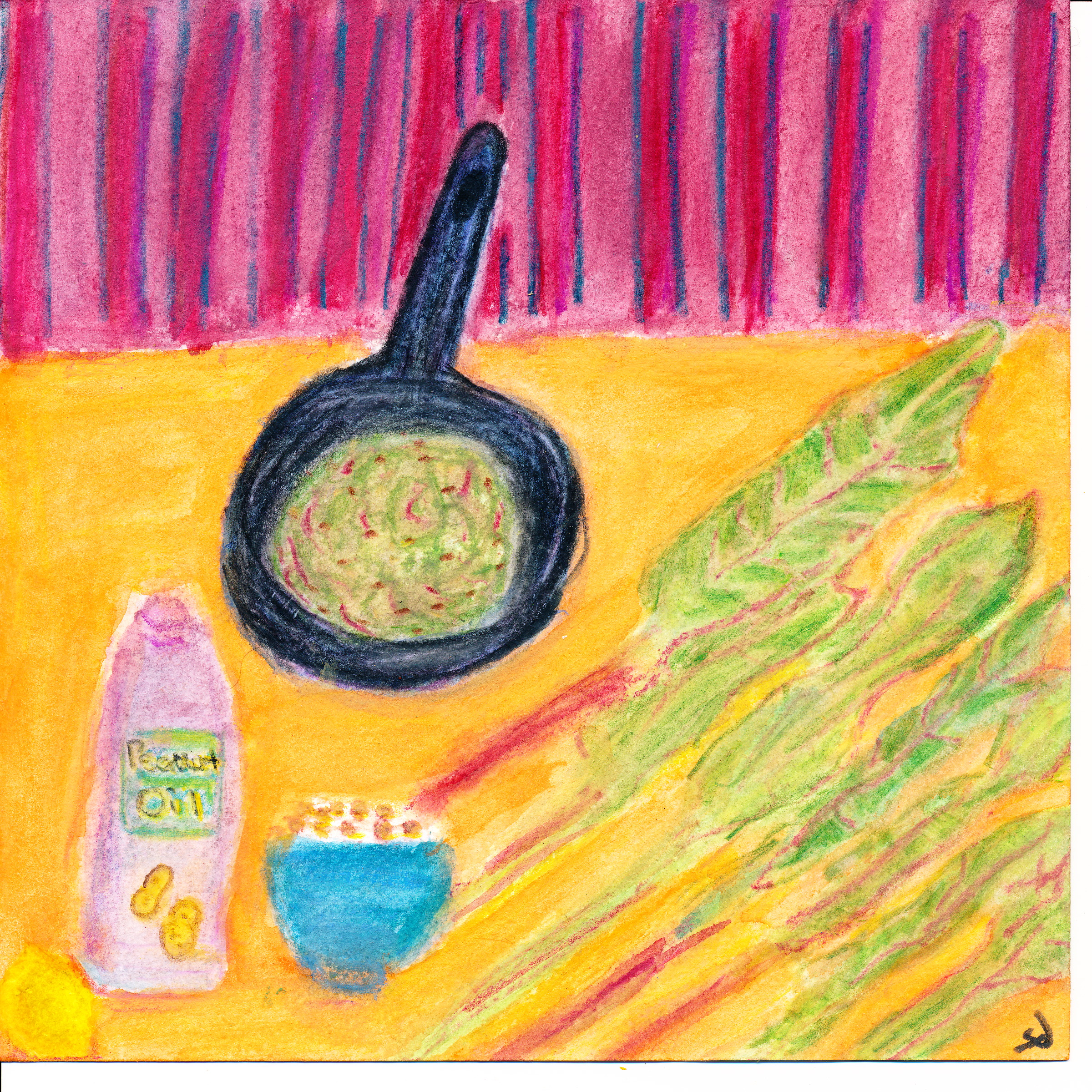
Painting of beet greens, cumin seeds, peanut oil.

Beet Greens with Cumin 8″x8″ gouache and watercolor pencil. Sharyn DImmick

Wednesday I was reminded of why I like to eat fresh and seasonal food. Wednesday is vegetable box day for me and I went down to Berkeley in the rain to pick up my vegetables. Among the other things I got were bunches of turnips and beets with their greens attached. I twisted the greens free and bagged them separately since I have been told that otherwise the greens draw nutrition from the roots. I knew I was going to cook some kind of oven dinner — I had leftover delicata squash to eat, for one thing. On the way home I decided we would eat mixed turnip and beet greens tonight to get them at their freshest and most nutritious. I also decided to cook the beets, remembering a wonderful sauce in my Joyce Goldstein Kitchen Conversations cookbook made from butter, honey, dry mustard, cinnamon and black pepper.

I consulted Mom about what else we could have. She suggested baking two large red potatoes and serving them with sour cream. Fine. We would have squash with brown sugar and butter, the potatoes, beets in a hot and sweet sauce. I would put in a rice pudding for a high protein dessert so that we did not get hungry after all those vegetables for dinner, utilizing some cooked brown rice we already had.

That left the greens. Because two of the vegetables had a sweet profile I knew the greens needed to be savory, so I discarded the idea of making them with raisins and walnuts  or with peanut sauce: these would have to be greens as greens. As I chopped the beet and turnip stems I suddenly thought, “What if I cook them with roasted cumin seeds?” Maybe that would tame the bitterness.

I pricked the potatoes and put them in a 350 oven with the whole kabocha squash (the farm newsletter recommended roasting it whole before splitting it open to remove the seeds and strings) and a Pyrex bowl of brown rice pudding, made with raisins, milk, sugar, a couple of eggs and enough butter to keep it from sticking. Then I peeled beets and put them in a saucepan on the stove (the oven was crowded, due to the giant squash, or I could have roasted them). While they cooked I made Goldstein’s marvelous sauce.

Then I got out the peanut oil and filmed a hot skillet with just a touch (under a tablespoon). After a minute, I added a couple teaspoonfuls of cumin seeds and let them pop before bringing the skillet to my cutting board for the beet and turnip stems. While they began to cook over medium heat I chopped the greens and put them into the skillet with all of the water that clung to them and popped a lid on. When they were done, I assembled a plate of one potato, half a delicata squash, one beet and a large serving of greens, to which I added a small squeeze of Meyer lemon.

I am happy to report that these were the best greens I ever tasted. The cumin worked its magic, giving off its fragrance and mellowing the greens’ strong flavors. If you are not a greens lover but are fond of cumin, I urge you to try it. It is beyond simple and yet the results are sublime. Yes, I did say sublime — the acid test will be tomorrow when I see how they are reheated.* There’s got to be something to eating your greens the day they are picked — but the cumin didn’t hurt either.

Non-Recipe Greens Recipe: Greens with Cumin Seeds

Wash whatever greens you’ve got — I used turnip and beet greens.

Separate stems from leaves.

Chop stems into small pieces. Chop greens separately.

Heat a skillet over medium high heat.

Add 2 tsp to 1 Tablespoon of peanut oil, depending on your oil tolerance.

When oil shimmers, add 2 tsp cumin seeds and let them pop.

Remove skillet from heat long enough to add chopped stems.

Return skillet to heat. Add chopped greens.

Cover and cook over medium heat to desired done-ness — I cook them until the liquid has evaporated — about five minutes.

Add a squeeze of lemon and eat while hot.

* I ate the leftover greens for dinner Thursday night. They were still wonderful, tasting of cumin.

P.S Forgot to say: I’m heading up to Portland for a long weekend and I, unlike most modern people, have no mobile devices. This may cause a delay in my approving comments, but I want to hear from you and I’ll approve them all when I get back. — Sharyn

Painting Note: For information about Beet Greens with Cumin or any other painting, please contact me here.

When I saw the list of vegetables from Riverdog Farm today I knew what I would be cooking soon: it is what I cook when zucchini first swings into season, along with corn and the first tomatoes — pancakes made of grated zucchini and fresh corn, bound with egg and a little flour, seasoned with fresh herbs, fried in butter and olive oil and topped with halved cherry tomatoes and a spoonful of sour cream. Can you say summer? Even late summer, as it turns out., or early fall. The seasons are wacko in California this year, with long spring rains and chilly weather, so all of our crops are later than usual.

Painting of Zucchini-Feta Pancakes and ingredients.

Zucchini-Feta Pancakes with Fresh Corn. 8″ x 8″ gouache and watercolor pencil. Sharyn Dimmick.

I first saw a recipe like this in Mollie Katzen’s Moosewood cookbook. As a non-lover of zucchini, I immediately saw the camouflage possibilities (My other go-to zucchini recipe is gingerbread muffins with grated zucchini). The first time I made it, I made it by the book. The next time I added fresh corn kernels and began topping it with tomatoes and sour cream, I love feta cheese — it is one of the cheeses I prefer to keep on hand, along with Parmesan, extra sharp cheddar and Gorgonzola — if I could only have four cheeses, those would be the four.

Why don’t I like zucchini? Does anybody care? I find the skin is often bitter and the flesh either bitter or insipid. I’m always disappointed when some Chinese restaurant fills their kung pau chicken with zucchini. I grew up eating zucchini baked in tomato sauce and topped with cheese and didn’t like that much either, but I am happy to make these pancakes whenever zucchini appears in the veggie box.

Here goes:

Zucchini-Feta Pancakes with Fresh Corn and Cherry Tomatoes

Grate 4 cups of zucchini. Salt it lightly and leave to drain in a colander for fifteen minutes.

While zucchini drains, separate 4 eggs, yolks into large bowl, whites into a small one.

Beat the egg whites until opaque and fluffy.

Add to egg yolks:

1 cup crumbled feta cheese (You can buy a block and crumble it with a fork or your fingers)

1/3 cup whole wheat pastry flour

chopped fresh herbs to taste — I like mint and dill. Basil is also good, or chives if you like an onion-y presence.

drained zucchini

kernels cut from 2 or 3 ears of fresh corn.

Fold in reserved egg whites.

Heat a skillet over medium-low heat. Fry cakes in a mixture of butter and olive oil (I usually scoop 1/4 to 1/3 cup of batter out with a measuring cup for each pancake).

Serve with halved fresh cherry tomatoes and a spoonful of sour cream or yogurt, or top with applesauce for a latke nouveau.

Notes: I often make just half a recipe, using two eggs and two cups of zucchini. And you don’t have to have zucchini — you can make this with crookneck squash, patty pan, or whatever summer squash comes your way, including mixtures of varieties.

If you don’t like feta, improvise with some soft cheese that you do like.

I haven’t tried this with grated winter squash or sweet potatoes yet, but it’s only a matter of time: you could even use summer and winter squash together as their seasons cross if you like both of them. And, of course, you can grate other things into them, but this is the way I like them.

Painting Note: I just updated the About page to include some notes on my painting media and process. If you are curious about the paintings, take a look. For information about “Zucchini-Feta Pancakes” or any other original painting please contact me here.

painting depicts ingredients for pasta with peanut sauce

Thai Pasta with Peanut Sauce 8″x8″ gouache on paper Sharyn Dimmick

The other day I started to think about what I had in common with kale:

1) I am not always sweet — sometimes I am quite bitter.

2) I am not to everybody’s taste: a little of me can go a long way.

3) I am rough around the edges

4) I am somewhat green.

5) I am tough.

Some people like kale in its raw state. Others like it lightly steamed or sauteed in minimalist preparations. For me to enjoy kale, it requires tender care and the presence of other ingredients that I like. Kale will never make the top of my favorite foods list, so I often resort to what I call camouflage cooking, a technique known to mothers everywhere, where you bury a vegetable in so many other flavors that it no longer calls attention to itself. You still get the nutritional value of the mean green vegetable which is very good for you: what you eliminate is what my Dad called “that nasty vitamin taste.”

Two weeks ago I met my friend Cathy at the Farmers’ Market in Berkeley and we began to discuss kale. She told me that she cooks it in a little oil with a little water and throws in walnuts and raisins at the end of the cooking. The raisins sweeten the kale, ameliorating the bitterness and the walnuts add richness and give the bitterness a different edge: it is like forgoing outright cruelty and making use of well-placed sarcasm instead.

Another way to camouflage kale is to turn up the heat: I have chopped kale leaves finely, after removing the ribs and stems, and thrown them into posole — hominy cooked with chiles or salsa, in chicken broth or pork stock, seasoned with lime. Canned Foods Grocery Outlet, Food Maxx and Mexican groceries sell posole in number ten cans: I usually open one, decant half of it into a big jar for the freezer, and throw the other half in a pot. I like to make posole with about half a jar of green salsa (maybe twelve ounces), a pint of chicken stock and the juice of one lime. If I want a sweeter flavor, I add chopped sundried tomatoes to it. The longer you cook the posole the better the kale blends with the other ingredients, melting into harmonious flavor.

The big guns of camouflage cooking with kale are peanut sauce and coconut milk. If you like peanut sauce, you know you can eat it on anything because what you will taste is peanut sauce. I make an instant peanut sauce that I eat on pasta in the following manner:

Put your pasta water on to boil. I like to use short pastas because they catch the peanut sauce (penne, fusilli, farfalle, — also known as twisties and butterflies). I usually use wheat pasta, but you can go authentic and use rice noodles if you want. Get out the bowl in which you plan to eat your pasta. Put into that bowl between two and three tablespoons of peanut butter (Please use natural peanut butter without added shortening). Squeeze one lime into the peanut butter. Add something hot — my favorite addition is Chinese chili paste with garlic, a teaspoon if you like heat, a quarter to an eighth teaspoon for just a hint. Get down your fish sauce or tamari and add a tablespoon. You now have hot, sour, peanut-y and salty. Add some brown sugar: start with a teaspoon and trade up — this will be a matter of taste and opinion about how much sugar you want to consume. We like it sweet. If you want it even sweeter, add some coconut milk from a can — a few tablespoons should be sufficient. To get it right for you, you will have to stir and taste the raw sauce. It isn’t going to hurt you — just don’t eat it all in the tasting phase or you may have to start over.

Before it is time to drain the pasta, I have usually had enough time to julienne some carrots and/or radishes, chop some broccoli or green beans or cucumber. Carrots, radishes and cucumber go directly into your bowl with the peanut sauce. Broccoli or green beans go into the pasta water for the last minute of cooking, after which you drain the pasta and vegetable and add it directly to your pasta bowl. Garnish with basil, Thai basil, cilantro, or chopped fresh mint. Toss madly.

I developed this recipe when I lived and cooked alone. It is an ideal one-person pasta. If I make it for two, I generally stir up two individual bowls of sauce. If I want to make a lot, I start with a big serving bowl rather than individual bowls, use larger amounts of sauce ingredients and might pop it in the microwave for a minute to make sure the peanut butter softens. If you like, make extra: it reheats well if you leave out the cucumber, or it can be eaten cold.

Thai Pasta with Peanut Sauce:

Boil water for one serving of pasta

While water comes to a boil, stir together in pasta bowl:

2 Tbsp peanut butter

1 Tbsp fish sauce

Juice of 1 lime

1 tsp chili paste with garlic

1 Tbsp brown sugar (or more or less to taste)

Julienne 1 carrot and/or three radishes. Chop some cucumber if you want. Add vegetables to bowl of sauce. By now, your pasta water should be ready. Start cooking pasta.

Cut up some broccoli or green beans. Add to pasta water in last minute of cooking.

Drain pasta and vegetables and add to sauce in bowl. Garnish with basil, Thai basil, cilantro or fresh mint. Stir it thoroughly with your fork. Enjoy.

Painting Note: For information about “Thai Pasta with Peanut Sauce” or any other original painting, please contact me here.

Painting depicts ingredients for recipe polenta with peaches

Summer Breakfast. 8″x8″ gouache and watercolor pencil Sharyn Dimmick

My mother went to Reno for a few days, leaving me in the house with our three cats, so I had three days to observe how I cooked for myself while she was gone. When I lived alone I developed a fondness for one-bowl cooking, complete meals that fit in a single bowl. Friday morning I made one of my favorite summer breakfasts, polenta cooked in milk, seasoned with vanilla extract and stirred into a bowl of diced peaches. It was so good that I made it again on Saturday — in fact, it is what I eat for breakfast any time we have fresh peaches in the house, usually from late May through early October.

The secret to this recipe is a fresh, tree-ripened peach. I buy most of my peaches from Frog Hollow Farm at the Berkeley Farmers’ Market. In formerly flush years I would buy them by the flat and we would eat peach waffles, peach bread pudding, peach cobbler. I would freeze peach puree to make waffles in the winter or spring. Now I buy them a few at a time: I bought four last Saturday, two Cal Reds and two O’Henry’s, enough for four breakfasts.

The other secret is cooking polenta in milk, which makes it lovely and creamy. I began cooking grains in milk when I broke my first bone five years ago, started cooking oatmeal in a cup of milk to make sure I would get daily calcium in the food I ate.

To make this dish, go out and pick a peach from your tree or buy a soft, sweet peach from your farmers’ market. Slice it and then chop the slices into smaller chunks. Put this into your cereal bowl. Then film the bottom of a saucepan with a little water, add a cup of milk, a dash of salt and a quarter-cup of polenta. Cook over medium high heat until it starts to bubble, then reduce heat to a simmer until it thickens enough to your liking. It’s a good idea to stir it frequently so that it won’t stick to the pan. When it’s done, remove it from the heat and stir in a capful of vanilla extract. Pour it over your peaches in your bowl, stir and dig in. The polenta warms the peaches. The juice from the peach sweetens the polenta. The yellows and oranges look like summer in a bowl.

 Depicts ingredients for whole wheat pasta with cilantro pesto and green beans

Cilantro Pesto with Green Beans. 8″x8″ gouache and watercolor pencil Sharyn DImmick

At lunch-time on Friday, I looked at the cilantro that I had bought a week before and stuck in a glass on the counter — I needed to use it. Cutting off the stems, I broke each leaf from its stem and tossed it into my blender. I went out and picked a Meyer lemon from the front yard, cut it, and squeezed it into the cilantro. I diced a red onion and minced half a clove of garlic. I added some chopped walnuts from our freezer (new crop has not come in yet). I moistened the mixture with some olive oil and started blending it while I got out some rinds of Parmesan, which I grated with my microplane. You can get a microplane, otherwise known as a rasp, at any hardware store — don’t bother with expensive versions from cooking stores: it is the best tool I know for grating hard cheeses and zesting citrus. I gave the blender a stir and added the cheese and a tiny pinch of salt.

Pesto done, I put on some water to boil and got down a package of whole wheat penne, taking out about a quarter pound (four ounces). While the water heated, I topped and tailed a large handful of fresh green beans and snapped them in half. I cooked the pasta for seven minutes or so, then added the green beans to the pasta water, cooking them for one minute more. I drained the pasta, scooped some cilantro pesto into a pasta bowl and stirred like mad to distribute it. It made a little more than I could eat — measurement is not my forte when I am not following a recipe — so I had a small serving leftover for Saturday’s lunch, which I ate cold — equally delicious. The lemon and onion in the pesto and the bitterness of the walnuts play off the sweetness of the green beans and whole wheat.

For dinner, I ate leftover Greek salad on Thursday and made a sandwich of leftover roasted pork loin with leftover apple coleslaw on Friday

Whole Wheat Pasta with Cilantro Pesto:

Combine in jar of blender for pesto

1 bunch cilantro, stems removed.
1 lemon or lime, zested, than juiced or squeezed
1 small red onion
1/2 clove garlic
2 Tbsp freshly grated Parmesan cheese
Olive oil to moisten

Salt to taste

3 to 4 oz whole wheat pasta per person.

1 large handful of fresh green beans, trimmed and cut in half.

Blend pesto. Cook pasta until almost done: about a minute out, add green beans to pasta water. Drain pasta and beans into a pasta bowl. Add some pesto and stir or toss to mix. If you have leftover pesto, it will keep in the refrigerator for a week, or you can freeze it.

When Mom got back Saturday afternoon she asked if there was any cooked food on hand. Nope. I told her I had eaten all of the leftovers. We ate bread, cheese, grapes (me) and tomatoes (her).

Painting Note: For more information on “Summer Breakfast” or “Cilantro Pesto with Green Beans” or any other original painting, please contact me here.

original watercolor of kale, tomatoes, onions, pen and ink bottle.

The Kale Chronicles. 8″x8″ watercolor pencil and gouache by Sharyn Dimmick

Few things reliably capture my interest more than messing with food and telling stories, whether in song, in images or on the page. I subscribe to a community-supported agriculture program each week, receiving a box of organically grown fruits and vegetables from Riverdog Farm in Guinda, CA. I began subscribing in 2007 and remember rhapsodizing over the taste of iceberg lettuce, green and fresh, picked that morning.

I also remember that first June when kale showed up in the box. I had never eaten kale. I had never seen kale. My friend Elaine loves it, steams it in the microwave and gets out her fork, but I did not fall in love with minimalist kale. I pored over cookbooks, learning to remove the ribs and stems before cooking it. I tamed it with acids: tomato sauce and lemon, vinegar. I added Indian spices and raisins. I chopped it into red lentil soup with plenty of garlic and fresh ginger (It gave my Mom gas and I had to eat it all myself. Ahem).

I do not hate kale. I have aversions to avocado and asparagus, tuna, mayonnaise, hard-cooked eggs and okra. Instead I consider kale to be a worthy adversary, something to be struggled with and mastered. I strike up conversations about it: “Do you eat kale?” “How do you cook it?” Kale keeps me on the lookout for new preparations, new techniques.

I have eaten red Russian kale, dino kale, curly kale in the last four years. I have combined it with spinach in lasagna. Two weeks ago I made an African peanut soup featuring onions, peanut butter, tomatoes, carrots, sweet potatoes, fresh green beans, garbanzo beans, kale, cilantro and lime. Everything but the peanut butter, lime, garbanzo beans and sweet potatoes came from the farm box — the sweet potatoes came from a farm stand in Suisun near where my sister-in-law lives. The soup was so good that I took it to a music potluck and when they ate it all I made another batch with the last of the ingredients. Here’s to Africa where they know how to cook kale!

African Peanut Soup (adapted from a recipe from yummly.com)

Saute 1 chopped onion, 3 minced garlic cloves, 1 Tbsp fresh ginger, 1 minced chile pepper in 1 Tbsp peanut oil. While that cooks, chop 4 fresh tomatoes. Add 1 Tbsp curry powder to saute mixture and stir to toast it. Add tomatoes, plus 1/2 cup peanut butter, 8 cups water or stock, 1 Tbsp tamari. Stir well and bring to boil.

While the soup cooks, chop 2 carrots and 2 large sweet potatoes. Add them, plus 1 can of garbanzo beans. Cook until tender while stemming and chopping a large handful of green beans and half a bunch of kale. Add green beans. Cook for 10 minutes. Add chopped kale and juice of 1 lime. Cook 10 minutes more. Garnish with chopped cilantro.