Archives for posts with tag: seasonal recipes

When I walked in the door this evening my house smelled like maple. I spent all day rolling, cutting, decorating and baking batches of Smitten Kitchen’s Nutmeg Maple Butter Cookies. I have to say that this cookie is my favorite variation on a classic Christmas sugar cookie. The dough handles perfectly (Is it the egg yolk that keeps it from drying out or getting too stiff?). And they taste fabulous. Deb makes hers austere, but when I make them I tart them up with colored sugar because, you know, when I make them they are Christmas cookies.

Here’s a secret to Dimmick rolled cookies (You may never look at cookies quite the same way again). My mother taught me to use a sequence of cutters: when the dough is untouched, when it has been chilling in the refrigerator and you pull your first quarter or eighth of dough out to roll, you select the cutters you are going to use. I like to start with six-pointed stars and Christmas trees. Then you use only those cutters every time you select a fresh round of dough. When you roll up the scraps and roll them out, you choose entirely different cutters: I chose a flower that I think of as a poinsettia, but could be a Christmas rose. All second-generation dough (aka re-rolls) is cut with this cutter. And if, God forbid, you have a third generation of dough made from twice re-rolled scraps, you choose yet another cutter.

Why do we do this? The first time you roll out dough it has minimal added flour on your work surface. The cookies that you get from a first dough are more tender and flavorful. By the time you are re-rolling dough, you have incorporated the flour that is on your work surface and you usually have to add a bit more flour when you roll it out so that it does not stick, so second and third-generation cookies have more flour in them and the dough gets worked more: both of those things toughen the cookies slightly. The compensation is that the re-rolled dough is usually a bit easier to work with due to the added flour and sometimes you can get the stiffer cookies quite thin. The second generation cookies may look better than the first generation ones, but the first ones taste better. Switching cutters functions as a code. You can say to those in the know, “The poinsettias are re-rolls,” while you make them attractive for others to grab.

My mother favored delicate, thin cookies and I share that preference. I tend to use small, angular cutters with unfussy shapes. My favorite cutters are just an outline of the shape, as opposed to the kind that have a flat top and a sharp cutting edge — cookies tend to get stuck in overly fancy cutters. I don’t make gingerbread men, although I have the cutters to make them.

As I was throwing red sugar onto the maple poinsettias, I realized that I would run out of red sugar before I had baked all of the ginger cookies (which I haven’t started yet). I also saw that I did not have enough powdered sugar to make royal icing for the pfefferneusse — that recipe makes a lot.

When you make cookies hour after hour by yourself, you get into a rhythm. Take a butter wrapper and use it to grease a baking sheet. Set that on the counter. Add flour to your work surface: I use a silicone mat over a marble slab. Pat the dough into a round as you would for pie crust. Flour your rolling pin. Roll out the dough as thinly as possible. I usually end up with one thick end on the top and am running out of room to roll, so I will break the thick part off and set it aside — it is just like new dough because I haven’t finished rolling it.

Choose your cutters and flour them. Place the cutter as close to the edge of the dough as you can. Then place the next cutter as close to the last place you cut as you can. After awhile, you start to see “If I turn the tree cutter right side up here and upside down there” I can cut very close together.” I imagine someone laying out paper patterns on fabric. I don’t think of myself as having strong spacial abilities, but I am good at placing cookie cutters, probably because I’ve done it a lot.

Pop the filled cookie sheet in the refrigerator to chill while you fill the next one. Transfer the chilled sheet to your work table for decorating. When all your trays are full of cut cookies, preheat the oven. Decorate the cookies while it preheats.

As I cut cookies, I move the scraps off to the side of the marble slab — I will gather them up to re-roll later. Mom sometimes made “scrap cookies” of the odd bits of dough between cookies. I prefer to re-roll the scraps and make cookies with recognizable shapes.

Suddenly I remember the family lexicon: members of my immediate family talked about “crap cookies,” not because there was anything wrong with the Christmas cookies we looked forward to all year but because my younger brother couldn’t say esses when he was little. “Scrap cookies” became “crap cookies.”

Before I decorated the last round of poinsettias, my phone rang. My former next door neighbor from Oberlin Avenue who is one hundred years old now was calling to wish me a merry Christmas. I was touched. I asked her if she would be going out to visit her daughter for Christmas. She was, but she wanted to see if I was home first. I told her I was baking cookies, that that had been one of Madge’s specialties and that I still baked them. She said she’d check up on me from time to time and I told her I had never forgotten how she sent us food when my mother was so ill.

While cookies bake, I mix up new batches of colored sugar. I’ve made light green, turquoise, denim blue, orange and an accidental brown — no matter what the package says you cannot make purple sugar with cheap liquid food coloring.

I do not set a timer. When the cookies are ready I will catch their scent wafting through the air. When cookies smell like cookies they are done.

I baked the last tray of cookies, washed my silicone mat and forced myself out of the house for a Safeway run. Safeway was out of red sugar, but I got powdered sugar and a few treats (coffee yogurt and tapioca pudding) and the thyme leaves I have been eying, outrageously priced at nine dollars, but 33% off this week. The walk stretched out my back a little, compressed from all the standing and sitting.

I fed the cat, had dinner myself (bagel, peanut butter, yogurt, raw carrots) and realized I wasn’t up for a second shift. The ginger dough is the hardest one to handle. Stay tuned.

Dear Readers,

In July 2024 I left my beloved California, the state I was born in and resided in most of my life. In early October I moved to a small city in Washington state (I am now hoping for the opportunity to buy a house in another, smaller city).

I am an economic refugee from California. I loved the Golden State and had a large community of friends in the Bay Area and elsewhere, but housing costs were too high even with an expected inheritance, so I moved to the Evergreen State to stay on the West Coast.

I am living in a 700 sq foot furnished rental cottage while I wait for my inheritance. 95% of my belongings are in a local storage facility. I have some winter clothes and three kitchen items of my own: a bamboo cutting board, a Pyrex pie plate and a one-cup liquid measuring cup. All of my cookbooks are in storage.

There are compensations to living here. I live between mountains and water up on a bluff above downtown. When I came here, turning trees greeted me with a fall display. And last weekend I had the pleasure of watching falling snow. The seasons here have neither the mild changes of California nor the severe weather of the upper Midwest.

For decades, I have been an habitué of farmers markets where the available food (and sometimes the vendors) changes with the seasons. I like to eat what is fresh, local and plentiful.

I also love to eat salads. My favorite salads are big bowls of crunchy romaine and Greek salads full of tomatoes, peppers, cucumbers, Kalamata olives and feta cheese. None of these things are local and available, although fresh corn lasted here well into October. So I’m getting really good at figuring out how to make delicious cold weather salads.

In fall I ate salads of radicchio, chopped dates and feta dressed with blood orange oil and lime juice, inspired by this recipe from Smitten Kitchen: https://smittenkitchen.com/2015/11/date-feta-and-red-cabbage-salad/ When spinach and mixed baby greens made brief appearances in December I bought bags of them each week and mixed them with chopped oranges, nuts, and a strong, garlicky red wine vinaigrette. When I lived in California I got bored with citrus. Here, I crave it, so I watch for specials on limes, lemons and oranges and incorporate them in salads or salad dressings. I bought a bottle of blood orange olive oil on my first local expedition in October: it is delicious and a little imparts a lot of flavor (Turns out the oil, which I bought from a vendor here, comes from California….).

When spinach and baby greens disappeared, I bought kale. Now the reason that I called my blog The Kale Chronicles wasn’t because I love kale, but because I am challenged by it. Last week I chopped the kale finely, mixed it with said blood orange oil and said vinaigrette, which consists of red wine vinegar, minced garlic, salt, black pepper and prepared mustard (I use the cheap, bright yellow stuff because I like sharp flavors). I let the kale sit overnight in the refrigerator before adding radishes, oranges and roasted almonds. It still tasted like kale, but a mellower, acceptable kale. This is a raw kale salad: if you want a cooked one, go here :https://thekalechronicles.com/2011/12/21/kale-conquered-the-kale-salad-i-love-and-the-versatile-blogging-award/

I was going to try marinating chopped kale in lemon juice and garlic, but today’s farmers had no kale: the only green vegetable available was Brussels sprouts.

Here’s what I did:

I removed the stem ends and sliced the sprouts finely into a large glass bowl. I added a tiny drizzle of olive oil (I’m running low) and the juice of half a lemon and tossed that mixture with my hands. Then I added two handfuls of dried cranberries. I slivered a Granny Smith apple from the refrigerator and re-tossed the salad. Then I added a dollop of yellow mustard and a sprinkling of chopped, roasted cashews and tossed the salad one final time. Then I dished myself a big bowl while I reheated a bowl of chili.

I could not stop eating this salad: I ate a full bowl and half a bowl more, resolutely putting the rest away for future meals. One thing about winter salads is that, like stews and soups, they keep well, and the flavors improve with time.

My take on constructing salads of strongly-flavored vegetables is to dress them first and let them absorb dressing before you add other ingredients. Add flavorful ingredients: I like dried fruit, citrus and nuts in winter salads, and sometimes feta cheese, but also pomegranate arils. If you skew more savory, you could add anchovies, olives, or Parmesan and skip the fruit — I won’t tell.

I’m not back in the habit of painting yet, although I painted during my travels in late summer and early fall, but these salads are colorful. If I do resume painting I’ll add illustrations to this post later.

Thanks for reading. And happy salad-making with whatever your market offers.

So, you know I’ve been on a “Work With What You Got” kick for October at The Kale Chronicles. You know that I have been eating rye flakes, rolled oats and granola cooked with dried apples and milk, and then with Tropical Traditions Coconut Oil and peanut butter: when we ran out of peanut butter I substituted cashew butter and somehow breakfast keeps rolling along. So does dinner: Mom bought some black cod at Trader Joe’s on Wednesday and with Johnny coming over for dinner on Friday night (Yay!) I prepared the fish by baking it in a foil packet (similar to the baked salmon I made here) with roasted red bell peppers and kalamata olives from jars, fresh basil from the basil plant on the breakfast room table and a squeeze of Meyer lemon from our front yard tree. I made another round of my version of Shira’s Brussels sprout salad with toasted hazelnuts and dried cranberries, put some red potatoes in the oven to bake with the fish and spent some time in the kitchen with my mother concocting a family favorite dessert, a baked lemon pudding.

Original watercolor painting shows baked lemon pudding and ingredients.

Lemon Pudding. 8″ x 8″ Gouache and Watercolor Pencil on Paper, Sharyn Dimmick.

The lemon pudding began, as things often do at our house, with substitutions: the classic recipe, culled from an index card in one of my mother’s recipe files calls for Wheaties (“Breakfast of Champions”) cereal in the topping. Mom’s search of our high storage cupboards revealed that the orange boxes she thought contained Wheaties were in fact Bran Flakes. Oh. She decided to combine Bran Flakes and Corn Flakes to approximate the missing Wheaties.

I went out to the yard to gather lemons from the tree, bringing in four of the ripest ones I could reach. I asked Mom about quantity. She said, “The recipe calls for the juice of two lemons, but these are bland — maybe add an extra one.”

I zested and juiced three lemons, squeezing each half through my hand. This resulted in just a quarter-cup of juice.

“That’s only a quarter-cup,” I said.

“Maybe do the other one,” she replied.

I juiced the fourth lemon, but did not zest it, mainly because I had absentmindedly cut it in half to squeeze instead of picking up the microplane. Life is imperfect and I one of its imperfect creatures.

I reminded Mom that the topping for this pudding is usually tooth-ache-ingly sweet. I was working on the lemon filling while she worked on the topping and we agreed to scant the sugar in our respective parts. She reduced the brown sugar in the recipe that doubles for crust and topping and I scanted the 3/4 cup white sugar in the filling. The result of the combined sugar reduction was a more delicious pudding than usual, which we ate with the leftover sweetened mascarpone from last week’s strawberry shortcake. I present to you the modified recipe with additional observations in the Food Notes.

Homey Lemon Pudding

For lemon filling:

Juice and zest 2 ordinary Eureka lemons or 4 Meyer lemons. Set aside.

Place in saucepan:

Scant 3/4 cup sugar

2 Tbsp flour

1/8 tsp kosher salt

Stir in gradually:

1 cup very hot water

Bring sugar-flour-water mixture to boil over direct heat, stirring constantly for ten minutes.

Remove from heat.

Beat 2 eggs until smooth.

Temper the eggs by drizzling a little of the liquid into the eggs and whisking with a fork. Drizzle a little more liquid and whisk again. Repeat two or three more times until the eggs are perceptively warm before adding the eggs to the filling and whisking to combine. Tempering the eggs prevents having bits of cooked eggs in your lemon filling.

Add reserved lemon juice and zest to filling and stir to combine. Let filling cool while you make the topping (which also serves as the pudding’s base). At this time, also preheat your oven to 325.

In a mixing bowl combine:

1 cup flour

3/4 cup brown sugar

1/2 tsp baking soda

a pinch of salt (unless using salted butter)

Cut in 1/3 cup shortening (Mom uses part margarine and part unsalted butter)

Add:

3/4 cup lightly crushed Corn Flakes

3/4 cup lightly crushed Bran Flakes (OR 1 cup Wheaties*)

1/2 cup shredded coconut

Press 2/3 of brown sugar mixture into the bottom of a square pan.

Pour cooled lemon filling over topping

Top with remaining 1/3 topping.

Bake for 40 minutes.

Serve with barely sweetened whipped cream (creme chantilly) or sweetened whipped mascarpone. If you use Cool Whip or whipped nonfat dried milk I don’t want to hear about it, although I am not in your kitchens to supervise what you do.

Food Notes: If you have Wheaties on hand you only need a cup of them: they are thicker and crunchier than the other cereals we substituted here. On the other hand, the recipe was formulated for “old Wheaties,” which had less sugar than the current product, so substituting Corn Flakes and Bran Flakes may more closely resemble the original recipe. Bran Flakes on their own lack the necessary crunch, which is why Mom opted to mix them with Corn Flakes here. If you use salted butter in the topping you can skip the pinch of salt — it will provide all of the salt you need. Mom uses commercial sweetened shredded coconut — you can use unsweetened if you like: the topping ingredients provide plenty of sugar! We like tart lemon fillings — if you like yours sweeter either don’t scant the sugar in the filling or use one fewer lemon than we did.

Johnny and I liked the pudding so much that we had another square apiece after breakfasting on scrambled eggs with roasted peppers and cheddar cheese and sourdough toast on Saturday morning…

Friday I called my friend Margit to ask her something or other and she said, “Oh. I forgot to tell you — the pears are ready for picking.” She has a backyard tree.

After lunch I walked down the hill, borrowed a tall kitchen step stool and began to pick pears. Most were green (good pears ripen off the tree), a few were yellow. I took a large bag home and revised my plans for making a large Gravenstein apple pie for my ballad group on Saturday, deciding instead to make a Pear Tart Tatin. This time around I added a jigger of dark rum to the pears after I cut them and sprinkled a few grains of crushed cardamom over the pears and caramel before I laid on the crust.

Original watercolor shows pain perdu with carmelized pears on plate.

Pain Perdu with Pears. 6″ x 6″ Watercolor pencil on paper. Sharyn Dimmick.

When the tart tatin was in the oven I noticed that I still had rum in the pie plate where the pears had been. You know I hate to waste things, so I went fishing for the yellowest pears I had, the ones that would not keep another day. I peeled them, cut away the cores and stems and any brown, mushy spots. I plunked them into the rum. After I finished flipping the tart tatin onto a plate I poured the pears and rum into the cast iron skillet and set it in the still warm oven. I hoped the pears would start to cook from the residual heat and perhaps soak up some caramel flavor from the pan.

This morning I wrote and read and listened to music for awhile before breakfast, perhaps a bit too long. I knew I wanted coffee and I knew I needed to cook the pears, but what would I do with them? I didn’t want to take the time to make a pot of oatmeal. Ah. Pain perdu, “lost bread,” aka French toast. Because I was only feeding myself I took 1 long slice of sourdough sandwich bread, cut it in half and toasted it in the toaster oven. While it toasted I beat 1 egg in a shallow pan, added about 1 and 1/2 Tbsp of sugar and a splash of vanilla. I put the bread into the egg mixture, turning it over once.

Meanwhile I set the cast iron skillet on low heat. I heated the pears, rum and leftover caramel for a few minutes, then pushed the pears to the side to continue cooking and added just a smidgeon of butter, perhaps a teaspoon to prevent the bread from sticking. I turned the heat up to medium and cooked the bread on both sides before removing it to a plate and spooning the pears and caramel on top of it.

Food Notes: This made a lovely breakfast as is, but I could imagine adding some ricotta, quark or yogurt for the contrasting flavor.

Other Notes: The Lauren Project is cooking right along. Several people have submitted recipes to the contest. Some people have sent us more than one. But those of you who have not submitted anything yet still have some time: the contest deadline is August 31, 2012, 12 midnight, Pacific Time. After that, Lauren will review (and perhaps test cook) some of the recipes and we will begin awarding prizes. In case you have forgotten, or are new to this contest, the prizes will consist of one red chile pot holder, one signed seasonal cookbook with paintings by Sharyn Dimmick, one copy of Sharyn’s music CD “Paris,” and one Kale Chronicles’ painting of your choice. One prize per person, please. When Lauren chooses her first winner I will contact that person to ask which prize they want and then we will move to the second winner and so on until we are out of prizes. All persons in the USA or Canada who submit recipes will be eligible for free shipping on any Kale Chronicles painting they purchase through the end of 2012.

Original painting of many-leaved tree with roots.

The Lovely Blog Award. 6″ x 6″ watercolor pencil on paper. Sharyn Dimmick.

Last week Shira of In Pursuit of More tagged me in a relay, charging me with writing about hope and John Clinock of artratcafe generously bestowed on me the one lovely blog award. I am honored by the kind intentions of my fellow bloggers and will do my best to live up to their trust.

A major tenet of the two forms of Buddhism I have practiced is the practice of letting go, letting go of outcomes, letting go of expectations, letting go of desires. This does not immediately sound like fun, does it? That’s because we want what we want, even if wanting it is causing our suffering. I am personally undertaking a course of consciously letting go these days because I find myself falling in love. First I fell in love with a city, a country, a way of life, when I went to France. Then I fell in love with my guitar again, starting to play daily after a hiatus of a year.  I fell in love with my room, starting to see ways that it could be improved. Every summer I fall in love with open water swimming when the days get warm enough to swim at the cove down in the Berkeley Marina. And, as you might have expected, I am somewhere on the continuum of falling in love with another person with all of that continuum’s abundant symptoms: sleeplessness, excitement, fear of the unknown. There is pleasure in falling in love and there is pain. There is fantasy and reality, hope and dread. I find that the easiest approach, although it is hard to put into practice, is to treat the entire experience as a practice, to work with whatever it brings to me in any given moment: if I am sleepless, get up and read or write. If I am inspired to write a love song, write a love song. If I am scared, feel the fear.

One aspect of treating life as a continuous practice is that there is no room for hope. Hope causes us to leap into the future, into some better world that is different from what we are experiencing right here, right now. When I am right here, I can respond to my fear or excitement as it occurs; when I am jumping into hope, I lose my opportunity in the present moment. My teacher is fond of saying “The love you want is no other place.” And, I, of course, am hoping that she is wrong, that there will be glorious love in a field of flowers some other day. But I know what she means: our only chance is this moment, what we find there now, where we find ourselves now. We can’t count on having another moment, better or worse.

What we can count on is that things will change: if I am sleepless for three weeks running, during week four I will fall into a deep sleep when the body needs it. The foods of the changing seasons that I highlight on The Kale Chronicles reveal this in a beautiful way: now there are Gravenstein apples and gypsy peppers, summer squash and tomatoes, cucumbers, green figs, the first grapes, blackberries, melons. Soon eggplants will come in and peaches will begin to fade away until next summer brings the new crop. I stir a couple of spoonfuls of apple crisp into my morning oatmeal and plan another round of zucchini-feta pancakes for lunch, topped with Sun Gold cherry tomatoes. Next month, perhaps next week, I will be eating something different. Food becomes more satisfying when you are not reaching for raspberries in December and tomatoes in February, when you eat what there is now, choosing your favorites, perhaps, but working with what you’ve got.

Love cannot resist reaching into the future, imagining scenarios, conjuring kisses out of the air. So let it. Just know that the fantasies, the daydreaming are a current and temporary state: mine them for their images and ideas, laugh at them and at yourself, an ingenue in a fifty-four year-old body. Watch as your mind tosses up Loggins and Messina songs (Where did they come from?). Sing them if you want — no one needs to know.

What do I hope for? I hope for the courage to face my life, the courage to be in whatever state I find myself in until that state changes. I hope for the courage to respond authentically to whatever I need to respond to. Today I thank Shira (who is in La Belle France) for encouraging me to meditate on hope and John who says lovely things about The Kale Chronicles. With my one-year blogging anniversary coming up fast (next Sunday) I tell you that I had some hopes for the blog: I hoped a few people would like my recipes. I hoped my writing would acquire a wider platform. I hoped a few people would buy my paintings and maybe even my music CDs. I hoped that I would find some writing students who want to do writing practice. Some of that has happened. But writing The Kale Chronicles has become much bigger than that because I have discovered an entire community of like-minded souls, people who care passionately about what they eat and where it comes from, but, beyond that, care about how they live their lives, treating each other with kindness and humor. I started a blog and found myself in a whole new community. I am made welcome here as I am made welcome in my communities of writers and singers and artists. And I will be calling on you soon with a special anniversary challenge, The Lauren Project — I know you will step up to the plate. There will be prizes and glory and the opportunity to help a lovely young woman find more joy in the kitchen.

Original watercolor painting shows ingredients for cucumber raita.

Cucumber Raita. 6″ x 6″ watercolor pencil on paper. Sharyn Dimmick.

In the meantime — back to the present — a simple raita recipe for cucumber season, courtesy of Padma, my Indian roommate in college, who taught me how to make it. The secret to good raita is no shortcuts — you must cut the cucumber into spears and de-seed it with a knife and then you must slice each spear into small bits with the knife — if you grate it, the cucumber turns watery. Raita is all about texture. So set aside an hour to make raita — you won’t be sorry.

Cucumber Raita

Peel 2 cucumbers (or use an Armenian cucumber, which requires no peeling). Slice each cucumber lengthwise into quarters, sixths or eighths, depending on its circumference. Remove all of the seeds. Slice the now seedless cucumber into small pieces and put in a steel or Pyrex bowl. Grate 1/2 of a fresh coconut into cucumbers. Add one bunch chopped cilantro.

Heat a small amount of peanut oil in a small skillet. When oil shimmers, add 1 tsp of mustard seeds and 1 dry red chile. Fry for a few seconds until mustard seeds pop and add chile, mustard seeds and oil to cucumber mixture to season it. Add plain yogurt and salt to taste, making it as creamy or as light as you like.

Food notes: You can, of course, make this with dessicated coconut — it’s just not as good as when you use fresh. Make sure your coconut is unsweetened — sugar in raita is gross. You can eat the raita as a salad, as a side dish with an Indian meal, or simply mixed with rice.

One Lovely Blog Award: I’m supposed to give you seven random facts about me. Here goes:

1) I’ve written two new songs in the last week, “Ingenue” and “The Werewolf.”

2) I like to eat pie for breakfast, although I usually eat oatmeal or polenta cooked with milk and sweetened with seasonal fruit.

3) My favorite color is kelly green. I also like lavender and blue, crimson, claret, raspberry, all balanced with plenty of black.

4) I am a Pisces, Sagittarius rising, Gemini moon, Venus in Aquarius.

5) Although I am a folk musician and will always be one, I have always (always?) had a fantasy of singing with a rock band.

6) If I could only eat one type of food for the rest of my life, it would be Indian food.

7) This bull needs a big meadow: don’t put me in a pigeonhole — I won’t fit.

Now I need to pass the award to fifteen of you. In no particular order

1) Celi at The Kitchen’s Garden — Celi writes about sustainable farming, a subject dear to my heart. Beyond that she is fun and knows how to tell a story.

2) Shira at In Pursuit of More has endeared herself to me by her generosity and her commitment to simplicity.

3) The Caerus blog, a brand new blog, showcases the artful thoughts of Suzanne Edminster, Karina Nishi Marcus and a growing cadre of guest artists. Look for it on Thursday mornings and go back to read the back archives.

4) The Literary Jukebox. I found this one this morning. Maria Popova posts a literary quote and a song everyday. Great for literate music junkies.

5) Debra at Breathe Lighter. Debra shares all aspects of her life in San Gabriel — recipes, photographs, pet stories, field trips, music, all accompanied by her enthusiasm for life.

6) John at artratcafe provides an art education by featuring the work of many diverse artists. He writes poems, too. Foodies will like his brilliant posts on food that combine illustrations, literary quotes and recipes with a certain je ne sais quoi.

7) John at From the Bartolini Kitchens writes an ongoing love letter to his Italian family and the foods of his culture. Want to make cheese or fresh pasta? See John.

8) Eva Taylor of Kitchen Inspirations  knows how to put it all together: the dress, the shoes, the place settings. Lately she has been experimenting with healthier, lighter versions of favorite foods, keeping to a low-carb diet.

9) Betsy of Bits and Breadcrumbs cooks food I want to eat — I’ve said it before and I’ll say it again.

10) My writing pal Bob Chrisman has branched out and now writes a memoir-type blog called swqm60. Check it out.

11) Jane Robinson at Art Epicurean posts abstract paintings and encouragement for creative types.

12) My old friend Maura writes theonceandfutureemptynest about her life with husband, children, grandchildren, parents, dogs, running shoes, kayaks and literary ambition. A graceful writer, her thoughts will resonate with the sandwich generation.

13) I’ve already sent you to look at Deby Dixon’s photos on Deby Dixon Photography.  Have another look, please.

14) Can’t leave out my pal, Movita Beaucoup! This chick is funny. And an incredible baker when she leaves off the Crisco frosting. And someday she is going to buy a painting (but you could beat her to it and buy up all of the best ones first. Just saying…)

15) Your nominee. Please use the comments to tell us all about the blogs you love the most, the ones you open first everyday, among other things. We have free speech here.

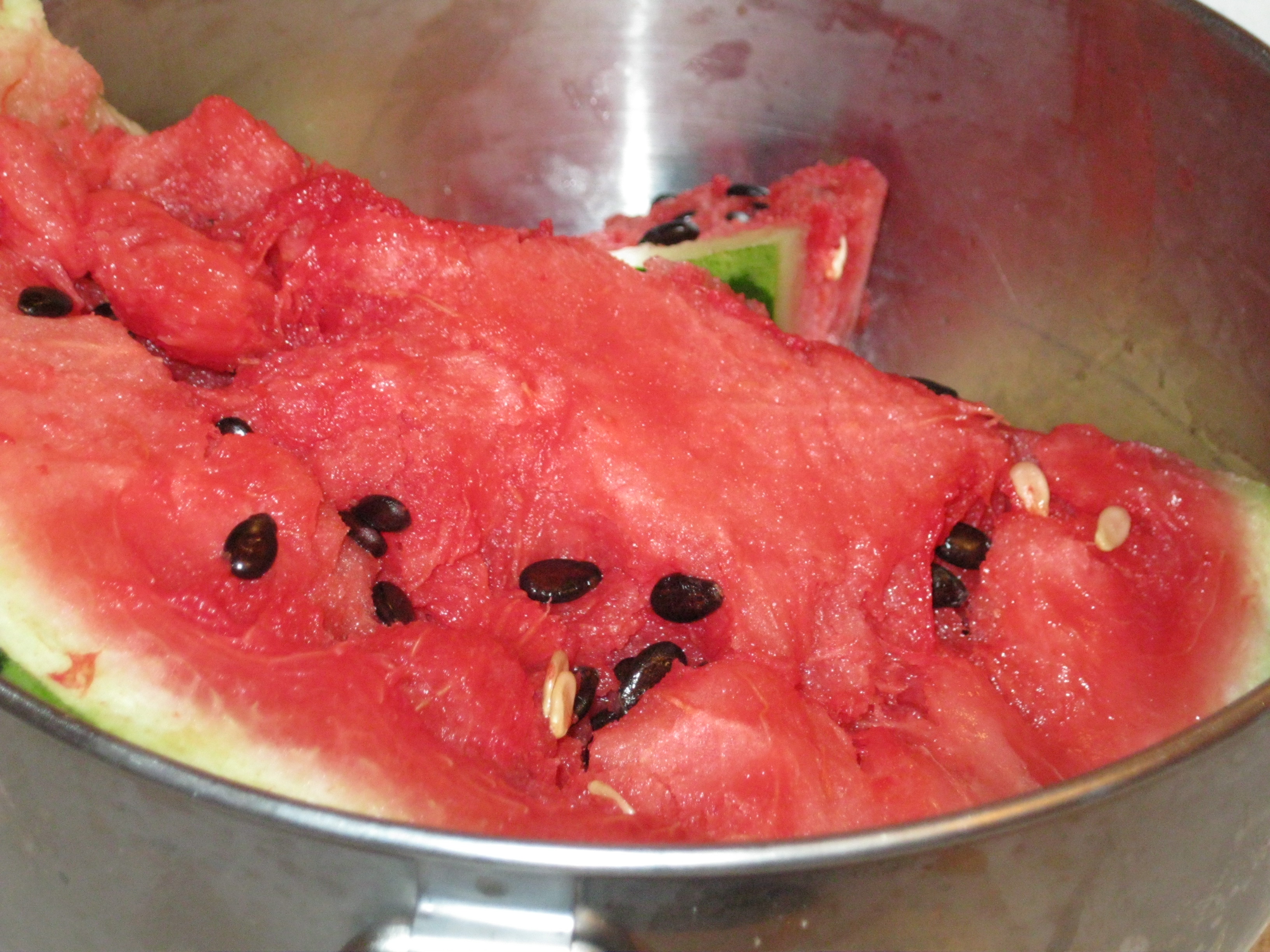
Photo of ripe red watermelon in steel bowl.

The one that got away — part of the watermelon that rolled off the counter.

On Wednesday I received a small watermelon from my Riverdog Farm CSA. Grown eighty-some miles away in summer heat, the melon was sweet and pink — I know because five minutes after I set it on the counter I heard an odd thunk: it had rolled off the counter and split open when it hit the floor. There would be no saving this watermelon for later. I picked it up, washed it off and tasted it. Good. Then I set it aside for a few days as the temperature took a nosedive and the fog rolled in to stay — who wants to eat watermelon in fifty-degree weather?

Fortunately, I had a plan for some of this watermelon: when I bought my Nesco American Harvest dehydrator the booklet contained this sentence: “Cantaloupe and watermelon slices become candy-like when dried.” Candy-like. Hmm. Then Krista and Jess reported on their dried watermelon chips. I knew I had to try it when watermelon came along again.

I spent an hour in the kitchen this morning, cutting 1/2 inch thick slices of watermelon, removing the seeds and cutting the rind away. The easiest way to do this proved to be to cut a slice and then slice through the melon perpendicular to the rind to produce small batons or wedges and then to cut the rind away. After half an hour of this, I noticed that I was developing a neat pile of watermelon rind.

Now, I am one of those people that, if you give her a slice of watermelon, will eat deep into the rind. Watermelon rind reminds me of cucumber with no bitterness and no seeds. And yet, because Mom doesn’t can, I have never made watermelon rind pickles. I called her into the kitchen and asked, “Back in the day when you ate watermelon pickles, were they sweet or sour?”

“Not sweet enough,” she said.

“Sort of like bread and butter pickles?” I asked.

“Not as good,” she said.

She told me to look in the old Mowequa cookbook, but I headed upstairs to check my saved blogs file. Not too far into the seven hundred recipes I had saved was Natalie’s recipe for watermelon pickle. I have started to make it and will report on the results on Wednesday.

Painting depicts apple pie ingredients: flour, butter, apples, cinnamon, nutmeg.

Gravenstein Apple Pie 8″x8″ gouache and watercolor pencil Sharyn DImmick

Things to make right now: Gravenstein apples are in! Ann and I picked a big bowlful of them from a yard in Berkeley and Mom made our first Gravenstein apple pie of 2012. I cannot say enough good things about this pie so if you are lucky enough to live within range of Gravenstein apples, by all means, get some. Bernie at the Berkeley Farmers’ Market has them right now if you don’t want to forage for them, or if you need more. I also made zucchini-feta pancakes this week. This time I threw a little leftover pesto with the fresh herbs and feta — it’s a delicious variation. As I write this I have another peach and plum crisp in the oven, this time made with white and yellow peaches and little cherry plums from someone’s backyard tree. And two days ago I made this tomato tart, again with lemon cheese, but with brown mustard and shredded tarragon. And of course this is a good time for Deborah’s somewhat famous tomato platter or Greek salad, with tomatoes and cucumbers in the market and peppers beginning to come in.

Photo of watermelon candy, aka dried watermelon

Watermelon candy in the dehydrator.

The watermelon candy is small and sticky — it reminds me of dried tomatoes, only sweeter and pinker. I was catching up on my sleep today after nearly a month of periodic insomnia so I didn’t take the time to do a new painting. Instead I offer you photos of watermelon and watermelon candy.

Original watercolor painting shows bowl of fruit salsa and ingredients.

Peach-Plum-Corn Salsa. 6″ x 6″ watercolor pencil on paper. Sharyn Dimmick.

I have my foot in several art camps: I hang out with writers at retreats. I meet regularly with groups of local folk musicians. And this past weekend I had the opportunity to attend to wrap-up party for the July 2012 Caerus Artist Residency in Sonoma County with my best friend (and Caerus co-founder) Suzanne Edminster.

I prepared a dish of fresh peach, plum and corn salsa, inspired by this recipe, and bought some blue and yellow gluten-free corn chips at the Santa Rosa Safeway. When I got to the party, the hostess gave me a bowl for the chips and I put my old, scarred Tupperware container on the table next to them. Other guests arrived, bringing fruit pies, buffalo wings, blackberry-apple crostata, pasta and green salads. The table held napkins, plastic forks and knives and paper plates.

I am used to folk music parties, which go something like this. Each person arrives and plunks something homemade or store-bought on a central table, greeting each other and often asking, “What did you bring?” Once people have dispensed with kitchen chores and stowed their instrument cases we take seats around the table and begin to chat and eat. It is only after we have served ourselves food and talked for awhile that someone will say, “Bill, do you have a song?” Or a late arrival will ask, “Have you been singing?” We say. “No, we’re still eating,” or “We haven’t sung a note.”

Musicians are always hungry. They congregate in kitchens where the acoustics are good, leaning against the counters. Opera singers cannot eat much before a performance, but feast afterwards — it doesn’t feel good to sing on an overly full stomach.  After a performance you are high on music, full of energy and ravenous.

Eventually at music parties everyone has had her fill and we start to sing, often taking turns going around the table. Some of us have tradtitional places or chairs we like to sit in. If it is big party, the tune-players will slip away to other rooms, leaving the singers to themselves. If it is a small gathering we will remain around the table all day.

The Caerus artists behaved differently. They sat their dishes on the table and started looking around. Some looked for places to display their art: an easel, a window seat, the edge of a wall. Most of them did not seem in a hurry to eat: they wanted to wander around and look at the art as though they were at an opening, carrying their small plates and congregating in groups of two or three. They ate alright, but they ate on the fly. My friend Suzanne says artists graze. I say that they are too busy to look around to eat seriously, but they will notice if the food is beautifully presented and admire serving dishes and particular utensils. These may be the people who say, “That looks too pretty to eat.” To a folk musician, there is no such thing as “Too pretty to eat” or “Too ugly to eat” either — if it is edible, someone will eat it.

At the Caerus party I parked myself in a chair next to the table (old habits die hard) and had conversations with whoever happened by. I stood out by not standing.

In case you are wondering what writers do at parties, in my experience they hug the table and yack: telling stories is the next best thing to writing them or reading them. And, in case you are waiting for a recipe, this is how I made the salsa.

Fresh Peach, Plum and Corn Salsa:

Chop 2 medium plums and 1 yellow peach into bite-sized pieces. Place in a medium-sized bowl.

Squeeze juice of 1 lime over the fruit.

Lightly steam two ears of corn and cut the corn from the cobs. Add corn to bowl.

Chop half a bunch of cilantro into mixture

Finely dice a small red onion. Add to bowl.

Cut 1 jalapeno pepper in half. Discard half of the ribs and seeds, reserving the other half. Mince the reserved ribs, seeds and jalapeno flesh. Mix thoroughly and allow several hours for the flavors to blend.

Food notes: I used Santa Rosa plums, a yellow peach and two ears of yellow corn, but you can use any plums, peaches or corn that you like. If jalapenos are too hot for you, discard all of the ribs and seeds before using and up the quantities of fruit and corn. If you freak out at cilantro or are allergic to it, substitute mint or fresh basil. And, of course, you can make it more acid by using more lime, more piquant with more onion. It would be delicious in a corn and cheese quesadilla or served alongside grilled chicken or fish. The original recipe calls for cumin, which I love — I just forgot to put it in this time.

I have been distracted this week, planning my life in advance, spending untold hours on the internet booking flights to and from Paris, reserving train seats, surveying my distinctly non-chic wardrobe with dismay and bemusement. It is odd spending the first few days of May madly thinking about mid-to-late June, when I will be at a writing retreat in Limousin with Natalie Goldberg and then in Paris itself.

Meanwhile, here in Kensington, our lone apple tree is in full bloom and spring crops slowly make their way into the farm box. Today I got snow peas and strawberries, asparagus and baby romaine lettuce, carrots and spring onions and braising greens. The breeze has blown all day. The sky is pale blue with wide filmy streaks of clouds.

The fruit and vegetables remind me of a meal I had last May in New York. Natalie had invited me and my friend and host Dorotea to lunch at her friend’s Manhattan apartment. Natalie and her friend had gone to a farmers’ market and come back with the first asparagus and strawberries of the season. Natalie fried up some gluten-free pancakes and set the berries and stalks on the table for our spring feast high over the Hudson River. Everybody but me tucked into the asparagus while I ate strawberries and pancakes for lunch.

May has come again and I am in my own kitchen. This morning I opened a bag of whole-grain blue corn that I stashed in the refrigerator when I last came back from New Mexico. The corn is fine-milled, pale blue with flecks of darker blue. I cooked up a quarter cup of it as a simple mush, boiling it in a cup of milk with a few grains of kosher salt and a small handful of dried sour cherries. The corn turned a lovely pale lavender color when cooked. I added a few drops of vanilla and stirred, then spooned up my breakfast, satisfied.

Blue Cornmeal Pancakes with Strawberries. 4″ x 6″ Gouache and Watercolor Pencil. Sharyn DImmick.

For tomorrow, I plan a simple elaboration. Tomorrow I will cook another pot of blue cornmeal mush, eliminating the cherries. I will beat in an egg or two, some flour, some milk, a few tablespoons of sugar and some baking powder. I will stir in 1 tsp of vanilla last. I will heat a skillet on medium heat, drop in some butter, swirl it in the pan and drop quarter-cupfuls of pancake batter onto the hot metal.

Before I prepare the pancakes, I will wash and hull the strawberries. I will taste one and decide whether or not they need sugar. Since I will probably be eating them with maple syrup I may not sugar the berries unless Mom insists.

I first learned to make these pancakes from a Mark Bittman recipe reprinted in a local newspaper. You can read it here. Then I realized a couple of years later that I could wing it by using leftover polenta or cornmeal mush from dinner and adding basic pancake ingredients. I felt like a genius, but I never would have thought of it had I not made Bittman’s wonderful recipe many times. The pancakes are filling, but not heavy, and have become one of my favorite breakfasts for the warmer months when fresh fruit becomes abundant. I like them best with berries or peaches –any berries, but strawberries are the berries of the moment in my neighborhood.

Food Notes: Blue corn, if you can get it, is wonderful. It contains more protein than yellow or white corn. Also, Monsanto, developer of much genetically-modified corn, reputedly does not bother with blue corn, concentrating its research on yellow hybrids. I don’t know about you, but I would prefer not to ingest Monsanto’s experiments or products if I can avoid doing so. Vanilla adds a lovely flavor to corn, dare I say je ne sais quoi? I urge you to try it next time you make a sweet corn recipe.

Travel Notes: I am currently looking for hotels in Paris. Nothing expensive. Cheap is good. The room can be simple and I don’t care if the building is old. The hotel needs to be safe and near a Metro stop. If anyone has suggestions, or suggestions about how to find what I need please comment below or contact me. Merci beaucoup. — Sharyn

In Northern California spring can start in February and continue through May. First we see daffodils, then flowering pear, plum, crab apple and quince trees. Spring crops come in slowly: green garlic, lettuce, then asparagus, followed by peas. On my last Farmers’ Market visit two weeks ago the strawberries had white shoulders and the grower I like to buy them from (Lucero Farms of Lodi) had not yet taken up a stall, but I had a feeling I would find strawberries today, and there they were, small red Seascape berries with long stems destined for the year’s first strawberry shortcake.

Painting shows a heart-shaped strawberry shortcake and baskets of berries.

Strawberry Shortcake. 8″ x 8″ Gouache and Watercolor Pencil. Sharyn Dimmick

There are many variations of strawberry shortcake: you can make it with angel food cake or lemon pound cake or sponge cake or olive oil citrus cake. I have tried them all, but my favorite recipe for strawberry shortcake is a biscuit base, split and covered with fresh strawberries, served with lightly sweetened whipped cream. To honor the ritual of spring I will use organically grown Farmers’ Market strawberries, and whipping cream from Straus Dairy in Marin County.

I will buy my cream at a local supermarket, but because it is Earth Day I want to think a bit about what it took to produce this traditional spring dessert. Someone had to plant the strawberries, tend them, water them, pick them, bring them to market. Someone had to raise sugarcane and refine it. Someone mined the salt, picked vanilla pods, raised wheat, ground it into flour. Someone had to raise the dairy cow, feed her on grass, milk her. Someone had to separate the cream, sterilize the bottles, fill and cap them. Someone had to drive the cream to the supermarket. Someone had to put it on the shelves. Someone had to drive the bus that takes me from market to market and home again. In a day gone by, members of my family, relatives from a few generations back, might have kept the cow and skimmed the cream and planted the strawberries in Illinois where they farmed, but my parents both moved to California as teenagers and never went back to the Midwest. Celia’s small farm at The Kitchens Garden might be something like the farms my mother knew in her youth, farms with hedgerows, vegetable gardens, small orchards, cows and chickens, diversified crops.

In California I now buy the bulk of my produce from an organic farm eighty-seven and a half miles from where I live. Someone drives to Berkeley each Wednesday and places boxes of vegetables and fruit on a front porch. I take a bus and walk several blocks, load the heavier vegetables into my backpack and the delicate items into a canvas bag. I have no choice in what goes into my produce box: someone at Riverdog Farm decides what is best each week and loads it up. I unpack the box and fold it: the farm driver will collect it the next week. I like the idea that I am getting produce picked that morning or the previous day and I like it that in a small way my food dollars are supporting small, diversified agriculture on a farm that uses organic growing methods: although I cannot farm myself I have farming roots. Small farmers are real to me,  people that raise food and think about how they are raising it. The Capay valley where my produce comes from has many small farms started by former students at U.C. Davis on land that agribusiness did not want.

I shop at the Farmers Market to supplement my produce box. There I can buy a flat of peaches in June, more corn in July, bunches of fresh basil in August, these first spring strawberries in April. Every week I can walk down the center aisle and look to see what has come in, compare prices, sniff the air perfumed by seasonal fruit. I am grateful to live in a state where the growing season is long and next to a city that supports three different farmers’ markets year-round.

Enough. Now it is time to go into the kitchen to make that special shortcake with the first strawberries.

First, shake the cream bottle to redistribute the fat evenly. Then pour the grassy-smelling cream into a small mixing bowl and set it into the refrigerator to chill, along with the beaters. The cream will triple in volume as you whip it, so make sure your bowl is not too small. If you wish, you may season it at this point: I like to add  2 and 1/2 tablespoons of sugar and 1 tsp. vanilla and, sometimes, the barest grating of fresh nutmeg.

While the cream chills, prepare the shortcake:

Preheat the oven to 425.

Sift together 2 cups of flour

1 Tbsp baking powder

1/2 tsp kosher salt

2 Tbsp sugar.

Cut in 1/3 cup unsalted butter (if you use salted butter, omit the kosher salt)

Add 1 cup milk

Stir just until combined.

Put into a buttered cake pan.

Bake for 12 to 15 minutes until lightly browned in spots.

While the shortcake bakes, prepare the strawberries: remove the hulls and stems and then wash berries in a minimum of water. Let them drain in a colander or pat them dry. Taste one. If your berries are ripe and sweet, you need not add anything, but if you are my mother you will insist on adding a few tablespoons of sugar so that the berries give off more juice — it’s your choice since Mom is not in the kitchen with you. You will also whip the cream now. We like ours moderately stiff so that we don’t have to whip it again the next day.

Once the shortcake is out of the oven, split it in half and pile berries between the layers and on top. Serve with whipped cream.

I will return the plastic strawberry baskets to the market next week for re-use (and perhaps buy more strawberries). I will return the cream bottle to the grocery store eventually, collect my deposit and try not to buy more cream for awhile.

Food Notes: Strawberry shortcake features two elemental foods, cream and strawberries. To make a delicious shortcake, start with the best cream and berries you can find: local dairy cream and organically grown berries will give you the best flavor. Some things are worth waiting for and it is better to make this with ripe, red strawberries that have developed their sugars than to use white-capped or green berries. If you cannot get local cream, choose cream from your market that has not been marked “ultrapasteurized.” Ultrapasteurized cream has been heated to a high temperature to give it a longer shelf life and has a cooked taste that you will want to avoid once you have tasted the alternative. We sweeten our cream with white cane sugar to keep the flavor pure, but you are free to use any sweetener you prefer as long as you do not introduce chemical sweeteners. Finally, you may use any sort of cake or biscuit base that you like, but I implore you to bake it yourself and eat it while it is warm from the oven.

Five years ago I cast my lot with Riverdog Farm in Guinda, CA, subscribing to receive their weekly vegetable box. I had been shopping at Farmers’ Markets since I lived in San Francisco, going to Saturday and Sunday markets to buy the bulk of what I cooked. When I moved back to the East Bay I took to frequenting the Berkeley Farmers’ Market. Although I love going to the market I had been interested in vegetables by subscription for a long time and when a friend recommended Riverdog’s program I signed up, initially splitting a box with my friend Elaine who lives in Berkeley.

My reading influenced me. I had read Barbara Kingsolver’s Animal, Vegetable, Miracle about how she and her family had endeavored to raise most of their food on their Virginia farm and to buy locally what they couldn’t grow themselves. This afternoon I refreshed my memory of Kingsolver’s first locavore spring as I contemplated what to write about today.

Spring has sprung by the calendar. The days are longer. Plane trees have leafed out. A few native freesias push themselves up in the yard. A full moon lit the mild, clear night on Friday as I walked the last two miles home from a Passover seder at Elaine’s, where we ate broccoli, roasted potatoes, duck, carrots in the matzo ball soup, charoset made of dried apricots and dates. Sun shone on the Berkeley market on Holy Saturday where people stood in line for green strawberries (I tasted one), berries with white shoulders, asparagus and globe artichokes. One patron snapped up the only box of snow peas. Spring produce is late this year in northern California, not as late as last year where unexpected ongoing rain slowed all of the crops, but this was a slim market on the day before Easter. I brought home a bottle of plum vinegar, two pounds of walnuts in the shell, a grapefruit for another round of Shrimp Diablo. I considered buying a large basil plant and plucking every leaf to make pesto.

This is the time of year when I wish I had preserved more during the summer and fall, roasted more red peppers and frozen them, dried more tomatoes and raisins, canned more dilly beans, made more pesto. I break out stores of canned tomatoes, jars of roasted peppers and chutney, condiments to lend flavor to our spring diet. We use frozen mozzarella, fresh spinach, cottage cheese, diced tomatoes and Prego marinara to make lasagna. I pile peach chutney, roasted peppers and fresh arugula on a broiled Portobello burger marinated in salad dressing. We make pies out of frozen peaches and canned cherries.

Painting shows leek-feta quiche and ingredients.

Leek-Feta Quiche. 8″ x 8″ gouache. Sharyn Dimmick

What I can rely on in March and April is an abundant supply of alliums: spring onions and leeks. Every week Riverdog sends us a pound or two. I use leeks instead of onions in carrot soup and find I do not care for the substitution: note to self — only white parts of leeks, which will not give the green tinge and the strong flavor. I slice one leek into rings in a bowl of water, separating each ring to let the sandy grit sink to the bottom. I heat a few teaspoonfuls of olive oil mixed with butter in a skillet, lift the leeks from the water, pat them dry and saute them. I preheat the oven to 325. I roll out pie crust, sprinkle the bottom with crumbled feta cheese, add the sauteed leeks. I cut a jarred roasted red pepper into squares and scatter them on top of the leeks and cheese. I add a few cubes of marinated feta, just enough to create a pleasant design on the red and green. I grate a few tablespoons of Pecorino over that.

Then I beat three eggs in a metal bowl and add a splash of milk, eyeball it and add a little more, whisking the custard together. I pour the custard over the vegetables and cheese and pop the quiche in the oven.

This is a rough recipe: I have made it many times and feel no need to make more than the roughest of measures. I’m going to guess slightly on the amounts I recommend (Sometimes I measure backwards, pouring out what I think I will need and then checking the amount for you by pouring liquid back into a measuring cup, for example). If you need to know exact amounts you might want to look up another recipe for that. I will refer you to my Mom’s recipe for pie crust because I can recommend it wholeheartedly as the pastry we use most often.

Make 1 recipe pie crust. Chill crust while you prepare the leeks.

Clean 1 leek by slicing it into thin rings and teasing each ring apart in a large bowl of water. Lift rings out with a slotted spoon or small sieve and pat them dry.

Heat 2 tsp olive oil and 2 tsp butter in a skillet. When combined, add leeks and saute.

While the leeks saute, you should have time to roll out your crust. Take 1/4 of your pie crust, flatten slightly and roll out on a floured board into a 10 inch circle. Fold and place in a 9-inch pie tin or tart pan.

Scatter feta cheese to taste on crust — I use enough to almost cover the bottom. Add sauteed leeks.

Slice 1 roasted red pepper into small squares. Scatter on top of leeks.

Sprinkle vegetables with additional feta, plus 2 Tbsp grated Pecorino or Parmesan cheese.

Beat 3 eggs. Add a splash of milk. Whisk. Pour custard over vegetables. if necessary, add milk to fill crust.

Bake quiche until top puffs and browns, at least half an hour.

Food Notes: You may, of course, substitute cheeses if you prefer something else to feta, substitute scallions or sauteed onions for leeks, substitute sun-dried tomatoes for the roasted red peppers. Quiche is, by nature, a flexible recipe. Because I was using feta, a salty cheese, I didn’t add any salt — if you choose a mild, sweet cheese, you might want to add some. If you want to eat this during Passover week, you could make it without crust.