Archives for posts with tag: The Kale Chronicles
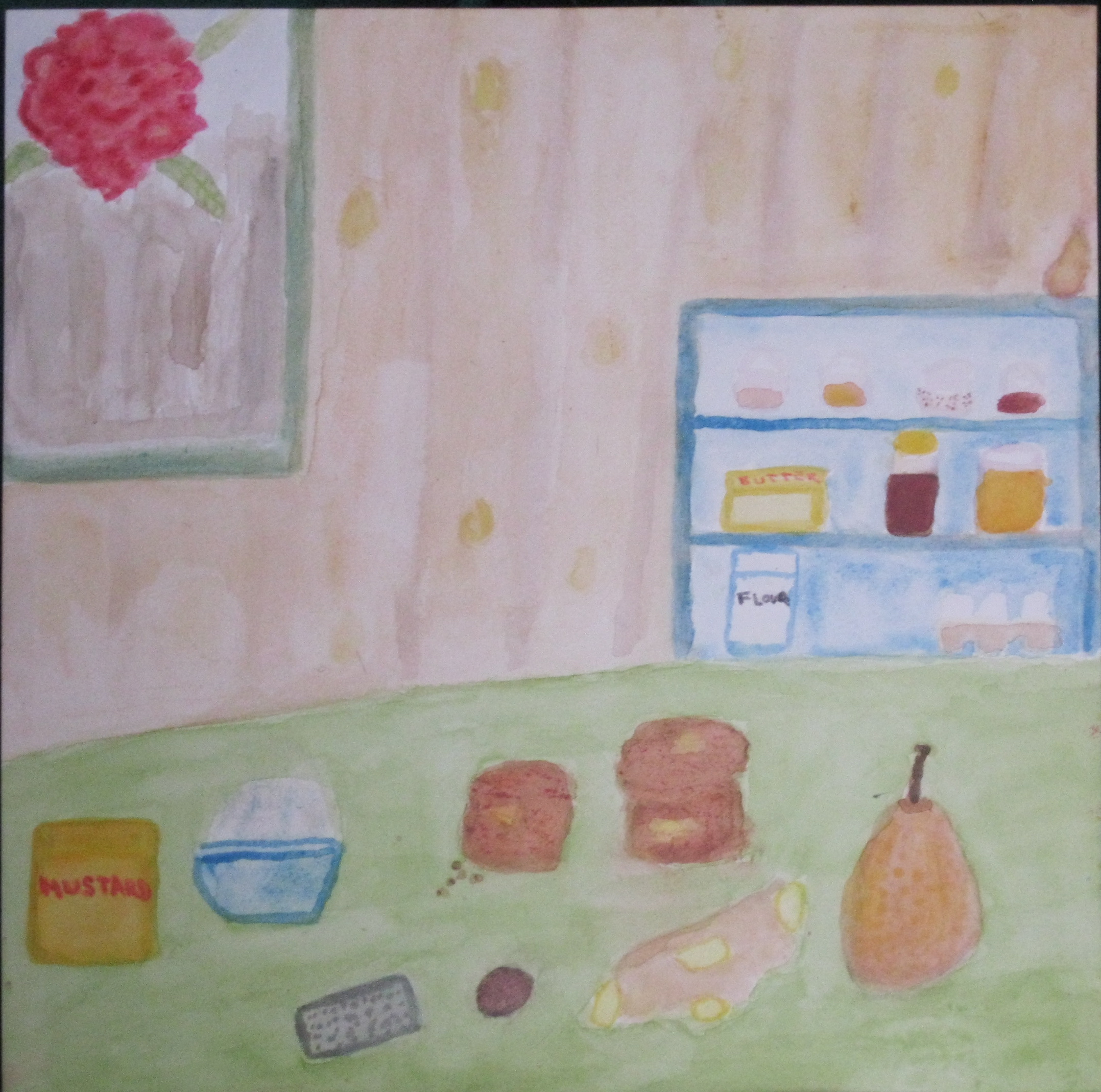
Painting depicts food items procured in weekly grocery shopping

The Groceries. 12″ x 12″ gouache. Sharyn Dimmick.

Last week I checked Riverdog Farm’s weekly online newsletter to see what vegetables we were going to get: tangerines, navel oranges, spring onions, cauliflower, carrots, dandelions. Dandelions! Oh, they didn’t! I read on to see that what they were really giving us was young leaves of chicory. The only thing I know about chicory is that you can make coffee substitute from it or add it to coffee for that New Orleans flavor. I Googled it. The coffee substitute is made from chicory roots. Shucks.

My mind goes back to salads we ate in Italy where they dug every bitter shoot out of the ground and dressed it in olive oil. But before I start whining in earnest I realize that a limited palette of ingredients is a test of cooking skill and creativity and that with a cabinet full of spices and a refrigerator containing milk, butter and cheeses I have more to work with than many people have had. What needs adjusting beyond the seasonings is my attitude.

This week I sufficiently adjusted my attitude to cook the chicory. I tasted it raw the day I got it: bitter. Before I cooked it I checked to see what will be in Wednesday’s box. The contents are not much different. For twenty dollars a week I am getting three pounds of fruit (oranges and tangerines) and six pounds of vegetables, including leeks, arugula, spinach, cauliflower, carrots and potatoes. That is the basic early spring produce palette here in Northern California.

This morning I went with my mother on her weekly shopping foray. This week we went to Food Maxx for canned cat food for our three cats and coffee beans for Mom. While we were there, we picked up two boxes of rolled oats, a bag of raisin bran, four boxes of whole wheat rotini, a jar of molasses, a box of Mexican chocolate, a small jar of Prego and a number ten can of hominy for posole. The food for humans in that came to $26.28 and we got a dime back for bringing our own canvas bags. Total: $26.18

We went on to Canned Foods Grocery Outlet, variously known to our friends as “Half Foods” and “Groc. Out” (before you turn up your nose, let me remind you that it was there I first found a bottle of Mosaic blood orange olive oil). There we picked up our dairy products for the week: half and half, buttermilk, sour cream and cheeses: jalapeno cheddar, a two-pound block of mozzarella for pizza-making, and a jar of marinated feta. We added in meat protein with a package of turkey sausage and one of Canadian bacon. Mom scored a 2 lb. bag of organic frozen green beans for $3.00 and a big bag of  fresh red potatoes for $2.00. I treated myself to a three-pound bag of Bosc pears from Washington State for $1.50 because the annual citrus glut is getting to me again — I will use the pears in desserts and soups and eat them as snacks. We bought a couple of cans of diced tomatoes for our winter-spring pantry, some flaked coconut and maple syrup for baking, a large package of English muffins and two different brands of commercial ginger snaps. Total for Canned Foods food: 44.83.

Adding up the food we purchased this week from all sources, I get $91.01. We will not shop again until next week and with all of this in the house we may not buy much next week beyond bread, milk and more cat food.

Now, we never start from a house empty of food. We keep a running pantry of baking supplies from butter and eggs to flour and cornmeal. We usually have walnuts and almonds and some dried fruit: right now we have dried peaches and apricots, sour cherries, raisins and home-dried apples and pears. When I get around to it, we will have home-candied citrus peels as well. We also stock rice, both brown and white, polenta and pasta. We make our own chicken stock, which we store in the freezer, and keep condiments such as mustard and red wine vinegar, soy sauce and sesame oil. We try to replace all of these items during sales to keep our costs down.

The chicory? I cooked it for dinner, after trimming all of the stems. I pulled out all of the stops. First I boiled it for fifteen minutes. Then I poured off the water, hoping to have leached out some of the bitterness. I tasted it again: still bitter and not quite dull in color. I put in a little more water and cooked it for ten more minutes. Then I pulled out a skillet, heated some olive oil and sliced up half a sausage into half-coins. I browned those while I microwaved about a quarter cup of raisins in some water (This green is seriously bitter and needed the help from the dried grapes). I added the drained chicory and some pressed garlic, then the raisins and soaking water. Even with the raisins, oil, garlic, sausage and blanching the chicory remained bitter — not slightly bitter, but majorly bitter. It is the kind of thing that gives vegetables a bad name. We ate it alongside some bland Kabocha squash gnocchi in (not bland) gorgonzola sauce. My first attempt at winter squash gnocchi lacked lightness as I had to work in extra flour to handle the dough: if I revisit gnocchi more successfully I will post the recipe later. We were grateful to have the Mexican chocolate as an after dinner treat: I prepared that with a square of bittersweet chocolate, an extra tablespoon of cocoa powder and a dash of vanilla extract in each cup, perfect for the rainy March night.

P.S. Mom, trooper that she is, reheated and ate the remaining chicory for breakfast. She said it was better after sitting overnight. I said I would never complain about kale again, knowing we could get chicory instead. We both shuddered.

Original photo of brown and blue eggs in gold star dish. Photo by Sharyn Dimmick.

The eggs that starred in Sunday night supper.

It is late on Sunday night on the day of the time change. It is, in fact, later than I would like it to be. I arrived home from a visit with my friend Suzanne in Santa Rosa bearing a gift of five eggs laid by her backyard chickens. Mom had been alone all weekend, except for an episode involving my cat Fiona, several neighbors, the police, my brother Bryan and my sister-in-law Barbara. Bryan got scratched and Fiona got liberated from the house she was trapped in — she is fine, if unusually skittish. Mom was tired and in no mood to cook and I knew the fresh eggs should be the star of our spring supper.

Original photo by Sharyn DImmick of eggs in a star dish, plus daffodil bouquet.

Photo: eggs and daffodils. Sharyn Dimmick.

Sometimes simple is best. I cracked the eggs into a metal bowl and whisked them with a little salt. Then I washed a bunch of spinach leaf by leaf, transferring each leaf to a dish towel. I sliced an onion into thin rings and put it to saute over medium heat in a little olive oil and a half tablespoon of butter. While the onions softened and browned I chopped the spinach leaves. As I added each batch to the pan, I seasoned them with freshly ground nutmeg and black pepper. When I added the last batch I grated about two tablespoons of pecorino into the greens with my microplane and put two plates in a warm oven.

Original watercolor painting of eggs and daffodils.

Sunday Night Supper. 8″ x 8″ watercolor pencil. Sharyn Dimmick

While I cooked the eggs by adding them to the pan with just a smidge more butter, Mom toasted some whole-grain tortillas. We each had our eggs and greens with an orange on the side. The food was beautiful, the deep yellow of eggs from free-range chickens, the vibrant green of spinach and spring onions. Alas, by the time we had cleaned our plates, the light was fading and I had yet to paint a picture. I gamely grabbed a gold star-shaped dish and a small bouquet of daffodils cut from our garden and set to work, sketching the star shape, working in yellow, brown, a bit of orange, greens. Above the star dish of brown and blue-green eggs I sketched in the yellow daffodils, one pale and one richer, sunnier yellow. I blended three different greens into a bunch of spinach, three more, plus cerise into quick onions. I added a purple tablecloth and then, as an afterthought, the dining room windows, framed in a deeper blue-green, almost peacock. The light was gone entirely and I “finished” the painting under the compact fluorescent light mounted over my bed.

Usually, I am satisfied with my paintings as I complete them and have at least a brief experience of falling in love with them. This one still looks like a sketch to me. “Oh well.” I say, like my northern friends. Perhaps some of you will enjoy seeing a beginning painting, a painting that is more of a sketch than a finished piece, an attempt or a gesture rather than a “real painting.” But if I paused to correct shading and continued to mess with it, I might never get this blog post finished. I include, for your pleasure, a few photos of the eggs: they might as well be film stars as well as the stars of a Sunday night supper.

Painting shows ingredients for rice cakes

Rice Cakes. 6″ x 6″ gouache and watercolor pencil. Sharyn Dimmick

Most mornings I eat oatmeal cooked in milk to jump start my calcium intake for the day. Our house is cold and warm breakfasts are usually welcome. But because we shop just once a week, there are occasionally mornings when the milk is gone and hot cereal is not an option. Heaven forbid that I would cook my oats in water, converting them to standard gruel.

These are some of our options for mornings we are out of milk.

1) Rice cakes: take some leftover rice. Crack an egg or two into it. Add some sugar, vanilla, nutmeg. Beat for a few minutes with a fork. Scoop out by 1/4 cup measures and fry in butter.

2) French toast: take the last few slices of bread. Toast them lightly if they are not already stale. Cut them in half. Beat a couple of eggs in a shallow bowl. Add juice and zest of one orange if you like, or just add sugar, vanilla and nutmeg as for rice cakes above. Soak the bread briefly in the egg batter. Fry in butter. Serve with powdered sugar, maple syrup, fresh fruit or fruit puree

If we have sour milk, buttermilk or yogurt on hand we can just make waffles, cornbread or biscuits.

Painting shows bread for French toast, eggs, orange.

French Toast. 6″ x 6″ gouache and watercolor pencil. Sharyn Dimmick.

If we have no milk products, sour or otherwise, we can get out our sourdough starter and make  sourdough biscuits with that, using a cup of starter, 1/4 cup of vegetable shortening, 1/2 tsp each of sugar, salt and baking soda, 1 cup of plain flour and 1 Tbsp baking powder. Mix them. Roll them. Cut them. Brush the tops with melted butter and let them sit for fifteen minutes while you preheat the oven to 425. Bake for 10-12 minutes

If I am feeling more ambitious than making biscuits and I have gotten up very early, I might return to my breakfast oatmeal and make it into some delicious oatmeal yeast bread, flavored with maple syrup. I have adapted this recipe slightly from an old cookbook called Coffee by Charles and Violet Schafer published in 1976 and now living in tatters on my bookshelf. This bread uses the sponge method, which will save you some time on the first rise (but you will have to knead it before the second rise after you add the remaining flour and salt).

Oatmeal Bread

Pour 2 cups of boiling water over 1 cup of rolled oats in a mixing bowl.

Measure 1 Tbsp of vegetable oil into a Pyrex measuring cup. Swirl oil to coat glass to the 1/2 cup mark.

Add oil to cooling oat mixture.

Into oiled cup, measure 1/2 cup maple syrup.

Add syrup to oat-water-oil mixture

Take that same old  Pyrex cup and add 1/4 cup lukewarm water.

Dissolve 1 Tbsp active dry yeast in the lukewarm water and stir with a fork.

While the yeast proofs, add 2 cups unbleached flour to your mixing bowl and stir. When mixture is lukewarm, add yeast and stir again. Cover with damp cloth and place in warm place to rise. Check in 30 minutes.

After your sponge has risen and fallen slightly, add 1/2 cup whole wheat flour, 2 and 1/2 cups unbleached flour and 1 tsp kosher salt to it.

This is when you knead it. I like to knead on a lightly floured bread board for at least ten minutes. If your dough is too sticky, add flour by the tablespoon until it is workable: dough will vary by the amount of moisture in the air, the temperature of your kitchen, the particular grind of the flour. Please add a little flour to the board, to your hands, or to the dough itself if you are having a lot of trouble with it: doughs containing honey, syrup or molasses are stickier than those that don’t, but you are going to love the flavor of this bread, so persevere.

After at least ten full minutes of kneading, you may want to add a little butter or oil to your mixing bowl. Rub it all over so that the dough won’t stick. Then plunk the dough back into the bowl, dampen your tea towel with warm water, wring it out and set it on the bowl again, placing the dough in a warm place for its second rise. Check it again in 30 minutes (or forty if you are reading a great novel). When it has doubled, take the time to grease two loaf pans or one loaf pan and a pie or tart pan if you want to make a round loaf. Using butter to grease the pans will add to the flavor of the finished bread.

Take the bread dough out of the bowl and set it again on your lightly floured bread board. Cut it with your dough cutter or bench scraper into two equal portions. Roll the first one up like a jelly roll and tuck in the ends: with any luck it will fit your loaf pan. Take the second piece of dough and roll it into a ball, continually tucking any edges under and smoothing the top. Place this ball in your pie or tart pan. Return shaped loaves to the oven to rise for fifteen minutes, then move them somewhere else while you preheat your oven to 375, making sure a rack is in the middle position with no rack above it (You should have already moved it when you were using it for the rising dough, but if you didn’t, do it now).

Painting shows loaves of oatmeal bread.

Oatmeal Bread. 6″ x 6″ gouache and watercolor pencil. Sharyn Dimmick

When your oven is hot, set the loaves inside and putter around for ten minutes, doing dishes or having a cup of tea. After ten minutes, reduce the oven temperature to 350 and go back to reading your novel. Resurface in 30 minutes to check your bread: when you thump it, it should make a good solid thumping sound and the crust should have some brown color. When it thumps satisfactorily, remove it to a cooling rack. Mom taught be to remove the bread from the pans so that the crust does not steam in the hot pans: if you do this, you will get a crustier, chewier crust.

Now go away again: if you cut the bread hot you will ruin the texture. It’s best just to forget about it for awhile. When it is cool or almost cool, you can slice it and savor the beautiful bouquet of maple syrup. Whatever you do not eat immediately makes lovely toast tomorrow and the next day.

Food notes: On rice cakes: these rice cakes are not Asian rice cakes. They are the kind of rice cakes some people make in Louisiana: a fried cake made of sweetened rice bound with eggs. On oatmeal bread: for its most wonderful qualities, this bread requires maple syrup. None of the other ingredients are expensive, so splurge every now and then and make it. Can you make it with honey or golden syrup or malt syrup or brown rice syrup? Yes, you can, but it will not be the same and not yield the same deliciousness. Can you make it with more whole wheat flour? Of course you can, but, once again, you will not get the same bread: whole wheat flour will make it browner and heavier and wheatier. I keep the whole wheat flour to a half cup for the nod to health, replacing a little nutrition in that unbleached flour, but oats are good for you, too. Happy breakfast.

Equipment notes: Few things make me happier than having a dough cutter. I baked for many years without one, but it is the easiest thing to use when you need to divide yeast dough.

Okay, so you know that Riverdog Farm keeps me well-supplied with winter and spring citrus: if you read The Kale Chronicles frequently, you will notice that lemons, tangerines and oranges show up in a lot of my recipes from November on. I’ve given you Swedish rye bread with orange and anise, orange-sesame vinaigrette, tahini-citrus salad dressing, orange-fennel salad, orange-cumin bread, tangerine curd, orange muffins, lemon sponge pie and Shaker lemon pie, lemon bars with a coconut brown sugar crust, a recipe for home-candied citrus peel. And then there is all of the stuff I don’t blog about: the orange zest and juice stirred into French toast, the lemon squeezed onto roast vegetables and greens and stuffed into chicken cavities. And still the tangerines roll on.

original watercolor painting of clementine bundt cake

Clementine Cake. 12″ x 12″ gouache and watercolor pencil. Sharyn Dimmick

A pound of Murcott tangerines rolled in last week and coincidentally I ran across a recipe for a clementine cake on Smitten Kitchen. Now, Deb can cook, and she got the recipe from Nigella Lawson, who makes her living as a cook. Separately, they insisted that I could boil my pound of tangerines for a couple of hours and then incorporate them into a gluten-free cake. Deb voiced the doubts anyone would surely have about this recipe. Would it be bitter? Would it rise? Would anybody eat it?

I needed to try this because it would use a whole pound of tangerines at one fell swoop and because I was going to a singing party at the home of a gluten-free friend yesterday and because it was such an odd method of making a cake, particularly the part about boiling a pound of whole tangerines. Deb had suggested that this cake got better as it sat and Mom suggested that I make it on Friday afternoon for the Saturday afternoon party.

I put my pound of tangerines into a saucepan, covered them with water and brought them to a boil and then let them cook for two hours. No, I did not peel them or seed them. I didn’t even wash them since they were organically grown and I would be using the nicely acidulated cooking water for some lucky outdoor plants.

While the tangerines cooked, I had plenty of time to prepare the other ingredients. I started with whole, skin-on almonds because I needed 2 and 1/3 cups of ground almonds. I tried running them through the meat grinder, but they only gummed up the works and ground unevenly as well. Then I realized I had a large Vietnamese mortar and pestle and started pounding away — after all I had two hours to wait for the tangerines (You modern types could use your food processors or buy ground almonds at the store: I enjoy knowing I can get ground almonds and some exercise at the same time). I scooped the first batch up with a 1/3 cup measure and put them in a small mixing bowl and started another batch. When I got tired of pounding, I took a break to take six large eggs out to sit at room temperature. While the eggs warmed, I went back to my mortar and pestle. When I had measured out enough pounded almonds, I set them aside in the small mixing bowl and turned my attention to the eggs.

I made a genoise once: it took me two tries to get it right. What I learned from making genoise is that you can get eggs or egg yolks to incorporate a lot of air and triple in volume like egg whites — you just have to beat them for a long time. I turned on my electric mixer at cake-mixing speed and eventually cranked it up higher and watched the volume of the eggs increase and the color get paler. When the eggs were three-quarters of the way up the bowl I started adding sugar, about a tablespoon at a time, until I had incorporated 1 cup and 2 tablespoons of sugar. I did not even think about scanting the sugar because this cake was going to contain tangerine skin and pith — all of it.

About now, the tangerines in the pot hit the two-hour mark so I used a cooking fork to remove them from the water and set them on my cutting board. While they cooled, I added my ground almonds slowly to the egg sugar mixture with the 1 heaping teaspoon of baking powder. I then preheated the oven to 375 with a rack in the central position and took out my precious bottle of Mosaic blood orange oil to grease a bundt pan. Hedging my bets, I sprinkled a generous tablespoon full of sugar over the oiled pan.

Then, as instructed, I sliced my tangerines in half and extracted all of the seeds. You must do this because citrus seeds are excessively bitter. I then used a chef’s knife to chop all of the tangerines as finely as I could, catching the juice in a bowl (the one the almonds had been in earlier), When they were chopped pretty evenly with just a few larger pieces of peel here and there I put them into the mixer with the other ingredients and let it run for two or three minutes.

The resulting batter was a beautiful thing — foamy, pale orange, flecked with bits of bright orange and brown. I tasted it cautiously. It had a slight bitter edge, but would be edible. The recipe made enough for me to make a small test cake in a rice bowl in addition to the big bundt so I was able to sample the finished cake without disturbing the party edition.

I baked my small cake for thirty minutes, at which point a toothpick came out dry. I left the big one in for ten more minutes and it, too, passed the toothpick test. We ate the rice bowl cake warm, only noting that it had a tendency to fall apart.

Saturday I took the other cake to the party. I ran a knife around the edges (which had pulled away from the pan) and upended it on a plate: it came out cleanly. The hostess, who eats gluten-free, liked it. One man asked for the recipe. The woman who has a baking contract with me asked if I would make her one next time she was in town. They sent me home with perhaps one small serving.

What did I think? I thought it was good. Perhaps not great. You have to excuse me for not being a big cake fan in any case. Other people like cake. People who liked cake liked this. One man asked for the recipe. One woman mentioned liking the bitter marmalade-like tang, although she wondered if she would like it with a tangerine juice and powdered sugar glaze. I did find it a bit hard to slice — it was rather soft and moist. I offer it to my gluten-free friends as a possible cake, not too hard to make, not too many ingredients and another use for the rolling river of tangerines.

Food notes: if this cake interests you, be sure to check out the comments on Nigella Lawson’s site: people have done some creative things with spices, made it into a Christmas cake, etc.

Things may be a little different around here at The Kale Chronicles for awhile. I’ll have some guest posts. I’ll continue to paint. Mom and I will figure out some kind of cooking collaboration eventually. But, in the mean time, in case any of you have ever wondered what it is like to use a walker, I wrote a description as my morning’s writing practice. Enjoy.

painting of coffee in mug, filter cone, place mat.

Morning Coffee. 6″ x 6″ watercolor pencil. Sharyn Dimmick

The Walker Routine

I crawl or scoot to the edge of my bed to grab the walker from the foot where I left it. I stand up on my right foot and stomp-hop over to my bureau by the light from the window to pull out some thick socks. Because there is not enough light to see the socks’ color, I turn back to press the mouse: the light from my computer screen is enough to see by. I choose two red socks.

I turn and lean toward a chest, a plastic storage container where a few clothes currently rest, grabbing my holey cashmere sweater turned pajama top (I have enough worn-out cashmere for a lifetime of p.j.s). I turn again and take two steps back to the bed, where I sit and put on the socks.

Lifting the walker over a gap too narrow for it to transit, I then stand again and make my way down the hall to the head of the stairs. Using the window ledge and the banister as handholds, I lower myself down onto the top stair, left foot extended in front of me. I fold the walker and begin propelling myself down the stairs using my hands and my right foot, taking the walker with me. At the foot of the stairs I lower myself onto the narrow landing, scoot across to the last two stairs to the kitchen, unfold the walker and use my right leg and two walls to stand again.

I enter the kitchen, flipping on the light. The kettle is on the stove, but its lid is missing. I scan for the lid, feeling frustrated for a moment, until I see it sitting in the dish drainer. I stomp-hop over to the sink and fill the kettle half-full of cold water, pivoting to set it on the burner and turn the burner on. I tuck the red plastic filter cone and metal cup under my arm. Then it is back to the far counter, stomp, stomp, stomp, stomp, pushing the step ladder out of the way once, twice, three times to free access to the coffee and cereal cabinet. Leaning on the counter with my left elbow, I take out my coffee canister and a metal coffee measure. Then I stretch up as straight as I can to pull a coffee filter from the box on the second shelf.

Leaning on the counter again, I use two hands to open my coffee canister — it has a ring-pull mechanism that takes considerable strength to break the air lock. I measure two scoops of coffee beans into the grinder, plug it in and press on the lid to grind the beans. One-handed doesn’t work so well, so I lean both hands on the grinder. I fold out the paper cone into the red filter and aim the ground coffee into the cone, first from the grinder, then from the lid.

The easiest way to move objects when using a walker is to set them on a surface and then pivot to set them on another surface. I am able to set the filter cone on the edge of the stove. Then I stomp, stomp, stomp to the cupboard for a coffee mug and a Pyrex measuring cup: if I’m going to go through this for coffee it is going to be a perfectly-made cup of coffee.

By now the water is boiling. I turn it off and pour one cup over my coffee grounds, then one-quarter cup. Ten ounces of decaf is my daily ration. While the coffee drips. I take the long way around to the refrigerator: it is just steps from the stove, but the walker will not go through on that side, so I walk all the way around the stove island to get the half and half, in a carton, thankfully, not a pitcher. Using the pivoting transfer technique I move the half and half from the refrigerator to the counter to the stove to the opposite counter.

I stomp, stomp, stomp back to the first counter to get a muffin out of the dish cupboard, stomp, stomp, stomp to the microwave to heat it. I am getting tired and pull it out and put it on a saucer after twenty-five seconds. Pivot-transfer to stove. Pivot-transfer to counter. Pivot-transfer to edge of breakfast room credenza. Pivot-transfer to table. Remove filter cone from coffee mug and place on metal cup. Pivot-transfer coffee-mug to counter. Pivot-transfer to credenza. Pivot-transfer to table. Stomp back for half and half. Pivot-transfer, pivot-transfer, pivot-transfer.

Sit down. Ah. Prop left foot over rung of walker. Pour half and half in coffee. Take bite of muffin. Chew. Drink more coffee. Consider getting cut grapefruit from fridge. Decide it is too much work. Take saucer and mug back to kitchen: if I am careful and dishes are empty I can hold one item between each thumb and some fingers and still grasp the walker firmly. Stomp, stomp, stomp. Reverse stomp. Retrieve half and half by pivot-transfer method and return it to fridge.

Stomp over to sink. Open cabinet. Bend down over top of walker, balancing to get compost can. Set compost can on edge of sink. Stomp back for used coffee filter. Place in compost. Replace compost under sink. Dabble hand in dishwater.

Grab clean water bottle for return trip upstairs. Stomp to foot of stairs. Sit. Fold walker. The easiest way to climb is to use a cross-wise technique: use left hand to grab a few stairs behind you. Use right foot to push off lower stair. Use right hand to hold folded walker steady against wall. Move water bottle up a few steps with right hand. Move walker with right hand. Move self with right foot and left hand. By the time I reach the landing I am sweating.

I gain the upstairs hallway, set my water bottle on the banister, unfold the walker, kneel and stand. I hook my thumb through the plastic loop on the water bottle lid and head for the bathroom. I don’t bother with closing the door: it is enough to set the water bottle on the counter, stomp across the floor to the commode and use the window ledge and sink edge to balance to pull down my pajama pants and pull my robe out of the way. Stand again.Yank pajamas up, first one side, then the other, while leaning on opposite side. Flush toilet. Wash hands. Lean against sink counter to brush teeth, which takes two hands. By now my right hip is cramping. I shift positions a bit while singing songs in my head to see that I brush long enough. Rinse toothbrush. Fill water bottle. Tuck thumb through loop. Turn and leave. Stomp, stomp, stomp, stomp. Stomp, stomp, stomp, stomp.

Painting shows pear-ginger muffins and ingredients

Pear Ginger Muffins aka “Brown Study” 12″ x 12″ gouache and watercolor pencil. Sharyn Dimmick

The Daring Bakers’ February 2012 host was – Lis! Lisa stepped in last minute and challenged us to create a quick bread we could call our own. She supplied us with a base recipe and shared some recipes she loves from various websites and encouraged us to build upon them and create new flavor profiles

Neither Lisa nor I had any idea just how challenging the Daring Bakers’ Challenge would be for me on my maiden voyage. The parameters were simple enough: make a quick bread, either in muffin or loaf shape. Post paragraph one above to begin the blog post.

I have cerebral palsy, which may or may not give me altered bone density. I have had all month to think about the baking challenge and to fantasize about what I would make. Should I make a coconut bread with fresh coconut and coconut milk? Should I concoct some kind of Nutella swirl thing in honor of Margit’s birthday month? Should I make something with limes, having scored a bag from the rotting rack at Canned Foods?

I mulled these choices over while I walked along Franciscan Way, going to Margit’s to feed her cats on Thursday morning. My left foot began to hurt insistently. I sat down on the verge to take off my shoe, thinking that my two-day old shoes were not fitting well. I ran my hand inside my shoe and straightened my sock, found nothing and resumed walking in some pain. Franciscan is a lonely stretch of roadway, abutting the Sunset Cemetery where my grandparents are buried. I fed the cats, cleaned their box, walked uphill to the Kensington Library, returned books, looked for job listings and went home for lunch.

My mother and I often have tea together in the afternoon in the upstairs library. She sits on the love seat and I sit on the matching dark red leather armchair with my feet on a black leather ottoman. When I removed my shoes, owing to the warm day, I saw that my little toe was blue and there was a bruise on the heavily calloused outside section of my left foot where the pain was. Uh-oh. The last time I had bruising like that I had broken my hand in two places.

By Friday I had called my foot doctor and requested an appointment and started to minimize any weight-bearing and to sit with my left foot elevated whenever possible. I brought a cutting board into the breakfast room and did all the chopping, slicing and peeling for soup that I could do sitting. By Sunday morning, I felt ready to tackle the muffin challenge. I pushed a light chair into the kitchen to encourage me to stay off my feet, maneuvered myself around as much as possible using the edges of counters and hopping carefully on my shod right foot. When I had to put my left foot down, I did my best to put my weight on the heel and avoid the front part of the foot.

I decided to make a variation on Mollie Katzen’s Spicy Gingerbread from The Enchanted Broccoli Forest, incorporating some finely diced pears with the sauteed butter and grated fresh ginger, and making the resulting batter in a standard 12-muffin tin. I began by whisking my dry ingredients together in a large mixing bowl:

1 cup unbleached flour

1/2 cup whole wheat pastry flour

1/2 cup whole wheat flour

1 and 1/2 tsp baking soda

1/2 tsp ground cloves

1/2 tsp dry mustard

1/2 tsp ground cinnamon

1/4 tsp kosher salt

generous grating of fresh nutmeg

Then I microwaved about 1 Tbsp of butter in a glass liquid measuring cup, swirling it in the cup to coat the sides to the 1/2 cup mark, before pouring it off into the muffin tin, a few drops in each cup. I then measured

1/2 cup honey

1/2 cup molasses into the pre-buttered measuring cup and poured them into a small bowl, to which I added

1/2 cup plain yogurt and

1 large egg.

I preheated my oven to 375 and put the butter-smeared tin into it to heat.

I whisked that together as I began melting 1/4 cup butter on very low heat in a small skillet. While the butter melted I peeled and chopped

2 small Bosc pears into a small dice

I then took a hand of fresh ginger from the freezer where we store it and grated three small knobs into the melted butter (about 3 Tbsp), added the diced pears and cooked it for awhile and turned off the heat while I rescued the tin from the hot oven.

I was all set to combine the ginger-butter-pear mixture with the honey, molasses, yogurt and butter and moved toward it, managing to knock both the bowl of wet ingredients, the whisk, the measuring cup and a rubber scraper onto the flour. I let out a cry, though not a swear-word, and righted the bowl to save what I could. The cry brought Mom from the upstairs to tackle the floor while I measured out another half cup of yogurt and a half cup of honey to replace what had been lost,  and added them to what remained in the bowl. I then moved my chair out of the mess, combined the pears, butter and ginger with the remaining molasses, honey, egg and yogurt, stirred the wet ingredients into the dry, swiped the now-cooled muffin tin with some Crisco that Mom got down from the cupboard for me and hoped for the best as I filled the tin and set it in the oven. I then stalked off  on my heels to make some coffee and set down morosely to let the muffins bake and the coffee water boil.

I needn’t have worried. The muffins came out gingery and delicious with small, soft chunks of pear glistening like jewels. They rose well. They browned well. I can now say that Mollie Katzen’s spicy gingerbread recipe is well-nigh indestructible, even if you drop the wet ingredients on the floor and spill half of them before incorporating your butter and ginger. Thank goodness. Now I will wait to see what the good doctor has to say this afternoon* while I consider the wisdom of taking on any further challenges than the ones I am already equipped with naturally.

* Sad to say my doctor’s visit was aborted by a sudden attack of norovirus. Today I switched to a walker until such time as I am allowed to darken his doorway. Projected visit: Friday morning.

Painting shows lemon bars.

Lemon Bars. 8″ x 8″ watercolor pencil. Sharyn Dimmick.

Two of my mother’s favorite flavors are brown sugar and coconut: when she was a child she mixed up a big jar of coconut and brown sugar, planning to eat it. Not only did her mother punish her for “wasting food,” she also threw out the mixture. Now, I ask you, who wasted that particular food?

Anyway, I arrived home yesterday from several days in the foothills of Amador County. In my absence, Mom had made a pot pie and roasted a pork loin and some vegetables. As we ate the pot pie for lunch, Mom said, a little sadly, that there were no sweets except chocolate and that she might have to just eat oranges.

My Mom is a hard worker and she has a sweet tooth. Plus, she had been given some Meyer lemons by our next door neighbor. I offered to make something since it was blogging day. I had just seen a recipe for lemon bars from Sawsan at Chef in Disguise this morning, which had sent me running to my Alice Medrich Pure Dessert cookbook and my binder of recipes to compare ratios for lemon bar base ingredients. I like lemon bars and will eat anything that even looks like one, but Mom and I agree that the crust on lemon bars is often too thick, too rich and too sweet. I asked if there was pie crust left from the pot pie. Negative. That meant I would be starting from scratch. Mom asked if I would want to make a lemon pudding instead. I naturally thought she meant our favorite lemon pudding which has lemon filling trapped between two layers of a rich mixture of Wheaties, butter, coconut and brown sugar. And then I thought, “Why not combine them? What if I made a base of butter, brown sugar, crushed Wheaties, flour and coconut and then put lemon filling on top of that?”

Down to the kitchen I went, taking the Medrich cookbook with me: I would use her recipe as a guideline for my lemon filling because she likes a tart lemon bar. I dug out the recipe for lemon pudding from a file box in the cabinet and studied the crust ratios for three recipes. I decided I would use 1/3 cup butter, 1/3 cup whole wheat pastry flour, 1/3 cup crushed Wheaties and 1/3 cup flaked coconut, plus 1/4 cup brown sugar for the pastry base, which I combined with a pastry blender and baked for twenty minutes in a 350 degree oven. I then turned the oven down to 300.

I meant to use Medrich’s measurements for the lemon filling, but I couldn’t bear the thought of 1 cup plus 2 tablespoons of white sugar, so I decided to use 1 scant cup instead. I was aiming for her 1/2 cup of lemon juice, but after I zested and squeezed five small Meyer lemons and one stray tangerine that some cat had batted under the sideboard (it resurfaced last week and had seen better days, looking a little battered), I had 1/3 cup juice plus a little and decided to go with that. I used 1 Tbsp of whole wheat pastry flour and 2 Tbsp of all-purpose flour, whisked that with the 1 cup sugar, whisked in three eggs, added the lemon juice and zest, and poured the result onto the hot crust.

I baked the bars at 300 for nearly half an hour until the filling no longer jiggled when I tapped the pan. I cooled the pan on a rack while I went to Berkeley to pick up my vegetables. It was a bad day for bus service: I returned three hours later, put the vegetables away and cut the first square from the pan. I cut it in half and brought half to Mom who was watching T.V. She approved of the strong lemon flavor, but wondered why there was no topping. I said that lemon bars usually don’t have a topping and if I had made crumb topping for the top it would have taken twice as much butter. She asked why I hadn’t dusted them with powdered sugar and I said I was afraid that they would be too sweet.

These lemon bars came out buttery and lemony with a delicious brown sugar and coconut crust. Despite the scant cup of sugar they were not too sweet. Many lemon bar recipes call for shortbread crusts that take an entire stick of butter: with 1/3 cup of butter, the flavor of butter comes through beautifully.

Food notes: To get a generous 1/3 cup of juice I used five small Meyer lemons and one small battered tangerine. If you use Eureka lemons, you may not need more than two. Meyer lemons are sweeter and less acidic than ordinary lemons, so you may need to increase the sugar to a generous cup and add a dusting of powdered sugar. If you have access to Meyer lemons, you can follow my measurements exactly, if that is your style. I was afraid to use all whole wheat pastry flour in the filling, but it worked fine in the crust. If you do not have Wheaties, you can substitute ground oatmeal (put rolled oats or quick oats in a blender for a few seconds), crushed wheatmeal biscuits, or a dry cereal of your choice.

painting depicts bowl of corn soup and ingredients with lime tree

Mexican Corn Soup with Lime Tree. 12″ x 12″ watercolor pencil and gouache. Sharyn Dimmick

While I was in northern New Mexico my meditation teacher gave me a bag of blue cornmeal from the local farmers’ market and the suggestion that I teach you to chew slowly. Two days into the retreat she recommended that we chew the first three bites of each meal thirty times.

Meditation retreats are full of odd suggestions to the uninitiated. The first time I went to one the teachers told us as we took each bite of food to think about all the things that produced the food: air, sun, rain, soil, bacteria, seeds, farmers, labor, plants, wind, bees, etc., etc. We were eating vegetarian food so we did not have to think about the animals who died, although they did mention bugs and mice killed in the fields during harvest. They instructed us to note while we ate biting, chewing and swallowing, if not the arising of the urge to bite, chew and swallow.

After three meals of thirty-chew first, second and third bites, we compared notes. One woman said she noticed that each kind of lettuce tasted different. A couple of women said they forgot about slow chewing until partway through each meal. One said she normally ate her meals in five minutes and that the slow chewing allowed her to look around and notice where she was. Some people said they ate less food. Others said they digested their food better. Two of us said that once we started counting chews we found it hard to stop. Lisa provided statistics: 43 chews per piece of bread, 32 per bite of salad, 51 per leaf of kale.

When I thought I would bring you something back from New Mexico I thought perhaps I would bring the recipe for butternut squash lasagna with bechamel or the potato and artichoke soup with chicken, or the intriguing brown soup of roasted parsnips and turnips. I did not imagine I would tell you to chew three bites of food thirty times during your next three meals. Try it if you want. You might notice the licorice taste of tarragon in the soup, the bite of the basil salad dressing, see the way a raw onion sends its sulfurous chemicals to the roof of your hard palate soon after you taste first the sweetness, then the sharpness.

Meanwhile spring has hit California with rain, blooming rhododendrons, pale daffodils, camellia buds, flowering fruit trees. The cold mornings and nights call for wintry soups. Here’s an easy one, a gluten-free, vegan corn soup, made from the kind of things that can get you through the winter and the bright flavors of lime and cilantro, which grows here long after the basil is gone. I copied this from a bowl of soup I once had at Radio Valencia in San Francisco, taught myself to notice the flavors and construct a similar soup. You can make it in the summer, too, when sweet corn comes in, but frozen corn is adequate for these frigid days and it’s a nice change from winter roots and greens.

Easy Mexican Corn Soup

Mise in place: you will need just four ingredients: a bag of frozen corn, a jar of red salsa, two limes,  one bunch of washed cilantro (fresh coriander), including the roots. You may reserve a few cilantro sprigs for a garnish. Equipment: one stock pot, one chopping knife, one blender and two hands.

Get out your stockpot and put it on your largest burner.

Plunk your frozen corn into the stock pot and open your jar of salsa. Pour the salsa over the corn and turn on your burner to low heat. Cut your limes in half and squeeze their juice into the pot (I just use my hands for this). If the limes are hard, roll them around on your cutting board before cutting and squeezing them. Now chop your cilantro, roots, stems and all, and throw it into the pot. Rinse your salsa jar with plain water and add the water to the soup. Cook until the corn is soft and puree the soup in the blender. I do this in several batches, sometimes leaving some whole kernels of corn for texture and appearance.

Food notes: I have made this with one pound of corn and fourteen ounces of salsa and with three pounds of corn and 28 ounces of salsa. I have added roasted squash to it when I had some leftover and the corn seemed skimpy. You can adjust thickness and heat by adding more water or more salsa. I have made it with green salsa (salsa verde): the thing is, green salsa tends to make the soup too hot (this soup gains heat as it sits) and the color is not as pretty — I would recommend using red. If you don’t like cilantro, this is not a soup for you — I can’t think of another winter herb to substitute for it. If you can, go for it and report back to the rest of us. This soup has every virtue you could want: it is low in fat, gluten-free, dairy-free and makes use of seasonal herbs and citrus, plus common foods stored for the winter. The thing is, it does not taste like a virtuous soup, and you can always eat it with toasted cheese. Someone I know once suggested putting shrimp in it. Have at it. For more soups and salads featuring fresh herbs, check out the February entries at No Croutons Required on Tinned Tomatoes.

Chewing notes: This soup will not give you opportunity for chewing practice, but perhaps you could eat it with some bread, tortillas, or a green salad. I can attest to the fact that chewing See’s chocolates does not make you eat fewer of them, but it does allow you to enjoy them more — guess what we eat on Valentine’s Day?

photo shows Mosaic blood orange oil, cookbook, oranges and muffins

Oops — no painting. Had to substitute a photograph

It is now February and the tangerines have stopped arriving, but the oranges are still in full swing. This morning was cold and we needed a hot breakfast. Because I am preparing for a trip to New Mexico I picked up my copy of Moosewood Restaurant Cooks at Home on my way down to the kitchen. This book falls open on its own to Multigrain Muffins on page 56, the recipe I use most often (For a zucchini season variation, those of you in the southern hemisphere might want to check out zucchini gingerbread muffins, adapted from the same basic recipe). The muffin is a good, plain, not-too-sweet muffin containing oats, whole wheat pastry flour, buttermilk and vegetable oil.

Because there were fourteen oranges sitting on the counter we were going to have orange muffins. Grab a large one and begin zesting it with the microplane into a small mixing bowl. All of your liquid ingredients, plus some brown sugar and quick-cooking oats are going to go in with the zest. Got all the zest? Now juice the orange into a one-cup measuring cup. I got somewhere between 1/4 cup and 1/3 cup. Since the Moosewood recipe calls for one cup of buttermilk, I pour buttermilk into the orange juice until I reach the 1-cup mark. See? I have just made my first substitution: 1/4 plus cup fresh orange juice plus zest for 1/4 cup plus of buttermilk. Both buttermilk and fresh orange juice are acid and will be reacting with the baking soda in the recipe to rise. Now I turn on my oven to 400.

Having substituted orange juice for part of the buttermilk I followed the recipe as written for awhile, adding to my orange-buttermilk mixture, one egg, 1/3 cup packed brown sugar and 1/2 cup quick-cooking oats.  I whisk all that together. Quick cooking oats feature smaller pieces than rolled oats. Soaking in liquids helps them break down and blend with the other ingredients — you won’t know they are in the finished product, which is useful if you have suspicious children or significant others who are dismissive of “health foods.”

The recipe calls for 1/4 cup vegetable oil. I usually use corn oil, but I have a secret ingredient for citrus recipes, a wonderful product by Mosaic, a blood orange olive oil. In case you don’t know yet that I am not a high-income gourmand who goes out and buys everything under the sun, let me tell you that this oil showed up at my local Canned Foods Grocery Outlet. My friend Elaine gave me some as a gift and I went down and snapped up another bottle of my own. If money is no object, order yourself some. If you find it on sale, stock up. This morning I was wondering if I could buy some blood oranges and whomp up some of my own for less than the cost of a new bottle (my supply is getting low), so I read the label. They make this stuff by pressing olives and blood oranges together. Oh. Too bad — I don’t have access to olives.

Anyway, back to the recipe. In the same measuring cup I used before I poured about 1 Tbsp blood orange oil. Then I filled it with corn oil to reach 1/4 cup. This was my second substitution and there is a theme here: with each substitution I am building orange flavor. I’ve added zest, juice and now oil made from olives and oranges. Just for the heck of it, I added 1 tsp of vanilla and a grating of nutmeg because I like them.

Okay. Now I’m almost done substituting. I docilely mix the 1 cup unbleached flour, 1 cup whole wheat pastry flour, 1/4 tsp salt, 1 tsp baking soda and 1 tsp baking powder called for in the book, whisking them together in a large mixing bowl. Before I stir them into the liquid ingredients I get out my standard 12-muffin muffin tin. I am too old to eat jumbo muffins — if I want more, I’ll just have two.

Oops. Substitution number three coming up: Moosewood says to oil the muffin tins: if I do, they will stick — I need something greasier than oil. I dig out the greasy margarine from the butter compartment (this is the kind of thing we use margarine for — if I didn’t use margarine I’d lube the tin up with good old Crisco or another vegetable shortening. Or if I had a butter wrapper handy I’d swipe it through the muffin cups). For insurance I melt the tiny half pat of butter on the butter plate and swab that in with my fingers. It will add flavor.

Time to mix the liquid with the dry ingredients. I made a well in the dry, poured the liquids in and mixed with a rubber scraper just until I saw no flour clumps, hauled the batter into the tin quickly with the same scraper and popped the muffins into the oven. While they baked for twenty minutes I had time to do all of the dishes and put stray ingredients away, plus get out a cooling rack.

The muffins were good. That’s why I’m telling you about them. I made myself a cup of decaf coffee with half and half and ate two of them slowly. They have a subtle sweetness, best noticed if you chew them thoughtfully rather than wolf them down. I know from experience that Moosewood’s Multigrain Muffins taste sweeter and stronger after they have cooled, but it is lovely to eat them hot on a cold morning and know that the ones you don’t eat will taste better later.

Food Notes: The Mosaic blood orange oil is a lovely thing. I said that already. I would try any oil of theirs that I came across. No, they do not pay me, and I have no affiliation with the company. Could you make lemon muffins instead? You certainly could. Tassajara Bakery used to make a killer lemon-ginger muffin. You could do that, too. Could you use all white flour? Sigh. Yes, you could, although it pains me to admit it. In the privacy of your kitchen you can pile on the white flour and white sugar, too. I do that in desserts sometimes, but I don’t like gummy, white muffins. Could you use a different oil? Sure. If you keep to the amounts given in the recipe you can make any reasonable substitution. Out of buttermilk? Use yogurt or sour milk. Have only regular milk in the house? Sour it with a little vinegar or lemon juice OR eliminate the baking soda and add an additional teaspoon of baking powder. Enjoy

Painting Note: There is no painting this week. I thought there would be — let’s just say time management is not my forte. I did take a few photos to prove that I actually made these muffins and didn’t make them up, so, just this once, I substituted a photograph for a painting.

By the time you read this I will be en route to Taos, New Mexico sans mobile devices for eight days. I will not be able to read and respond to comments until my return on February 12, but I love it when you comment. If I can, I will bring you back something good from the land of green chile and pine nuts.

“Live in each season as it passes; breathe the air, drink the drink, taste the fruit, and resign yourself to the influences of each.”
Henry David Thoreau

and if that means 15 kinds of citrus meals, so be it.
Suzanne Edminster at Saltworkstudio
http://saltworkstudio.wordpress.com
Ms. Edminster is my best friend and kindly sent me the Thoreau quote this afternoon for the blog. To me the quote and her comment capture the essence of seasonal cooking: things never taste fresher or more lovely than in their true season and we are wise to eat them then and let them pass for the rest of the year as the calendar and the fields move on to new delights. We may, like Greg Brown’s grandmother, put the summer in jars, if we have the skill, and be able to taste raspberries on our toast in February (to my mind preferable to any red velvet dessert). Or we may make do with frozen berries and store-bought jam and wait for each season to come round again. And while there are delightful days for seasonal cooks when we buy our favorite things at the market or get our favorites in our CSA there are also the days when we say, “Oh, God. Another bunch of kale. Another four pounds of tangerines. What am I going to do with ten leeks and four celery roots?” A cleverer person than I called this “vegetable triage.” Most of us seasonal cooks are dedicated to this way of eating and living and will eventually grumble and take up the challenge.
Painting depicts partial Shaker Lemon Pie in front of a Meyer lemon tree.

Meyer Lemon Pie. 12″ x 12″ watercolor pencil, watercolor and gouache. Sharyn Dimmick

Debra of Three Well Beings wondered if I needed an assignment to get me going again on blogging about seasonal food. She asked if I had any more lemon recipes. Well, there is one lemon recipe I have been wanting to try ever since hearing about it: Shaker lemon pie, a pie of thinly-sliced lemons marinated in sugar overnight before being mixed with eggs, butter and flour and baked in a two-crust pie. You heard me right: two crusts. Every other lemon pie I make is a one-crust affair and even though I am temporarily out of unbleached flour I have pie crust in my refrigerator because we always make four crusts at a time. You can find my mother’s pie crust recipe here, if you need a recipe.

You can’t get any more local than going outside the front door to pick Meyer lemons off your own tree. Our tree is organic, too, meaning we give it very little: coffee grounds, tea leaves, water and a little copper now and then. Mom has been pruning it relentlessly to try to get it to bear its fruit high above the ground, hoping that snails all have fear of heights, so it is not the most prolific lemon tree on the block, but it had enough lemons for the pie (the recipe I used called for two, but that looked so pitiful in my glass bowl that I went out and picked a third to add to it).

I brought the lemons back inside, rinsed them and dried them. Before I even went to the kitchen or the yard I Googled a recommended recipe and tried to find out how to slice lemons “paper-thin.” No luck. Considering that recent tests put me in the first and fifteenth percentile for manual dexterity (that means either ninety-nine or eighty-five percent of people tested are more dextrous than I am), I recognized that thin rounds might be a problem. I have neither the patience nor the experience of Shaker women who have made this pie many times, although I share their desire to cook frugally.

First I tried a thin-bladed serrated knife. I worked slowly and held the lemon firmly. I even sliced off a slab on one side so that the lemon would sit flat on the cutting board. Try as I might I could not get those tissue-thin perfect slices. Next, I got out the mandoline. The mandoline sliced through the pith and tore the lemon flesh. Not good. Finally, I took up a sharp steak knife and slowly, carefully, tried to cut see-through slices. I got a few. The closer you get to the far end of a lemon, the harder it is to hold it steady. I need a lemon vice. The only thing I didn’t try was the meat slicer.

Because I was using whole lemons, minus only the seeds, I put in the entire two cups of sugar the recipe called for: lemon pith is bitter and I did not want a bitter pie: tart, yes, bitter, no. And I followed the recipe for filling that my friend Carol uses, purloined from the online version of Joy of Cooking because I had never made this pie before.

I put the lemons to marinate in a clear glass bowl in the refrigerator, placing a china plate on top to seal the bowl (I am one of those people who feels bad when I use plastic wrap and I love finding ways around it). Then yesterday we went out and bought the flour we needed to finish the pie during our weekly grocery-shopping rounds.

First I rolled out the bottom crust and put the oven on to preheat at 425. Then I whisked 4 large eggs in a mixing bowl and added 3 Tbsp flour. Why didn’t I whisk an egg slowly into the flour and avoid lumps? Because sometimes I don’t think, that’s why, but you can do it that way. Then I melted 1/4 cup unsalted butter in the microwave and had to let it cool. Why didn’t I melt the butter first before beating the eggs? See above answer. I don’t often use mise en place, although quite often I should.

Anyway, with a lot of whisking I got a fairly smooth mixture, then added the lemon-sugar mixture and whisked again. I poured it into my prepared pie shell and rolled out a top crust, pinched the edges together and put the pie into the oven. This is one of those stay in the kitchen (or use a timer) recipes because you need to turn the oven down to 350 after 25 minutes. It might be a good idea to turn it down a little sooner or start it at 400 — my crust browned awfully fast. The filling turned a jammy, deep golden color, reminiscent of the color of the ripe Meyer lemons themselves.

Madge, the pie critic, commented that it was a little bitter. She’s right — it has a slightly bitter edge like a mild marmalade does because you use the whole lemon. I don’t mind it. It has deep lemon flavor. And her comment did not stop her from having another piece at lunch today. If you need a pie that is all sweetness and light, this is not your pie, can’t be your pie. If you love all lemon desserts all the time, make it and see what you think.

painting shows a single red shoe.

One Red Shoe. 8″ x 8″ gouache and watercolor pencil. Sharyn Dimmick.

Okay, so what’s this about the red shoe? Not in the pie, silly. Cecilia of TheKitchensGarden kindly awarded me the Educational Shoe Award, given to blogs that teach, because I preach the gospel of seasonal cooking and because I chime in with helpful hints on other food blogs when I think something I say might be helpful. It came with a high-heeled red shoe. I am grateful to Cecilia for honoring me and my two cents worth: she lives on a farm, raising animals and bees and crops, preserving her own bounty and wishing us cheery good mornings from her Illinois homestead. She also writes and coaches us on how to take better photos. I am also grateful to her for giving me the opportunity to paint red shoes. Turns out I own and have owned several red shoes, but this is the first red shoe that came to mind, a little flat number because I can’t walk in high heels. I will pass on the award in a future post after I have had time to study some potential recipients and think on it.

Food notes: You need the sugar in this pie — all of it: you need it to transform the bitter pith. I can’t recommend experiments or substitutions because this is the first time I have made this pie, although I can confess to wondering if I could make it with thin-skinned Valencia oranges, or a mixture of oranges and lemons. The official recipe says “thin-skinned lemons” (Meyers are perfect). You need thin-skinned varieties because they have less pith.