Archives for category: home cooking
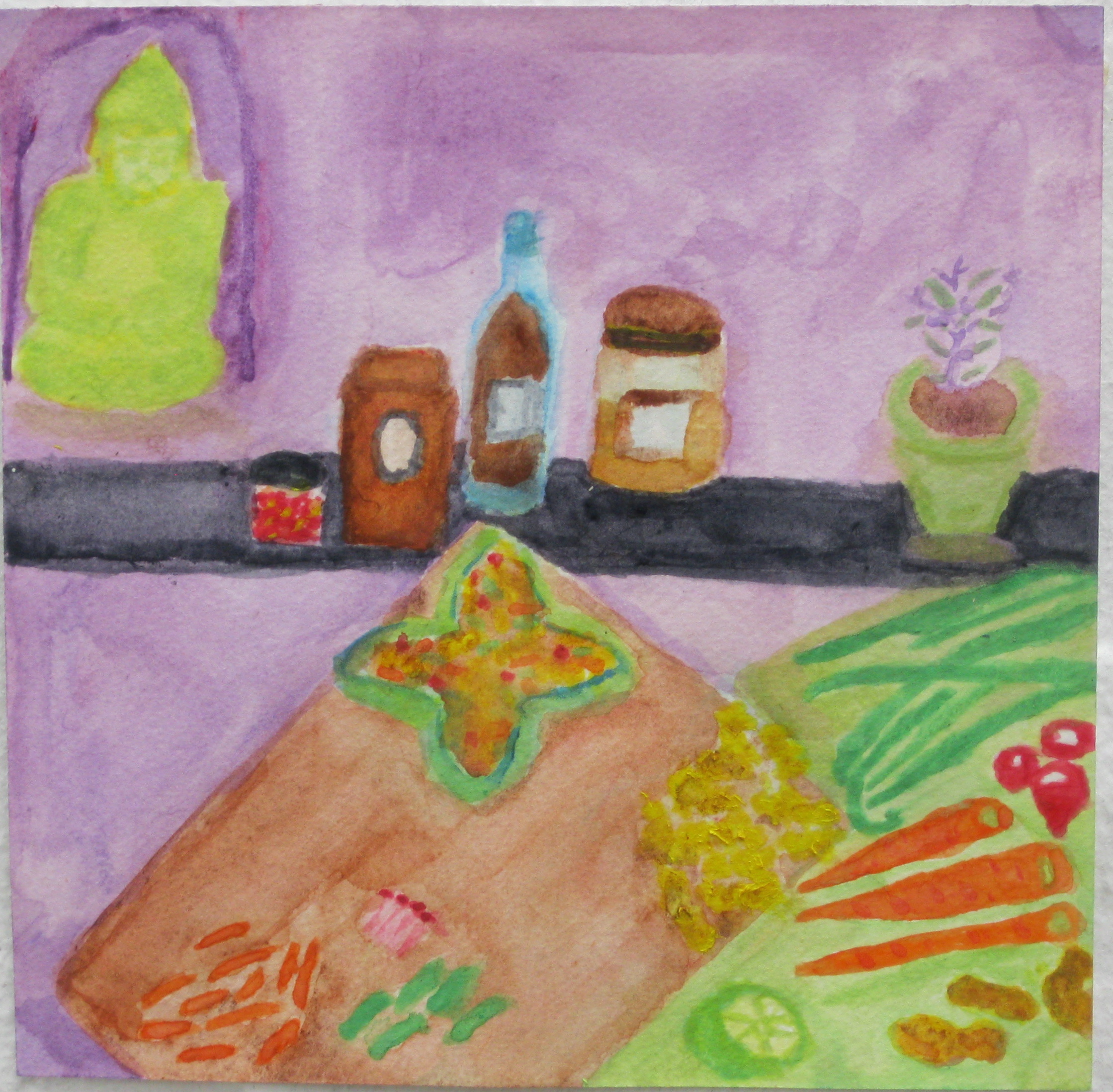
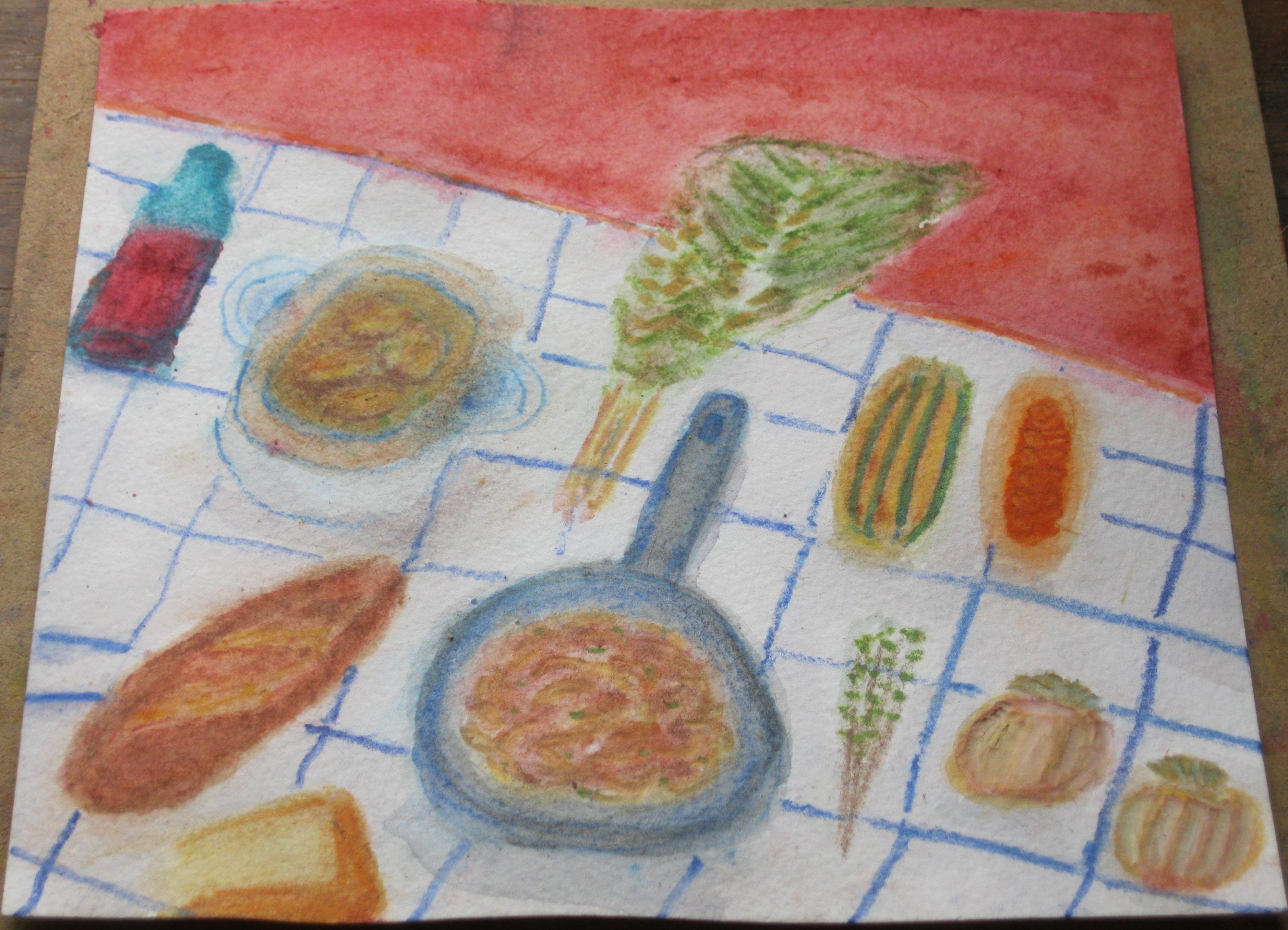
painting depicts onion soup and fall vegetables

Onion Soup, 8″ x8″ watercolor pencil and gouache. Sharyn Dimmick

Today we had our first real fall day: when it dawned with blue sky and white clouds there was a distinct chill in the air, a crispness. By 11:30 I was digging cashmere sweaters and long underwear out of my camphor chest. When I went down to the kitchen for lunch, I grabbed the last bowl of vegetable soup from the refrigerator.

Because I have been gone for three days I looked around the counter and into all of the covered pots in the fridge. First I found a pan of meat brownings. Then my eye fell on two large onions from last week’s farm box and a half-loaf of crusty sourdough. The butter plate with a smidge of unsalted butter clinched it: we would have French onion soup for dinner and because I would need to brown the croutons in the oven we would have another Gravenstein apple pie. I’ll roast delicata squash while I’m at it and there is some Swiss chard with our name on it. Dinner will come together in a snap.

I began by peeling and slicing the two large onions as thinly as I could, while I heated a skillet and added a little olive oil and all of the butter I could scrape off the butter plate. After I put them in the pan I cleaned the cutting board, composted the onion scraps and took four large apples from fridge, checking to make sure we still had pie crust. By this time, Mom was back from errands and made tea so I turned off the browning onions and retreated upstairs for a cup of tea. By then it was raining, making me glad to be inside cooking and puttering.

Tea finished, I peeled apples for the pie and cut the squash open. I started scooping seeds into the compost and then realized I could start a vegetable stock with apple peels and squash innards, not to mention the tough ends of Swiss chard, so I covered the seeds and strings from the second squash with some water in a saucepan and set it to simmer with the apple peelings and trimmings.

Classic onion soup uses Gruyere. Gruyere is rare in our house, as is any kind of French or Swiss cheese. What we have is Parmesan, since throwing the lemon Stilton in the tomato tart last week, so I will shave Parmesan onto croutons to top the soup. Browned Parmesan is delicious (sometimes I eat it on buttered whole wheat toast) so I don’t see this as a problem.

French Onion Soup

Put on a skillet to heat over medium heat.

While skillet heats, peel and slice thinly:

2 large onions

Add about 1 Tbsp olive oil to skillet, plus a little butter — maybe 1 tsp

Brown onions slowly over medium heat — if you don’t stir them much they will brown faster.

While onions brown, slice

4 slices of crusty bread and

Slice cheese to taste (I used an ounce or two of Parmesan, but you can use anything you like)

Add 1 tsp thyme to onions

Season with black pepper and salt to taste.

Put browned onions in oven-proof casserole with a broad opening.

De-glaze onion pan with 2 Tbsp of wine and add to onions in casserole.

Add 1 pint chicken stock. If you have brownings from another project, add them too.

Preheat oven to 375 degrees.

Place slices of bread on top of onions and broth. Add cheese. Bake until cheese browns.

Serves four, or two very hungry people.

If you want to emulate my style of cooking, consider what else you can bake in a 375-degree oven. In my case, it was apple pie and two delicata squash, which I baked cut side down in a Pyrex pan. When they were done, I flipped them cavity side up, added a dot of butter, a tsp of homemade syrup (brown sugar, honey, water and the dregs from a bottle of maple syrup) and black pepper and let them bake for five more minutes. You could also add ginger jam or chutney to season the squash instead of syrup, or just use brown sugar and butter.

While everything baked, I cleaned and chopped a bunch of Swiss chard, separating the stems from the leaves. Using the onion skillet, I heated about 1 tsp of olive oil and cooked the stems first for a minute or two, then added the shredded leaves, covered and steamed for five minutes in the water that was clinging to the leaves.

After we ate the squash I added the roasted skins to the stock pot — I’ll boil it again tomorrow. Eventually, I’ll reduce it, strain it and freeze it and have it on hand for the first batch of butternut squash soup later in the fall.

Painting Note: For information on “Onion Soup” or any watercolor painting, please go here.

When I saw the list of vegetables from Riverdog Farm today I knew what I would be cooking soon: it is what I cook when zucchini first swings into season, along with corn and the first tomatoes — pancakes made of grated zucchini and fresh corn, bound with egg and a little flour, seasoned with fresh herbs, fried in butter and olive oil and topped with halved cherry tomatoes and a spoonful of sour cream. Can you say summer? Even late summer, as it turns out., or early fall. The seasons are wacko in California this year, with long spring rains and chilly weather, so all of our crops are later than usual.

Painting of Zucchini-Feta Pancakes and ingredients.

Zucchini-Feta Pancakes with Fresh Corn. 8″ x 8″ gouache and watercolor pencil. Sharyn Dimmick.

I first saw a recipe like this in Mollie Katzen’s Moosewood cookbook. As a non-lover of zucchini, I immediately saw the camouflage possibilities (My other go-to zucchini recipe is gingerbread muffins with grated zucchini). The first time I made it, I made it by the book. The next time I added fresh corn kernels and began topping it with tomatoes and sour cream, I love feta cheese — it is one of the cheeses I prefer to keep on hand, along with Parmesan, extra sharp cheddar and Gorgonzola — if I could only have four cheeses, those would be the four.

Why don’t I like zucchini? Does anybody care? I find the skin is often bitter and the flesh either bitter or insipid. I’m always disappointed when some Chinese restaurant fills their kung pau chicken with zucchini. I grew up eating zucchini baked in tomato sauce and topped with cheese and didn’t like that much either, but I am happy to make these pancakes whenever zucchini appears in the veggie box.

Here goes:

Zucchini-Feta Pancakes with Fresh Corn and Cherry Tomatoes

Grate 4 cups of zucchini. Salt it lightly and leave to drain in a colander for fifteen minutes.

While zucchini drains, separate 4 eggs, yolks into large bowl, whites into a small one.

Beat the egg whites until opaque and fluffy.

Add to egg yolks:

1 cup crumbled feta cheese (You can buy a block and crumble it with a fork or your fingers)

1/3 cup whole wheat pastry flour

chopped fresh herbs to taste — I like mint and dill. Basil is also good, or chives if you like an onion-y presence.

drained zucchini

kernels cut from 2 or 3 ears of fresh corn.

Fold in reserved egg whites.

Heat a skillet over medium-low heat. Fry cakes in a mixture of butter and olive oil (I usually scoop 1/4 to 1/3 cup of batter out with a measuring cup for each pancake).

Serve with halved fresh cherry tomatoes and a spoonful of sour cream or yogurt, or top with applesauce for a latke nouveau.

Notes: I often make just half a recipe, using two eggs and two cups of zucchini. And you don’t have to have zucchini — you can make this with crookneck squash, patty pan, or whatever summer squash comes your way, including mixtures of varieties.

If you don’t like feta, improvise with some soft cheese that you do like.

I haven’t tried this with grated winter squash or sweet potatoes yet, but it’s only a matter of time: you could even use summer and winter squash together as their seasons cross if you like both of them. And, of course, you can grate other things into them, but this is the way I like them.

Painting Note: I just updated the About page to include some notes on my painting media and process. If you are curious about the paintings, take a look. For information about “Zucchini-Feta Pancakes” or any other original painting please contact me here.

Painting of Bengan Bharta and Ingredients.

Bengan Bharta. 8″ by 8″ gouache and watercolor pencil. Sharyn DImmick

When I was in my last year of college at U.C. Santa Barbara I lived in an apartment on Pardall Road with a roommate from Thailand and one from India. I had just come from a year as an exchange student in Ireland and was happy to serve as a cultural interpreter as necessary for Karuna and Padma. I also reveled in the exposure I got to Thai and Indian foods and recipes. I ate my first dosa and raita, my first green papaya salad, and got hooked on both cuisines, so, keeping a seasonal and local focus, I sometimes make forays into Thai and Indian cooking.

For me, that requires cookbooks, although I can fake Thai soups and noodle dishes by now (some of you may have seen the peanut sauce recipe recently). I own Charmaine Solomon’s “The Complete Asian Cookbook” and Shanta Sacharoff’s “Flavors of India,” but my favorite Indian cookbook comes from Berkeley’s own Ajanta restaurant: it’s called “Ajanta: Regional Feasts of India” by Lachu Moorjani. Ajanta is simply the best Indian restaurant I have ever eaten at (I have never been to India). Moorjani cooks with what’s in season, rotating regional dishes through his menu each month. If you can go once a month, go, but take other people with you so that you can sample each monthly special.

This week the CSA from Riverdog Farm contained about three pounds of tomatoes, a pound of bell peppers and two purple and white speckled eggplants. When tomatoes and eggplants come together in the fall, I like to make baingan bharta or bengan bharta, an Indian dish of chopped roasted eggplant simmered in a sauce with fresh tomatoes, ginger, onions, a green chile, paprika, turmeric, cumin seeds, coriander and cayenne. I loved this dish the first time I tasted it, right out of the Tasty Bites package, but thanks to Moorjani I now know how to make my own from scratch.

Without further ado, Moorjani’s recipe, followed by food notes from me where I explain a few minor adjustments I’ve made and give some procedural information.

Baingan Bartha (Pureed Roasted Eggplant with Onions, Tomatoes and Spices)

2 large round eggplants, about 1 pound each.

6 Tbsp oil (I used between 2 and 3  of peanut oil — more on that later)

2 tsp cumin seeds

2-inch piece of fresh ginger, peeled and finely chopped ( I mince mine and don’t bother to peel it)

1 hot green chile (serrano or jalapeno), chopped

3 medium onions, peeled and chopped

6 medium tomatoes, chopped

4 tsp paprika

1/2 to 1 tsp cayenne

2 tsp turmeric

2 tsp coriander

2 tsp salt (I cut it down to one)

1/4 cup chopped cilantro

I began by turning on the oven to 400 degrees, pricked my two eggplants with a fork and let them roast while I had a cup of tea and checked my email. When I pulled them out of the oven and set them on the stove to cool I peeled and chopped my onions and pulled my ginger out of the freezer where I store it. I hacked a slit in it and let it thaw slightly while I chopped a previously roasted green chile (just because I had it — if I hadn’t I would have used a raw one, but I have made this before). By the time I had chopped all of those onions, I could get the knife through the ginger and minced it while I heated 2-3 Tbsp of peanut oil in a big skillet over medium heat. When the oil shimmered, I measured out my cumin seeds and threw them in, quickly adding the ginger and chile, then the chopped onions. I cooked all that over medium heat for about 10 minutes while I chopped a monstrous 1 and 1/2 pound tomato, green in color, not in ripeness, and a smaller red tomato. I threw in another tomato I had roasted yesterday (waste not, want not, and this is a cooked dish). It was lovely to see the soft green, bright red and reddish violet of the vegetables before they cooked down. I cooked the tomatoes for five minutes.

While my tomatoes cooked I measured my salt and spices, scanting the salt and using the smaller amount of cayenne specified. Then I stirred the spices into the tomato mixture and turned to my now-cooled eggplant, stripping off the skin and chopping it finely.

If at any time my onions, eggplant, or tomatoes had begun to stick to the pan, I would have added a little more oil and turned down the heat a notch. This time I didn’t need to do either. Tomatoes, onions and eggplants vary in their water content, so you never know. Also, many cooks use more oil than I do, so I never accept oil measurements at face value unless they are in cake recipes and in cake recipes I might substitute  yogurt for some or all of the oil.

About this time I put on a pot of water for brown rice — I can’t tell you how much water because we measure it by sticking our index fingers into the rice pot and measuring water to the first joint. I can tell you that I have large hands and long fingers, as does my mother, who originated this technique and that we have cooked rice in the same pot since I can remember. The finger measurement is good for one cup of rice, brown or white: I used brown basmati. When the rice was in the pot I scooped the chopped eggplant into the skillet, scraping the bottom with a spatula to check for browning, It was fine, so I left it to go upstairs and ask Mom what she wanted instead of cilantro, which I was out of. I then went out to the garden and picked a combination of Thai basil and mint. I stirred the Thai basil into the eggplant and left the mint minced on the cutting board in case Mom didn’t want any. The recipe is good with cilantro, but one of the house rules here is that we do not go to the store for one ingredient: instead we make do, substitute, cook something else if necessary.

While the rice cooked and the baingan bharta finished cooking, I made a smoothie out of a nectarine, some buttermilk and a small handful of almonds. Because I was eating it with Indian food, I crushed a few cardamom seeds in a mortar and pestle and added them. Had I been at Ajanta I would have finished the meal with cardamom gelato and a pot of chai — and we would have gotten kabuli naan (flat bread with cashews) because my Mom is addicted to it. She would have ordered lamb and I would have browsed through the specials before making my decision.

If you are local, or visiting Berkeley, or, really, anywhere in the Bay Area, you should eat at Ajanta at least once. You will find it on the internet at http://www.ajantarestaurant.com. Moorjani sells his cookbook there, as well as a box of Indian spices, including some hard to find ingredients. This duo makes a fabulous present for the would-be Indian cook and the winter holidays will be here before you know it.

Painting Note: For more information about “Bengan Bharta” or any other original painting, please contact me here.

painting depicts ingredients for pasta with peanut sauce

Thai Pasta with Peanut Sauce 8″x8″ gouache on paper Sharyn Dimmick

The other day I started to think about what I had in common with kale:

1) I am not always sweet — sometimes I am quite bitter.

2) I am not to everybody’s taste: a little of me can go a long way.

3) I am rough around the edges

4) I am somewhat green.

5) I am tough.

Some people like kale in its raw state. Others like it lightly steamed or sauteed in minimalist preparations. For me to enjoy kale, it requires tender care and the presence of other ingredients that I like. Kale will never make the top of my favorite foods list, so I often resort to what I call camouflage cooking, a technique known to mothers everywhere, where you bury a vegetable in so many other flavors that it no longer calls attention to itself. You still get the nutritional value of the mean green vegetable which is very good for you: what you eliminate is what my Dad called “that nasty vitamin taste.”

Two weeks ago I met my friend Cathy at the Farmers’ Market in Berkeley and we began to discuss kale. She told me that she cooks it in a little oil with a little water and throws in walnuts and raisins at the end of the cooking. The raisins sweeten the kale, ameliorating the bitterness and the walnuts add richness and give the bitterness a different edge: it is like forgoing outright cruelty and making use of well-placed sarcasm instead.

Another way to camouflage kale is to turn up the heat: I have chopped kale leaves finely, after removing the ribs and stems, and thrown them into posole — hominy cooked with chiles or salsa, in chicken broth or pork stock, seasoned with lime. Canned Foods Grocery Outlet, Food Maxx and Mexican groceries sell posole in number ten cans: I usually open one, decant half of it into a big jar for the freezer, and throw the other half in a pot. I like to make posole with about half a jar of green salsa (maybe twelve ounces), a pint of chicken stock and the juice of one lime. If I want a sweeter flavor, I add chopped sundried tomatoes to it. The longer you cook the posole the better the kale blends with the other ingredients, melting into harmonious flavor.

The big guns of camouflage cooking with kale are peanut sauce and coconut milk. If you like peanut sauce, you know you can eat it on anything because what you will taste is peanut sauce. I make an instant peanut sauce that I eat on pasta in the following manner:

Put your pasta water on to boil. I like to use short pastas because they catch the peanut sauce (penne, fusilli, farfalle, — also known as twisties and butterflies). I usually use wheat pasta, but you can go authentic and use rice noodles if you want. Get out the bowl in which you plan to eat your pasta. Put into that bowl between two and three tablespoons of peanut butter (Please use natural peanut butter without added shortening). Squeeze one lime into the peanut butter. Add something hot — my favorite addition is Chinese chili paste with garlic, a teaspoon if you like heat, a quarter to an eighth teaspoon for just a hint. Get down your fish sauce or tamari and add a tablespoon. You now have hot, sour, peanut-y and salty. Add some brown sugar: start with a teaspoon and trade up — this will be a matter of taste and opinion about how much sugar you want to consume. We like it sweet. If you want it even sweeter, add some coconut milk from a can — a few tablespoons should be sufficient. To get it right for you, you will have to stir and taste the raw sauce. It isn’t going to hurt you — just don’t eat it all in the tasting phase or you may have to start over.

Before it is time to drain the pasta, I have usually had enough time to julienne some carrots and/or radishes, chop some broccoli or green beans or cucumber. Carrots, radishes and cucumber go directly into your bowl with the peanut sauce. Broccoli or green beans go into the pasta water for the last minute of cooking, after which you drain the pasta and vegetable and add it directly to your pasta bowl. Garnish with basil, Thai basil, cilantro, or chopped fresh mint. Toss madly.

I developed this recipe when I lived and cooked alone. It is an ideal one-person pasta. If I make it for two, I generally stir up two individual bowls of sauce. If I want to make a lot, I start with a big serving bowl rather than individual bowls, use larger amounts of sauce ingredients and might pop it in the microwave for a minute to make sure the peanut butter softens. If you like, make extra: it reheats well if you leave out the cucumber, or it can be eaten cold.

Thai Pasta with Peanut Sauce:

Boil water for one serving of pasta

While water comes to a boil, stir together in pasta bowl:

2 Tbsp peanut butter

1 Tbsp fish sauce

Juice of 1 lime

1 tsp chili paste with garlic

1 Tbsp brown sugar (or more or less to taste)

Julienne 1 carrot and/or three radishes. Chop some cucumber if you want. Add vegetables to bowl of sauce. By now, your pasta water should be ready. Start cooking pasta.

Cut up some broccoli or green beans. Add to pasta water in last minute of cooking.

Drain pasta and vegetables and add to sauce in bowl. Garnish with basil, Thai basil, cilantro or fresh mint. Stir it thoroughly with your fork. Enjoy.

Painting Note: For information about “Thai Pasta with Peanut Sauce” or any other original painting, please contact me here.

Painting depicts apple pie ingredients: flour, butter, apples, cinnamon, nutmeg.

Gravenstein Apple Pie 8″x8″ gouache and watercolor pencil Sharyn Dimmick

2023 Recipe Update: Some years ago the manufacturers changed the formula for Crisco, which changed the texture. Now I use 1/3 cup butter, 1/3 cup Crisco and 1/3 cup lard for the shortening in pie crust.

Sometime in August Gravenstein apples come to the Berkeley Farmers’ Market. By early September they are gone. As soon as I see them I start buying them, buying no fewer than ten pounds at a time and stashing them at the back of our very cold refrigerator to make Gravenstein apple pie.

Gravensteins are an early apple here. They come in before Pippins, before Pink Ladies. They are perfect pie apples, tart and crisp with an intensely apple flavor. I grew up eating green Gravensteins from my grandmother’s tree in El Cerrito, climbing into the crotch to pick them, picking up windfalls to trim for pies and apple sauce. When the crop was bountiful, Mom would peel and quarter apples and save them in the freezer for later in the year.

Gravenstein apple pie initiates apple pie season at our house. The season will finish when we pick the last apples from the dwarf tree in our backyard, when the market moves to winter citrus, when I can no longer scavenge fallen apples in the streets of Berkeley (It’s amazing to me how many people have apple trees and let the fruit fall where it is smushed under the wheels of cars — we seem to have forgotten what food is and where we can get it as well as how to cook).

To make apple pie you need two things: good cooking apples and flaky, tender pie crust. If you do not live where Gravensteins grow, consult farmers at your local farmers’ market for recommendations for local apples. Let them know you will be making pies with them. Pippins also make fine apple pies.

To make pie crust, follow my mother’s recipe, given below. Do not deviate from it if you want good results. It may look a little different than other recipes you have seen or tried: for one thing, it does not start with two sticks of butter and does not include ice water. It is a Swedish pie crust and includes an egg and vinegar — don’t ask me why, just trust me on this one.

What does it use instead of butter? Vegetable shortening — you know that stuff that comes in a can. You are worried about transfats. I know. You have never had Crisco in your house. Well, you need it to make Madge’s pie crust. The only acceptable substitute is lard: if you use butter instead you will get a heavy, greasy pie crust, so don’t do it — just follow the recipe. You don’t eat pie everyday and a little vegetable shortening isn’t going to kill you, so use Crisco or use lard and get on with it.

Measure into a large mixing bowl:

3 cups unbleached flour
1 tsp salt

Cut in :

1 cup shortening, comprised of 1/3 cup butter, 1/3 cup Crisco vegetable shortening and 1/3 cup lard

Stop when the shortening is in pieces the size of small peas.

Into a one-cup measuring cup, break

1  large egg

Whisk it with a fork until blended. Then add:

1 Tbsp cider vinegar and
Water until mixture measures a little more than 1/2 cup.

Whisk liquids to blend. Add to flour-shortening mixture. Stir just until blended, then work with your hands to shape crust into a large patty. Wrap the patty in waxed paper and refrigerate it while you make the filling. Do not wash the mixing bowl yet — you are not done with it.

For a standard two-crust apple pie, peel and core 4-5 large apples, cutting them into quarters and slicing them crosswise. If you want your apples to stay white, keep a cut lemon handy and squeeze it periodically onto your sliced apples. Taste your apples though — if they are quite tart you may not want to add lemon: just let them darken.

Put the sliced apples in your mixing bowl (the one that you didn’t wash). Toss them with:

1/3 to 1/2 cup sugar, depending on sweetness of apples.
1 tsp cinnamon
1 tsp nutmeg.

Preheat your oven to 375 ( 350 if using Pyrex).

Now roll out your crusts. Remove pie dough from the refrigerator and cut it into quarters. Wrap two quarters back up and store them in the refrigerator for another pie (They’ll keep more than a week if wrapped well).

Flour a bread board, table, or other work surface, or place a thin linen or cotton kitchen towel on a surface and flour that. Or flour a new-fangled Silicone mat, which makes rolling out thin crust a lot easier. Flour a rolling pin.

Take your first quarter of dough and round it into a circle with your hands, smashing it slightly. Now pick it up and turn it over. Take the rolling pin to it, rolling in all directions, trying to keep it circular and making sure to roll out any thick edges. Do not be afraid — use a firm, light hand. Roll it thin. When you think it is large enough, take out your pie tin and set it on top of the dough: the bottom crust has to be larger than the pie plate because it has to cover the sides and make the edge crust. When you are satisfied, fold the crust in half and again into quarters. Pick it up, plunk it in the pie tin and unfold it again. If it tears, don’t worry you can patch it with more crust glued in place with a little water. If you guessed wrong, you can patch in crust above where yours ends and roll out a rim crust with your fingers by rolling scraps into a rope.

Now add the apple mixture to your bottom crust. Dot apples with a little butter. Roll out the top crust and place on top of the apples. Make sure to attach the top crust at the edge of the pan. Slash the top several times with a knife, prick holes with a fork or channel Martha Stewart and make cut-outs (Guess which of these things I don’t do?).

Bake pie for 45  minutes. Serve warm. Top with ice cream if desired.

Food notes: this recipe makes a tart pie. We like them that way: the taste of the fruit comes through. We scant the sugar in every pie we make and we always taste the fruit as a guide to how much sugar to add. Our pies do not have the gluey sweetness and texture of commercial pies you may have eaten.

Madge’s recipe makes four crusts: we have never cut it down. We either make two pies at once, or save the crust for another day and another pie — lemon? Quiche? Chicken pot pie? Tomato tart!

While you are enjoying your apple pie I will be traveling to New Mexico on September 4 for a writing retreat with Natalie Goldberg. I will be in silence for five days, unable to check my email or read and respond to your comments. I will attempt setting my blog robot to send you a recipe while I am gone and I will respond to all questions and comments upon my return on September 12. I’ll miss you, believe it or not. I leave you with an unfair question for pie fans: What is your favorite pie?

— Sharyn

Painting Note: For information on “Gravenstein Apple Pie” or any other original painting, please contact me here.

Painting depicts ingredients for recipe polenta with peaches

Summer Breakfast. 8″x8″ gouache and watercolor pencil Sharyn Dimmick

My mother went to Reno for a few days, leaving me in the house with our three cats, so I had three days to observe how I cooked for myself while she was gone. When I lived alone I developed a fondness for one-bowl cooking, complete meals that fit in a single bowl. Friday morning I made one of my favorite summer breakfasts, polenta cooked in milk, seasoned with vanilla extract and stirred into a bowl of diced peaches. It was so good that I made it again on Saturday — in fact, it is what I eat for breakfast any time we have fresh peaches in the house, usually from late May through early October.

The secret to this recipe is a fresh, tree-ripened peach. I buy most of my peaches from Frog Hollow Farm at the Berkeley Farmers’ Market. In formerly flush years I would buy them by the flat and we would eat peach waffles, peach bread pudding, peach cobbler. I would freeze peach puree to make waffles in the winter or spring. Now I buy them a few at a time: I bought four last Saturday, two Cal Reds and two O’Henry’s, enough for four breakfasts.

The other secret is cooking polenta in milk, which makes it lovely and creamy. I began cooking grains in milk when I broke my first bone five years ago, started cooking oatmeal in a cup of milk to make sure I would get daily calcium in the food I ate.

To make this dish, go out and pick a peach from your tree or buy a soft, sweet peach from your farmers’ market. Slice it and then chop the slices into smaller chunks. Put this into your cereal bowl. Then film the bottom of a saucepan with a little water, add a cup of milk, a dash of salt and a quarter-cup of polenta. Cook over medium high heat until it starts to bubble, then reduce heat to a simmer until it thickens enough to your liking. It’s a good idea to stir it frequently so that it won’t stick to the pan. When it’s done, remove it from the heat and stir in a capful of vanilla extract. Pour it over your peaches in your bowl, stir and dig in. The polenta warms the peaches. The juice from the peach sweetens the polenta. The yellows and oranges look like summer in a bowl.

 Depicts ingredients for whole wheat pasta with cilantro pesto and green beans

Cilantro Pesto with Green Beans. 8″x8″ gouache and watercolor pencil Sharyn DImmick

At lunch-time on Friday, I looked at the cilantro that I had bought a week before and stuck in a glass on the counter — I needed to use it. Cutting off the stems, I broke each leaf from its stem and tossed it into my blender. I went out and picked a Meyer lemon from the front yard, cut it, and squeezed it into the cilantro. I diced a red onion and minced half a clove of garlic. I added some chopped walnuts from our freezer (new crop has not come in yet). I moistened the mixture with some olive oil and started blending it while I got out some rinds of Parmesan, which I grated with my microplane. You can get a microplane, otherwise known as a rasp, at any hardware store — don’t bother with expensive versions from cooking stores: it is the best tool I know for grating hard cheeses and zesting citrus. I gave the blender a stir and added the cheese and a tiny pinch of salt.

Pesto done, I put on some water to boil and got down a package of whole wheat penne, taking out about a quarter pound (four ounces). While the water heated, I topped and tailed a large handful of fresh green beans and snapped them in half. I cooked the pasta for seven minutes or so, then added the green beans to the pasta water, cooking them for one minute more. I drained the pasta, scooped some cilantro pesto into a pasta bowl and stirred like mad to distribute it. It made a little more than I could eat — measurement is not my forte when I am not following a recipe — so I had a small serving leftover for Saturday’s lunch, which I ate cold — equally delicious. The lemon and onion in the pesto and the bitterness of the walnuts play off the sweetness of the green beans and whole wheat.

For dinner, I ate leftover Greek salad on Thursday and made a sandwich of leftover roasted pork loin with leftover apple coleslaw on Friday

Whole Wheat Pasta with Cilantro Pesto:

Combine in jar of blender for pesto

1 bunch cilantro, stems removed.
1 lemon or lime, zested, than juiced or squeezed
1 small red onion
1/2 clove garlic
2 Tbsp freshly grated Parmesan cheese
Olive oil to moisten

Salt to taste

3 to 4 oz whole wheat pasta per person.

1 large handful of fresh green beans, trimmed and cut in half.

Blend pesto. Cook pasta until almost done: about a minute out, add green beans to pasta water. Drain pasta and beans into a pasta bowl. Add some pesto and stir or toss to mix. If you have leftover pesto, it will keep in the refrigerator for a week, or you can freeze it.

When Mom got back Saturday afternoon she asked if there was any cooked food on hand. Nope. I told her I had eaten all of the leftovers. We ate bread, cheese, grapes (me) and tomatoes (her).

Painting Note: For more information on “Summer Breakfast” or “Cilantro Pesto with Green Beans” or any other original painting, please contact me here.

original watercolor of kale, tomatoes, onions, pen and ink bottle.

The Kale Chronicles. 8″x8″ watercolor pencil and gouache by Sharyn Dimmick

Few things reliably capture my interest more than messing with food and telling stories, whether in song, in images or on the page. I subscribe to a community-supported agriculture program each week, receiving a box of organically grown fruits and vegetables from Riverdog Farm in Guinda, CA. I began subscribing in 2007 and remember rhapsodizing over the taste of iceberg lettuce, green and fresh, picked that morning.

I also remember that first June when kale showed up in the box. I had never eaten kale. I had never seen kale. My friend Elaine loves it, steams it in the microwave and gets out her fork, but I did not fall in love with minimalist kale. I pored over cookbooks, learning to remove the ribs and stems before cooking it. I tamed it with acids: tomato sauce and lemon, vinegar. I added Indian spices and raisins. I chopped it into red lentil soup with plenty of garlic and fresh ginger (It gave my Mom gas and I had to eat it all myself. Ahem).

I do not hate kale. I have aversions to avocado and asparagus, tuna, mayonnaise, hard-cooked eggs and okra. Instead I consider kale to be a worthy adversary, something to be struggled with and mastered. I strike up conversations about it: “Do you eat kale?” “How do you cook it?” Kale keeps me on the lookout for new preparations, new techniques.

I have eaten red Russian kale, dino kale, curly kale in the last four years. I have combined it with spinach in lasagna. Two weeks ago I made an African peanut soup featuring onions, peanut butter, tomatoes, carrots, sweet potatoes, fresh green beans, garbanzo beans, kale, cilantro and lime. Everything but the peanut butter, lime, garbanzo beans and sweet potatoes came from the farm box — the sweet potatoes came from a farm stand in Suisun near where my sister-in-law lives. The soup was so good that I took it to a music potluck and when they ate it all I made another batch with the last of the ingredients. Here’s to Africa where they know how to cook kale!

African Peanut Soup (adapted from a recipe from yummly.com)

Saute 1 chopped onion, 3 minced garlic cloves, 1 Tbsp fresh ginger, 1 minced chile pepper in 1 Tbsp peanut oil. While that cooks, chop 4 fresh tomatoes. Add 1 Tbsp curry powder to saute mixture and stir to toast it. Add tomatoes, plus 1/2 cup peanut butter, 8 cups water or stock, 1 Tbsp tamari. Stir well and bring to boil.

While the soup cooks, chop 2 carrots and 2 large sweet potatoes. Add them, plus 1 can of garbanzo beans. Cook until tender while stemming and chopping a large handful of green beans and half a bunch of kale. Add green beans. Cook for 10 minutes. Add chopped kale and juice of 1 lime. Cook 10 minutes more. Garnish with chopped cilantro.