Archives for category: Uncategorized

Dear Readers,

Today they are voting for the best cake over at Movita Beaucoup. My Mexican Chocolate Beet Cake is in Group Three. You might not think it is the best cake there, but if you are a cake fan you might enjoy looking at the displays of cakeness. Here’s what Movita had to say:

“A vote for Sharyn is a vote for art. And a vote against using red food colouring to create a trend that is way stupid.”

Don’t you like the way she talks?

painting depicts Mexican chocolate beet cake and ingredients.

Mexican Chocolate Beet Cake. 8" x 8" Gouache and Watercolor Pencil. Sharyn Dimmick.

There are four groups of cakes at Movita’s, with links to blogs, photos, stories, so if you just need to look at cake right now get on over there.

I’ll be back with some kind of non-cake seasonal food and a new painting on Wednesday before midnight.

Thanks, as always, for reading The Kale Chronicles.

— Sharyn

P.S. The voting is closed now. The prize went to a sweet little cake made by one of Movita’s ballet students, flanked by heart-shaped notes from the others. Thank you for every vote for art and for beet chocolate cake. Movita has decided to make this an annual event, so you can get your cake on next year if you want.

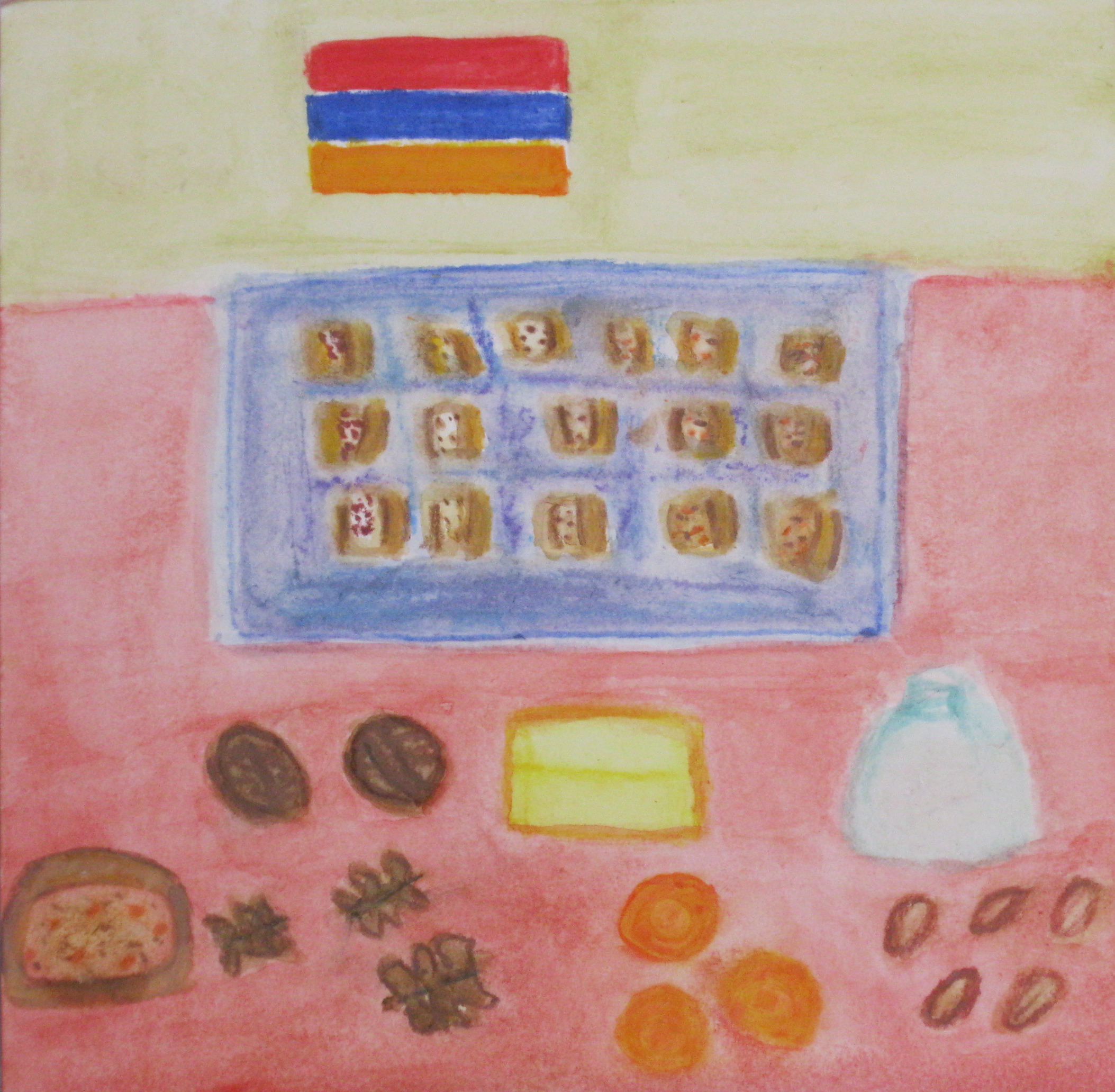
Painting depicts tray of nazook, a filled Armenian pastry.

Nazook. 8″ x 8″ Gouache and Watercolor Pencil. Sharyn Dimmick.

The Daring Bakers’ April 2012 challenge, hosted by Jason at Daily Candor, were two Armenian standards: nazook and nutmeg cake. Nazook is a layered yeasted dough pastry with a sweet filling, and nutmeg cake is a fragrant, nutty coffee-style cake.

Now that the required opening paragraph is out of the way, I’ll tell you about the baking. Although I was excited to see two baked goods that I had never heard of, I was distressed when I read the ingredients: both recipes contain an awful lot of butter and sugar. I decided that nazook was the lesser of the two evils, nudged by the fact that Mom generally likes yeasted pastries and doesn’t like cakey coffee cakes.

I made a half-recipe of nazook pastry dough as instructed:

Nazook Pastry Dough

Stir together 1 packet of dry yeast (not proofed) and 1 and 1/2 cups sifted flour.

Cut in 1 stick (8 oz.) of soft butter.

Stir in 1/2 cup sour cream (I made mine from the cream leftover from last week’s strawberry shortcake, soured with a teaspoon or so of buttermilk)

Knead until well-mixed.

Wrap and refrigerate overnight — I left mine in a metal mixing bowl, and secured a tea towel over it with a rubber band.

Then make the filling. Right. The traditional nazook filling given was full of flour, sugar and more butter, but Jason did say you could fill it with anything but chocolate and he even gave the chocolate lovers a dispensation to use that. I couldn’t bring myself to make it. Instead, I made some rustic almond paste by pounding 1 cup of granulated sugar with two cups of raw almonds in a mortar and pestle and adding 1 tsp each of vanilla and almond extract. Almond paste takes egg white and the pastry called for egg wash made from an egg yolk, so I added 1 egg white to the almond paste just before I filled the pastries.

The next morning I was in the kitchen before breakfast to divide the dough in half and to roll each half into a long, thin rectangle. The pastry resisted rolling and I had to work quite hard and patiently to get the long rectangle. After you get the rectangle rolled out, you spread the filling on it and roll it up long side to long side — the opposite of how you would make cinnamon rolls. Flatten the roll slightly with your hands, brush it with egg wash, which also helps seal the edges and cut it into smaller pieces. I cut eight from each roll — I could have cut ten from the first one. The second “half” of the dough proved to be a little smaller.

But you see, I can’t leave anything alone. When I saw that the almond paste was running a bit low after the first batch, I quickly cut up some dried apricots and soaked them in a little hot water. I mixed those in with the remaining almond paste for the second batch. I had trimmings left from the ends of each roll and some edges that I squared up, so I rolled those into a small rectangle, cracked some walnuts, spread this dough with a tablespoon of butter, a sprinkle of sugar and cinnamon and some walnut pieces.

Place filled pastries on baking sheet. Bake at 350 for about twenty-five minutes

The results: Nazook turns out to be a tender pastry, dark and shiny from the egg wash. Our favorite filling turned out to be the last one: butter, sugar, cinnamon and walnuts, but I liked the almond paste with apricots, too, and my sister-in-law liked the ones with the almond paste. Next time I would make classic almond paste, by blanching the almonds, mixing them with confectioners’ sugar, egg whites and extracts and grinding it all in the blender.

Proper almond paste:

Blanch 1 and 1/2 cups almonds by boiling them in water for a few minutes. Drain, cool slightly and slip off the skins with your fingers.

Sift 1 and 1/2 cups confectioners’ sugar

Add 1 egg white and 1 tsp almond extract.

Blend all ingredients in blender until combined.

Food notes: I wish I had had some cream cheese, quark or cottage cheese in the house because I think Nazook would be lovely with a sweetened cream cheese (or ricotta) filling. I might try mixing dried cherries into almond paste as well since I liked the apricot-almond combination. Because the dough for Nazook contains no sugar and produces tender pastry, I am tempted to try making savory pastries with it some time, using mushrooms, sun-dried tomatoes, chard and cheese.

Photo shows green corn worm in ear of organically grown yellow corn.

Unseasonal corn worm.

It’s been that kind of week. The kind of week when you flush the toilet and it doesn’t work the first time. The kind of week when your browser refuses to work on the day you plan to book your airfare to Europe. The kind of week when you make a carrot and fennel soup from a recipe in the newspaper. You use the freshest of ingredients and the best of milk and the soup is blah, boring, and an unattractive color. By your third bowl of it in three days you steam some beet stems and puree them to add to the soup and that fixes the color issue, but not the taste.

You make one of your favorite breads and one loaf is fine and the other is gummy in the middle. Your mother hangs out three loads of clothes and you look up from a dinner of shrimp diablo and beet greens with cumin, only to find out that it is raining.

You are planning to make a birthday cake. You thought you would get it done today, but the beets you are cooking on the stove release beet-colored steam all over just as you are about to leave the house to catch the bus to get your weekly vegetables. Fortunately, the birthday girl lives far away and you only promised to email her a photo of the cake by Friday midnight.

You didn’t think when you started this blogging gig that you would ever miss a post. That is until you got norovirus in February, which slowed you down for three awful days. You don’t have norovirus now, but you might as well have because it would fit right in with this kind of week. You try to add a new scan of a painting to this apology post and your scanner has apparently lost its ability to communicate with your computer or vice versa.

So what can I say? I’m sorry. Nothing new I have made this week has worked out well yet and I’ve already given out the recipes for the other things we have been eating. I’ll be back in a few days, I expect, perhaps with that cake.

In Northern California spring can start in February and continue through May. First we see daffodils, then flowering pear, plum, crab apple and quince trees. Spring crops come in slowly: green garlic, lettuce, then asparagus, followed by peas. On my last Farmers’ Market visit two weeks ago the strawberries had white shoulders and the grower I like to buy them from (Lucero Farms of Lodi) had not yet taken up a stall, but I had a feeling I would find strawberries today, and there they were, small red Seascape berries with long stems destined for the year’s first strawberry shortcake.

Painting shows a heart-shaped strawberry shortcake and baskets of berries.

Strawberry Shortcake. 8″ x 8″ Gouache and Watercolor Pencil. Sharyn Dimmick

There are many variations of strawberry shortcake: you can make it with angel food cake or lemon pound cake or sponge cake or olive oil citrus cake. I have tried them all, but my favorite recipe for strawberry shortcake is a biscuit base, split and covered with fresh strawberries, served with lightly sweetened whipped cream. To honor the ritual of spring I will use organically grown Farmers’ Market strawberries, and whipping cream from Straus Dairy in Marin County.

I will buy my cream at a local supermarket, but because it is Earth Day I want to think a bit about what it took to produce this traditional spring dessert. Someone had to plant the strawberries, tend them, water them, pick them, bring them to market. Someone had to raise sugarcane and refine it. Someone mined the salt, picked vanilla pods, raised wheat, ground it into flour. Someone had to raise the dairy cow, feed her on grass, milk her. Someone had to separate the cream, sterilize the bottles, fill and cap them. Someone had to drive the cream to the supermarket. Someone had to put it on the shelves. Someone had to drive the bus that takes me from market to market and home again. In a day gone by, members of my family, relatives from a few generations back, might have kept the cow and skimmed the cream and planted the strawberries in Illinois where they farmed, but my parents both moved to California as teenagers and never went back to the Midwest. Celia’s small farm at The Kitchens Garden might be something like the farms my mother knew in her youth, farms with hedgerows, vegetable gardens, small orchards, cows and chickens, diversified crops.

In California I now buy the bulk of my produce from an organic farm eighty-seven and a half miles from where I live. Someone drives to Berkeley each Wednesday and places boxes of vegetables and fruit on a front porch. I take a bus and walk several blocks, load the heavier vegetables into my backpack and the delicate items into a canvas bag. I have no choice in what goes into my produce box: someone at Riverdog Farm decides what is best each week and loads it up. I unpack the box and fold it: the farm driver will collect it the next week. I like the idea that I am getting produce picked that morning or the previous day and I like it that in a small way my food dollars are supporting small, diversified agriculture on a farm that uses organic growing methods: although I cannot farm myself I have farming roots. Small farmers are real to me,  people that raise food and think about how they are raising it. The Capay valley where my produce comes from has many small farms started by former students at U.C. Davis on land that agribusiness did not want.

I shop at the Farmers Market to supplement my produce box. There I can buy a flat of peaches in June, more corn in July, bunches of fresh basil in August, these first spring strawberries in April. Every week I can walk down the center aisle and look to see what has come in, compare prices, sniff the air perfumed by seasonal fruit. I am grateful to live in a state where the growing season is long and next to a city that supports three different farmers’ markets year-round.

Enough. Now it is time to go into the kitchen to make that special shortcake with the first strawberries.

First, shake the cream bottle to redistribute the fat evenly. Then pour the grassy-smelling cream into a small mixing bowl and set it into the refrigerator to chill, along with the beaters. The cream will triple in volume as you whip it, so make sure your bowl is not too small. If you wish, you may season it at this point: I like to add  2 and 1/2 tablespoons of sugar and 1 tsp. vanilla and, sometimes, the barest grating of fresh nutmeg.

While the cream chills, prepare the shortcake:

Preheat the oven to 425.

Sift together 2 cups of flour

1 Tbsp baking powder

1/2 tsp kosher salt

2 Tbsp sugar.

Cut in 1/3 cup unsalted butter (if you use salted butter, omit the kosher salt)

Add 1 cup milk

Stir just until combined.

Put into a buttered cake pan.

Bake for 12 to 15 minutes until lightly browned in spots.

While the shortcake bakes, prepare the strawberries: remove the hulls and stems and then wash berries in a minimum of water. Let them drain in a colander or pat them dry. Taste one. If your berries are ripe and sweet, you need not add anything, but if you are my mother you will insist on adding a few tablespoons of sugar so that the berries give off more juice — it’s your choice since Mom is not in the kitchen with you. You will also whip the cream now. We like ours moderately stiff so that we don’t have to whip it again the next day.

Once the shortcake is out of the oven, split it in half and pile berries between the layers and on top. Serve with whipped cream.

I will return the plastic strawberry baskets to the market next week for re-use (and perhaps buy more strawberries). I will return the cream bottle to the grocery store eventually, collect my deposit and try not to buy more cream for awhile.

Food Notes: Strawberry shortcake features two elemental foods, cream and strawberries. To make a delicious shortcake, start with the best cream and berries you can find: local dairy cream and organically grown berries will give you the best flavor. Some things are worth waiting for and it is better to make this with ripe, red strawberries that have developed their sugars than to use white-capped or green berries. If you cannot get local cream, choose cream from your market that has not been marked “ultrapasteurized.” Ultrapasteurized cream has been heated to a high temperature to give it a longer shelf life and has a cooked taste that you will want to avoid once you have tasted the alternative. We sweeten our cream with white cane sugar to keep the flavor pure, but you are free to use any sweetener you prefer as long as you do not introduce chemical sweeteners. Finally, you may use any sort of cake or biscuit base that you like, but I implore you to bake it yourself and eat it while it is warm from the oven.

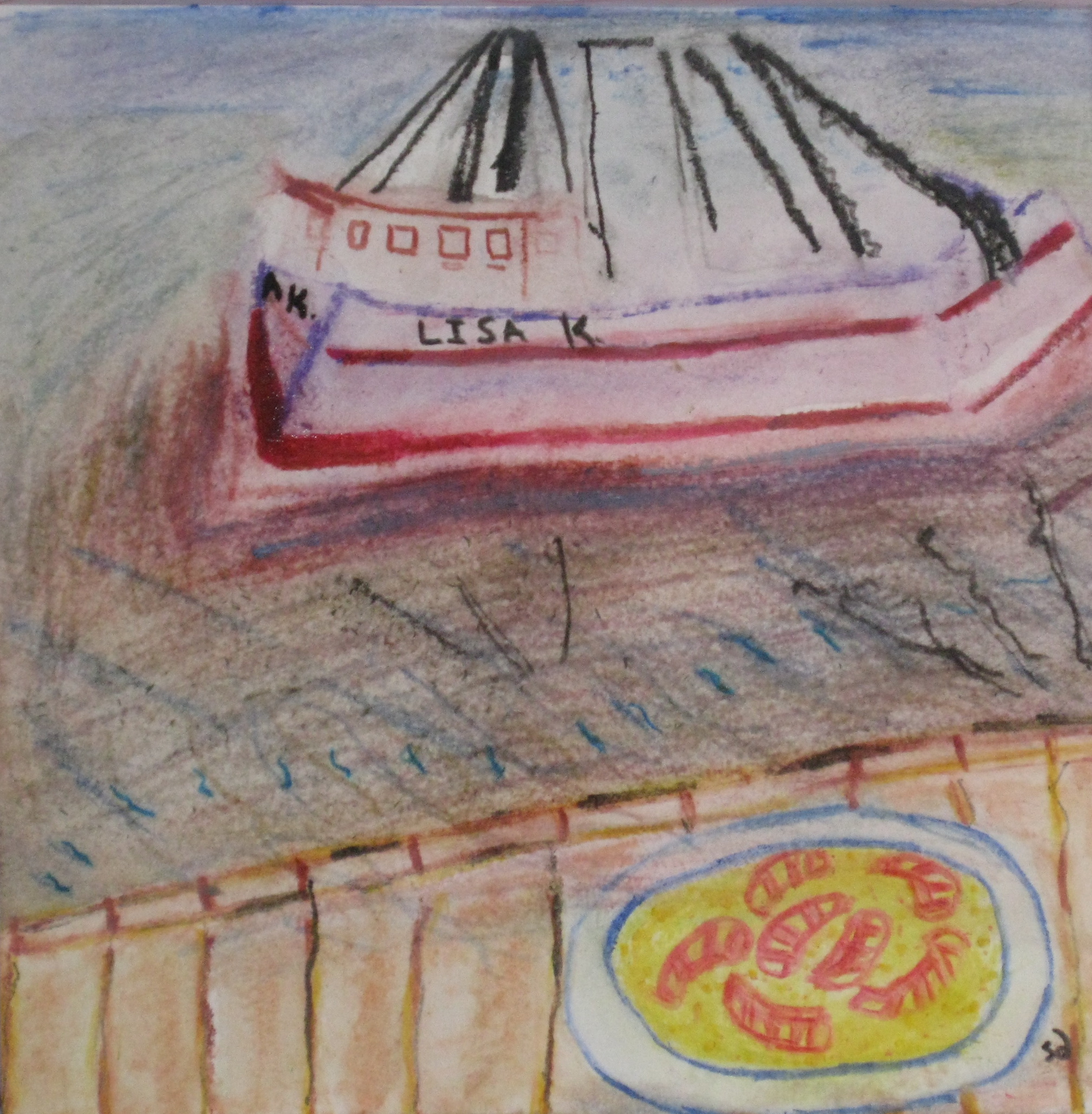
painting shows dish of shrimp and grits and a shrimp boat.

Shrimp and Grits. 8″ x 8″ watercolor pencil, gouache and ink. Sharyn Dimmick.

All of my friends like to write and eat. Well, some of them like to sing and eat and some of them like to talk and eat, but all of them like to eat. Lisa Knighton, whom I met at a retreat with Natalie Goldberg, is a fitness trainer who likes to eat healthy, fresh, local food, to bake cakes and to tell stories. Just see how many stories she starts to tell you in this post. Lisa hales from Athens, Georgia, and has come to “The Kale Chronicles” to teach you how use wild-caught shrimp and that Southern staple grits in the entree shrimp and grits. By the time you read this, you’ll be wanting to make them for supper (Let me just apologize in advance for the funky spacing in Lisa’s post — even re-typing it won’t fix it — I tried).

Who knows the first time I was fed grits. Probably would have to count all the times my mother ate corn grits when she was pregnant with me.
Daddy makes his grits with water, on the stove top in a small, metal pan. The corn grits bubble for 20 minutes, at least. He tells me: “Take a quarter cup of grits. Sometimes I measure the water and other times I don’t.”
Grits ain’t groceries.
Mama says that when she was a little girl her father was responsible for making her breakfast. “Each morning, before school,” she says, “My daddy would serve grits and sunny-side-up eggs. And as he put the grits on my plate, he said ‘Grits ain’t groceries.'”
Grits may not be groceries — meaning grits were staples — always in the southern house and made fresh at the nearest grist mill, often ground from the family’s very own corn. Grits are always eaten, at least in my family, with salt and black pepper and a spoonful of softened butter.
Another food I grew up eating was shrimp. Big Daddy, my daddy’s father, used to own an oyster bar, just off the main square in downtown Blakely, Georgia. At Christmas time, instead of turkey and such, Daddy, Uncle Charles, and boy cousins old enough to operate oyster knives shucked croaker sacks full of fresh oysters pulled from Apalachicola Bay on the Gulf of Mexico. Also, we ate tender Gulf shrimp, most often boiled and served hot with a small side bowl of cocktail sauce. I don’t ever remember sitting down for a Christmas meal: my cousins and I stood about eating the seafood as quick as it was prepared.
April begins shrimp season in Georgia. These days we bring shrimp home to Athens from the salty Atlantic waters near Darien, Georgia in McIntosh County. When we travel back from visiting this lowland county, situated along the Altamaha River, a place made infamous by Melissa Fay Greene’s 1991 work of nonfiction, Praying for Sheetrock, we always have the blue cooler iced down and full of these sweet, wild-caught Georgia shrimp.
When I set out to make grits, gourmet grits, I turn to Nathalie Dupree, author of cookbooks of the American South. When Natalie lived in Georgia I once had the good fortune to attend an afternoon party at her home in the pretty town of Social Circle. Her large dining room table was decorated with food she’d prepared, but all I remember was the big helping of warm cheese grits I ate, scooped from a large, hollowed-out round of Parmesan cheese. I’ve adapted the shrimp and grits recipe I offer from Nathalie Dupree’s Shrimp & Grits Cookbook. I’ve also provided links to two places located here in the South where you can order yellow grits, or white grits. I encourage you to select  wild caught shrimp for this recipe.
Shrimp and Grits (serves four)
First, bring all of your ingredients to room temperature before cooking.
2 cups water
1 cup milk (1%, 2%, or whole — just know that the fattier the milk, the creamier the final taste)
1 cup half and half (have another 1/2 cup water or half and half on hand to use when the mixture begins to thicken).
2 cloves garlic, finely chopped
1 cup grits (white or yellow will do  — just know that white grits are more refined and smooth, and yellow grits are rustic, coarser.)
1 pound of shrimp, peeled, heads removed.
1/4 to 1/2 stick unsalted butter
1/2 cup fresh shredded mild to medium cheddar cheese
1/2 to one cup fresh-grated Parmesan cheese
salt and fresh-ground black pepper
Get out your biggest, sturdiest cooking pot. I use a 4-quart with a heavy bottom. Once the grits begin to bubble, you are going to want to have plenty of room in the pot for the mixture to gurgle and bubble without it going over the sides. To the pot, add the water, milk and half and half, then bring all to a simmer over medium heat, stirring frequently. Add the grits and garlic, and stir well and often since you do not want this mix to clump or stick.
Bring the grits mixture to a slight boil, then reduce the heat.  Add salt and pepper.  Again, stir often, cooking about 15 minutes. Then add in extra water or half and half here (the mix should not be runny though) and the desired amount of butter and cheeses, letting this mixture cook for another 5 to 10 minutes: keep it creamy and loose and stir well so that the cheeses do not stick. Taste the grits then. You will want a soft texture, nothing gritty or hard.
When you have the grits like you want, add the shrimp and stir, coating the shrimp well. The hot grits and cheese will cook the shrimp and they’ll be ready in about two to three minutes, as soon as the shrimp turn a pretty pink.
Serve in large bowls alongside glasses of sweet tea.

In 1997 and 1998 I was sculpting large dolls — three feet high — out of porcelain clay and painting their heads, hands and feet. It was then that I acquired my painting palette, a cheap round plastic palette with a clear plastic top. This morning as I passed my desk I checked to see whether I had closed the palette properly and a large piece of brittle plastic broke off in my hand. I slapped some masking tape on the top and went on about my business, but the incident reminded me that I wanted to write about plastic.

painting shows grains, pulses and sauce stored in glass jars

Storage Jars. 6″ x 6″ Gouache on paper. Sharyn Dimmick.

Now, some of you will already be wondering why I didn’t immediately throw the broken plastic in the trash and go out and buy another palette, perhaps even a better one. The answer is two-fold: the lid that broke serves only the purpose of covering the paint so that it will stay moist and, with tape, still serves that purpose, but also plastic is problematic to dispose of properly and I feel it is best to limit plastic acquisitions whenever possible. The bottom of the palette where the paints sit is undamaged and I do not often have guests in my painting room, aka my bedroom. I also prefer to reserve what money I have for travel and other treats instead of using it to replace shabby possessions. If I did a self-portrait in the house jeans I am wearing right now it would tell you a lot about me: they have frayed hems and a side seam that is about to go on the inner thigh. I cannot remember when I bought them or at what thrift store but I can assure you that I have had them for more than five years.

Ahem. Why do I want to talk about plastic? Well, first of all, I read Beth Terry’s blog, My Plastic-Free Life, and follow her attempts to live free from plastic. She lives not far from me and does more than I will ever do to eradicate plastic from her life. I believe she is like a canary in a mine or a Cassandra we do not want to listen to as she chronicles the evils of plastic and its ubiquitousness. She goes to extremes that you might not want to go to — but you might: have a look at her blog and see what you think. She was talking about the amount of plastic packaging at Trader Joe’s the other day. Coincidentally, I had just stopped at Trader Joe’s for a couple of things (coconut milk, limes, dried apricots) and had had to make the unfortunate choice between limes coated with “edible wax” without packaging and organic limes in plastic netting. Which would you choose? Beth would tell me that the cans of coconut milk I bought are lined with plastic and frown that I would even consider buying apricots in a plastic bag. All I can say is that my Mom prefers apricots from Turkey to California-grown and Trader Joe’s meets her price point.

Painting shows refrigerator contents stored in paper, glass and china.

Refrigerator Storage. 6″ x 6″ Gouache on paper. Sharyn Dimmick.

I believe that people want to do the right thing and that the right thing varies according to person and situation. I also believe that many of us are wanton in our use of plastic, that we use it unthinkingly and discard it unthinkingly. Many a young person has probably seen little at the store that is devoid of plastic packaging: it is in my lifetime that we got plastic tamper-proof seals on every bottle of pills, plastic film on cottage cheese and yogurt cartons, plastic bottles of soft drinks, plastic bottles of drinking water. It is in my lifetime that Quaker Oats went from selling rolled oats in a cardboard carton with a string you pulled to open it to the current carton topped with two plastic lids (one you remove to open it, the other reseals the carton). In my lifetime, the Ziploc bag went from something that did not exist to a required item at airports.

I am fortunate to have learned some of the old ways: my grandmother taught me to place a dampened tea towel over rising bread dough and my mother to store leftover pie crust in waxed paper. Plastic wrap often seals poorly anyway, so you will see me rubber-banding paper, wicker plates, cardboard or tea towels over the top of bowls to bring dishes to potlucks. You will see me washing plastic bags and drying them on the line so that we can continue to use them to store food. Like many of you I carry a backpack and canvas totes to pack my food at the grocery store and farmers’ market. I have a marked preference for buying food in glass, which I can re-use, and cans, which I can at least recycle. We use ancient Tupperware around the house, which seems to have the virtue of lasting forever with little degradation. We do our best to re-use those yogurt containers, bought mostly in quart-size, handy for storing soup or taking it on the road. And I carry a quart-sized water bottle with me, which I refill from taps and water fountains everywhere.

Painting shows bag of flour and steel bowl covered with striped dish towel.

Bread Rising. 6″ x 6″ Gouache and watercolor pencil. Sharyn Dimmick.

I reserve the worst of my spleen for single-use plastic: since I am not going to wash and re-use plastic wrap it is better not to use it in the first place if I can possibly avoid it. I can store food in cooking pots. I can cover a bowl with a plate or a clean cloth. Some foods, for example, cucumbers and mushrooms, keep better if they are not stored in plastic.

How many of you work to minimize the use of plastic in your kitchens? Please raise your hands and share your tips with me and with Beth. The world will thank you for it, although not the plastic-producing corporations.

Five years ago I cast my lot with Riverdog Farm in Guinda, CA, subscribing to receive their weekly vegetable box. I had been shopping at Farmers’ Markets since I lived in San Francisco, going to Saturday and Sunday markets to buy the bulk of what I cooked. When I moved back to the East Bay I took to frequenting the Berkeley Farmers’ Market. Although I love going to the market I had been interested in vegetables by subscription for a long time and when a friend recommended Riverdog’s program I signed up, initially splitting a box with my friend Elaine who lives in Berkeley.

My reading influenced me. I had read Barbara Kingsolver’s Animal, Vegetable, Miracle about how she and her family had endeavored to raise most of their food on their Virginia farm and to buy locally what they couldn’t grow themselves. This afternoon I refreshed my memory of Kingsolver’s first locavore spring as I contemplated what to write about today.

Spring has sprung by the calendar. The days are longer. Plane trees have leafed out. A few native freesias push themselves up in the yard. A full moon lit the mild, clear night on Friday as I walked the last two miles home from a Passover seder at Elaine’s, where we ate broccoli, roasted potatoes, duck, carrots in the matzo ball soup, charoset made of dried apricots and dates. Sun shone on the Berkeley market on Holy Saturday where people stood in line for green strawberries (I tasted one), berries with white shoulders, asparagus and globe artichokes. One patron snapped up the only box of snow peas. Spring produce is late this year in northern California, not as late as last year where unexpected ongoing rain slowed all of the crops, but this was a slim market on the day before Easter. I brought home a bottle of plum vinegar, two pounds of walnuts in the shell, a grapefruit for another round of Shrimp Diablo. I considered buying a large basil plant and plucking every leaf to make pesto.

This is the time of year when I wish I had preserved more during the summer and fall, roasted more red peppers and frozen them, dried more tomatoes and raisins, canned more dilly beans, made more pesto. I break out stores of canned tomatoes, jars of roasted peppers and chutney, condiments to lend flavor to our spring diet. We use frozen mozzarella, fresh spinach, cottage cheese, diced tomatoes and Prego marinara to make lasagna. I pile peach chutney, roasted peppers and fresh arugula on a broiled Portobello burger marinated in salad dressing. We make pies out of frozen peaches and canned cherries.

Painting shows leek-feta quiche and ingredients.

Leek-Feta Quiche. 8″ x 8″ gouache. Sharyn Dimmick

What I can rely on in March and April is an abundant supply of alliums: spring onions and leeks. Every week Riverdog sends us a pound or two. I use leeks instead of onions in carrot soup and find I do not care for the substitution: note to self — only white parts of leeks, which will not give the green tinge and the strong flavor. I slice one leek into rings in a bowl of water, separating each ring to let the sandy grit sink to the bottom. I heat a few teaspoonfuls of olive oil mixed with butter in a skillet, lift the leeks from the water, pat them dry and saute them. I preheat the oven to 325. I roll out pie crust, sprinkle the bottom with crumbled feta cheese, add the sauteed leeks. I cut a jarred roasted red pepper into squares and scatter them on top of the leeks and cheese. I add a few cubes of marinated feta, just enough to create a pleasant design on the red and green. I grate a few tablespoons of Pecorino over that.

Then I beat three eggs in a metal bowl and add a splash of milk, eyeball it and add a little more, whisking the custard together. I pour the custard over the vegetables and cheese and pop the quiche in the oven.

This is a rough recipe: I have made it many times and feel no need to make more than the roughest of measures. I’m going to guess slightly on the amounts I recommend (Sometimes I measure backwards, pouring out what I think I will need and then checking the amount for you by pouring liquid back into a measuring cup, for example). If you need to know exact amounts you might want to look up another recipe for that. I will refer you to my Mom’s recipe for pie crust because I can recommend it wholeheartedly as the pastry we use most often.

Make 1 recipe pie crust. Chill crust while you prepare the leeks.

Clean 1 leek by slicing it into thin rings and teasing each ring apart in a large bowl of water. Lift rings out with a slotted spoon or small sieve and pat them dry.

Heat 2 tsp olive oil and 2 tsp butter in a skillet. When combined, add leeks and saute.

While the leeks saute, you should have time to roll out your crust. Take 1/4 of your pie crust, flatten slightly and roll out on a floured board into a 10 inch circle. Fold and place in a 9-inch pie tin or tart pan.

Scatter feta cheese to taste on crust — I use enough to almost cover the bottom. Add sauteed leeks.

Slice 1 roasted red pepper into small squares. Scatter on top of leeks.

Sprinkle vegetables with additional feta, plus 2 Tbsp grated Pecorino or Parmesan cheese.

Beat 3 eggs. Add a splash of milk. Whisk. Pour custard over vegetables. if necessary, add milk to fill crust.

Bake quiche until top puffs and browns, at least half an hour.

Food Notes: You may, of course, substitute cheeses if you prefer something else to feta, substitute scallions or sauteed onions for leeks, substitute sun-dried tomatoes for the roasted red peppers. Quiche is, by nature, a flexible recipe. Because I was using feta, a salty cheese, I didn’t add any salt — if you choose a mild, sweet cheese, you might want to add some. If you want to eat this during Passover week, you could make it without crust.

painting shows bowl of chicken-coconut soup with Asian condiments

Chicken-Coconut Soup. 8″ x 8″ watercolor pencil. Sharyn Dimmick.

The weather swings from mackerel skies to overcast, from sun to rain. The farm box remains remarkably constant in content: spring onions, leeks, carrots, cabbage, cauliflower, tangerines. Today we got cilantro and asparagus as well. My mother has been under the weather for days, following a diet of toast, toast and toast. What can I possibly make for dinner?

I settle on an old favorite, a spin on Thai chicken-coconut soup with plenty of winter vegetables: carrots, cabbage, spinach and leeks.

I begin by making coconut milk. I measure two cups of unsweetened coconut into the blender while I heat 2 and 1/2 cups of skim milk on the stove. (The richness of the milk does not matter: we are using it to extract the coconut flavor from the coconut — I’ve used everything from whole milk to skim and water in a pinch). Blend the warmed milk and the dry coconut for a minute or two and then strain out the coconut. Throw that same coconut back in the blender with two cups of warm water and make a second batch, straining the coconut out. Now you may throw the coconut meat out, or compost it: all of the flavor has gone into the bowl of thick and thin coconut milk.

I heat two pints of homemade chicken stock on the stove and add the coconut milk and most of a boned and skinned chicken that we roasted earlier in the week. I add 1 Tbsp. fish sauce and the juice of one lime and about 1/2 tsp of chili paste with garlic. I let the meat simmer in the broth while I cut up two root ends of lemongrass and slice about 1 Tbsp of frozen fresh ginger into thick coins. Leaving the lemongrass and ginger large means we will be able to spot them in the soup. I add a bowl of leek rings that I cleaned and cut a couple of days ago.

Mom slices carrots into irregular pieces — like making carrot sticks — and washes spinach leaves. I wash and chop the roots of today’s cilantro and add them to the simmering pot. I slice cabbage thinly.

Then we go upstairs and watch an episode of “The Rockford Files.”

When we return to the kitchen, Mom turns up the pot to high and adds the carrots. In three minutes the carrots are almost cooked and I turn the burner down to medium and add the cabbage. Oops. I have underestimated the volume of the soup, so instead of cooking spinach in the soup we put spinach leaves in our bowls and ladle the hot soup on top of them, turning off the soup pot. I garnish my bowl with fresh cilantro. There is plenty of soup for future meals: we will reheat it and add fresh spinach and cilantro to our bowls again.

Food Notes: As you can see, this is not a precise recipe. The basics include a blend of chicken broth and coconut milk and the classic Thai seasonings of ginger or galangal, lemongrass, fish sauce, and chilies. You can vary the amounts of fish sauce, lime juice, chili paste, lemongrass and ginger to taste. If you like your soup sweet, you can add brown sugar. You can make it with canned coconut milk, either regular or light, which is what I do when I am not out of canned coconut milk. Tonight’s version was mild, rather than spicy, to accommodate Mom’s indisposition, but you can amp it up with loads of chili paste or fresh chilies. You can make it traditional Thai style with no vegetables at all. You can add rice noodles or rice. You can use leeks, spring onions, or scallions. You can include sweet potatoes or broccoli, as long as you do not cook them too long in the soup. If you like crunchy broccoli, you might want to put it in your bowl and pour the soup over it like we did with the spinach: by the time you get to the bottom of your bowl the broccoli will be nicely cooked. This is a nice soup to eat when you have a cold or when you are trying to tempt someone with a low appetite: packing it full of vegetables adds vitamins and minerals to the broth.

Painting Notes: The quickest of paintings to meet a deadline.

Painting shows knishes and ingredients.

The Irish Knish. 12″ x 12″ gouache. Sharyn Dimmick

Although my family is half-Irish, we are not big on St. Patrick’s Day food here. I should say I am not big on St. Patrick’s Day food, having suffered through a few childhood years of corned beef and cabbage. I lived in Ireland for a year when I was in college and remember the big food groups being potatoes, Swedes (rutabaga) as big as your head, bacon, butter and cheese with sides of oatmeal, biscuits and “puddings” covered with custard which came out of a tin. I also ate prawn sandwiches from a sandwich shop near Trinity College and gyros from carts off the street. In Dublin, I bought groceries daily and set my milk in a bowl of water on a window ledge: when the rare sun came out, the milk spoiled and it was time to make soda bread.

Yesterday, however, I came across a potato knish recipe on Smitten Kitchen (two, actually). Her knishes were so beautiful that I decided to make some, substituting the classic Irish vegetable, cabbage, where she had used kale. As I peeled and cleaned potatoes, I thought of my Irish grandmother, Grandmother Carroll, and was vigilant about removing every spot and blemish from each spud. Then, as I was sweating leeks and boiling the red potatoes, I realized that I could make the knish into a complete meal by adding some finely diced Canadian bacon to my leek mixture, giving the nod to my mother’s birthplace in Manitoba and the bacon of Ireland at the same time. Ye who eat kosher may recoil in horror here, but I imagine that many an Irish housewife in New York tried a knish or learned to make one from a neighbor and sweetened the recipe with bacon or ham in her own kitchen. I will not be offended if you leave out the Canadian bacon or if you only make knishes from your grandmother’s recipe.

I had never made a knish at all before this and I’m not even sure that I have eaten one. Certainly, no one has ever made them for me. I was up against a new dough. The filling of leeks, potatoes, cabbage and Canadian bacon was not unlike soups I have made this winter, although knishes require no broth and Deb added cream cheese to the potatoes. I followed suit with that: when I tasted the potato filling before making the knishes, the potatoes had a lovely sweet taste, coming from the cheese and the barely sauteed shredded cabbage. The tablespoon of butter in the saute pan came through, too.

I followed the unfamiliar directions: divide the dough. Roll half of it into a 12″ x 12″ rectangle (Hey! I know what those look like from painting). Put half the filling across the bottom of the dough, making it about two inches wide and roll it up like a cigar, twice around with the dough. Mark off dough at around 3 and 1/2 inches (basically cut it into three equal parts). I did not fully understand the instructions for twisting the dough, but I managed to close one end of each piece, converting that to a knish base. Nor did I trim the excess dough as suggested: I just let it wrap part-way around and “glued” it with a finger dipped in water. There never was a Dimmick that did not like extra crust or extra dough.

I even made egg wash because I had seen the beautiful browning on Deb’s knishes and coveted it: in fact it was the browning and the cunning round shape with a little filling showing that made me want to make these knishes in the first place. Brushing things with egg wash is the kind of step I am often tempted to skip because then you have that lonely egg white sitting in the fridge and have to start thinking of what to do with it (it may go into the next batch of waffles or pancakes to make them extra light). I dutifully applied egg wash with a pastry brush.

I am pleased to say that the knishes came out beautifully. They looked something like Deb’s with their browned exterior and a little window of creamy potato peeking out of the tops. The crust was thin and crisp, the filling soft and warm and savory. I served them with some warmed applesauce and a pot of Irish breakfast tea, a warming lunch on a soft gray day.

Food notes: For detailed instructions, please read Deb’s second knish recipe on Smitten Kitchen. I used olive oil for the vegetable oil she calls for and it worked fine. I substituted 1 cup of finely shredded cabbage for the kale. I folded 1/4 cup diced Canadian bacon into the leeks when they were almost done cooking, stirred, and put the lid back on. When the leeks were done, I put the cabbage in with them and cooked the mixture for two minutes more. I saved the potato water from boiling the potatoes because my grandmother taught me to use that in yeast bread. If I had been thinking, I might have cooked extra potatoes and used them to make potato bread. Next time: if you are Irish, you cannot eat too many potatoes, or too much bread either. Happy St. Patrick’s Day!

Painting depicts food items procured in weekly grocery shopping

The Groceries. 12″ x 12″ gouache. Sharyn Dimmick.

Last week I checked Riverdog Farm’s weekly online newsletter to see what vegetables we were going to get: tangerines, navel oranges, spring onions, cauliflower, carrots, dandelions. Dandelions! Oh, they didn’t! I read on to see that what they were really giving us was young leaves of chicory. The only thing I know about chicory is that you can make coffee substitute from it or add it to coffee for that New Orleans flavor. I Googled it. The coffee substitute is made from chicory roots. Shucks.

My mind goes back to salads we ate in Italy where they dug every bitter shoot out of the ground and dressed it in olive oil. But before I start whining in earnest I realize that a limited palette of ingredients is a test of cooking skill and creativity and that with a cabinet full of spices and a refrigerator containing milk, butter and cheeses I have more to work with than many people have had. What needs adjusting beyond the seasonings is my attitude.

This week I sufficiently adjusted my attitude to cook the chicory. I tasted it raw the day I got it: bitter. Before I cooked it I checked to see what will be in Wednesday’s box. The contents are not much different. For twenty dollars a week I am getting three pounds of fruit (oranges and tangerines) and six pounds of vegetables, including leeks, arugula, spinach, cauliflower, carrots and potatoes. That is the basic early spring produce palette here in Northern California.

This morning I went with my mother on her weekly shopping foray. This week we went to Food Maxx for canned cat food for our three cats and coffee beans for Mom. While we were there, we picked up two boxes of rolled oats, a bag of raisin bran, four boxes of whole wheat rotini, a jar of molasses, a box of Mexican chocolate, a small jar of Prego and a number ten can of hominy for posole. The food for humans in that came to $26.28 and we got a dime back for bringing our own canvas bags. Total: $26.18

We went on to Canned Foods Grocery Outlet, variously known to our friends as “Half Foods” and “Groc. Out” (before you turn up your nose, let me remind you that it was there I first found a bottle of Mosaic blood orange olive oil). There we picked up our dairy products for the week: half and half, buttermilk, sour cream and cheeses: jalapeno cheddar, a two-pound block of mozzarella for pizza-making, and a jar of marinated feta. We added in meat protein with a package of turkey sausage and one of Canadian bacon. Mom scored a 2 lb. bag of organic frozen green beans for $3.00 and a big bag of  fresh red potatoes for $2.00. I treated myself to a three-pound bag of Bosc pears from Washington State for $1.50 because the annual citrus glut is getting to me again — I will use the pears in desserts and soups and eat them as snacks. We bought a couple of cans of diced tomatoes for our winter-spring pantry, some flaked coconut and maple syrup for baking, a large package of English muffins and two different brands of commercial ginger snaps. Total for Canned Foods food: 44.83.

Adding up the food we purchased this week from all sources, I get $91.01. We will not shop again until next week and with all of this in the house we may not buy much next week beyond bread, milk and more cat food.

Now, we never start from a house empty of food. We keep a running pantry of baking supplies from butter and eggs to flour and cornmeal. We usually have walnuts and almonds and some dried fruit: right now we have dried peaches and apricots, sour cherries, raisins and home-dried apples and pears. When I get around to it, we will have home-candied citrus peels as well. We also stock rice, both brown and white, polenta and pasta. We make our own chicken stock, which we store in the freezer, and keep condiments such as mustard and red wine vinegar, soy sauce and sesame oil. We try to replace all of these items during sales to keep our costs down.

The chicory? I cooked it for dinner, after trimming all of the stems. I pulled out all of the stops. First I boiled it for fifteen minutes. Then I poured off the water, hoping to have leached out some of the bitterness. I tasted it again: still bitter and not quite dull in color. I put in a little more water and cooked it for ten more minutes. Then I pulled out a skillet, heated some olive oil and sliced up half a sausage into half-coins. I browned those while I microwaved about a quarter cup of raisins in some water (This green is seriously bitter and needed the help from the dried grapes). I added the drained chicory and some pressed garlic, then the raisins and soaking water. Even with the raisins, oil, garlic, sausage and blanching the chicory remained bitter — not slightly bitter, but majorly bitter. It is the kind of thing that gives vegetables a bad name. We ate it alongside some bland Kabocha squash gnocchi in (not bland) gorgonzola sauce. My first attempt at winter squash gnocchi lacked lightness as I had to work in extra flour to handle the dough: if I revisit gnocchi more successfully I will post the recipe later. We were grateful to have the Mexican chocolate as an after dinner treat: I prepared that with a square of bittersweet chocolate, an extra tablespoon of cocoa powder and a dash of vanilla extract in each cup, perfect for the rainy March night.

P.S. Mom, trooper that she is, reheated and ate the remaining chicory for breakfast. She said it was better after sitting overnight. I said I would never complain about kale again, knowing we could get chicory instead. We both shuddered.