Archives for category: Uncategorized

Another weekend I followed Johnny up to a north bay folk festival to hear him play, tagging along with Marlene, who was going. I made a Greek salad for the potluck dinner and baked a big apple pie. I wore a plunging halter top, an art deco rhodium-plated necklace that had belonged to my paternal grandmother and my habitual black jeans. I brought my guitar, hoping to get a chance to play a couple of new songs for Johnny in the evening sing-around that followed the concert performances.

After singing a gospel-inflected song and a political piece, Johnny said “We’ve been talking about spiritual things, but now it’s time to talk about the carnal, y’all…” He went on for awhile and I have always wished I had a recording of that introduction to his rocker “Burnin’ Up.” The crowd danced and smiled.

When Johnny came off stage I came to say hello to him before returning to my seat at the edge of the stairs. He sat in a chair behind me for a bit, nudging me and poking me like a schoolboy with a forbidden crush on a girl while I bantered with him, saying things like “It’s too bad you don’t know any nice people.”

“I know, darlin’,” he said, shaking his head. “But I got you, babe,” he added, putting his arm around me for a minute.

I had had misgivings about Johnny after attending a previous gig of his. I was singing back-up for him on a tribute to Woody Guthrie as part of a group he called the Hard Times Choir. The event manager had offered every musician two drink tickets for beer or wine. I didn’t plan to use mine. Johnny came to me after he had drunk his two beers.

“They only give you tickets for two beers,” he said. “Would you buy beer for me?”


“I don’t think I could do that,” I said, not wanting to break the rules, thinking two beers should be enough for anyone, not wanting to procure alcohol.


“It’s not a problem,” he said, going off to ask someone else.


That request was my first indication of Johnny’s thirst, his capacity and his willingness to bend the rules to get what he wanted. Trying to avoid heartbreak, I had gone home and written a song called “The Werewolf” about the fear I had felt growing up in an alcoholic family. In the song after describing the atmosphere around my father, my older brother and my sister-in-law, the breath-holding and the scenes, I address Johnny directly:


And then there’s you, I like you a lot.
I dream of sharing everything we’ve got.
Don’t know you so well that I’d know for sure
If that old werewolf is knocking at your door.

There is no room in a heart to share
If you’ve got a werewolf already living there.
I’d give you my love, but it won’t get through —
The werewolf will get it, and then he’ll turn on you.

Just a story, just a song,
Just between friends while we’re getting along,
Just one thing that you should know:
If I see the werewolf, then I have to go.

At the Cur-Ville Festival, I saw Johnny drinking prodigiously, filling cup after cup from a keg on the porch, but remaining lucid, jovial, funny, steady on his feet. And everyone I talked with loved Johnny: they told me he was a great guy, generous, how helpful and encouraging he had been to them, what a good friend.

Mid-afternoon, Johnny gathered together “the ballad gals” and his friend Reid, who was visiting, for an impromptu round of singing on the porch. I got my friend Mary to sing “Peggy Gordon,” a song she owns, in my opinion. For the first time ever, Johnny took a harmony on the chorus, rather than simply listening. I sang “Poor Lazarus,” a blues ballad about an outlaw — Johnny would know — he always kept a record of what people sang. Reid sang a song about falling over drunk.

We would have continued to sing in our small group, but some of the other musicians were anxious to start a song circle and asked us to join them. I got out my guitar, planning to sing “The Werewolf” or “Ingenue,” which I had written about falling in love with Johnny, but it was not to be. Every time I got ready to open my mouth and strike my chord some other gal with a guitar would launch into an original song. Johnny and Marlene did a duet on the hilarious “Third Rate Romance,” which I had never heard before, before Johnny left the circle, crossed the yard and began playing duets with Beth, a striking woman with big blue eyes and waist-length brown hair that I had seen with him at the Woody Guthrie gig. I watched them from afar.

When Marlene signaled that she’d like to go, I collected my dishes from the potluck table and told her I’d be just a minute. I walked over to Johnny to say goodbye and a bystander asked who I was.

“This is the fabulous Sharyn,” Johnny said with a smile.

“The fabulous Sharyn,” brown-haired Beth echoed softly, trying it on and raising her eyebrows. I bade Johnny goodbye and turned to leave with Marlene and Reid, helping pilot us all back to the East Bay by way of Petaluma.

* * *

When ballad group came around the next month I brought my guitar and got there early. Johnny arrived early as well. Looking at the clock, I asked the hostess if I could play an illegal song before the meeting started at two o’clock, in about ten minutes.

“Yes,” said Johnny. The others nodded.

“Sweet song or scary song?”

“Sweet song first,” Johnny said, always ready to lead.

I sang “Ingenue,” a song about the experience of falling in love, watching my thoughts, moving helplessly under love’s spell. It ends, “But my heart is singing like an ingenue/Singing and falling, falling for you.”

Johnny enthused over “Ingenue.”

“I could hear Bonnie Raitt doing that song.”

“That would be great,” I said, “As long as she doesn’t mess it up.”

“Now, play the scary song,” he said.

I glanced at the clock again.

“Go ahead,” said the hostess.

So I sang “The Werewolf” before we switched to the traditional ballads we had come to sing. I don’t remember what else happened that day, but tall, long-legged Mr. Harper offered to walk me back to BART.

“I’m slow,” I said, being more than a foot shorter than he was, carrying a heavy guitar case and walking with a limp.

“That’s fine,” he said.

We walked the seven or eight blocks saying little of consequence.

Johnny told me later that when I sang “Ingenue” he had the thought that I must be falling in love with someone and a twinge of regret that the song wasn’t about him. He also registered the desire to kiss me for the first time.

I felt no hint of this in the BART station as we paid for our tickets and descended the stairs to the single platform. We stood together, waiting for the trains that would take us in opposite directions. He looked down at me and said, “You’re a captivating singer. That song … well, both songs.”

I looked up into his light eyes and said, “I had good inspiration for those songs.”

He nodded.

I drew a deep breath.

“You know those songs are about you, right?”

“No, I did not know that. ‘The Werewolf,’ too? I need to hear those songs again.”

Just then my train pulled alongside the platform.

“That’s my train,” I said.

“I might call you,” he said, as the doors opened and I stepped through them.

That day on the BART platform was the day I got on the Johnny Harper train. It arrived with a chance meeting, a couple of songs and then I was gone, over the moon, madly in love. He fell hard in love with me, too. We began talking on the phone that evening, spending hours talking like love-struck teenagers.

Johnny said he didn’t want a casual relationship, only a serious one. My heart leapt at those words. We began to pledge ourselves to each other over the next three nights of phone conversations.

One night while conducting our relationship entirely on the phone, I said, “Sing me a lullaby.”

He hesitated.

“There will be no firing squad,” I said, “Just sing me something.”

I know I ought to remember what that first lullaby was. I don’t. Johnny would have known. He probably kept a list somewhere. From that night on, it became a tradition for Johnny to sing me a lullaby every night that we were not together in person.

I met Johnny fairly late in the game. He had jettisoned a marriage and a band. When we met, I was fifty-one and he was sixty-three. In 2009 our mutual friend Marlene McCall brought him to a monthly session I had started where we sang traditional ballads at a home in Berkeley. This man that I had never seen before walked in one day, parked his Marshall amp next to an electrical outlet and told me “Move over, darlin’,” usurping my customary place at the foot of the table. I was not primed to like him, neither his electric guitar nor his take-charge attitude. I grudgingly shifted my chair over about a foot, maintaining a semblance of my space.


But when the session started I saw how he listened to the singing, his expression rapt, following every nuance, every ornament of the long Scottish and American ballads we sing. I saw his eyes riveted on each singer’s face, his right hand scribbling singers’ names and song titles on white paper that he kept in the breast pocket of his long-sleeved black dress shirt.


I fell in love with Johnny’s versions of blues ballads: “Frankie and Albert,” “Stagolee” and “St. James Infirmary.” I got used to his long introductions (The man liked to talk…). Gradually, over two years, after one incident where he flirted with me for a minute, I began to fall for the man himself. I contrived to be places he might be. I missed him when he wasn’t at a Ballads session — he was prone to disappear every once in while for a month or two.


In July 2012, just back from a meditation retreat, I decided to email Johnny about getting together to swap songs. I paid out a lot of rope, saying I didn’t know how busy he was or if he would be interested. I offered to invite Marlene so that we would have the possibility of singing three-part harmony.


He called me up, we jostled schedules for a week or so, and then fixed a date. I would go out to meet him at his house in San Leandro. I remember fussing about what to wear on the warm Saturday afternoon.


After taking a bus, a BART train and a moderately long walk, I arrived sweating slightly. I walked into his living room, furnished with a couple of oak chairs, a worn blue love seat, a cheap oblong table and three entire walls of record albums, CDs and music books. His red Telecaster and vintage 00018 Martin waited on their music stands.


Johnny did not offer me refreshments. Instead, he directed me to lay my guitar case across the oak chairs and unpack. He sat in a black padded folding chair near his teaching table, a beer at his right hand, plugged in, tuned up.


Early on he sang me Allen Toussaint’s “New Love Thing,” which would become our song: “I lost my job and I don’t care — I got me a new love thing.”


When he finished playing that one, I said “Tell me you didn’t write that song.”
“I like that song,” he said.
“I like it, too, but it is a catalog of disasters. You’re inviting misery.”


He told me I didn’t understand, that in New Orleans where Toussaint lived, people celebrated every good thing even if they lost their jobs, wrecked their cars, etc.

Our music exchanges were less than stellar. Johnny assumed that we would play everything together, jam; I thought we would take turns singing solo. Since breaking my left hand in two places in 2006 I haven’t had much stamina for playing in first position, which tires my damaged hand. I usually play capoed up to 5th or 7th fret. It is not easy for me to play with others: I can’t just watch their left hands for the chords, or play the chords as they are called because I am fingering the songs in whole different keys and have to transpose on the fly. Johnny could have played along with anything I played, but I don’t remember that he did. He accepted my wish to trade songs instead. He sang me an original song, “Work With What You Got,” rich in rhythm and groove and light on melody. He sang me a Buck Owens tune. I sang him love songs: Si Kahn’s “Queen of the Cowboy Cafe” and Kevin Welch’s “Something ‘Bout You.”


I didn’t see anything of Johnny’s house that day other than the living room and the bathroom. I remember a ragged deep pink towel hanging on a towel rack. Johnny took my empty water bottle and refilled it from the kitchen, bringing it back to me.


As the afternoon wore on I found myself hoping Johnny would suggest having dinner. He didn’t. I left his house thinking, “I want to sleep with him, but I don’t want to clean his house.” I bought a Drumstick from a passing ice cream truck to tide me over until I could arrive home on the last bus.


As it happened, the Ballad group met the next day. Johnny settled into his chair next to me and I said, “Guess which song I can’t get out of my head?”
“Work With What You Got,” he replied promptly.
“You’d like that,” I said, “But it’s ‘Got Me a New Love Thing.’”

Dear Johnny,

I’m wondering if you enjoyed your birthday breakfast: eggs sunny side up, homemade hash browns, bacon and sausage, fresh fruit, plenty of coffee, zucchini muffins. I would not eat the eggs for you, but they were there shining in the pan. Other people ate them.

Thank you for being with me in this beautiful place. You always talked about coming to New Mexico, eating green chile cheeseburgers in San Antonio and seeing the license plate-covered guitar. You loved that story: I told you about that guitar on a little stage with a piano, the kind of joint you could play, but I never showed you the picture because no one sent it to me before you died. I hope you can look at it through my eyes when I get it.

I don’t know how you would have felt about the snow. You would have wanted to crank up the heat, maybe sit by the fire where I’m sitting now. You would have looked dramatic in the snow with your black clothes and your silver hair, but you did not have clothes warm enough for snow when I knew you. You toured in Montana once, but it must have been in the summer.

I always want to share Mabel Dodge Luhan House with people who are special to me. Mom never came. You never came here — always too busy or else incapacitated. Suzanne came here and she doesn’t talk to me anymore. You know that.

Dorotea is here, the one who called you Johnny Love and wanted to sing back-up on my records. Natalie is here — you met her a long time ago. She asked me to sing a song you liked during slow walking and I sang “The Cuckoo” because it worked with the pace. I didn’t say, “I can’t” or “Johnny’s songs were made to dance to, they all have rhythm and a strong groove.”

I wanted to sing “They All Ax’ed for You.” I’ve always loved your version of that. I’ve taken up singing it and made up a new verse for you. Your verse goes

I went on over to the other side and they all axed for you:

The heavenly host was out of hand and they needed somebody to lead the band.

I went on over to the other side and they all axed for you:

The devils axed and the angels axed and Saint Peter axed me, too.

Baby, they all axed for you…

They all ax for you, Johnny. We all miss you. Gavin is collecting the scraps you left behind — the tapes, the charts the CD roughs, the video. Jerry is taking things off your computer. People are posting videos with the names of the songs wrong and no attribution. You would have hated that.

Me? I’m learning some of your songs and planning to learn more. Lucy came up and cleaned your house and started going through your things. I’m hoping you find a way to intercede and give me the Martin and I think Jerry should have the red Telecaster if James Clifford doesn’t want it.

I don’t know if you were mad at me when you died, or merely heartbroken or resigned. I wish I had talked to you one more time and said something kind. I wish I had been with you when you breathed your last breath to soothe your brow and give your forehead a kiss. I know you wanted me there again: you told me so. But it was not to be — I couldn’t leave my 92-year-old mother. I never stopped loving you or wanting things to be better, wanting you to achieve your full potential.

All my love,

Sharyn

I said, describing my recently deceased former partner, “This train was bound for glory, but derailed at regular intervals.”


Betsy said, “I’ll bet there’s a story behind that.”


There is a story, but there are missing pieces in the telling because we can’t look straight into the character’s heart and mind.


The man, John Harper Lumsdaine, aka Johnny Harper, was bound for glory (and would have appreciated the nod to Woody Guthrie’s autobiography). Born the eldest son of a family of boys, he sang “Tying a Knot in the Devil’s Tail” to his spellbound elementary school classmates, having heard it a few times on the radio or around the house, spooling out the long tale of drinking, hell-raising and branding, dehorning and knotting up the devil.


At seventeen, Johnny met a girl who played the guitar. He began to play himself, first to impress her, and then because he fell in love with the combination of music, song and story. He fell so hard that he dropped out of Stanford University to pursue music, giving up a scholarship and landing in the Viet Nam war. He fell so hard that he determined to master not one, not two, but all the styles of American roots music, from blues to R&B to classic country, from gospel to funk to rock and roll. And master them he did, spending hours listening to records, copying licks, watching the hands of guitar-players when he went to concerts.


Johnny started out on acoustic guitar, but when he was in the Navy he heard The Byrds’ version of “Mr. Tambourine Man.” Transfixed by the sound of Roger McGuinn’s electric 12 string, Johnny moved to acquire the record and an electric guitar. He spent his shore leaves in Hawaii haunting record stores, ever eager to hear more, to learn more.


Released from the service as a conscientious objector with the help of an Episcopal priest, Johnny parlayed his love of music, his skill and dedication, into a career. He ran Down Home Music record store in El Cerrito for awhile, played in bands, DJ’d a radio show on KPFA Berkeley. He formed bands of his own and played all over the San Francisco Bay Area for years. He toured playing guitar behind Maria Muldaur. People who saw Johnny perform never forgot him: his patter, his impish grin, his command of his entire vocal range from the deepest half-spoken growl to the softest falsetto coo, and his incomparable, spirited, polyrhythmic guitar-playing. If you heard him play, Johnny Harper put a spell on you.


I came to know that Johnny was a versatile player. He worked solo, in duets, quartets and larger bands. An acoustic-based folksinger myself, I longed for Johnny to tone it down and play with the restraint that I would have played with had I had his chops. But in living with him, watching him rehearse, listening to him and attending his shows I came to understand that Johnny was at his best as a bandleader. He chose the songs, wrote the arrangements, selected the players and rehearsed them with care and patience and then let fly on stage a spicy gumbo of music long-simmered in his skill. He fronted his bands dressed in black with his red Telecaster strapped across his body, his long legs encased in black jeans.


People danced at Johnny’s shows. They laughed and cried and begged for the Mardi Gras beads he threw to them. They hired him to play at their weddings, funerals and street parties. They took guitar lessons from him. One of his friends followed him to every gig as sound man, roadie, whatever he needed.


When people heard Johnny play for the first time, whether he was fronting a band, hosting an open mic or playing behind someone else, they came away asking, “Who was that guy?” He was that good, that talented, that memorable.


So why, as our friend Dale Geist says, do you not know about Johnny Harper? Why isn’t he a household name? Why don’t you have a shelf of Johnny Harper CDs and a playlist of Johnny Harper favorites? What could stop this glory-bound train of talent, ambition, drive, energy and joy?


What indeed. Some time after Johnny fell in love with American vernacular music, Johnny fell in love with the bottle. No one is sure when it happened. Like many people, Johnny turned to whiskey and beer for solace, for company, for the buzz. The bottle sang a siren song to Johnny, telling him he could do whatever he wanted, that together they were invincible, immortal, telling him that she would always love him, inspire him, comfort him.


And so, after years of hard work, after some success, after promising beginnings, the Johnny Harper train began to derail. When Johnny felt under pressure from a project, under pressure from his impeccably high standards, almost always when he was on the verge of a success — a CD release party for a protege, a video shoot, a series of tribute shows to the music of The Band — Johnny ran off the rails, blew off the gig or the rehearsal or the studio date, holed up in his house with the blinds closed, hollow-eyed, drinking, watching videos for hours on end, letting his phone ring unanswered until the voicemail got full and, sinking further, letting go of showers, shaving, changing clothes, eating.

Every time he fell, Johnny got up again and gave life another try. Until this time:

On a February day or night in 2022, Johnny Harper breathed his last. He died alone on the floor of his bedroom, leaving behind students, friends, an ex-wife, a former partner, professional colleagues, fans and admirers, a beloved niece, some cousins and a brother, plus a huge trove of cassette tapes, CDs, video footage and other music that had not met his standards. He lives on in his students and in the minds and hearts of those who loved him.

Dear Readers,

Since I last wrote I have embarked on serious work on my memoir. I am five chapters in what I call a first or second draft, depending on my mood. The memoir originated in a habit of writing that I have had for most of my life, aided by over twenty years of writing and meditation retreats with Natalie Goldberg, and vomited on the page in three years of NaNoWriMo from 2009-2011. I had written a lot, over 150,000 words, plus countless stints of writing in notebooks and I did not what to do with what I had, so I let it sit. And sit. And sit.

Then, shortly after I wrote my last blog post in January 2021, Saundra Goldman invited me to a free webinar on writing. One of her questions caused me to weep, sweat, lose sleep. She said, “Tell me about experiences when you went out on your own and what you dreamed of.” The question haunted me, bringing every failure in my life into focus. She was offering a four-session class in February. And, before I even started it I knew it was time to write the memoir, time to dig into what my life had been and the root causes of much heartache and self-doubt.

Before Saundra’s class started I set a strong structure in place to help me make it through the emotional ups and downs of writing. I already had a writing group that I met with once a week. To that I added twenty minutes of sitting meditation each morning and a ten-minute check-in write that Saundra recommended: “Where I Am.” Right after breakfast I returned to my room to sit and write.

When I took Saundra’s class I connected with one of the other students. I liked her energy. I liked her project. I reached out to her on Facebook and joined a dyad of writers who wrote with each other twice a week for an hour and read to each other for an hour on Fridays with limited feedback. I was nervous about giving and receiving feedback because I had been working in a tradition for over twenty years where you don’t comment on each other’s work at all. At the same time, I was excited because I was engaged with the memoir again. Writing is lonely work and being able to ask questions about how my work was landing with listeners felt helpful.

I registered for one of Natalie’s online writing classes to keep me going after Saundra’s class ended and signed up for a writing retreat in July in Wisconsin, even though the pandemic still raged through the United States — I figured if it was impossible Natalie would cancel the retreat. I started meeting with a writing group twice a week rather than once, knowing that every time I attended I would be writing. If I could I would work my memoir into the writing topic; if not writing would keep me limber for memoir writing.

With my structure in place, I wrote. I had written a draft of my first chapter in 2019 for a manuscript review. I took out the draft, reread it, read the comments Natalie had made, thought about them and began to craft a new shape for the chapter. I took out some parts I loved, hoping to use them later, and tried to make the story clearer. When I thought I was done with the chapter I asked a few writing friends to read it and comment. I asked one of them, my most clear-eyed and enthusiastic reader, what he thought the story needed next and he said the reader needed a break from the intensity of chapter one.

I considered what I could start with in chapter two and ultimately decided to go back to the day I was born, before I was born, where the main character was my mother.

All through the writing process I spend time rereading parts of notebooks and journals, making time lines for the section I am working on, drawing diagrams to represent potential structures of the book. I work intuitively, letting writing do writing. Sometimes I don’t know for days or weeks what is happening next in a chapter or in the memoir as a whole, but I keep writing anyway, even if I’m writing “I don’t know what else needs to go in chapter five.”

I also keep asking for what I need. One day I was writing in writing group about wanting more feedback from people who did writing practice. When I read the piece aloud, one of the listening writers said to me “We have a group like that that meets on Wednesday evenings.”

I agreed to attend one meeting to see how it went before making a commitment: my entire writing life I have stayed away from “critique groups” and competitive situations. At that first meeting we got a fun writing topic, a piece of a Nick Drake song. No one was slashing and burning the writing we heard. I joined up and added the Wednesday Evening group to my writing, support and feedback structure.

Why am I telling you all of this? Because if you want to work on a sustained writing project such as a book you will need a good structure. My pal Saundra will tell you to study books for their structure — she’s good at that. But the structure I mean is a writing and emotional support structure because writing a sustained work is hard work. The part that no one tells you about writing a book is that you will unearth things about yourself and your past as you write and it will not all be pretty and some of it will not feel very good.

So, first things first: if you want to write a book, do whatever supports your sanity. For me this is sitting meditation. Then make some writing structures: if you like writing groups or classes, join some and show up for every meeting. If you want or need feedback, find a trusted friend or two who is willing to read your work periodically. Ask people for what you need and see if it doesn’t appear.

And then what? Keep going. Keep going when you write junk. Keep going when you are confused. Keep going when you don’t know where you are going. Let writing do writing.

Dear Readers,

You probably think I have dropped off the face of the earth if you think of me at all — it’s been a long time since I have written here. The last you heard I had pinkeye and had just released “The Border Song” on the WOS podcast and was writing my memoir. The Covid-19 pandemic has taught us all that life transforms itself in unexpected ways: shortly after I wrote my previous post in October 2019 I gathered up my cat, Fiona, and made an emergency move back to Kensington. Fiona and I took up residence in a former storage room and I spent the next four months packing and unpacking boxes, cramming my belongings into closets and rooms that already held the possessions of three other adults.

On the first day of 2020 Fiona disappeared. I spent a month looking for her and found no trace. A coyote had come into our yard for the first time and must have snatched my beloved cat.

At the end of February 2020 I went off to Taos, New Mexico for a retreat with Natalie Goldberg and numerous old friends. I made plans to meet a friend in D.C. that summer to travel to West Virginia to see a small town, attend a music festival and possibly look at houses. I returned to Kensington, visited Johnny, who was in the hospital, and returned to my former yard to dig up the blueberry, Robert the raspberry, and my fig tree. I trundled them home in a grocery cart and planted them in pots on the deck below my small room.

Then I returned to work, busking in downtown Berkeley for a week. That Sunday I went downtown to pay my phone bill and return a library book and everywhere I went people were coughing: on the bus, in the AT&T store, outside the library. We were starting to hear about the coronavirus, but no one knew much.

I got sick the next day and was sick for a good two months. Longer, until the end of May with fatigue, an extremely sore throat, swollen glands. And a week after I first got sick California went into lockdown.

I’ve been home ever since: musicians can’t play in public safely, especially those of us who sing. Bus travel is not recommended, so I spend most of my time around the house like many of you do now. I’ve adapted to singing on Facebook, doing monthly live-streams and occasional special projects. It is not the same as singing for an audience that you can see and hear, even an audience of commuters, because the commuters buy coffee, smile, wave, ask directions, sing along occasionally, make requests and comments, put money or snacks in your guitar case; when you live-stream you look at a tiny light on your computer. People can see and hear you, but you can’t see or hear them. I saw a photo of one guy who had lined up dolls and stuffed animals in rows on his desk so that he had someone to sing to.

Robert the raspberry adapted the best to his new environment. I had cut him back before I dug him up and in the spring he grew new canes and bore green leaves, flowers and fruit. The blueberry survived and looks healthy — it leafed and flowered but the birds got whatever fruit it produced. I tried netting both berry plants, but the leaves did not react well to the net, so the plants have to take their chances with the wildlife.

The fig tree had just started to produce its 2020 figs when I dug it up and transplanted it — not ideal, I know, but the best I could do, the best chance I could give it for life. It had been a healthy, happy tree in San Leandro in amended soil, growing near other plants, including the persimmon tree. After I transplanted it into a large ceramic pot it lost its fruit and then its leaves. This is called transplant shock: the tree is alive, but shocked into dormancy. I don’t know if it is grieving or sulking, or if it is just lonely. The only thing I can do is give it water and mulch and hope it decides to bloom and bear again someday. It does have the company of an English holly tree, but, because they are not in the ground together, the holly may not be able to whisper words of encouragement. Like me, the fig put its 2020 plans on hold and will see what 2021 brings.

Dear Readers,

Unfortunately I have pinkeye and can barely see to type, but I wanted to let you know that my song, “The Border Song” is featured in the Women of Substance podcast today. If you see this after today, you can still hear it by looking for show #996.

Here are some links. Please listen if you get a chance. Thanks, Sharyn

WOSPodcast:
iTune: https://itunes.apple.com/us/podcast/women-of-subst…
Website: http://www.wosradio.com
Twitter: http://www.twitter.com/wosradio
Facebook: http://www.facebook.com/wosradio

Those of you who know me well will think I have a lot of gall discussing the subject of maturity. I know. But I am here to tell you about the state of my Conadria fig tree. I planted it in 2018.

After I placed it in its planting hole I gave it some compost tea. Since then I have been giving it gray water (about four or five gallons a week), and clearing weeds from around its base. It takes what it wants from the rain and sun and soil.

Conadria Fig, August 2019.

Last year it bore five delicious green figs. But look at it now! There are at least twenty-five figs this year, a five-fold increase. My new favorite sandwich is to pick a ripe fig, cut it open, put it on a piece of sourdough bread cut side down and then top it with a slice of ham and a piece of cheese. Yum. Perfect lunch food during hot weather.

I am not a person with an abundance of patience, or a person who gives the plants in the yard minute, exacting care. I love them and care for them, but they have to do well on their own to survive out there. It’s true that I ran out to prune the persimmon tree this winter when the wind was threatening to break several branches. It was the first tree I planted in our bare yard because we needed both wind breaks and shade. The persimmon has yet to fruit, although it is now taller than I am — I’m sure I’ll be doing a dance when I see its first Fuyu persimmon.

I did not plant anything this spring, busy with IRS paperwork, waiting for the rain to end, digging holes in my yard for soil testing. My lax gardening style allows plants to go to seed and reproduce themselves. This does not produce the “house and garden” look, as at any season things are growing leggy and going to seed, but it does produce a lot of free food. I can count on chard, kale and lettuce to reproduce themselves and I can have free tomatoes as long as I let them grow where they want — mostly through the squares of the patio. I also have volunteer butternut squash and a few Thai basil plants that like a spot by the north fence and come up there each year.

August tomatoes.

We are in full tomato season now. Yesterday I picked two full baskets. This morning I picked another basket three-quarters full. Then I sorted all of the tomatoes with splits and wrinkles and sun-scald, cut them in half and filled trays for the dehydrator. We will eat them in the winter and spring when there are no good tomatoes to be had.

I have many excuses for not gardening more than I do. At the moment they include practicing music a couple of hours a day and working to turn my voluminous memoir writing practices into a real book. I still cook, but I tend to cook the same things over and over and I have given you most of my go-to recipes already. I am, however, grateful and joyful when the yard produces food that we can eat.

I apologize to all readers for the ugly ads that show up in my blog posts. I have nothing to do with soliciting them, or selecting them. I would remove them all if I could. I had not seen one until I looked at my most recent post this morning. Ugh. Do your best to ignore them, please. And thank you for reading.


Young Fuyu persimmon

I took a big step this month toward extending the food I grow. Yesterday I planted my first tree, a Fuyu persimmon. This sounds simple, but it was months of work, from learning about trees and deciding what to put in first to breaking up a concrete slab with a sledge hammer and hauling the concrete out of the planting hole. I bought the tree with a Christmas gift certificate and redeemed another certificate to transport the tree.

I relied on the advice of many gardening books, especially Grow a Little Fruit Tree by Ann Ralph.  I selected the Fuyu because it is a hardy tree, generally free from diseases, because its foliage turns color in the fall, because I enjoy eating Fuyu persimmons and because we desperately needed a shade tree (our yard had no trees or shrubs) and the summers are hot. It was the best tree I could come up with to provide fruit, foliage and shade.

Between me and my desired tree, lay many obstacles, including the stump of a large pepper tree, years of drought and a 50″ x 29″ slab of reinforced concrete. I tried undermining the slab by digging the dirt out from under it, hoping it would break and fall. Then Johnny, who rarely spends time in the yard, decided to discuss my plans with our kind landlord. Richard brought a ten-pound long-handled sledge and set to work. And when he went away he left the hammer leaning against the fence and I took up where he left off, bashing away. One of the more satisfying moments I had was watching the slab crack into three pieces.

Wheelbarrow and sample concrete.

After hauling chunks of concrete across the yard I began to dig the planting hole. About a foot and a half down I found another chunk of concrete. This is life in my hard-luck yard. My landlord had taken his sledge home and I had only a borrowed one-pound sledge, which felt like a child’s toy after the larger hammer. Naturally, I found the concrete as it was getting dark the evening before I planned to pick up my tree.

I wondered if I should delay getting the tree, but I had been working on this for six months and my gut said, “Get it.” I wanted to take advantage of the recent rain. I did not know if I could get the concrete out of the planting hole, but the nursery said I had up to forty-eight hours to plant the tree after I brought it home.

I might be out there digging and swearing instead of writing a blog post now, except my brother’s girlfriend Jayzie dug that concrete out of the hole. It was a small round chunk, eight inches thick. My friends Barbara and Dan call these concrete obstructions “Basic Concretians.”

Jayzie and I dug and filled and Bryan drew us a level and held the tree straight.

After they left, I moved more concrete and rocks, leveled the dirt in the pit, and flipped back all of the pavers I had removed for easier excavation. Then I went in and had a long soaking bath and a hot meal.

Pruned Rose #1

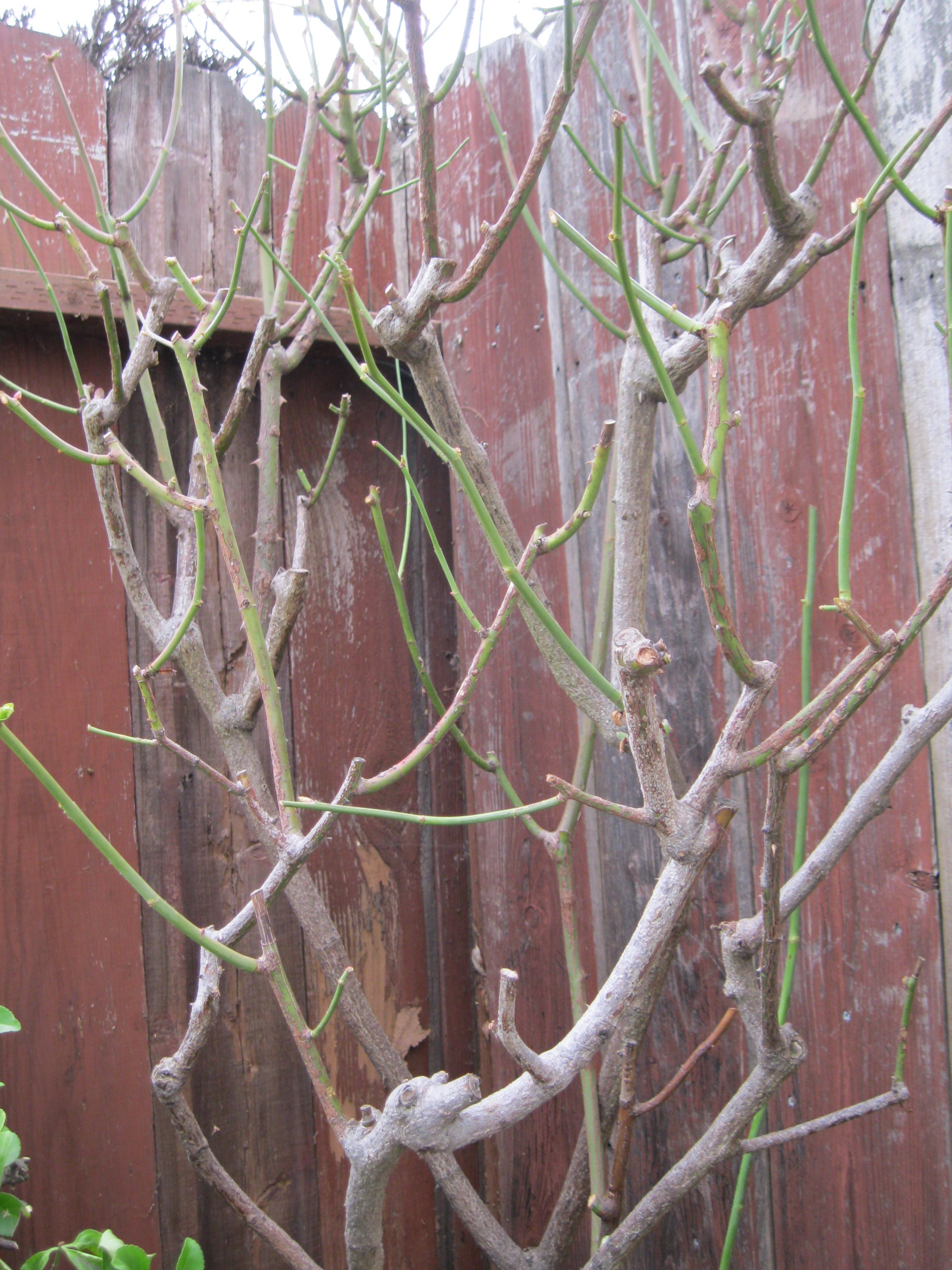
This morning I was at it again. When I went to get my tree yesterday I took a class in rose care and pruning. The cold January day gave me the perfect opportunity to practice on the Sterling Silver rose in the front yard, a tangled mess that had not been properly pruned in years. Our instructor said that roses were forgiving so I took courage and pruned wayward branches, cut away rose hips, clipped yellow leaves. When I could get to the bottom of the plant I took off suckers, cleared away debris, removed the intruding branches of the nearby hedge. I hope the rose will appreciate some air and light.

I appreciate all of the help I got to begin my backyard orchard, including Natalie Goldberg’s teachings about great determination. Do I want more trees? Oh yeah. Shrubs, too. Berries, Meyer lemons, Kadota figs, grapes. I could use a few days off from encounters with Basic Concretians, but my birthday is coming up next month and Berkeley Horticultural throws its remaining stock on 30% off sale on March 2nd.


Summer of 2015 was all about tomatoes for me: the forty-some volunteer tomato plants sprang from seeds of fallen tomatoes I planted last spring. They grew, blossomed, played host to myriad aphids and, in spite of that, produced more tomatoes than I have ever had to work with, mostly cherry tomatoes and a drying variety called Principe Borghese. All July and August I picked them, washed them, dried them, put up vats of pasta sauce in the freezer. I made experimental tomato sugar plums. I considered making tomato caramel. We ate them in Greek salad and BLTs. I developed two versions of a pasta using pan-roasted cherry tomatoes and fresh corn with either andouille or chicken chorizo (The Mexican version is my favorite).

The only thing I didn’t do is can them — we don’t have a dishwasher and I don’t have a canning kettle or a living grandmother to show me all of the old-fashioned tricks for canning in a simple kitchen.

The summer ended with a week-long heat wave. I watered the plants on the first day and then they were on their own because it was too hot to venture into our unshaded yard.

Last weekend I cut the abundant dry weeds from the side yard, probably twelve or sixteen grocery bags of them. Some of them were taller than I was. That felt like a fall chore. Then, yesterday, I sang at the Farmers’ Market in Berkeley. It was a fall market all of a sudden. There were strawberries, but not enough for everyone who wanted to take them home. There were a few peaches left, but more pears. And there were apples everywhere — I bought fifteen pounds of mixed varieties for ten dollars and cut down a cardboard box so that I could shove them in my refrigerator to join the bowl of Gravensteins I bought for pies a few weeks ago (It has been too hot to turn on the oven). I do not know the names of all of the apples I got, or the flavors and textures: lunch today may be a hunk of bread, pieces of cheese and slices of different apples. My new favorite, identified by the farmer who sold me the mix, is a Royal Empire, a mid-season apple: they taste exotic, spicy, and have plenty of juice and crunch.

The tomatoes are still producing fruit and blossoms. I begin to think of drying more of them, running the dehydrator at night. I also begin to think of soup, perhaps a corn chowder with the last of the sweet corn, or a butternut squash soup from last year’s squash — I still have a few in the garage. Perhaps I will cook them all and store the puree in the freezer for easy fall and winter soups. I freeze the seeds and skins, too, for stock.

I am not assured of cool weather. The weather is the wild card in California. Four years of drought. Record heat. There are clouds in the sky this morning, which means it will not get as hot as it otherwise could, but it has been a crap shoot whether to turn on the oven for months — as soon as I make pie crust, it turns too hot to bake. Make iced tea and we will have a cool day and I will get out the tea pot and drink hot tea instead. I have taken to watching the news on TV just to hear what they are saying about the weather.

It is dark later in the mornings: soon I will begin my walk to BART in the dark. It is dark when I get up now and the light fades early. I don’t remember dark mornings coming in early September, but I guess they do every year.

I do remember the food transitions. Right now I have lemons, peaches, Armenian cucumbers and red bell peppers, plus all of those apples.  I did not cook last week, living on milkshakes, smoothies, the occasional Greek salad and canned re-fried beans. Yes, I stock those for emergencies, hot weather and days when I am too tired to make my own from dried pintos. I think I should make some roasted strawberries for Johnny for the winter if I see strawberries next week.

When I was writing this post last, it was becoming fall 2015. Now it is spring 2016 and volunteer tomatoes are up in the yard, along with lots and lots of chard and kale that re-seeded themselves (I don’t mind at all — they compete with the weeds). I have three butternut squash plants — I threw a rotting squash from 2014 into a heavily mulched area and, voila, new squash plants.

We are eating fresh strawberries again and lots of fresh salads, which helps us both in our efforts to lose pounds we accumulated over 2015. I am baking sourdough bread once more. My latest quest is to eat “clean food” — i.e. food not touched by the industrial food system. For now we have given up white sugar and most white flour. We use maple syrup and dried fruit in our oats. We eat polenta. I use commercial whole wheat and rye flours in bread, with just a little bread flour, but I am on the track of a freshly-milled whole wheat flour. Although I miss cheese and pasta, I do buy some organic milk and yogurt from a dairy farmer. We eat a lot of legumes, too, and wild-caught shrimp and fish.

Eating less sugar was the big surprise. My skin improved. My gums improved. I still daydream about good desserts, but fresh fruit tastes really good when it is ripe, local and seasonal, whether it is strawberries or blood oranges. Dried fruit offers other options. Sometimes I will have yogurt with fruit and honey. Right now I am enjoying the freshness of a lot of things we eat: today my lunch was a salad of watercress, lettuce, cilantro, roasted beets, raw carrots, walnuts, feta and blood oranges in a balsamic vinaigrette.

I have had a left knee injury since December 2015, which is slowing me down and keeping me from things I like to do, but I found this draft post and thought I would send it out to all my patient readers to say that I am alive, still feeding us and growing things, still playing music, not painting much or writing much, watching the seasons turn through the plants in the yard and the food on our plates.