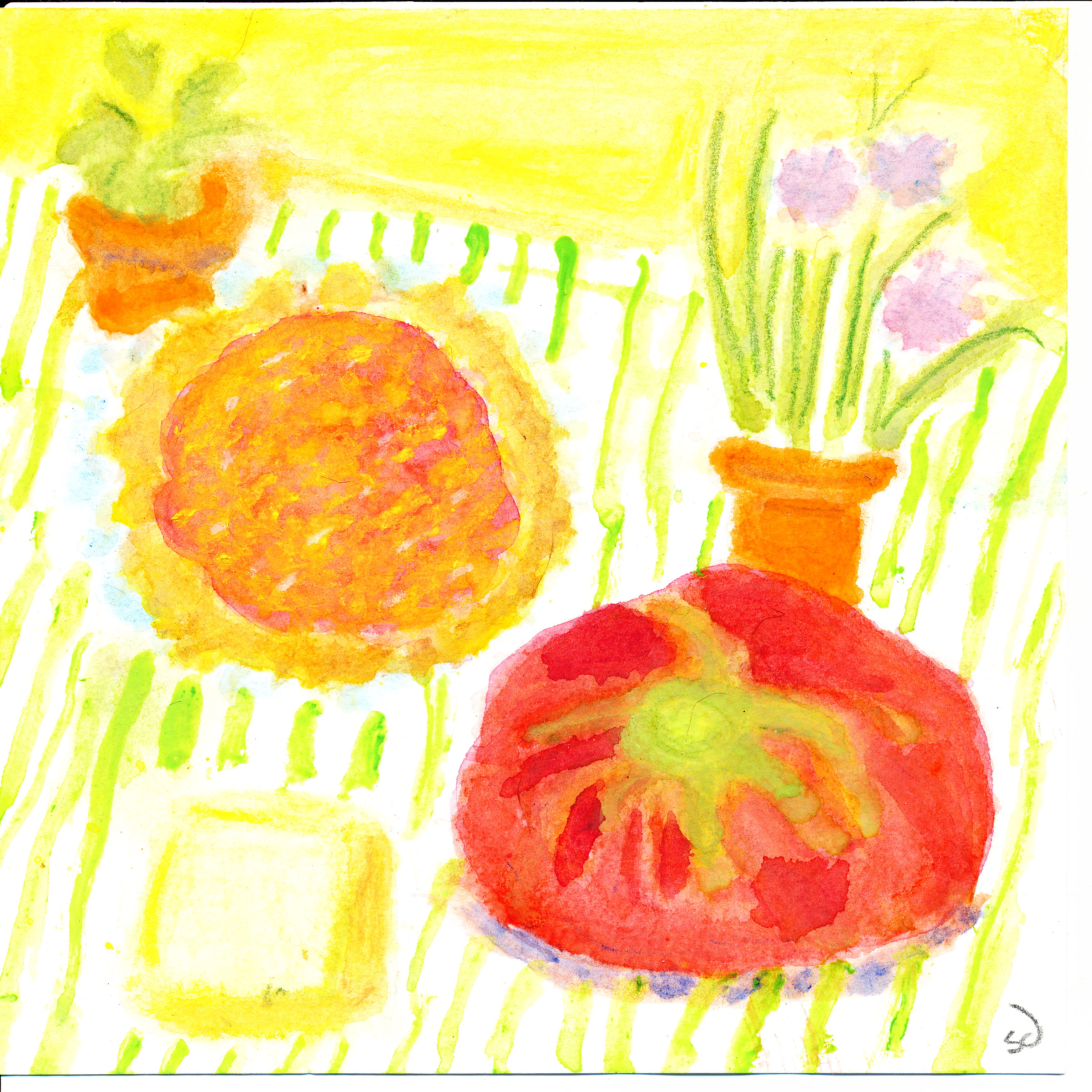
Painting of orange on plate in Mabel's dining room, Taos, New Mexico.

First Orange. 8″ x 8″ watercolor pencil and gouache. Sharyn Dimmick

I ate my first orange of the season this morning, the first one I’ve had since March. The fruit plate at breakfast In New Mexico has been full of melons: I know they can’t be seasonal — not watermelon anyway. Today I turned first to the stewed prunes. I had two, but they were cold. Then I saw oranges in the fruit bowl and went up to investigate. The first orange was large. sporting a blue and white label: I squinted and read “Australia.” I put it back, but now I wanted an orange. I found a small one with no sticker. I took it, hoping it had been trucked no further than California where I live, two states away.

Taking it back to the table I peeled it with my fingernails and then used a knife to get under the thick white pith, losing a little juice as the knife pierced the flesh. Wiping my hands on my napkin, I removed the navel and separated the first segment from the broken halves.

It tasted like sunshine: winter sunshine — a little sweet, acid, radiant in my mouth. I understood for the first time how my mother felt in Canada and Illinois when she got an orange in her Christmas stocking: how wonderful it must have tasted in the dead of winter when they were rare.

Mom has never lost her taste for oranges. We argue about them. She wants them in August and September when it is not orange season. I remind her that in January, February and March we will be inundated with citrus: I spend March making tangerine curd to eat on angel food cake, devising citrus dressings for salads, drying and candying citrus peels. We make Swedish rye bread in the winter with orange zest and fresh juice.

When Mom moved to California in 1944 she said you could buy oranges everywhere: from roadside stands, from trucks on San Pablo Avenue. She bought an orange juicer — not an electric thing, but a press with a screen and long handles: you bring the handles together and squeeze halved oranges or lemons between metal plates. The screen catches the seeds and the juice falls into a reservoir below with a pouring spout. It does not work well if you have removed the peel for zest or candying — it was designed for halved citrus, squeezed whole.

I have never been partial to the standard American trio: apples, oranges and bananas, sitting on the counter year-round and incorporated into every fruit salad and lunch box. I eat apples in season, drying them for the winter and giving them up when they come from cold storage. I like oranges when I am hiking and fresh food is scarce, or when, like this morning, I take a walk in thawing snow: I walked to town to get a coffee, walked back in time for morning meditation, craved fruit at breakfast. The orange tasted like lost gold recovered, what explorers had been looking for as they sailed around the world.

Oh, you’ll want a recipe. Alright. This is how to candy citrus peel: orange, lime, tangerine, lemon, or grapefruit. I started doing this when I got interested in using the whole fruit: if I’m not zesting citrus fruit there is all of that peel left over — why not turn it into winter sweets? Home-candied peel bears no resemblance to that nasty glaceed mixed fruit you find in the store. I chop candied peel into breakfast muffins, use it in orange French toast, or eat it straight out of the jar when there are no sweets in the house and I want a little something. Sometimes I save mixed citrus peels in a bag in the freezer: when I have a lot, I take them out and candy them all at once. It’s best to use organically-grown fruit for edible peel, but if you only have commercially-grown citrus available, be sure to wash it with dishwashing liquid and water, rinse it and dry it before peeling so that you are not ingesting any unwanted chemicals.

Here’s what you do. Peel a lot of citrus fruit or take your bag of saved peels from the freezer. You can candy several types at once — you don’t need to separate them. If you are peeling fresh fruit, score the peel into quarters with a knife: this makes it easier to peel.

Place your peels in a large saucepan of cold water: you want 2 cups of water per eight limes or lemons, six tangerines or oranges, or three grapefruit. Bring peels to rolling boil. Drain them. Start again with cold water. Repeat. The thicker the peel, the more times you should blanch it — grapefruit peel takes at least four times,

Cool the peels and scrape the white pith from them with a knife or the side of a spoon, being careful not to break the peel — if it breaks, you can’t brag about it, but it is no tragedy — you’ll just have some smaller pieces. Cut the peels into strips.

Now return the peels to your saucepan with equal amounts of sugar and water — say 2 cups each. Bring to a simmer and cook without stirring until peel is translucent. This takes about an hour. If you are a thermometer-wielding type. Alice Medrich says to get the syrup to between 220 and 222 degrees.

Remove peel with slotted spoon and cool in a single layer on a rack over a baking sheet (the peel will drip for awhile).  We set ours in our oven overnight. When peel is dry, dredge it in sugar and store it in sugar in a glass jar in your refrigerator. If you make enough it will last you until citrus comes in again the following year. It makes great gifts, too. People have been known to dip it in chocolate or caramel.

The Kale Chronicles’ Food Manifesto: Ideas I Try to Live By

painting of foods for four seasons

Seasonal Food 6″ x 6″ gouache and watercolor pencil. Sharyn Dimmick

1)   Eat fresh, locally-grown food in season.

Fresh food tastes good. It has more vitamins and minerals in it than preserved food. If you can grow your own food, go for it. If you can’t, seek out farmers’ markets or a community-supported agricultural program. Familiarize yourself with what grows in your area when.

2)   Adapt recipes to use local resources.

For instance, pesto recipes often call for pine nuts. Here in the Bay Area of Northern California, pine nuts are currently selling for thirty or forty dollars a pound. I make my pesto with walnuts, which grow in California and can be found at my local farmers’ market in bulk. If you live in an area that produces almonds, hazelnuts, black walnuts, macadamia nuts, Brazil nuts, substitute them for pine nuts. Eat pine nuts when you go to Italy or visit New Mexico.

3)   Use what you have on hand.

Instead of running out to get ingredients, practice cooking with what you have on hand. Develop a regular routine for food shopping and stick to it. You will save time and money if you are not always running to the store and you will develop your creative cooking muscles. Mom shops for groceries once a week at a variety of places (Safeway, Grocery Outlet, Food Maxx or Country Cheese). I pick up a box of vegetables in Berkeley on Wednesday afternoons and often go to the Saturday Farmers’ Market.

4)   Do not waste food.

We spend money for food and then we throw it away when it is less than perfect or past the pull date. Many people frequently throw away food that can be eaten. A routine throw-away is sour milk (or half and half, or cream), or, worse, milk that has just passed its pull date. Sour milk, cream, etc. can be substituted for buttermilk in recipes that involve cooking or baking. Sour milk can also be “sweetened” with baking soda and then used in cooked or baked recipes meant for fresh milk.

painting shows dehydrated and canned food for winter

Food for Winter 6″ x 6″ gouache and watercolor pencil. Sharyn Dimmick

5)   Find simple ways to preserve foods for winter.

I bought a dehydrator a year and a half ago. Now I make my own dried tomatoes which I use during the winter in soups, pastas and salads. I have also dried apples and pears and I’m just getting started. With trepidation I learned how to put up dilly beans, a baby step into home canning. When I make pestos or curry pastes, I put part of the yield in the freezer for later.

6)   Develop a personal pantry based on what you like to eat and ingredients you use frequently.

For example, I am a baker as well as a cook, so I stock a baking pantry with flours, sugars, molasses, honey, maple syrup, vegetable shortening, oils, nuts, coconut, dried fruit, yeast, and leavening agents. I cook Chinese food so I keep soy sauce, peanut oil and chili paste with garlic, fresh ginger. I cook Thai food so I keep fish sauce. A pantry rich in canned tuna and white beans would do me no good because I am not going to cook with those ingredients, or canola oil, which tastes like fish to me, but I do keep lots of pasta, polenta, rolled oats, dried tomatoes, kalamata olives.

7)   Stock your pantry when you find good deals on things you use often.

We are infamous for buying canned sour pie cherries by the case. We like cherry pie. Sour cherries make the best pies. Canned cherries keep. So when Grocery Outlet features canned cherries we buy a case at a time. We keep them in the garage. We have learned the hard way that inexpensive pie cherries are hard to find, so when we see them we buy them. We also stock up on sugar, flour, butter, pastas, and miscellaneous canned goods when they are on sale.

painting shows stock pot, skillet and ingredients.

Making Stock 6″ x 6″ gouache and watercolor pencil . Sharyn Dimmick.

8)   Learn to make stocks.

You don’t have to go to cooking school for this. You don’t have to roast bones (although roasted bone stock is supposed to be good). The Greens Cookbook has wonderful recipes for vegetable stocks, which I recommend. But any old person can plunk a chicken or turkey carcass into a pot of water with some vegetables or vegetable trimmings (the ends of carrots, tough ends of celery, celery leaves, cilantro roots and stems, the skin of roasted winter squash), simmer it, strain it, skim of the fat and, voila, a base for soups, sauces, chicken pot pie, Chinese stir fries. For me, chicken stock is indispensable. We keep it in pint containers in the freezer.

9   Develop your cooking resources.

I learned to cook by cooking with my mother and asking questions about what she did, but I also learned by tasting lots of foods, watching cooking shows on PBS, reading cookbooks and having conversations with others about food, especially people whose cooking I liked. We keep an old Betty Crocker picture cookbook as our cooking Bible. I have bought the cookbooks of several of my favorite restaurants: Ajanta, Henry Chung’s Hunan, Greens, and Chez Panisse (I really like the Chez Panisse Desserts cookbook, which taught me how to make fruit caramel and variations on fruit curds and has a good section on seasonal fruit in California). I keep a large binder of recipes from the food sections of two newspapers, organized by main ingredient or type of food: Carrots, Chocolate, Cookies, Corn, Fennel, Fish, Lemons, Pancakes, Pasta, Peppers, Pumpkin, Soup, etc. I browse through it when I’m trying to remember what I cook with savoy cabbage or looking for that fabulous Polenta Pancakes recipe from Mark Bittman. I also search online when I need more ideas and subscribe to more than a couple of food blogs.

10) Don’t be afraid.

Remember, cooking is fun. It is a sensual experience standing in front of a cutting board with the smell of fresh basil wafting through the air, hearing the snap of green beans as you trim them, seeing the colors of eggplant, peppers and peaches sitting on the counter. If you are not sure how to do something, you can always consult a cookbook, watch a video online or call another cook on the phone. If you tackle a technique or dish you have never attempted you might want to follow instructions carefully the first time around, but once you learn some cooking principles and the rules of substitution you will be freer to cook what you have and turn it into what you like.

painting of sour cherry pie, cherry syrup and ingredients

Sour Cherry Pie (Detail) 12″ x 12″ gouache and watercolor paper. Sharyn Dimmick

How can cherries be a part of seasonal cooking in November when I don’t live in Australia? When the weather turns cold we turn to preserved foods. We still have apples on our backyard apple tree, but Mom asked me to roast a pork loin and some squash while she and my sister-in-law Barbara scrubbed and taped walls for painting (I know I got the better part of this division of labor). Because I am supposedly getting ready for a week away, I wanted an easy pie with no peeling and paring, no slicing, so I went for the canned cherries in the garage. These are pitted sour cherries canned in juice. Mom had made crust earlier in the week, so it was pie time again. And while I’m at it, I’ll just say that I have made fresh sour cherry pie from some sour cherries I scored at the Ferry Plaza market in San Francisco and — drum roll — we prefer pie made with canned sour cherries.

Here is how to make cherry pie — my cherry pie.

Make the crust first. If you make Madge’s recipe, you will have enough crust for two cherry pies, so you can pit my cherry pie against your favorite recipe, double the filling recipe and make two cherry pies from this recipe or save the extra crust for quiche or apple pie. Our recipe is handy at Thanksgiving and Christmas when you are baking lots of of pies, but. truth to tell, pie is never a problem here: we’ll eat it for breakfast, dinner, lunch and tea.

Once again, the no-rant version* of pie crust for your convenience:

Cut 1 cup of vegetable shortening plus 2 Tbsp of butter into 3 cups of unbleached flour and 1 tsp salt  until the mixture resembles small peas. Do not overwork the dough — you want to see streaks of fat in the raw dough: they will melt while baking and create flaky crust. If you use salted butter, you can reduce the salt to 1/4 tsp.

Into a 1-cup liquid measuring cup, break 1 large egg. Beat egg with fork until blended.

Add 1 Tbsp cider vinegar to egg and stir. Then add water until combined liquids measure 1/2 cup, plus a little more.

Add liquids to shortening and flour and work just until combined. Pat dough into a flattened circle. If you are a novice pie baker, you may want to wrap the dough in waxed paper and chill it for awhile. The intrepid and experienced can divide the dough in half and proceed by cutting one half-circle in half again — this recipe makes four crusts, so half of it will give you the crust for your two-crust cherry pie.

Roll crust out on a floured work surface with a floured rolling pin. Roll firmly but lightly, being sure to roll all the way to the edges — you want the crust thin, but you don’t want to press it down and make it stick. You’ll figure it out — it’s not that hard. Try your best to keep the crust circular. Measure the crust by setting your pie plate on top of it, allowing for enough crust to cover the sides. Fold rolled crust into quarters to pick it up and unfold it again in your pie tin.

Now you have an aesthetic choice to make. For that classic lattice cherry pie you can roll your next quarter of crust into another circle and cut the crust into long strips, which you will lay crosswise over the filling later. If you don’t have the inclination to build a lattice, just take your circle and fold it into quarters, leaving it for the top crust later.

Go and preheat your oven to 375 degrees if using a Pyrex pie plate. If you use metal, you can start the pie at 400, but be on hand to turn it down after ten or fifteen minutes.

Now the filling:

Mix 1/4 cup cornstarch and scant 3/4 cup sugar in a dry saucepan. Whisk until blended.

Open 2 cans of sour cherries packed in water (Do not use cherry pie filling, which belongs on The Horror Roll). Drain the juice from the cherries into a 2-cup measuring cup — you will have about 1 and 1/3 cups. Leave the drained cherries in the cans for now.

Whisk 1/3 cup cherry juice into the cornstarch and sugar and stir with whisk until thickened over medium heat. The first sign that the cornstarch is working is the appearance of little shapes that look like ragged skin. If you don’t care for the pale pink color add the secret ingredient, red food coloring, drop by drop until you get a hue you like — I particularly recommend this option if you are going the lattice crust route or planning to take photos of your pie. When the mixture is thick and glossy add the reserved cherries, remove from heat and stir in

1 Tbsp butter and

a grating of fresh nutmeg

Pour the filling into your prepared pie shell and weave your lattice strips over the top, or plonk your unfolded top crust over the filling and make an attractive pattern of knife slashes for vents. Do not wash your saucepan yet! Place pie in oven. Bake for about 50 minutes or until crust is nicely browned and filling is bubbling.

Now, remember that other cup of cherry juice sitting in your measuring cup? You can drink it if you want to, which Mom does sometimes, but this is what I do with it: put it in your saucepan. Add some sugar — more than a Tablespoon, less than a cup. Turn the burner back on and boil it down until thickened — you want it to coat the spoon and be bubbly and shiny. Decant carefully into a glass jar (pour along a spoon or a knife if you are nervous — the metal absorbs some of the heat). Let cool and then refrigerate. This will keep indefinitely in a cold refrigerator. It is delicious on cornmeal pancakes, stirred into your morning oatmeal, over ice cream, with lemon pound cake …. You can also add some cream and cook it into cherry caramel — you’ll never drain cherries over the sink or throw out cherry juice again!

Let your pie cool while you eat dinner or make tea (at least fifteen or twenty minutes — the hotter the pie when you cut it, the more likely the filling is to run. We don’t care a whole lot about this, but for a prettier pie give it some cooling time).

Serve plain or a la mode.

*For the full rant on pie crust, please visit Gravenstein Apple Pie.

Food notes: For the full flavor benefit you must make this with sour cherries packed in water and scant the sugar as I do. For those of you stateside, canned sour pie cherries show up infrequently at Canned Foods Grocery Outlet — aka “Half Foods.” Some cherry pie recipes call for lemon — that will not be necessary with this pie. Please do not make it with sweet cherries (Bings, Burlats, etc.) — sour cherries have a different flavor, the ideal flavor for cherry pie in my opinion. Try them and see. If you are out of cornstarch, you can substitute flour: if you use flour, your filling will be cloudy rather than clear, but it will taste equally good.

On Kale: When I wasn’t making cherry pie, baking acorn squash with hot mustard, honey, lime and black pepper, roasting the squash seeds or boiling down cherry syrup I finally tried my friend Cathy’s version of kale with fresh walnuts and homemade raisins. The verdict at the table? “It’s still kale.” Back to the tasting laboratory…

I’ll be away for eight days starting Sunday sans electronic devices with which to entertain you or read and respond to your comments. Please make comments anyway if you are so moved. I’ll be back to coach you through your cherry pie crises well before the run up to Thanksgiving. I’ll also instruct the robot to give you a post to read on Wednesday while I am gone. Au revoir, dear readers. I’ll be back in person November 14 with stories to tell and perhaps a new recipe or two.

self-portrait of Sharyn Dimmick at Occupy Oakland with meditator and wolverine rolls.

Self-Portrait at Occupy Oakland with Wolverine Rolls. 8″ x 8″ gouache and watercolor penciil. Sharyn Dimmick

Last week was quite a week: I landed in Oakland, CA, for two days of vocational tests so that some poor soul can help me find a suitable day job. The testing center sat across the street and several stories above the site of “Occupy Oakland.” To get to my testing site by 9:00 AM I had to leave my house when it was barely light, loaded with reading material, pens, water, a thermos of milk and enough food for lunch and to get me through five hours of testing. I went back today for the third and final testing shift.

The first day I took sourdough bread, Cotswold cheese, an apple, two homemade spice snaps and a zucchini-gingerbread muffin. The next day I don’t remember what I took, but it was similar: apple, cheese, bread. I eat my lunch in the park where the demonstrators gather.

Monday I had off from testing and got to stay home all day. I took advantage of the hours at home to mix up some sourdough of my own, using recipes from my favorite bread book, The Cheese Board Collective Works (Read more about my most-used cookbooks here). Sourdough breads are made from wet, slow-rising doughs so it helps to have a whole day to make them.

I made a batch of wolverines, a round, part-whole wheat, sourdough bun, containing dried sour cherries, apricots and pecans (I used walnuts). The original recipe also calls for golden raisins (sultanas), but I see no reason to include them.

About now, you are either turning away in horror at the dried fruit, or you are hoping for the recipe. Alas, I must encourage you to buy your own copy of The Cheese Board Collective’s book because the instructions for making the sourdough starter alone take two full pages. Wolverines are made from a recipe called “Suburban Bread” (another full page), but they get their own page, too, and you also need to read the pages on shaping, working with sourdough and making sourdough in a non-commercial oven. Me? I’ve done this before.

Anyway, a “quick” batch of wolverines takes over nine hours if you already have your sourdough starter on hand. That I had — my “Cheese Board” starter gave up the ghost a couple of years ago, but I made a new sourdough starter from another recipe four weeks ago and have a healthy batch in the fridge that must be used weekly. I’ve been making “cowboy biscuits,” leavened with sourdough, soda and baking powder once a week, but Mom informed me on Sunday that she liked regular baking powder biscuits much better. Oh well. So I had the sourdough starter and we love wolverines. “We” love bread of all kinds (except perhaps sourdough biscuits and Irish soda bread), but we are particularly partial to crusty yeast-risen breads. I like wolverines so much that I ate two last night when they came our of the oven, had one for breakfast this morning, and took another for lunch today with some more Cotswold cheese. It is with the greatest restraint that I am not eating another as I type but am instead eating cold green beans with a bit of basil.

I ate my wolverine sitting on the ground in a sunny spot next to the bicycle lockers. The tent city was much larger than it had been on Friday afternoon and there were a lot of new booths and information tables. The Buddhist Peace Fellowship does sitting meditation there, so I sit with them after I eat my lunch while people talk, the wind blows, traffic signals send their audible walking calls, a clock tower chimes the half hour. I think about my blog and day jobs when I forget to focus on my breath or sounds or sensations. I “sit” on my backpack, pretending it is a zafu, putting it between my knees and sitting astride — it makes a pretty good substitute, although I can feel the lumps made by my water bottle and thermos.

Vocational testing doesn’t tell me much I don’t already know: I like writing, painting, singing and cooking. “About” page gives you more of the scoop on this. I’ll write for hire. I’ll teach writing practice for hire. I like to sell paintings. I sell music CDs too. I sit with the Buddhists for free and I cook for free. Long, complicated projects like wolverines don’t phase me because I like to take my time doing things and make things from scratch. Sourdough baking is a big adventure — if you love yeast baking and are up for a challenge, get yourself a good instruction book and go for it on a day when you can be home all day (or all night for you night-owls). If you don’t have sourdough starter on hand, you’ll need anywhere from three days to two weeks to mix it up and get it going vigorously. If you go for the Cheese Board book, you’ll find wonderful recipes for pizza and many quick treats such as muffins and scones in addition to the sourdough chapters.

Occupy Oakland is calling for a general strike tomorrow. I imagine the Peace Fellowship will be sitting there again. I will be “working” at home again and grateful to be there with my computer and my paints, a pot of black tea and at least one more wolverine.

Cowboy Sourdough Starter (adapted from The Cheese Board Collective Works and the “Rocky Mountain Sourdough Starter” recipe in The Book Lover’s Cookbook).

Get a glass jar with a non-rusted metal lid. Please note: this metal lid is the only metal object you will allow near the starter and you don’t want the metal to touch the starter. Big pickle jars are good. Punch several small holes in said lid, as though you want to keep something alive in the jar (You do!)

Place 1 and 1/2 cups unbleached flour or bread flour in the jar.

Add 1/2 cup whole wheat flour or rye flour

Add 1 tsp kosher salt.

With a wooden spoon, stir to mix well. Do not use metal while making or handling sourdough starter.

Dissolve 2 and 1/4 tsp  baking yeast (equivalent of one packet) in

2 cups warm water (not too hot or you’ll kill the friendly yeast)

Add dissolved yeast to jar and stir again with your wooden spoon until it is mixed well.

Place a folded linen or cotton smooth kitchen towel on top of your jar and set it in a warmish place where you can remember to stir it twice a day. You will be leaving it out for at least two or three days — remember, you want it to sour. Save the lid for later — you don’t need it at this stage. The towel allows your local yeasts that live in the air to join the yeast in the jar.

Check the starter twice a day. When it is bubbly and smells like yeast you can bake with it by taking it out cup by cup and adding it to biscuits, pancakes or yeast breads. Whenever you remove a cup of starter you need to add a cup of water and a cup of flour to the starter jar.

Sourdough starter is designed to be used once  a week or more often. You can store it in the refrigerator. Sometimes liquid separates and rises to the top. You can either pour this off or stir it back in. It will keep for months if you use it regularly. Watch out for mold (mine has never molded): if your starter develops visible mold or bad smells throw it out, wash your jar thoroughly and start again.

painting of lemon pie and blue teapot

Lemon Sponge Pie, 8″ x 8″, gouache and watercolor pencil. Sharyn Dimmick

My late older brother ate pretty much the opposite of what I eat. He ate a lot of fast food, quick food and processed food. He drank mugs of coffee laced with up to a quarter cup of sugar, minus what he spilled on the counter. He liked raw carrots and celery and fresh strawberries, but he only ate those things if someone else washed them, cut them up and put them in a bowl for him, preferably on the counter where he could see it. The only other vegetable he consumed regularly was onions, although he once ate seven jars of marinated artichokes out of the case Mom gave him on Christmas Day. In the fruit category he liked raisins, strawberry milk and blueberry pie.

In the last year of his life, Kevin had an experience that improved his diet slightly. He liked to tell the story. His then girlfriend, Barbara, who would become his wife, had a cat named Jigs. Jigs looked forward to Kevin’s visits because he nearly always brought bags of fast food with him. One day Kevin arrived with a McDonald’s bag, containing a cheeseburger and an order of Chicken McNuggets. Kevin broke  open a McNugget and gave it to Jigs. Jigs sniffed it, immediately commenced to try to bury it and walked away, insulted. Kevin said, when he told the story, that if a cat wouldn’t eat something that was supposed to be chicken he wasn’t going to eat it anymore either.

Michael Pollan has famously given us the guideline not to eat anything your grandmother wouldn’t recognize as food. We hew pretty closely to that in our household these days, although we each have our indulgences: we buy Prego spaghetti sauce because Mom made her own for years and we can honestly say we like Prego better. I particularly like the Italian sausage flavor. We use it for quick suppers. Sometimes I add fresh summer squash or mushrooms or eggplant to the sauce, but sometimes I don’t. Beyond that, my personal weaknesses are for Cheez-It crackers and Golden Grahams cereal. I know I can make cheese straws, but I love Cheez-Its  right out of the box. I don’t buy them often. Golden Grahams are even less defensible — they are tooth-achingly sweet and taste like candy: to be able to eat them at all, I mix them half and half with some healthier cereal — anything not sweetened — and eat them with almonds. I allow myself about one box a year, on sale only.

To me, scary food does not mean food that appears to be dripping blood or cupcakes accented with spiders: scary food means food that has been so processed that it does not resemble the original food it came from.  An order of Chicken McNuggets is a good example, but so is anything labeled “cheese food” or  “pasteurized processed cheese,” as well as white bread from the grocery store. There are many more examples: please feel free to tell me about your personal food horrors in the Comments. Perhaps I’ll put up a link called “The Horror Roll” and list some of your candidates there.

Halloween was Kevin’s birthday. There is nothing he liked that I cook on a regular basis and if I shared one of his “recipes” you would stop reading this blog. Seriously. Instead, I’ll share with you a favorite family recipe that my mother made yesterday with ripe Meyer lemons from our neighbor’s tree and her famous Swedish pie crust. For your convenience, I’ll give you the pie crust recipe below, but I’ll spare you the editorial commentary: for the full rant on pie crust, please visit the Gravenstein Apple Pie post. Meanwhile, get ready to make a Lemon Sponge Pie, which is much like a lemon meringue pie, except that you fold the egg whites into a lemon custard, which includes milk. If you like lemon desserts, you will want to try this.

Make the crust first:

Sift 3 cups unbleached flour with

1 tsp salt

Cut in 1 cup Crisco (or other vegetable shortening) until it is the size of peas. Add a little butter (1-2 Tbsp for flavor).

Break into a one cup measuring cup:

1 large egg. Beat it until blended.

Add to egg:

1 Tbsp white or cider vinegar

Add water until combined liquids reach 1/2 cup, plus a little.

Add liquids to flour, salt, shortening and butter. Stir together crust and form it into a flattened round. Cut 1/4  from the round — this is your crust for this lemon pie. Wrap the other 3/4 crust in waxed paper and store it in the refrigerator for your next pie or quiche (Crust recipe makes 4 single crusts or 2 double-crust pies).

Pat pie crust into a circle on a floured work surface. Roll it out, making sure to roll in all directions and roll out any thick edges. When you think you are done set a 9″ or 10″ pie plate on top of crust. Adjust as needed: you need to roll this crust very thin for best results.

Transfer your crust to your pie tin. The classic method is folding the crust into quarters and unfolding it in the tin.

Now preheat your oven to 400 degrees or 350 if using a Pyrex  pie plate. Proceed with filling.

Pie filling:

Separate 2 large eggs, whites into a small mixing bowl, yolks into a larger one.

Beat the egg whites until fairly stiff. Leave beaters in place and change to larger bowl.

Beat egg yolks with:

1 cup milk

1 cup sugar

1/4 cup flour.

Zest 3 or 4 lemons over the bowl of egg mixture. Squeeze juice from lemons into bowl — you need at least 1/3 cup of juice.

Fold egg whites gently into the other ingredients and pour filling into your prepared crust. Transfer the pie to the oven. Keep an eye on it —  you are going to bake it for about 25 minutes, but this pie burns easily. If you are worried about it, put a strip of foil over the crust. Bake until filling is not sloshy. Allow to cool to lukewarm — if you cut it too warm, the filling will run and you will have pudding with crust rather than pie.

Like it? You can bake three more with the crust you now have on hand, or you can make quiche, apple pie, pumpkin pie, chocolate pie — whatever you like best.

Food Note: I use Meyer lemons in this recipe because we grow them. Eurekas or other tart lemons are fine, but don’t go above 1/3 cup of juice with them: Meyer lemons are sweeter than other varieties.

The Horror Roll: To nominate candidates for  “The Horror Roll,” please list foods or “foods” that scare you by their apparent deviation from real food in the Comments section. I’ll start a “Horror Roll” page soon with some of the most horrendous nominees. In fact, I’ll start it now. Check it out.

Halloween painting of cocoa shortbread cookies with bats.

Trick or Treat Cocoa Shortbread. 8″ x 8″ gouache and watercolor pencil. Sharyn Dimmick

Trick or Treat. I’m not here, am I? Because I’ve gone to post on ArtEpicurean for pre-Halloween fun. Please follow me over there for a delicious treat, my beloved cocoa shortbread cookies tricked out in Halloween costumes. Usually, I don’t break out this recipe until Christmas, but I wanted to do something special for Jane, a woman after my own heart who posts recipes inspired by or accompanied by paintings.

I’ll give you a thumbnail of the cookie painting, but please go visit Jane’s blog for the recipe. You won’t be sorry. Just click on the link that says ArtEpicurean in the first paragraph if you haven’t done so already, or scroll all the way down to the bottom of the page and click ArtEpicurean in my links section. We’ll save you some cookies.

P.S. I have to be away early this morning through late afternoon. If something goes wrong with the link, please  use your initiative and Google “Art Epicurean” to get your recipe. I’ll check in as soon as I can — before 6 PM PST. — Sharyn

P.P.S. The link in the first paragraph works now, thanks to Sally B. Sorry that it failed earlier.

Update: It is now approaching Christmas 2014 and the ArtEpicurean link no longer works so I have decided to re-post my cocoa shortbread recipe here as a service to all lovers of shortbread and chocolate. As always, using the best-quality ingredients you can find or afford will yield the most delicious shortbread.

Cocoa Shortbread

Break into small pieces, 2 sticks butter*. Soften for a few seconds in microwave. Measure 1/2 cup granulated sugar, plus 2 Tablespoons* Work sugar into butter — I like to use my hands, but you can use a spoon if you like. Whisk together 2 cups sifted unbleached flour and 1/2 cup unsweetened cocoa powder, sifted. Add flour/cocoa mixture to sugar and butter and mix until blended. Add vanilla extract to taste.*

Chill dough for at least an hour. This step is important for both flavor and texture.

Preheat oven to 300 degrees.

Shape cookies by into small balls with hands and then smush your thumb into the center to make thumbprint cookies. Or mix equal parts unsweetened cocoa powder and powdered sugar in a shaker and use that to “flour” a work surface. Work with half to a quarter of the chilled dough at a time, depending on your skill and the coldness of the day. Flatten dough into a pat (like pie crust). “Flour” your rolling pin, cookie cutters and board or counter with the cocoa/powdered sugar mixture (I like to use a marble slab and rolling pin for rolled cookies). Roll out dough to 1/4 or 1/2 inch thickness and cut with decorative cutters. Place on ungreased baking sheets and decorate with colored sugar.*

Bake for twenty minutes at 300. For best results, rotate baking trays from back to front and from bottom to top rack at the ten-minute mark. Use caution in removing cookies from baking sheets — they are tender when hot and can break easily if you touch an adjoining cookie while working your spatula under another.

Note on ingredients: You can use unsalted butter if you prefer. If you do, add just a pinch of kosher salt to the dough to avoid a flat taste. I like to use one stick of unsalted butter and one stick of salted butter and omit the salt. Use vanilla extract, rather than artificial vanilla — it costs more, but you don’t have to use a lot, the flavor is superior and it does not have dodgy chemicals in it. You can also make your own vanilla if you have vanilla beans and spirits lying around. You could also try infusing the butter with ground vanilla beans instead of using extract (I haven’t tried this option yet). Coarse colored sugar works better than fine sugar, which can end up being absorbed into the dough as it baks. Nevertheless, I have had some success with making my own colored sugar out of either turbinado or white sugar by shaking it in a jar with food coloring. Shake well and save money. Turquoise, purple, hot pink and light lime green look beautiful on the dark dough, as would a light orange yellow. Mocha enthusiasts could add a pinch of instant espresso powder to the dough.

Enjoy!

painting shows ingredients for pasta: broccoli, lemons, feta, fresh basil, dried pasta.

Broccoli-Feta-Basil Pasta. 8″x 8″ gouache and watercolor pencil. Sharyn Dimmick

This week I got a big bunch of fresh basil in the farm box. Fresh basil in October? I’ll take it. I used some of it to make a quick pesto to eat on Portobello mushroom “burgers” last night. I used the rest to make my favorite quick pasta dish: pasta with broccoli, feta and basil.

This is almost a non-recipe.

1) You put your pasta water on to boil

2) You get out a box of pasta — I like short pastas with this: farfalle, fusilli  or penne. I use half a pound for two people because I like leftovers and because when we eat this pasta we eat it as a one-bowl meal.

3) While the water heats and the pasta cooks, wash and chop your broccoli into bite-sized pieces. How much broccoli? I can’t tell you that. How much do you have? How much do you like broccoli?

4) Crumble some feta cheese into a large serving bowl or two individual pasta bowls (You can make this for one, too — just use less of everything). I’m going to say four ounces of feta for two people, but if you want to use more, use more. The more cheese, the better it is, really.

5) Squeeze the juice of one or two lemons over your cheese.

6) Grind some black pepper over  the cheese if you like pepper.

7) Do a quick chiffonade of basil leaves into the cheese.

8) Throw your chopped broccoli into the pasta water in the last minute of the pasta’s cooking. Cook one minute only.

9) Drain pasta and broccoli

10) Toss with feta and basil mixture, or put in individual bowls and stir like mad with a fork to distribute cheese. The cheese melts a little on the warm pasta, releasing the perfume of the basil.

Food Notes: This is best to eat in late spring and early fall, whenever you have the intersection of fresh basil and broccoli and lemons, but I make it in deep winter, too, substituting dried oregano and red wine vinegar for the basil and lemons. It’s good with roasted red peppers or bits of sun-dried tomatoes added to it, too, which add color contrast and winter vitamins. I make this pasta with fresh green beans if I don’t have broccoli — that’s good, but the broccoli version is better. What you don’t need is any salt or olive oil: feta is plenty salty on its own and provides enough fat. Keep it simple.

This is really good made with whole wheat pasta, too, which I buy whenever I find it on sale.

Please come back on Friday for a Halloween surprise.

Painting of a Pink Poached Pear

Dream Pears 7″ x 7″ Acrylic on Fabriano  Paper by Suzanne Edminster

Dear Readers and Cooks,

I am pleased to introduce my first guest post on “The Kale Chronicles.” My real-life best friend Suzanne Edminster is a painter who lives in Santa Rosa who teaches popular classes in acrylic painting techniques which you can find on her website, SaltworkStudio. What not everybody knows about Suzanne is that she is a talented hostess who can pull together delicious meals with skill and grace. Just for you, she painted the painting and wrote out the recipe. Enjoy.

Sonoma Pears Poached in White Wine and Blueberries

On an autumn night in Santa Rosa I was contemplating a bag of small Bartlett pears that had been carried too long in the car and were starting to bruise. I was longing for a sweet, elegant way to cook pears without messing with pie crust, cobbler or crumble. I developed this recipe as one that could, in the best of all possible worlds, be cooked with fruit from our garden, though I draw the line at keeping goats for cheese– four chickens are demanding enough.

We have two young pear trees in our urban backyard orchard, both Red D’Anjou. This was a mistake; we were given one of the two trees and was assured it was a Bartlett. Neither is bearing yet, as we’ve had to take young fruit off too-young branches to avoid breakage. Scott, my husband, planted 9 kinds of blueberry bushes in a raised bed, but between chickens, squirrels, raccoons and other poachers, we got a total of about five blueberries from the plants this year, although they are bearing well. Next year, bird netting goes over all and the humans of the house can eat the harvest. Eventually I’ll try this recipe with our own blueberries (self-frozen if need be) and our own pears.

At the end of the summer we had overbought on white wine and had not yet laid in the stock of red. My mother used to serve red warm cinnamon pears—yes, I think she used cinnamon drop candy on them and to make the sauce!– and I really wanted the pears to turn that glorious holiday crimson. What could I do to give the wine a color? We had small frozen organic blueberries that we keep on hand for cereal. I adapted Stacy Slinkard’s recipe for Red Wine Poached Pears that I found in About.com at http://wine.about.com/od/howwineismade/r/poachedpears.htm. The result was delicious, and the color of both sauce and pears, a deep red-purple, divine. Surprisingly, the blueberries held their shape through the longish poaching time. I used fresh lime juice from our lime trees rather than lemon, and I chose soft new Sonoma goat cheese to offset the brilliant sweetness of the pears in the sauce. Scott and I agreed that the white, tangy bite of goat cheese was perfection on the warm red pears. A bonus of this recipe is that the whole house smelled of pear-pourri!


Sonoma Pears Poached in White Wine and Blueberries

Ingredients:

4-6 halved, cored pears (peeling is optional and top stems can be left on)

1½ cups of white wine (your choice)

½ cup of granulated sugar

2 tablespoons of fresh lemon or lime juice, with optional zest

2 teaspoons vanilla

1 teaspoon cinnamon

½ to 1 cup fresh or frozen blueberries

Soft plain or new goat cheese

Combine all the ingredients, except pears and goat cheese, and bring to a boil. Let the sugar and wine combine, then add the pears face-down and simmer for about 15-20 minutes, turning once after about 10 minutes. Pears should be tender and easily poked through with a fork, but don’t overcook them. Remove pears and boil the wine/pear sauce until reduced by half. Serve pears warm in bowls with a small dollop of soft goat cheese in the middle of each half. Pour warm sauce over all. It’s excellent cold as well.

Painting Note: This slightly cosmic pear painting shows both the pinkish red of the sauce and the purple of the blueberries. It’s 7” x 7”, acrylic on paper. The pink-purple ranges from Alizarin Crimson to Fluorescent Magenta. You can see more of my paintings at www.saltworkstudio.net . Or visit my blog at http://saltworkstudio.wordpress.com/

Painting of a To-Do List

To-Do List. 6″ x 6″gouache, watercolor pencil and ink. Sharyn Dimmick

What if you come to visit and there is nothing new to read?

On days when I don’t post, I invite you to:

1) Read the About page (there’s a lot of information there).

2) Scroll all the way down to the bottom of the Home page and click on various links. In the links section, you can find links to other artist’s sites, food blogs, sites for writers and cool participatory events like NaNoWriMo, which will begin soon.

3) Cruise through all of the illustrations on the site. I’ve added archives at the bottom of the home page, which should make this easier to do now.

Think about which is your favorite painting. Tell me.

Even think about buying one.

Which would you like to see in a future give-away?

Or would you rather have the last copy of my homemade illustrated cookbook made before I started “The Kale Chronicles?”

4) Check out the food blog links in the Apple Cake with Caramelized Fennel and Dark Rum post — you may find a new favorite or two.

5) Visit the Go-To Cookbooks post and think about your favorite cookbooks. Leave comments if you want.

6) Learn to make your own pie crust: follow the directions given under “Gravenstein Apple Pie.”

painting depicts Canary melon, limes, chile paste, peanuts and fish sauce

Canary Melon Salad 8″ x 8″ gouache and watercolor pencil, Sharyn Dimmick

Those of you who know me well know I am iffy about melons: I like watermelon and ripe honeydew, but I O.D’d on orange melons sometime after childhood. When I get a new melon, it is not necessarily a day of rejoicing. Wednesday’s CSA brought a rather large and spectacularly yellow Canary melon. I had never tasted one before. To make matters worse, my mother does not eat melons of any description, except for a token piece of watermelon on the hottest of days.

I got a sneak peek at the melon on Saturday morning at the Farmers’ Market because they were giving pieces away at the Riverdog Farm stand. It was very sweet, floral or perfumy, complex and not orange: it was a melon I could eat.

In the schizophrenic weather of Northern California October I am cooking posole in the morning for a hot lunch and wishing I had gone swimming by mid-afternoon. After thinking about it for six days I knew what I was going to do with the ripe melon: I would fix it Thai-style with chile paste and fresh lime juice and some fish sauce and eat it on a bed of arugula, also featured  in the farm box.

As I sliced and seeded the melon, I tasted it again. It was really sweet. After I cubed each slice into a bowl, trying for bite-sized pieces, there was a lot of juice in the bottom.

I took another bowl, added a dollop of chile paste from my trusty jar, squeezed a lime into that and  added a touch of fish sauce. I tasted the dressing. Pretty good. I combined the dressing with the melon and tasted it again. Hmm. Could it use more lime? Try again to be sure. At this point I was standing at the cutting board tasting rapidly. Yes, It could use more lime. I cut another and squeezed in half of it. “More,” the melon said, “More.”

I ended up using two limes’ worth of juice in the salad. And I tossed in two packets of honey-roasted peanuts leftover from my last Southwest Airlines flight. I ate every bit of this in my large salad bowl and drank all of the juice from the bowl and am happy to say that I have enough melon and arugula left to make another batch for lunch tomorrow (or the next time it turns hot).

Canary Melon Salad with Arugula, Lime and Chile Paste

Slice and seed 1 Canary melon. Cut it into bite-sized chunks.

Wash and dry enough arugula to give each eater a portion of salad.

Make a dressing of a dollop of chile paste (up to 1 Tbsp if you like heat. 1/4 tsp if you are wary of chilies), plus the juice of 2 limes and a splash of fish sauce. (It helps if you taste the dressing with a piece of melon and a leaf of arugula to know what you are getting).

Toss arugula with dressing and remove arugula to individual salad plates or bowls or a family-style platter. Pour remaining dressing over melon and toss. Pile melon on top of arugula. Garnish with whole or chopped peanuts to taste.

Food notes: I meant to garnish this with Thai basil and/or mint as well, but I never made it out to the yard to pick any. But if you have more discipline than I do by all means add either herb. I might like this with cooked shrimp or prawns, too, or even grilled beef, or coins of sausage.

Painting Note: I was uploading the painting and realized I forgot to paint the arugula. Oh well. Artistic license.

Next Week’s Treat: Next week “The Kale Chronicles” will feature a guest post by painter Suzanne Edminster who will share with you her recipe for poached pears with goat cheese.