Archives for category: salads

My weekly trip to the farmers market is always an adventure: what will there be in the last week of April? After decades of farmers market shopping, farm box subscriptions and growing my own food in California, I had a pretty good idea what to expect in the markets there. I knew homegrown cherry tomatoes might be ripe on June 30, or Fourth of July and sweet corn would soon follow, but I have lived two states to the north for less than a year and do not know what to expect.

I’ll adjust, but I am not adjusted. The days have gotten long here and cavalcades of flowers are blooming: bulbs and shrubs and flowering trees: peonies, iris, tulips, lilacs, rhododendrons, cherries and plums. And yet the food crops are stubbornly behind sunny California or even foggy coastal California.

I got excited on Friday because the market newsletter had said there would be strawberries this week. I packed empty glass containers to carry them home in and got to the market just as it opened to be sure to get some.

I didn’t see any strawberries when I walked through the market. I stopped to buy radishes and spring salad mix and a loaf of whole wheat sourdough. I walked through a second time. No strawberries.

I stopped by the market booth. “The newsletter said you would have strawberries this week. Did the vendor not come?”

The woman in the booth looked at me.

“Strawberry plants,” she said, naming the vendor.

Oh.

I spotted some rhubarb. Perhaps it was dreaming of strawberries like I was.

I did not buy any rhubarb this week. Once, in an effort to try everything in a market, I bought a bunch of rhubarb and made all kinds of things with it. You can read about those experiments here. I may get so I crave rhubarb in the spring after a few years in Washington, but I am not there yet.

There are no root crops in the market except radishes. Where are the carrots, the spring beets, the new potatoes?

On my way out, I bought arugula with my last six dollars. I’ll be eating both salads and cooked greens this week: spring salad mix, arugula, radish greens, bok choy and the last of some savoy cabbage I bought some weeks back. The arugula farmer had cauliflower, but I do not like cauliflower (If I want some, I can get some next week).

Once home I cooked my last two beets: I will eat those in salads this week with walnuts, feta, various greens and a vinaigrette with pomegranate molasses (I found pomegranate molasses at the health food store this week and am delighted to have it).

I am beginning to long for fresh fruit. I have blood oranges, oranges, lemons and limes. I have frozen blueberries. I have canned sour pie cherries. I have dried cranberries and dried cherries and dates. I eat all of these things. If I were in California I would be feasting on strawberries by now. I can make wonderful cherry pie out of canned sour cherries. I can make candied orange peel and eat it in oatmeal with dates and cinnamon. I have jams and apple butter as well. I can make do.

The truth is I am tired of winter eating. I am glad of spring salads. And I wonder what we will have to eat next week in western Washington.

Dear Readers,

In July 2024 I left my beloved California, the state I was born in and resided in most of my life. In early October I moved to a small city in Washington state (I am now hoping for the opportunity to buy a house in another, smaller city).

I am an economic refugee from California. I loved the Golden State and had a large community of friends in the Bay Area and elsewhere, but housing costs were too high even with an expected inheritance, so I moved to the Evergreen State to stay on the West Coast.

I am living in a 700 sq foot furnished rental cottage while I wait for my inheritance. 95% of my belongings are in a local storage facility. I have some winter clothes and three kitchen items of my own: a bamboo cutting board, a Pyrex pie plate and a one-cup liquid measuring cup. All of my cookbooks are in storage.

There are compensations to living here. I live between mountains and water up on a bluff above downtown. When I came here, turning trees greeted me with a fall display. And last weekend I had the pleasure of watching falling snow. The seasons here have neither the mild changes of California nor the severe weather of the upper Midwest.

For decades, I have been an habitué of farmers markets where the available food (and sometimes the vendors) changes with the seasons. I like to eat what is fresh, local and plentiful.

I also love to eat salads. My favorite salads are big bowls of crunchy romaine and Greek salads full of tomatoes, peppers, cucumbers, Kalamata olives and feta cheese. None of these things are local and available, although fresh corn lasted here well into October. So I’m getting really good at figuring out how to make delicious cold weather salads.

In fall I ate salads of radicchio, chopped dates and feta dressed with blood orange oil and lime juice, inspired by this recipe from Smitten Kitchen: https://smittenkitchen.com/2015/11/date-feta-and-red-cabbage-salad/ When spinach and mixed baby greens made brief appearances in December I bought bags of them each week and mixed them with chopped oranges, nuts, and a strong, garlicky red wine vinaigrette. When I lived in California I got bored with citrus. Here, I crave it, so I watch for specials on limes, lemons and oranges and incorporate them in salads or salad dressings. I bought a bottle of blood orange olive oil on my first local expedition in October: it is delicious and a little imparts a lot of flavor (Turns out the oil, which I bought from a vendor here, comes from California….).

When spinach and baby greens disappeared, I bought kale. Now the reason that I called my blog The Kale Chronicles wasn’t because I love kale, but because I am challenged by it. Last week I chopped the kale finely, mixed it with said blood orange oil and said vinaigrette, which consists of red wine vinegar, minced garlic, salt, black pepper and prepared mustard (I use the cheap, bright yellow stuff because I like sharp flavors). I let the kale sit overnight in the refrigerator before adding radishes, oranges and roasted almonds. It still tasted like kale, but a mellower, acceptable kale. This is a raw kale salad: if you want a cooked one, go here :https://thekalechronicles.com/2011/12/21/kale-conquered-the-kale-salad-i-love-and-the-versatile-blogging-award/

I was going to try marinating chopped kale in lemon juice and garlic, but today’s farmers had no kale: the only green vegetable available was Brussels sprouts.

Here’s what I did:

I removed the stem ends and sliced the sprouts finely into a large glass bowl. I added a tiny drizzle of olive oil (I’m running low) and the juice of half a lemon and tossed that mixture with my hands. Then I added two handfuls of dried cranberries. I slivered a Granny Smith apple from the refrigerator and re-tossed the salad. Then I added a dollop of yellow mustard and a sprinkling of chopped, roasted cashews and tossed the salad one final time. Then I dished myself a big bowl while I reheated a bowl of chili.

I could not stop eating this salad: I ate a full bowl and half a bowl more, resolutely putting the rest away for future meals. One thing about winter salads is that, like stews and soups, they keep well, and the flavors improve with time.

My take on constructing salads of strongly-flavored vegetables is to dress them first and let them absorb dressing before you add other ingredients. Add flavorful ingredients: I like dried fruit, citrus and nuts in winter salads, and sometimes feta cheese, but also pomegranate arils. If you skew more savory, you could add anchovies, olives, or Parmesan and skip the fruit — I won’t tell.

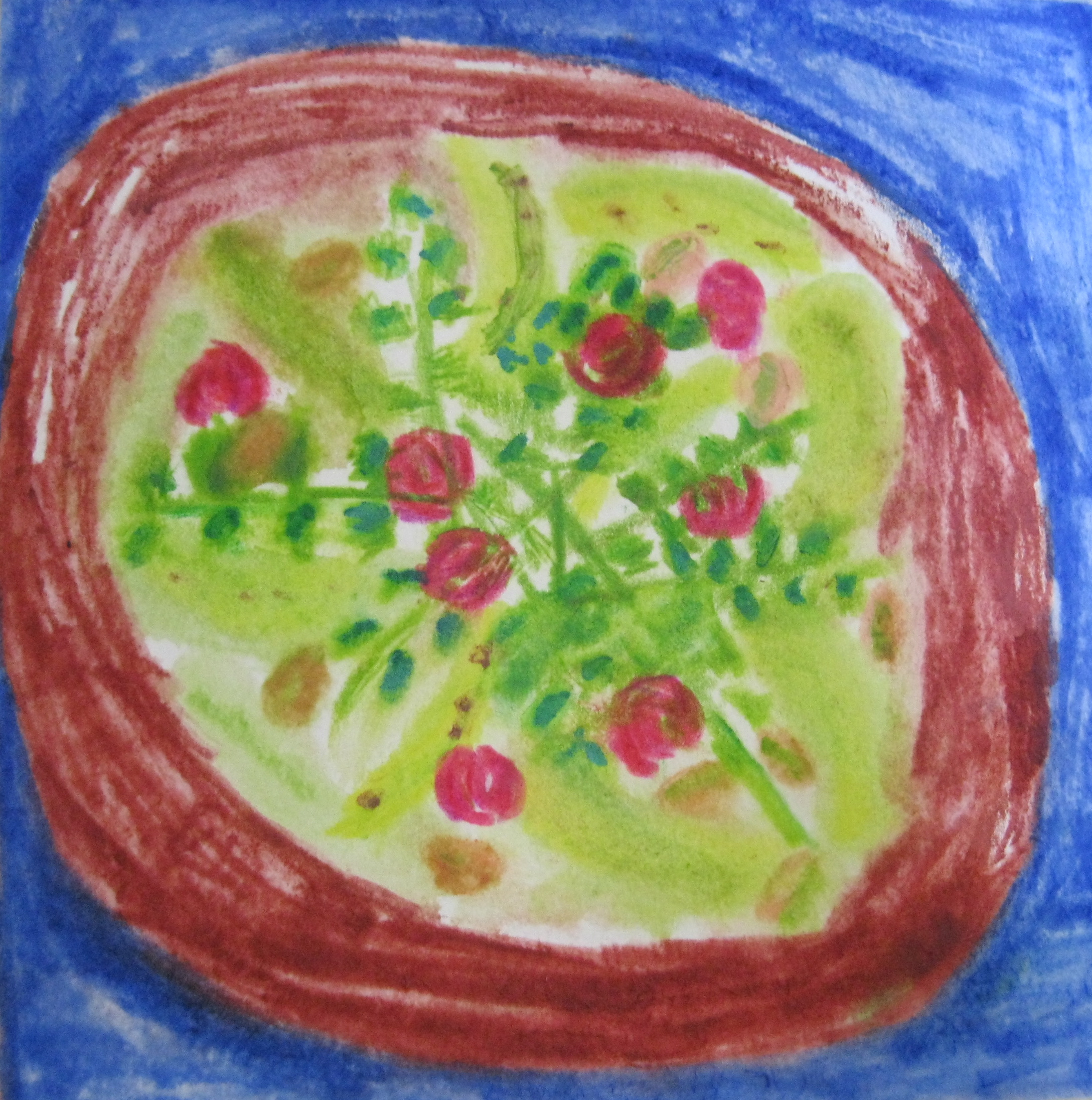
I’m not back in the habit of painting yet, although I painted during my travels in late summer and early fall, but these salads are colorful. If I do resume painting I’ll add illustrations to this post later.

Thanks for reading. And happy salad-making with whatever your market offers.

Those of you who are kind enough to follow The Kale Chronicles as it morphs from a twice weekly blog to a monthly blog will have noticed that it did not make its May deadline. It was inevitable, given some things that are going on and it may be rocky here for awhile. I have not had time to take pictures, much less paint them in the last week or so — I have barely been able to attend to the garden (I just spent an hour on my hands and knees, pulling out burr clover).

But I harvested at least half a basket of Sun Gold cherry tomatoes tonight from the plant that has dynastic ambitions — having taken over as much of the fence line as possible (I think), it has shifted its focus to growing out over the patio. Johnny said it had to be cut back, but I am not going to do that. Perhaps I should have put in more stakes or a tomato cage, but it is too late for that now. It swallows up and shades everything in its path with abundant foliage and hundreds of yellow blossoms. It is the biggest tomato plant I have ever seen and I fear to think of what my Amish paste tomatoes and my Principe Borghese plants are going to look like — both of them have larger tomatoes than the Sun Gold.

I have pepper plants hardening off and chard that is bolting. We can eat lettuce from the garden now, as well as chard and kale and tomatoes. I set out some new Thai basil seeds because the Thai basil I planted before is underneath the giant tomato. In the process of digging to enrich the soil for the basil I discovered concrete about a foot down at the end of one of the bean rows. Uh-oh. I have not yet determined how far the concrete extends (I’m not that fond of digging).

My green bean plants have little tiny green beans and the Scarlet Runners do too. My pinto beans and black-eyed peas seem to have hybridized in a giant tangle: when they started out they looked like bush beans, but then the bush beans grew tangled vines that refuse to take to the supports I gave them. Meanwhile some of the butternut squash plants are growing through a row of green beans and I can no longer walk on what was a path in that part of the garden. I think that I saw some tiny butternut squash tonight, although I have seen no squash blossoms, which makes no sense — the only things in blossom are the tomatoes and various beans.

I need to know a lot of things. I need to know how to confine indeterminate tomatoes (and perhaps how to prune the non-bearing branches). I need to know how to encourage the butternut squash to fruit and how to protect the squash as they grow. I need an advanced placement course in staking and supporting plants because muddling through it on my own was not adequate (I have raised indeterminate tomatoes before, thank you very much, but only in ten gallon buckets, where they stay put, where, in fact, they were spindly and only produced a few handfuls of tomatoes. I love the abundance, but I am afraid we will not be able to walk in our yard by August and I feel sorry for the other plants that have no chance and no space to grow. I need to know what particular horrible garden pests or diseases have been plaguing my red cabbage plants, which may not be long for this world, although I have not had a single cabbage.

I sort it out as best I can. The garden is my refuge from other difficulties and I love going out and picking or cutting things to eat. Last night I made a chicken salad that incorporated cherry tomatoes and lettuce from the garden. I also used plain Greek yogurt, Madras curry powder, lemon juice (lime is better), celery and golden raisins.

May highlights included a visit from my best friend and her husband on the day that twenty-six mph winds blew the tomato trellis down and ripped stakes through the ground and my guest appearance with Johnny’s band, Johnny Harper and Carnival, in Sebastopol. I sang “Evangeline” by Robbie Robertson, which Emmy Lou Harris sang in “The Last Waltz.” The band has been doing a special series of shows featuring the music of The Band, while incorporating some of Johnny’s original compositions. Johnny is hard at work on a CD, to be released in October if all goes according to plan.

I hope you all are enjoying your late spring/early summer.

Sharyn (aka The Kale Chronicler)

Back when I wrote my tagline, local ingredients, transformation and creativity, I couldn’t see how transformative and creative life was going to get: what I knew was that I was committed to the practice of eating foods in their seasons and that I was nearly incapable of following a recipe without making some change based on making it healthier or using ingredients we had in the house. When I started The Kale Chronicles I had lost my day job but I could draw unemployment compensation for awhile and had some savings. I put my energy into nurturing the blog, hoping I might sell a few paintings and find a few writing students as my writing gained wider exposure.

Fast forward to 2012. I made a trip to France and acquired a guitar-player, coincidentally the love of my life. I took care of my teeth, which needed a few small repairs, and suddenly I was without funds — without savings, without much in my checking accounts, with retirement funds that it is too early to touch.

Now it is October, 2012. I dubbed it “Work With What You Got” month on The Kale Chronicles. Halfway through the month, I have not starved. Saturday the 13th I was down to $2.75 in my wallet, but I picked up $40.00 by having a garage sale on Sunday, Mom sprang for two tomatoes from the Farmers’ Market on Saturday and half a pound of shelled walnuts and we are, indeed, cooking with things we have in the house. Two tomatoes plus some lettuce and bread, some sliced dill pickles, mustard (for me), mayo (for Mom) and some turkey bacon gave us turkey BLTs for lunch. Mom cooked wheat berries for breakfast. Mixing them with dried cranberries, a tablespoon each of coconut oil and peanut butter plus a cup of milk gave me a filling breakfast.

After which I went to play music in the downtown Berkeley BART station this morning, trying my hand at the old trade called busking. Yes, that silver-haired woman singing with a beat-up Harmony guitar was me. I left my house at dawn to secure a good spot for the day and I sang for two hours, garnering five dollars above and beyond my bus fare, plus one $1.75 BART ticket. The first person I saw come down the escalator threw me some change, which felt like good luck to me.

Five dollars a day net may not be much, but if I make that everyday it will add up to a hundred and fifty a month. Besides, it was fun: I can honestly say I liked it better than any day job that I have ever had. I felt comfortable playing for two hours, except when I needed to stop and drink water. I felt grateful to anyone who threw change my way and to the three people who placed single dollar bills in my guitar case. One woman inquired about a CD, took the time to pick it up and turn it over in her hand and to ask me the price. I have ideas for things to play later (I’d love to learn the “Java Jive” and “One More Cup of Coffee for the Road” to take advantage of my position near the Peet’s kiosk) and I am sure I am going to learn more everyday.

Original painting shows shaved Brussels sprouts salad and ingredients.

Brussels Sprouts Salad. 8″ x 10″ gouache and watercolor pencil on canvas. Sharyn Dimmick.

All this is to say why I didn’t get a blog post out on Sunday as usual — I was busy earning money, just as I was busy this morning. Before I got so enterprising I did cook something new though, a shaved Brussels Sprouts Salad with Apple Cider Vinaigrette, inspired by Shira’s recipe on In Pursuit of More.

I was dubious about eating raw Brussels sprouts and thought I might blanch them instead, but I gamely tasted a tiny raw shaving. It was okay, actually, a bit stronger than raw cabbage. So I shaved fifteen Brussels sprouts (Trader Joe’s sells big stalks of them for three dollars apiece), added a quarter cup of  dried cranberries, forgot to use nuts (Shira used toasted pecans) and started concocting dressing.

I’m always appalled by large quantities of oil and I like my salad dressings sharp and tart, so I started with Shira’s 1/4 cup of apple cider (from the pantry, remember?) and 1/4 cup of cider vinegar, but I couldn’t bring myself to use 1/2 cup of olive oil. Instead I used 1/4 cup, plus about 2 Tbsp brown mustard and perhaps 1 tsp of honey. I ground some black pepper over the sprouts and cranberries, poured some dressing on and dug in.

I liked this salad so much that, having made it at lunch time, I was back eating it at dinner, having added 1/4 cup of shelled, toasted hazelnuts. The nuts may have made it even better, playing off the deep fall flavors of apple and mustard and greens. The dressing makes way more than you will need for a single salad and I have at least a cup of it waiting in the refrigerator to see what else I will eat it on: I plan to try making this salad with regular cabbage, shredded finely, while the dried cranberry supply holds out. Shira likes the dressing on cooked sweet potatoes, which sounds good to me, although we are currently a sweet-potato-less household.

Meanwhile, I have started experimenting with the coconut oil that Tropical Traditions so kindly sent me. First I put a tablespoon in a cup of hot cocoa, as suggested in one of their recipes, and then I tried adding a tablespoon of it to my oat-rye-granola cereal cooked in milk. I added a tablespoon of natural peanut butter, too, hoping to capture the elusive flavor of the coconut and peanut candy the Chick-O-Stick. I found that adding just one teaspoon of raw sugar brought the flavors together beautifully and that the coconut oil and peanut butter combo give my morning cereal some serious lasting ability — about four hours worth of activity later I finally got hungry again.

I am still working my way through the pears from my friend Margit’s tree. Because we picked them green and I stored them in the back of our refrigerator in a paper bag they have been holding up nicely.

Original watercolor shows salad of pears, arugula, cranberries, feta, pistachios.

Pear-Arugula Salad. 6″ x 6″ watercolor pencil on paper. Sharyn Dimmick.

Two nights ago I wanted a light dinner. I had some arugula I needed to use. I had pears. I decided to make a salad. I washed and spun the arugula in the salad spinner. Then I went out to pick a ripe Meyer lemon from our tree. Returning to the cutting board, I squeezed both halves of the lemon into the bowl and then cored and sliced three greenish pears lengthwise, leaving the skins on. I tossed the pears with the lemon juice to prevent browning. Then I added a small splash of olive oil and tossed the arugula and pears again. Next I shelled some pistachios and grabbed a handful of dried cranberries.

I was thinking of shaving Parmesan or Pecorino Romano into the salad, but feta won out: I crumbled a small block of feta over the greens, fruit and nuts, then tasted to adjust seasoning. The only thing it needed was a bit of honey to bring out the sweetness. I drizzled a little on top and tossed the salad again.

This is a wonderful salad for the first few days of fall weather when it is sometimes warm enough to eat a salad for lunch or dinner. I served it again last night as a side salad with a dinner of turkey chili, cornbread and Gravenstein apple pie. The second time I made it I used roasted pistachio oil instead of olive oil. By the time I cooked and ate I didn’t have enough time to finish my painting, which is why this post is a day later than usual.

If you should live somewhere where pears and arugula are available in late November, this would make a lovely Thanksgiving Day salad. If not, make it and eat it while pears and arugula are to be had.

Yes, I am still here (I haven’t decamped for France again), but I thought you might enjoy a special tomato season treat, a guest post from my friend Deborah Sandler.

Deborah Sandler has enjoyed California’s bounty of fresh local food since arriving here in 1979, and swears never to live anywhere else because the food is so good.  She loves to cook and to feed people, and often tells her guests, “Nobody goes hungry at my house!” Deborah is a Farmer’s Market freak, often attending at least two a week, year round, rain or shine, on the lookout for whatever is in season and at its best.  Tomatoes are one of her favorite foods, and she shares one of her tomato recipes here.  When she isn’t cooking, she sings, and practices family law (while making sure to bring her office-mates lots of fresh food, because nobody goes hungry in her office either).

Original watercolor painting shows platter of tomatoes, olives, basil, feta cheese.

“My Somewhat Famous Tomato Platter.” (after Deborah Sandler). 8″ x 8″ Acquarelle on Paper. Sharyn Dimmick.

Tomatoes are finally in season!  I yearn for them during the winter, and sometimes am seduced into buying hothouse tomatoes that look lovely but do not have the texture or zing of the real thing.  When you bite into a tomato that has been locally grown, recently picked, and never refrigerated, the flavor is huge and unmistakeable.  When I was growing up on the East Coast, tomatoes came wrapped in plastic, colored a sickly pink, four to a package, all exactly the same size and shape, firm and tasteless.  I lived in the suburbs, and didn’t know anyone who was growing tomatoes, so it was quite rare that I got to taste a real tomato.  That changed once I moved to California.  Many of the restaurants featured amazing tomatoes in their salads, and friends actually grew some in their yards.  I had no idea a tomato could look, smell or taste like this!  In recent years, heirloom tomatoes have appeared all over the place, stunning in their profusion of shapes, colors and flavors.  Their names are poetic and whimsical – here are just a few examples from one web site that sells seeds for them, and from my  local Farmer’s Markets:  Arkansas Traveler, Banana Legs, Bloody Butcher (ew!), Cherokee Purple, Black Russian, Dingwall Scotty, Green Zebra (and yes, these have stripes), Halfmoon China, Hank (hey, that’s my dog’s name!), Jersey Devil, Berkeley Tie-Die, Brandywine, Mortgage Lifter, Mr. Stripey, Nebraska Wedding, Yellow Pear, and Stump of the World.

I live in Contra Costa County in the San Francisco Bay Area, about 30-45 minutes inland from the ocean and from San Francisco.  For those not in California, that means that the climate here is far different from that in San Francisco.  Where the City might be 62 degrees and foggy on a summer afternoon, here it may be over 100 degrees and sunny.  We get some of the San Francisco fog, but not much.  The down side is that our winters are colder, foggier, and danker than those in San Francisco.  We are only an hour from the Central Valley, which runs down through the center of the state, and where much of the nation’s produce is grown.  Even closer is Brentwood, a major agricultural area just to the east of us, that features plenty of U-Pick farms and orchards, as well as farm stands.  Because our local weather is so warm, plenty of people around here grow their own produce, and some even sell at the local Farmer’s Markets.  Here is a partial but by no means exhaustive list of Farmer’s Markets within 15-30 minutes of my house:  Martinez Sunday morning (I think this is now year-round), Martinez Thursday mornings, Concord Tuesday afternoons (year round), Concord Thursday evenings, Pleasant Hill, Lafayette, Moraga, Danville, Orinda, Walnut Creek Saturdays at The Shadelands and Sundays on Locust Street (more on these below), Martinez at the Contra Costa County Regional Medical Center, Walnut Creek Kaiser, Concord High School, and the list goes on.

My favorites are the Walnut Creek Saturday morning market at The Shadelands, and the Walnut Creek Sunday morning market on Locust Street.  Both are very large, with over 40 vendors,  and both are year-round.  The Saturday market is only a few years old but already bustling with happy patrons.  The Sunday market has been there over 20 years, and most of that time I’ve been there.  The vendors there have watched my kids grow up, and know me well as one of their regulars.  At The Shadelands, my favorite tomato vendor is Swank Farms, which has several tables strewn with all sorts of heirloom tomatoes every week.  At the Sunday market, I like Roseland Farms, where the seller has numerous flat boxes of heirlooms sorted by color.  He also is one of the very few vendors that sells San Marzano tomatoes, one of the world’s best cooking tomatoes.  These last weeks sitting out on the table, cook into very flavorful sauces and soups, or can be sliced into salads as firm yet flavorful dependable little oblong beauties.  Roseland Farms also has a big pile of cherry tomatoes of all kinds, and you can grab them by the handful or pick them out one by one.  The Shadelands market had a map with push pins, showing the location of each vendor, and how far away their farm is from the market site.  The average distance they come is only 89 miles.  The average distance food travels to our supermarkets is 1,500 miles.  The map had a sign on it reading, “Choose the food less traveled!”

Here is one of my favorite things to do with tomatoes.  This is my somewhat famous tomato platter.  Amounts are approximate.  I made this up, and it doesn’t have official amounts of anything.  Mess around with this as much as you want, and change it to your taste. The secret is the freshness of the ingredients.  And do not ever refrigerate tomatoes – it destroys their flavor!  Slice several heirloom tomatoes (as many colors as possible) onto a large platter in several layers.  You can make patterns of color or just do it randomly.  Chop up a handful or two of feta cheese and sprinkle that over the tomatoes.  Then sprinkle a generous handful or two of olives over that.  Lately I use mixed Greek olives from Whole Foods, and I recommend you not use olives from a jar – get fresh ones from an olive bar if you can.  If you have fresh heirloom cherry tomatoes in several varieties, sprinkle a handful of those over the top. Then chop up a generous handful or two of fresh basil leaves and sprinkle that over the top and around the platter.  The vinaigrette I use is homemade, and is quite tart, so you may want to try it separately before using it here, to adjust for taste if you want. This reverses the usual proportions in a vinaigrette, and has 2 parts vinegar to 1 part oil.  1-1/2 T best quality olive oil, 3 T red or white wine vinegar, 10-15 shakes of salt, 10-15 grinds of fresh ground pepper or 3 or 4 shakes of coarse ground black pepper, 2 or 3 shakes of granulated garlic, 2 or 3 shakes of dried mustard. Mix thoroughly and pour over the tomato platter, serve immediately.

Warning: this post may contain an embedded rant or two.

In the kitchen this morning, I have two large dry crusts of French bread, three eggs and several heads of baby romaine lettuce from the farm box. This late spring day appears to be one of the warm variety. I don’t know if these ingredients suggest anything to you: to me they suggest Caesar Salad.

My mama told me that Caesar Salad contains anchovies in the dressing. Cursory internet research suggests that Cesare Cardini used Worchestershire sauce rather than anchovies. I don’t even like anchovies, but I was taught to chop them finely and put them in the dressing for a Caesar Salad, so I do. I would not eat them on pizza. I would not snack on them out of the tin. I have never dared to make a pasta puttanesca because of the anchovies in it, but I keep anchovies in a jar of olive oil just so that I can make this salad when the mood strikes or when the ingredients are sitting around in the kitchen.

Furthermore, I do not care for any egg preparation that involves soft egg yolks — or hard egg yolks, for that matter. That leaves out poached eggs, fried eggs, eggs sunny side up, deviled eggs, hard-boiled eggs and Easter eggs. But I make an exception for Caesar Salad dressing, which calls for a coddled egg, cooked for one minute before you mix it with the other dressing ingredients.

Painting shows Caesar Salad and ingredients.

Caesar Salad. 8″ x 8″ Gouache and Watercolor Pencil. Sharyn Dimmick.

The salad that makes me set aside my food aversions is truly magical. You put in anchovies and barely cooked egg yolk, garlic, olive oil and lemon juice, black pepper. You toss the dressing with croutons, Romaine leaves and freshly grated Parmesan cheese and you have a crunchy, green refreshing salad with adequate protein from fish, egg and cheese. There is no need to add shrimp or grilled chicken to this salad as many American restaurants do.

First, make garlic-infused olive oil. Heat some garlic cloves in olive oil and allow the garlic and oil to sit while you do other things. While you are at it, halve a raw clove of garlic and rub it onto your wooden salad bowl. If you like raw garlic, set aside a couple of cloves to squeeze into the salad, or pound them in a mortar or mince them with a knife. I actually like minced or pressed raw garlic better than the more subtle garlic oil.

Then make croutons. Chop your leftover French bread into cubes. We like to use stale sourdough. You can saute them in a little of your garlic oil, or you can toss them with some of it and bake them in your oven for a few minutes at 300 degrees. I usually bake my croutons. Sometimes I just bake sourdough bread without any oil: the croutons will absorb dressing from the salad anyway.

Then wash your romaine lettuce and dry it thoroughly in a dish towel or a salad spinner.Tear into bite-sized pieces unless you particularly enjoy the exercise of cutting lettuce with your fork. Place lettuce in your garlic-rubbed salad bowl.

Take two or three anchovies from a tin and mince them finely — no one wants a big bite of anchovy in this salad — we just want the flavor. Set them aside for now.

Grate some Parmesan cheese. 1/4 cup will do in a pinch, but you might want to use more to get the snow drift effect.

Halve one lemon and get ready to squeeze it.

Dress your lettuce with a small amount of garlic olive oil. Add minced garlic if using.

Now coddle an egg: boil it for one minute only. Remove it from the pot. Crack it right into your salad bowl and toss with the lettuce.

Add the minced anchovies and toss again.

Squeeze lemon directly onto the salad. Toss again.

Add croutons and grated Parmesan. Toss again.

Grind some fresh black pepper over the salad. Toss again.

Taste and adjust seasonings.

Food notes: If you can’t stand handling anchovies, you could try using anchovy paste in a tube. I have never used it. Please do coddle the egg and use it in the dressing: the slightly-cooked egg, anchovies and lemon are what creates the distinctive Caesar dressing. You cannot get the proper effect without the egg. You cannot get the proper effect without some form of anchovies — if you are afraid of them, try using a little less — start with one anchovy if you are squeamish and work your way up. You cannot skip the cheese either, or the croutons — if you do, you have not made a Caesar salad, but some other kind of romaine salad. You cannot make a vegan Caesar — don’t even try. If you are a vegan, find some other way to eat your romaine. You cannot make a kale Caesar either: by definition, Caesar salad is made of romaine lettuce. Got it? You have latitude with the garlic, the oil, and the croutons and the amount of anchovy you use. For the Parmesan, you need to get the good stuff and grate it yourself: this is not the time to use stale, pre-grated cheese or the stuff in the green can: when you are only using a few ingredients, they need to be the freshest and finest you can get. That chicken and shrimp? Save them for another entree or cook and serve them on the side, please. Once you try the real Caesar salad, you will love it or hate it, but at least you will know what it is, that you have tried Caesar salad and not one of the many abominations that blacken and borrow its name.

If you’ve made it through the rant, you may notice that I put no salt in the dressing: both anchovies and cheese pack a lot of salt and I don’t miss it. But I did say you could adjust seasonings: that is code for add lemon, salt, pepper, garlic or cheese to taste. Enjoy. And if you experience any revelations after making proper Caesar salad, please come back to testify in the Comments section.

photo depicts fresh lettuce in colander with Buddha looking on.

From the Winter Garden. Photo by Kuya Minogue.

Today The Kale Chronicles features a guest post from Kuya Minogue of Creston, British Columbia, who shares what she has learned about winter gardening in her locale. Kuya and I met at a Natalie Goldberg writing retreat in New Mexico. When I saw a Facebook post of hers on harvesting greens from her winter garden I asked her to share her garden story with you. Although it is May and not winter in the northern hemisphere now, perhaps it will allow some of you cold-climate gardeners to plan next year’s winter garden. You can find more of Kuya at zenwords here.

When it’s twenty below Centigrade outside and the garden is buried under four feet of snow, it’s hard to imagine that under the plastic cloches and row covers in the greenhouse beds, the spinach, lettuce, chard and cilantro that I seeded in late August are lying dormant, waiting for a warm day to awaken them from their winter hibernation. But it only takes a few warm days in mid-winter to bring them out of sleep and into a delicious and completely alive salad.

photo of spinach growing in Creston, B.C.

Spinach in January. Photo by Kuya Minogue.

Last year, we had a week of above zero sunshine in Creston, BC where my winter garden lives, and by the end of that week, when I removed the cloche from the spinach bed, I found salad ready greens. The leaves were thick and juicy. There’s nothing better than a garden fresh salad in January, and the amazing thing is that all it took was one plastic snow-covered cloche to keep the plants alive and a few warm days to make a salad. When the weather turned cold again, I recovered the spinach and it lived through another two months of frost.

In that January warm spell, when I looked at the lettuce under the row cover inside the greenhouse, the leaves were so withered that I thought that winter had taken them. But by the first week of March, the lettuce had revived, and by the second week of April, we were eating fresh spinach and lettuce salads straight out of the garden. I was afraid the lettuce would be bitter, but only the outside leaves had the taint of winter. The butterball at the centre of the plant was crisp and fresh, and tasted like summer.

I don’t like to mix my first collection of winter salad greens with store bought tomatoes, cucumbers or avocado. I prefer to sprinkle winter garden green onions and a handful of garden-fresh cilantro over the greens, and to make a lemon and olive oil dressing that has a squirt of liquid honey and tamari sauce, and a sprinkling of minced garlic from last year’s garden. From first bite to the last, I’m transported to the warm days of summer.

Hardy greens survive the winter too: chard, kale and a chinese vegetable whose name I don’t know are ready to eat by mid March. By mid April, they are so prolific that I invite anyone who comes to the Zen Centre to meditate or do some yoga to take a mixture of these greens and some winter garden onions home with them so they can clean them, cut them into bite size pieces and then stir fry them in sesame seed oil, lemon juice and tamari.  The cooking greens are also delicious if I simply steam them and eat them with a little butter.

painting of picked mixed greens in colander, Buddha image.

Buddha with Greens from the Winter Garden. 8″ x 8″ Gouache and Watercolor Pencil. Sharyn Dimmick.

I learned about winter gardening when one of my Zen students, a horticulturalist, offered to give a Winter Gardening Class at the zendo. Having lived through many years of Canadian winters, I was skeptical when we seeded the beds in late August and then put them under cover in mid-October. It just seemed impossible that anything as delicate as spinach or lettuce could survive the winter. But I was wrong. Even in Canada, we can grow greens in the winter and eat garden-fresh salad in the spring. If we can do it here, you can do it anywhere.


painting depicts ingredients for Romanesco with Gorgonzola Over Pasta recipe

Romanesco. 12″ x 12″ gouache and watercolor pencil. Sharyn Dimmick

This week’s farm box included romanesco. Romanesco looks like cauliflower invented by Martians: it has points, spirals, triangular formations and it is often a stunning shade of neon green. You may not have eaten it: I would not have eaten it if I had not subscribed to Riverdog Farm in 2007.

Now, I’ll just tell you that I grew up eating cauliflower smothered with cheese sauce. I would have grown up not eating cauliflower smothered with cheese sauce if I could have managed it, but our family had rules, one of which is that you ate everything you were served. I did not make up this rule, but I had to live with it.

Part of my journey as a cook and as an adult has been to revisit foods I did not care for in my childhood. Some of them stay on the “Do not eat” list: avocado and asparagus have not made it to edible, much less pleasurable, and English peas require careful and judicious camouflage. I still will not eat cauliflower in pale orange cheese sauce, but I will eat it with a sauce featuring two of my favorite things: gorgonzola and cumin seeds.

The same farm that brought romanesco into my life brought me the recipe with which to cook it from the RiverNene CSA in England. I modified their ingredients list and then I modified their cooking method: what I have kept are a little butter, the cumin seeds, some milk and some gorgonzola, although not the quantities of each that I first saw. To get the most out of the creamy, cheesy sauce I like to serve it with pasta. I like whole wheat penne because the darker-colored pasta looks nice with the pale vegetable and sauce and has a nice chewy texture. That said, you could serve it on spinach pasta or tomato pasta for some color and you can eat it without pasta if you are counting carbs.

Romanesco with Gorgonzola over Pasta

Put your pasta water on to boil.

Cut or break your romanesco into florets.

Melt a little butter in a saucepan, perhaps 1 or 2 tablespoons

Fry 1 Tbsp cumin seeds in the butter until aromatic.

Stop the cooking by whisking in 2 Tbsp of flour

Then add some milk — start with 1/2 cup and have more at the ready.

Alternate stirring the sauce and breaking up some Gorgonzola to melt into the sauce. The cheese will help thicken the sauce. If it gets too thick, add a little more milk. If it is too thin, cook it down for awhile or add more cheese.

When your pasta water boils, throw in 1/2 pound of whole wheat penne.

After the pasta has cooked for ten minutes, add your broken or chopped romanesco to the pasta water. Cook for one minute and drain, letting the pasta water fall into a serving bowl to preheat it.

Transfer the sauce, pasta and romanesco to your (drained) serving bowl and stir so that everything gets coated with sauce. Eat while it is warm.

Food Notes: If you don’t have romanesco, you can make this with cauliflower, or even broccoli — it just won’t have the Martian atmosphere. Sometimes I add a few snipped sundried tomatoes into the sauce for the bright taste and the flecks of color: it is winter, after all. Regular pasta works, too. Sigh. The original recipe called for 2 Tbsp of brandy — if you are a brandy-swiller, go ahead and add it to the sauce: I’m sure it tastes delightful.

I like to serve this with a winter salad of raw spinach and sliced oranges. Sometimes I dress it with Orange-Sesame Vinaigrette. However, I had recently read about an orange-tahini dressing and wanted to see if I could put one together (I love tahini and January is a big citrus month). I started by juicing one orange, one Eureka lemon and two Meyer lemons. That yielded one half cup of juice, which I poured into my old Good Seasons cruet (Remember those? They are handy for salad dressings that don’t come in packets!) I added 3 Tbsp Tahini. I tasted it. Now what? I had on the counter some olive oil that I had used to cover roasted red bell peppers. The peppers went onto last night’s pizza, but the oil. I measured 2 Tbsp of the roasted red bell pepper oil. Mmm. That gave a nice roasty flavor. Gotta have salt: I put in 1/2 tsp Kosher salt. And garlic: I pressed 1 small clove of garlic. A little sweetness: in went 1 tsp honey. I thought about putting some cumin in it, but I kept it simple this time — there’s cumin in the romanesco sauce after all.

For a little more heft, I kneaded up a batch of black rye bread, basing it on a recipe by Heidi Swanson of 101 Cookbooks. But I left out the carrots and the caraway and threw in a little orange juice and zest. It’s rising now: I’ll report on it on Wednesday (or not, if it is not worth writing about).

It’s still January, so they are still doing citrus recipes over at #citruslove. They are worth checking out if you like citrus or have a seasonal glut of it like we do.

painting depicts meal of bread, soup and salad for January

January Feast. 12″ x 12″ gouache and watercolor pencil. Sharyn Dimmick.

In January I crave greens. After the excesses of the winter holidays with their meat, squash, bread, potatoes and sweets, I want things sharp and bright-tasting while still needing warm dishes to chase away the chill. Thursday I cooked all day and hit upon that classic meal of soup, salad and bread.

I started with the oven on for Savoring Every Bite’s caramelized oranges and made some granola while I was at it, plus roasted a kabocha squash. Then I cleaned leeks and peeled potatoes for soup, scrubbing the potatoes first so that I could toss the peels and tough leek greens into a stock pot for vegetable stock. While that boiled, I sauteed 3 sliced leeks, 2 cloves of garlic, 1/2 cup of minced ham and some crumbled dried rosemary (use fresh if you grow it) in 2 Tbsp butter. As that cooked I peeled and diced about 1 pound of yellow Finn potatoes and added them to the pan to brown a bit. I then covered them with a pint of chicken stock and four cups of water, covered the pot and let them cook. Then I got out the mandoline to shred Savoy cabbage — I shredded nearly half a head of cabbage and set the mandoline aside for another use later.

When the potatoes were tender I mashed some of them and left some chunks. The soup was a little watery, so I seasoned it with salt and pepper and let it continue to cook uncovered.

Meanwhile, I got out three small fennel bulbs, whacking off the stalks and fronds for the vegetable stock pot, along with the tough outer pieces. Then I cut each bulb in half and shredded it with the mandoline over a salad bowl. I scored the peel of 1 large navel orange into quarters, saving the peel to candy another day, and segmented the orange and sliced the segments, putting them into the bowl with the fennel. Then I took my remaining orange-sesame vinaigrette and poured it over the oranges and fennel and stuck the bowl in the refrigerator.

I turned off the soup and let it sit (I added the cabbage ten minutes before reheating and serving it).

Then I turned my attention to bread, an orange-cumin yeast bread adapted from Mark Miller’s Coyote Cafe cookbook. The warm oven from caramelized oranges, granola and roasted squash would help the bread rise. Here’s my modified recipe

Orange Cumin Bread

Juice and zest 1 large orange (about 1/2 cup juice)

Scald 1/2 cup milk and set off heat to cool.

Dissolve 2 packages active dry yeast in 1/2 cup lukewarm water (or measure 4 and 1/2 teaspoons dry yeast).

Into large bowl of stand mixer, measure

1/2 cup sugar (any kind will do)

4 Tbsp corn oil

1/4 cup cornmeal

1 cup whole wheat flour

2 Tbsp ground cumin, plus the scalded milk and the orange juice and zest.

1/2 cup warm water

Mix to combine and then add dissolved yeast. Mix again.

Now add 4 cups unbleached flour and

1 scant Tbsp kosher salt

Switch to dough hook, or knead by hand, remembering to knead for at least ten minutes to develop the gluten. This dough can be sticky so you may need to add a little extra flour a tablespoon at a time or keep flouring your kneading surface.

Put dough in large bowl (I use the same one I mixed in) greased with a little oil or vegetable shortening. Cover dough with damp smooth kitchen towel (I warm my towel in the microwave for twenty seconds) and set bowl in warm place to rise until double (about an hour). Punch down and let rise again until doubled (thirty minutes this time). Meanwhile grease two standard loaf pans.

When bread dough has risen for the second time, deflate it and shape into two loaves. Put loaves in prepared pans and let rise until dough is even with the edge of the pan. Fifteen minutes before it gets there, slash the dough with a sharp knife — I make two parallel diagonal slashes in the top of each loaf — and preheat oven to 400 degrees. Bake for forty minutes, until crust is brown and tapped loaf sounds hollow. Remove from pan and cool on rack.

Now you can heat up your soup, toss in the cabbage, take the salad from the fridge and feed some happy people.

Soup notes: Any kind of potatoes will do for this soup — just don’t use purple ones! If you are a vegetarian, omit the ham and chicken broth in the soup and prepare it with vegetable stock or milk and water. If you are an omnivore and don’t have ham on hand, you could substitute bacon or prosciutto. If you don’t have leeks, substitute onions. If you don’t have Savoy cabbage, use another kind — anything but red or purple which will give you an undesirable color.

Bread notes: Mark Miller’s recipe calls for dried milk and orange juice concentrate — I have adapted it to use whole foods instead. He also calls for starting with whole cumin seed, toasting it and grinding it. I have done this and it is good, but if your cumin is fresh or you can’t get cumin seed, you can just use ground cumin. If your cumin has been around for awhile, toast it in a dry skillet. This bread is light and wheaty: for a variation, try reversing the proportions of cornmeal and whole wheat flour. Like most breads with fruit in them, it makes excellent toast.

This month I am participating in citruslove, a glorious collection of seasonal citrus recipes, #citruslove. Check ’em out here at the bottom of the post. Click on Linky tools there to see all the submissions.