Archives for category: desserts
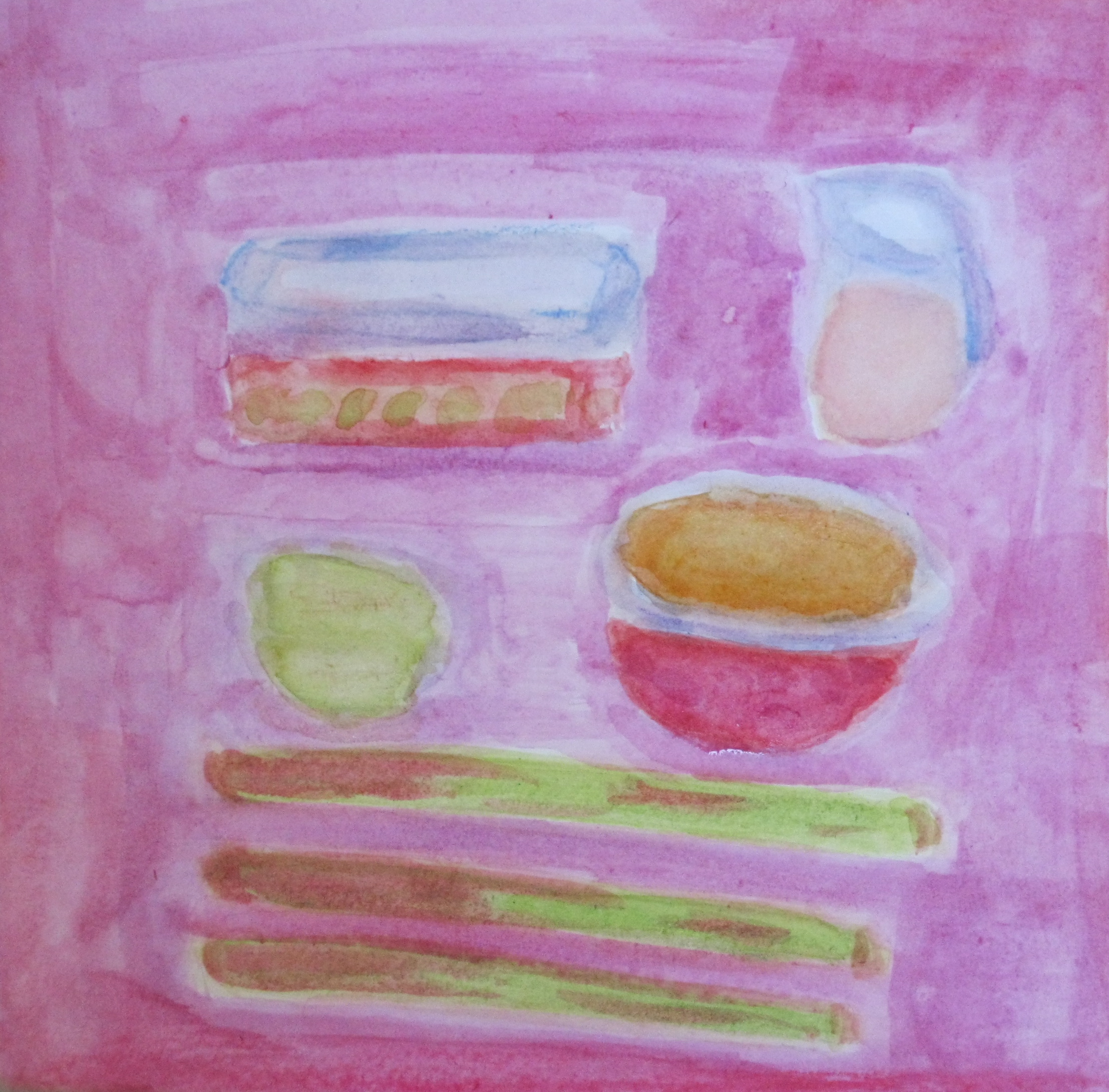
Original painting shows cherry plums, plum cake, plum caramel.

Plum Cake. 9″ x 12″ Gouache and Watercolor Pencil on Paper. Sharyn Dimmick.

Sometimes circumstances conspire to create an end. Today is my sister-in-law’s birthday and she is coming over to go out to lunch with my mother in Walnut Creek. Barbara likes plum cake. I had half a colander of fresh cherry plums on the counter and a jar of wild plum jam that I needed to use. I had just read David Lebovitz’s blogs on butterscotch sauce (which I am dying to make) and peach cobbler, plus a post on plum cake made with cornmeal from Two Peas and Their Pod. Barbara loves whipped cream. So what would I do? I would make the cornmeal-plum cake, adapting it a little to give it a more butterscotch-y flavor by substituting some evaporated cane juice for half a cup of the white sugar and I would use the jam to make some plum caramel to serve with the cake.

For the plum caramel, I followed a recipe from Chez Panisse Desserts, except, instead of cooking fresh plums, I just added plum jam (aka cooked plums) to the caramel base, cooked it for a few minutes and strained the results. You can make simple caramel by putting 1/2 cup of sugar in a saucepan with 2 Tbsp water and melting it over high heat, shaking the pan every now and then (do not stir). When it takes on a pale golden color, remove it from the heat and carefully add 1/4 cup water, not getting too close to the pan. You can stir now. If you are adding fruit puree to the caramel, add it now (this works with any berry or stone fruit), add it now and cook for a few minutes over medium heat. Strain out any solids or seeds that have slipped through, put your caramel in a clean jar in the fridge and you are good to go for later. Fruit caramel is less acidic and more complex than simple purees and is perhaps my favorite recipe I learned from this cookbook.

Now the cake. You can see the original here. Since cakes are not my favorite things I followed the recipe closely with just two substitutions (okay, three). First, I had medium eggs rather than large — they were organic and brown — so I threw in an extra one. Then, I had lots of cherry plums rather than the four or five large plums cited in the recipe. I already told you I put in 1/2 cup of evaporated cane juice for 1/2 cup of white sugar. Oops. Um. Four substitutions. I substituted a quarter cup of sour half and half for some of the buttermilk because, you know, we had it, and it is similar, but richer.

So, this is what you get when you put together all of those substitutions with the original recipe:

Barbara’s Birthday Plum Cake

Pit the cherry plums you are using (Or pit and chop larger plums into bite-sized pieces). Set aside.

Preheat oven to 350.

Measure 1 and 1/2 cups unbleached flour. After measuring sift it into a small mixing bowl.

Whisk into flour 1 tsp baking powder,

1/4 tsp cinnamon

1/8 tsp kosher salt

1/2 cup corn meal

Then soften 1 and 1/2 sticks of unsalted butter (12 Tbsp)

Cream butter with 1/2 cup granulated sugar and 1/2 cup evaporated cane juice until light and fluffy.

Add — one at a time — 4 medium eggs (or use three large), incorporating egg fully before next addition.

Measure 1/2 cup buttermilk (or 1/4 cup sour cream or sour half and half, plus 1/4 cup buttermilk, which is what I used).

Alternate flour mixture and buttermilk, in increments, starting and ending with flour.

Butter and flour a cake pan. I used a bundt pan because it looks festive.

Scrape half of the batter into the pan. Scatter plums over batter. Top with remaining batter.

Bake for fifty minutes. Test to see if it is done. In a bundt pan, my cake took one hour and five minutes to show some browning on the top and to pass the toothpick test.

Cool by hanging bundt pan on a glass bottle. This is fun. Trust me.

Serve with barely sweetened whipped cream and a pool or drizzle of plum caramel. If you are my sister-in-law, add more whipped cream. Enjoy.

Food Notes: Keeping to the art of substitution, you can use any sour thing for the buttermilk — yogurt, sour cream, creme fraiche, even sour milk. You can make the cake as originally suggested with all white sugar, or use all evaporated cane juice. You can probably use some other fruit for the plums, although the plums (with skins) provide a beautiful color and a nice tartness that plays well against the cake. The whipped cream provides yet another contrast (and besides, we like whipped cream when we are celebrating).

Watermelon pickle: I had a problem with the watermelon pickle — it wasn’t the recipe — it was me. so I’ll be trying it again with this week’s watermelon and report back on that later.
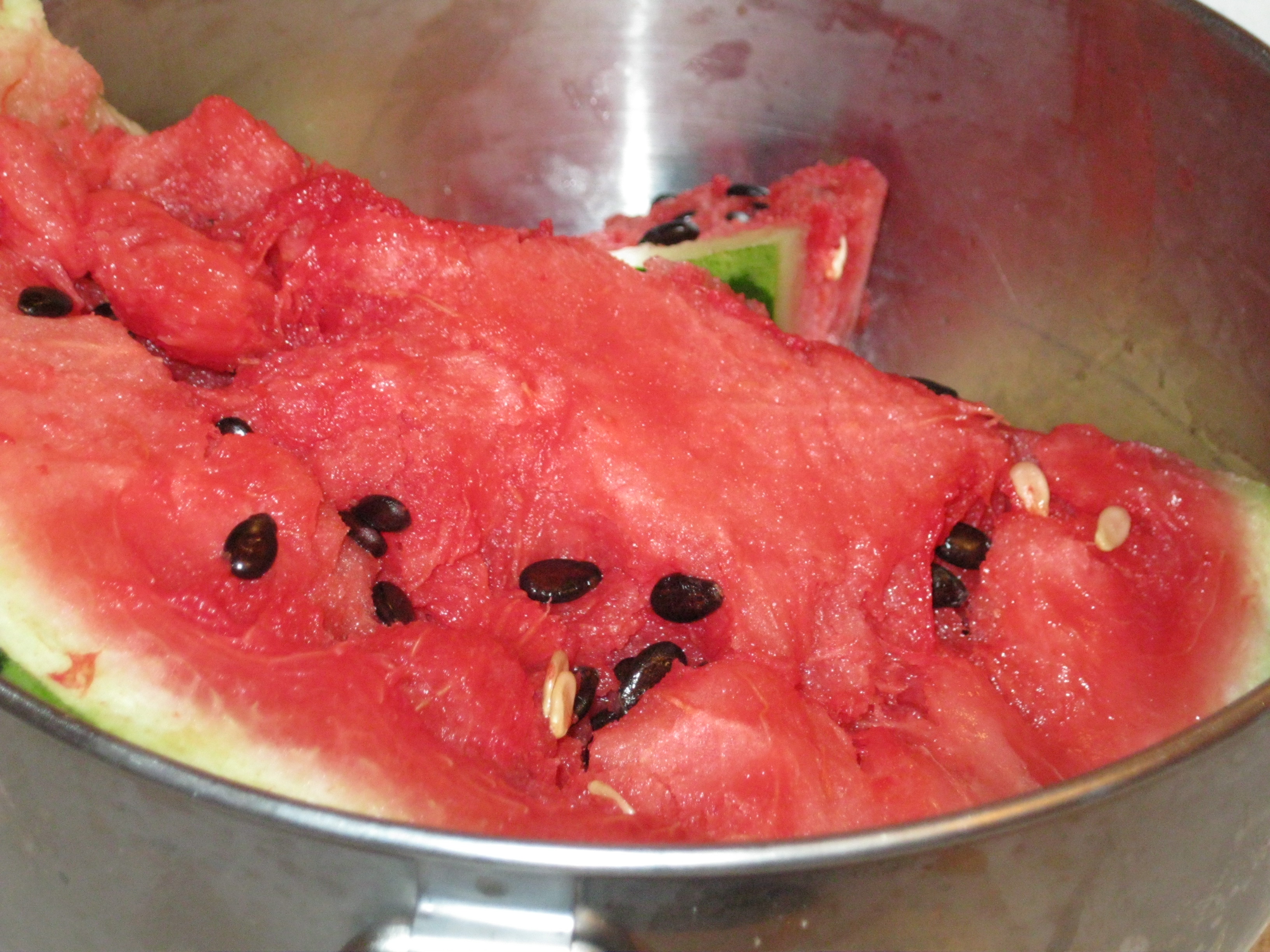
Photo of ripe red watermelon in steel bowl.

The one that got away — part of the watermelon that rolled off the counter.

On Wednesday I received a small watermelon from my Riverdog Farm CSA. Grown eighty-some miles away in summer heat, the melon was sweet and pink — I know because five minutes after I set it on the counter I heard an odd thunk: it had rolled off the counter and split open when it hit the floor. There would be no saving this watermelon for later. I picked it up, washed it off and tasted it. Good. Then I set it aside for a few days as the temperature took a nosedive and the fog rolled in to stay — who wants to eat watermelon in fifty-degree weather?

Fortunately, I had a plan for some of this watermelon: when I bought my Nesco American Harvest dehydrator the booklet contained this sentence: “Cantaloupe and watermelon slices become candy-like when dried.” Candy-like. Hmm. Then Krista and Jess reported on their dried watermelon chips. I knew I had to try it when watermelon came along again.

I spent an hour in the kitchen this morning, cutting 1/2 inch thick slices of watermelon, removing the seeds and cutting the rind away. The easiest way to do this proved to be to cut a slice and then slice through the melon perpendicular to the rind to produce small batons or wedges and then to cut the rind away. After half an hour of this, I noticed that I was developing a neat pile of watermelon rind.

Now, I am one of those people that, if you give her a slice of watermelon, will eat deep into the rind. Watermelon rind reminds me of cucumber with no bitterness and no seeds. And yet, because Mom doesn’t can, I have never made watermelon rind pickles. I called her into the kitchen and asked, “Back in the day when you ate watermelon pickles, were they sweet or sour?”

“Not sweet enough,” she said.

“Sort of like bread and butter pickles?” I asked.

“Not as good,” she said.

She told me to look in the old Mowequa cookbook, but I headed upstairs to check my saved blogs file. Not too far into the seven hundred recipes I had saved was Natalie’s recipe for watermelon pickle. I have started to make it and will report on the results on Wednesday.

Painting depicts apple pie ingredients: flour, butter, apples, cinnamon, nutmeg.

Gravenstein Apple Pie 8″x8″ gouache and watercolor pencil Sharyn DImmick

Things to make right now: Gravenstein apples are in! Ann and I picked a big bowlful of them from a yard in Berkeley and Mom made our first Gravenstein apple pie of 2012. I cannot say enough good things about this pie so if you are lucky enough to live within range of Gravenstein apples, by all means, get some. Bernie at the Berkeley Farmers’ Market has them right now if you don’t want to forage for them, or if you need more. I also made zucchini-feta pancakes this week. This time I threw a little leftover pesto with the fresh herbs and feta — it’s a delicious variation. As I write this I have another peach and plum crisp in the oven, this time made with white and yellow peaches and little cherry plums from someone’s backyard tree. And two days ago I made this tomato tart, again with lemon cheese, but with brown mustard and shredded tarragon. And of course this is a good time for Deborah’s somewhat famous tomato platter or Greek salad, with tomatoes and cucumbers in the market and peppers beginning to come in.

Photo of watermelon candy, aka dried watermelon

Watermelon candy in the dehydrator.

The watermelon candy is small and sticky — it reminds me of dried tomatoes, only sweeter and pinker. I was catching up on my sleep today after nearly a month of periodic insomnia so I didn’t take the time to do a new painting. Instead I offer you photos of watermelon and watermelon candy.

Original watercolor painting shows fruit crisp and ingredients.

Peach and Plum Crisp. 8″ x 8″ Gouache and acquarelle on paper. Sharyn Dimmick.

I am not the most informed person in the world: I find that reading a daily paper depresses me and paralyzes me with all that I don’t know and all that I can’t do about things. I watch Bill Moyers on PBS and occasionally dip into The Newshour. I read a local weekly rag, The East Bay Express, sometimes focusing on the astrology column and the restaurant reviews, although I usually read the cover story. Other than that, I get my news from Facebook updates and a few chosen sources that I subscribe to.

Because of that, I learned about the movie theater shootings in Colorado on Facebook on Friday afternoon. A friend of mine, Deby Dixon, posted a link to a blog she wrote about the brevity of life and the importance of following your dreams while you have time and health because none of us know when our life will be cut short, when our health will fail, when life or death will intervene in some unexpected fashion. Deby wondered if some of the people in Colorado died wishing that they had gotten to some dream of theirs. Deby’s story and her reflections moved me to tears and I asked permission to share it with you. You’ll find her post here, along with some of her photographs: Deby is traveling and photographing the beauty and majesty of our national parks.

What do you do when life smacks you down, when you suffer a loss? You grieve. You tell the story to others. You seek comfort. Perhaps you seek to comfort others. What comforts me in my most dire straits is beauty. Which is not to say that beauty makes me feel all better right way: beauty breaks open the heart, opening it up to the full catastrophe of grief, but beauty also helps you bear having your heart open in its pain. Beauty is a reminder that in the face of loss there are moments of great beauty and tenderness, that we are in this together, that the sun rises even on our worst day, scattering light through the atmosphere. Sometimes it doesn’t seem fair that the sun is shining — how can it be when we have suffered such a blow?

How to deal with a tragedy on a food blog? When you are grieving, it can be hard to eat. But you need to eat. In my hardest times I have found it was easier to eat with other people, that I could eat a few bites in the company of a trusted friend if I could not eat alone. So my recommendation for you this weekend is that you find some way to share a meal with someone else. It could be a version of David Lebovitz’s tomato tart.

You could go to a potluck and bring a loaf of bread, a dessert. a salad. What matters is that you eat with others to ease your hearts and theirs. And that someone puts something beautiful on the table: a vase of flowers, a special tablecloth, a rose from the yard, a silver pitcher, a photo of your best beloved.

Original ink and watercolor sketch of old Harmony guitar.

Harmony Guitar #3. 5″x 7″ ink and watercolor on paper. Sharyn DImmick

After I heard about the shooting in Colorado I spent a few hours sketching my old Harmony guitar that I got from a pawn shop in San Francisco. I listened to music as I worked. The Harmony is beat up, but has a sweet tone: to me it is beautiful. I share it with you and I urge you to look at Deby’s photographs and, possibly, to listen to some music you love, hymns or loud rock and roll — it matters only that you love it.

A simple seasonal dessert we have been eating lately around here is mixed peach and plum crisp. I’ve been making it with fresh Santa Rosa plums (both from the farm box and from my sister-in-law’s tree in Vallejo) and fresh peaches from Frog Hollow Farm. I usually use a Betty Crocker apple crisp recipe for the proportions of the topping ingredients and make the topping with rolled oats, unbleached and whole wheat flours, butter, brown sugar, nutmeg and cinnamon, but a few weeks ago I made a gluten-free version to take to a party: what I did was use more oats and substitute a couple of tablespoons of cornstarch for the flour (Oats are gluten-free if you make sure to buy oats that have not been processed in a facility that also processes wheat and other grains). You can make it either way. I usually make it in an 8″ x 8″ Pyrex pan, but sometimes I double the topping amounts, use more fruit and bake it in a 9″ x 13″ pan.

Gluten-Free Peach and Plum Crisp

Preheat oven to  350.

Slice enough fruit to cover the bottom of an 8″ x 8″ square pan. If you have small plums, it might take a whole bag; if you have average plums, use four or five, plus four or five peaches.

Combine 1 cup gluten-free rolled oats and 2 heaping tablespoons cornstarch.

Add 1/2 cup  brown sugar, plus nutmeg and cinnamon to taste.

Cut in 1/3 cup butter.

Sprinkle topping over fruit.

Bake for 35 minutes or until sufficiently browned to suit you.

Serve with creme fraiche, whipped cream, burnt caramel ice cream, or just with a little milk or cream drizzled on top. Share with someone.

For the standard version, use 1/2 cup of flour, 1/2 cup of rolled oats and the same amounts of butter, brown sugar and spices as above and follow the same baking and serving instructions.

Original watercolor self-portrait with produce and guitar. Sharyn Dimmick.

Self Portrait with Wanting Mind. 8″ x 8″ Gouache and acquarelle.

Recently, I have been reintroduced to wanting mind. You know, the voice in your head that says life would be glorious if the day were sunnier, if there were more space in the freezer, if he would call. Wanting mind is a tremendous source of suffering because when you are listening to its siren song that something different would be better you can miss the opportunities that surround you right now, at this moment. Wanting mind likes to whine about the small thing that it has focused on like a high-powered laser directed at a spot of brain cancer, but whereas the laser may do you good, wanting mind will not.

It does no good to whine about what you don’t have or what you wish you had, dreaming up imaginary improvements to the present moment. You can put those on the page or the easel: often I paint things to look better than they actually do: my favorite is inventing backgrounds so that I don’t have to paint the same walls and windows over and over — I create wallpaper, wooden counters, checkered floors never seen in my actual house. It is alright to imagine improvements that you can create, but it is better if they don’t depend upon the actions of others or require removal of reality: thirty years of wishing I did not have cerebral palsy did nothing to remove it; accepting that I have it has been much more helpful.

What could I find to want in the middle of glorious summer? The farmers markets are overflowing with peaches, corn, tomatoes, ripe strawberries, blueberries and blackberries. My beloved Gravenstein apples will come in in two or three weeks says the apple man. Frog Hollow Farm had a sale on “cosmetically challenged peaches” Saturday, three dollars a pound for organic gold, and I took home a big sack. Fresh green figs came in the Riverdog Farm box, along with tiny green beans, cucumbers, lettuce, the first orange cherry tomatoes, fresh basil. For breakfast this morning I could have peaches, ollalieberries, blueberries or all three.

So what am I complaining about? I’m not complaining, I’m making a point: humans can always find a way to wish something was different, whether it is the weather, the menu, the president. Corporations make it their business to supply us with everything we want, things we don’t want and things we hadn’t even thought of wanting. Do you want tomatoes in December? Someone will ship them across the world for you. They won’t taste good. They will vaguely resemble tomatoes. And then you will think  what you need is fresh basil to go with them. But you don’t. What you need to do is wait for summer to taste the ripe, heirloom tomatoes on Deborah’s platter or pick them with Claire out of her allotment in England. Whenever summer comes where you live there will eventually be tomatoes and that is the time to eat them.

Seasonal eating is a voice speaking against the utterances of wanting mind. Seasonal eating tells you to go out and buy the peaches now because they will never get any better than on this July day in California. You eat them for breakfast with polenta cooked in milk and vanilla extract, sometimes a sprinkle of almonds. Seasonal eating says “Buy all of the ripe fruit you can eat — it’s better for you than other things, anyway.” The key is “ripe fruit,” whatever is coming off the trees and bushes in your neighborhood right now. If you are handy at preserving, you can buy extra and save some to freeze or can to tide you over in the winter months of potatoes, carrots, winter squashes and hardy greens. I always dry tomatoes. I never dry enough to last until the next tomato season, but I keep at it.

Two nights ago I took six bags of citrus peels from the freezer (We did need freezer room) and began the laborious process of scraping pith from them with a steak knife and a teaspoon. My hours of work will be rewarded with long-keeping candied peel from the lemons, oranges, limes and grapefruit we ate in the long winter months: the candied peel will enhance Christmas pfefferneusse, flavor muffins, serve as sweet snacks when this year’s peaches and berries are long-gone. This morning I took the thrice-boiled peels and scraped the white pith from them, watching the thin-bladed knife slide under the loose pith, left hand reaching into the pot for a new peel, right hand wielding the blade. And I realized I was out of time, that the only objects in the world were the citrus peels, the knife, the motion, the smell drifting up from the cutting board, that I no longer knowed or cared what time it was. This is the opposite of wanting mind and the cure: become absorbed in something simple.

The best way to make friends with seasonal eating is to visit farmers’ markets. Go every week for awhile to become familiar with what is in season now. Choose your foods and plan your menus around what is available. Or you can look for a CSA box, a community-supported agriculture program, that serves your area. For a flat fee, you get a box of fresh-picked produce each week, helping you to eat what is at its best now (My CSA also gives us some preserved things, precious bags of dried tomatoes and peaches during the winter or early spring).

Gardeners and farmers know that many things taste their best right out of the ground, warmed by the sun, eaten before the natural sugars can turn to starch. Nutritional studies now tell us that organically grown fresh-picked produce has more vitamins, minerals and micronutrients than produce that has been trucked across continents or oceans in refrigerated containers. Biting into just-picked local produce can even quell the wanting mind for a few minutes, stop it dead as it thinks instead “This is marvelous.” Unfortunately, its next thought will be, “How can I get more?”

Eating seasonally keeps me experiencing the pleasures that can be had on any given day. In the fall I might enjoy mushrooms. Every winter I make butternut squash soup with ginger. In the warm days of midsummer and early autumn I cannot eat enough Greek salads, enjoying the convergence of cucumbers, bell peppers and tomatoes. The first big treat of spring is strawberry shortcake. And we are all happier when we reach for the pleasures that we can have: when it is too cold to swim, light a fire and curl up with a book, bake some biscuits, make some gumbo, or get out a big pot and those citrus peels And when he is busy doing whatever he is doing it is a good time to pick up the guitar, the pen, the saucepan, the cookbook, the paintbrush — even the vacuum cleaner — and just do the next thing. He’ll call in his own time and the moment is about what to do when you feel that longing tugging at your sleeve.

Food Notes: As a bonus for soaking, scraping and boiling all of those peels, I got, besides the candied peel and the moments of peace, a lovely citrus-flavored simple syrup for cake, iced tea, baklava?

Painting Note: This week and last I have been participating in a new do-it-yourself artist residency, the Caerus Artist Residency, started by my friend Suzanne Edminster and her friend Karina Nishi Marcus. For a peek at my current sketchbook (including a slide show), please visit the Caerus blog.

This is a hard time to leave the Bay Area: I took my first swim of 2012 in the Berkeley Marina two days ago. Cherries and apricots are here, with peaches coming soon. I’m going on vacation at the end of the week, traveling to France for a writing retreat with Natalie Goldberg and a few days in Paris. 
Meanwhile, it’s time for another guest post on The Kale Chronicles. Lisa Knighton, who taught us how to make Shrimp and Grits back in April, is back with one of her favorite cakes for you. Enjoy.
Original watercolor painting shows vanilla cake with caramel icing.

Caramel Cake. 8″ x 8″ Gouache on paper. Sharyn Dimmick.

Cake making stirs my earliest memories. My mother and my grandmother often allowed me to help, sat me up on the counter-top, wedged the large mixing bowl tight between my skinned knees, then said in a soft voice: “Here, hold the mixer steady.”

They instructed me to keep a close eye, watch as the beaters turned the softened butter and white sugar to a creamy, fluffy mixture.
“Listen, now,” Granny said. “This is the secret to a good cake: cream the butter and the sugar for a long time.”
“How long?” I would later ask, once I was living on my own and trying to make the perfect birthday cake.
“Oh, I don’t know how long,” Granny said. “When it looks light and fluffy, give it a taste. It’s ready for the next step when the sugar crystals aren’t crunchy anymore.”
I worry that cake baking is a dead art. I ask around to see if this is true.
Cindy, a cousin who teaches elementary school in Georgia, writes me to say: “Lisa, cake baking here is not a dead art.”  Her family’s favorite is a Cream Cheese Pound Cake. She tells me that she likes to try new recipes.

Glenda, another cousin, tells me that her favorite cake is: “A toss up between old fashioned Lemon Cheese Cake and Caramel Cake with really thin layers.”

Glenda’s mother, Aunt Anna often made freshly grated coconut cake for her daughter’s birthday. “I loved watching her crack that coconut and shred it,” Glenda says.
Pat, a friend from Birmingham, Alabama, bakes Toll House cakes, “Like the cookie, but a cake!” And Rita, who lives and works in Germany, tells me about a raspberry cake her son and husband enjoy.

Isaac, my twenty-one year old nephew, asks: “Will you to teach me to make a cake?”
I have him set up the stand mixer, take out all the ingredients. When we reach the first step, I lean in and say: “The secret to a good cake is in this step.” Isaac turns to me, and smiles. He’s heard this before. I’m glad to be passing along this cake making tradition.
When I bake a cake, I begin with white layers, sometimes called vanilla layers. For this recipe, I turn to Bevelyn Blair’s Everyday Cakes. My favorite is Layer Cake No. 1. As a matter of fact, when I open the cookbook, the pages automatically fall open to this recipe on page 97.
Hill Street Press, of Athens, Georgia, reissued this baker’s-necessity-of-a-book back in 1999. I do have many favorites from Blair’s book, including the German Chocolate Cake and the Brown Sugar Pound Cake. Forget the box mixes and get to work on a masterpiece from this book. You will not be disappointed. And hey, let me know how your cake turns out.
Layer Cake No. 1
2 sticks butter
2 cups sugar
5 eggs
3 1/2 cups sifted cake flour
3 teaspoons baking powder
1/2 teaspoon salt
1 teaspoon vanilla extract
1 cup milk (2% or whole)
Bring all refrigerated ingredients to room temperature.
Preheat oven to 350 degrees F. Cream butter and sugar until light and fluffy, 6 to 8 or more minutes (remember, this is the secret to a good cake: creaming the butter and sugar until the crystals of sugar are nearly dissolved). Add eggs one at a time and beat well after each egg. Mix together your sifted flour and other dry ingredients. Alternate adding small amounts of the flour mixture and the milk to make your batter. Add the vanilla. Mix well.
Pour batter into three or four greased and lightly floured cake pans. Bake 20 to 25 minutes or until tests done. Cool, then assemble layers, covering each with caramel icing.
Betty Kea’s Caramel Icing
1 1/2 sticks butter
1 cup light brown sugar (packed)
6 tablespoons half & half (or one small can of milk)
2 cups sifted powdered sugar (4x)
Bring butter and brown sugar to boil. Boil four minutes, stirring constantly. Add 6 tablespoons half & half, stirring; boil for two more minutes, stirring. Remove from heat and allow to cool for ten minutes. Add the powdered sugar and beat until smooth.
Blog Notes: Watch for another cake post on June 27th, “Let Them Eat Cake, Part II.” Thanks to the magic of WordPress I can post something while I am gone, without lifting a finger or breaking silence. I haven’t lost my seasonal focus, but I will not be cooking for the next couple of weeks. I will be eating and I will tell you all about that when I return in early July. I’ll just remind you that I own no mobile devices and will not be able to respond to comments while I am away, but I love reading your comments and I will answer you when I get home. Lisa may chime in on the cake comments, too.

I was excited to see rhubarb at the Berkeley Farmers’ market last Saturday — I think it is the first time I have seen it there. I had seen a delicious-looking recipe for a rhubarb-cherry crumble with fresh ginger on local kitchen, one of the blogs I always enjoy reading. Kaela preserves a wonderful variety of jams, pickles and marmalades. Here was a crisp that I could tackle easily with cherries in season.

I have had few encounters with rhubarb in my life. My mother never cooked it at home, although she ate it as a child in Illinois. Neither of us like cooked strawberries, preferring to eat them raw, so strawberry-rhubarb pie is not in our pie arsenal. I once ate some rhubarb pie at a doll class potluck — the baker thought its pink color was particularly appropriate for a group of women artists. While I didn’t have to choke it down, I didn’t jump for joy and ask for the recipe either.

Now, if rhubarb grew abundantly in our yard or if a neighbor left baskets of it on our porch I would figure out how to make it palatable or resort to ferreting out all of my rhubarb-loving acquaintances and foisting it on them. Riverdog Farm has not included it in a box in the last five years either. But a couple of years ago I had had my best encounter to date with rhubarb: Toni, who grows it in her Oakland yard, smothered it with brown sugar, dried fruit, nuts and sweet spices, popped it into the oven and roasted it. The result was brown and syrupy and sweet. But when I asked her for the recipe this year she could not remember ever making it that way, a brilliant improvised recipe lost to the world.

When I bought the rhubarb last week, I tasted it cautiously at the bus stop, breaking a small piece off the end of a raw stalk. How sour would it be? I am happy to report that it didn’t lock my jaw. The taste reminded me of chewing sour grass when I was a kid, faintly reminiscent of lemon and green plants. But rhubarb is one of those things like quince — most people do not eat it raw. Cooking transforms it, but tasting it raw does not help you plan how to cook it.

painting shows rhubarb in various preparations.

Rhubarb Experiments. 8″ x 8″ Gouache and Watercolor Pencil. Sharyn Dimmick.

This morning I turned to the guidelines of other cooks: what have they done with it? Well, they boil it with sugar, raw or white or brown. They stew it with prunes and apricots. They combine it with strawberries in pies and compotes and jam. Enterprising cooks use it in sauces for roast pork. I hunted through some cookbooks for awhile. Then I cut and measured my remaining rhubarb: I had three cups left.

Fine. Enough for three small experiments. Experiment #1, rhubarb roasted with vanilla bean and Creme de Cassis, suggested by The San Francisco Ferry Plaza Farmers’ Market Cookbook. Experiment #2, rhubarb cooked down to a syrup, a variation on Heidi Swanson’s Rhubarb and Rosewater Syrup recipe. Experiment #3, rhubarb cooked in a compote with dried fruit, adapted from the Eat Fresh, Stay Healthy cookbook, an offering from the used book sale at the Kensington Library.

Experiment #1, the roasted rhubarb, smelled wonderful, both before and after baking, from the perfume of the vanilla bean and the Creme de Cassis. This rhubarb, mostly pale green with red ends remained green after roasting. The syrup has a slight dark red tinge. I tasted the result cautiously, one piece on a small spoon. It is delicious. The white sugar, vanilla and black currant liquor have mellowed the rhubarb into something tasty: I could eat it straight from a bowl, topped with cream, milk, half and half or yogurt, or I could mix it into cereal.

Experiment #2, rhubarb syrup, essentially rhubarb simmered in a simple syrup to which I added a vanilla bean, tasted good, with just a hint of rhubarb flavor. I used 1 cup of rhubarb, 1 cup of sugar, 1 cup of water and 1/2 of a vanilla bean. I let the rhubarb marinate in the sugar for a couple of hours before I added the water and brought it to a simmer. I strained the syrup from the cooked rhubarb. It came out blush pink. I tried an ounce of it in about four ounces of sparkling water with lime. I also tried an ounce of it in some cold tea. I’ll eat the leftover sweetened rhubarb puree with some light cream for dessert some night this week, or stir it into my morning cereal. It is too early in the day to put some of the syrup in a glass of sparkling wine, but I may get to that.

Experiment #3, the compote, may be the least successful. I simmered 3/4 cup dried prunes and 1/4 cup dried apricots in a cup of water with some nutmeg, fresh ginger and 1/3 cup of sugar before adding the rhubarb for five or six minutes. The problem with this is that the rhubarb has not absorbed the flavors before it begins to break down. But it may taste better tomorrow after sitting — compotes often do. I tasted it warm.

I brought the rhubarb-cherry crumble to a singing session on Friday. Some people liked it. I was disappointed. The color was lovely: the rhubarb and cherries melded into a deep red. The fruit proved to be too sweet for my tastes (I was afraid to scant the sugar due to my inexperience with rhubarb preparations) and there was an off-putting flavor, which I believe was the taste of the rhubarb. I made a crumb topping with butter, homemade granola (not very sweet), brown sugar and a few tablespoons of flaked coconut. I thought the topping was also too sweet and will go back to using plain rolled oats in crisp topping (Local Kitchen’s recipe calls for a gluten-free topping with  brown rice flour, oats, butter, and flax seed).

Food notes: If you are a confirmed rhubarb lover and have no fear of canning, you might want to try Local Kitchen’s rhubarb prosecco jelly. It’s the sort of thing I would love to have a taste of, but would not want to commit to making it unless I had tasted it first. Disclaimer: I have been exercising a lot lately, which might be why the sweet rhubarb syrup, roasted rhubarb and puree suddenly tasted great…

P.S. I mixed rhubarb compote into my blue corn cereal this morning and it was just fine: with the heat of the cereal, the cooked rhubarb melts into the compote and what you get is a spicy syrup. And rhubarb syrup in water is nice on a hot day.

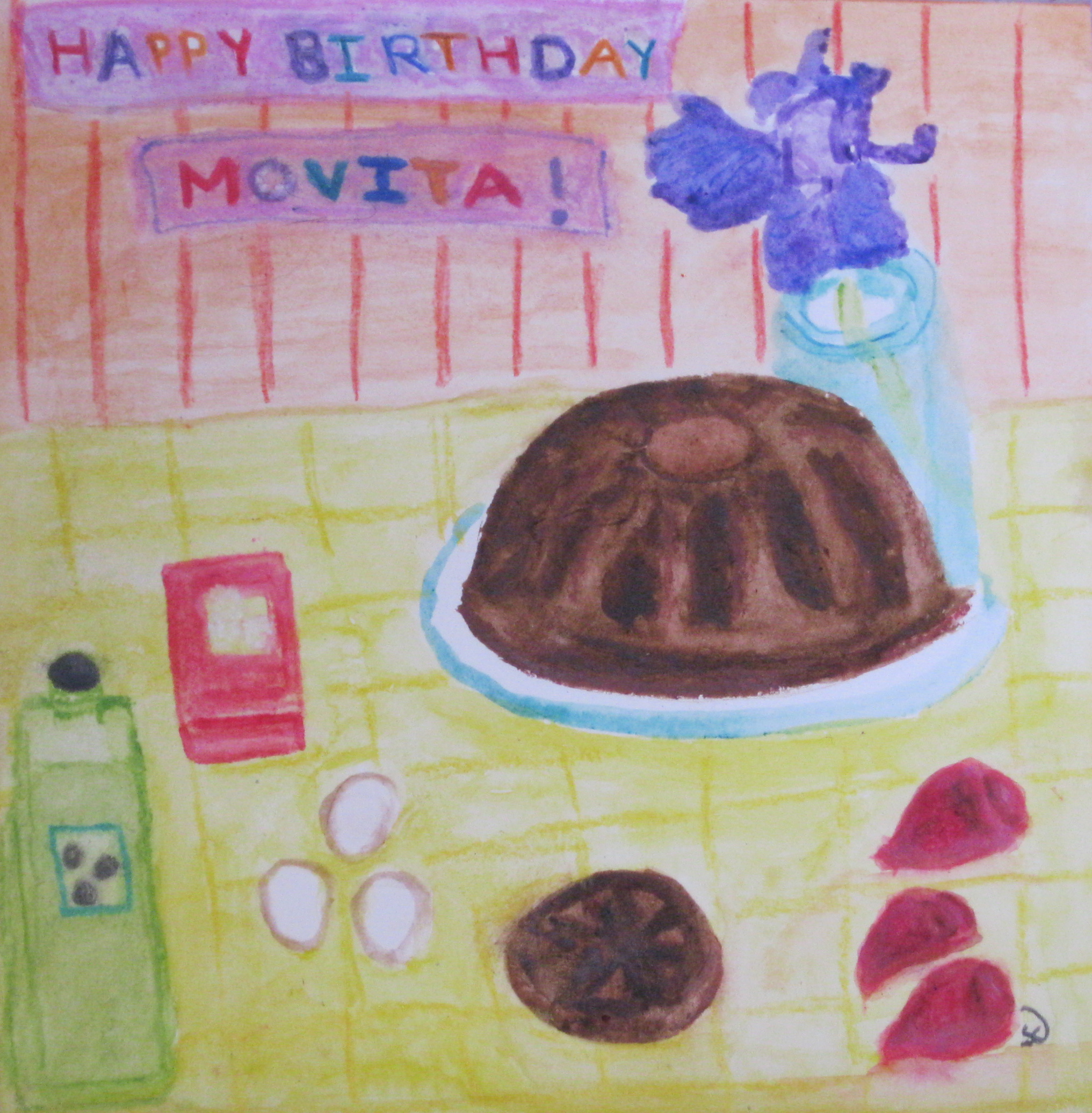
painting shows a Mexican chocolate beet bundt cake with birthday banner.

Mexican Chocolate Beet Cake. 8″ x 8″ gouache and watercolor pencil. Sharyn Dimmick.

Sometimes I think I am wacko. Having gotten up to roll and fill Nazook, an Armenian pastry, before breakfast, I lingered in the kitchen to make a cake for someone who isn’t here and isn’t going to be here — isn’t a definition of whacked doing things at the behest of people who aren’t there?

Let me explain. There is this blogger who goes by the name of Movita Beaucoup. She challenged all comers to bake her a birthday cake and send her a photo by midnight. She promised us prizes. If you are reading this before 10 PM on Friday you still have time to get in on the action: just bake a cake and submit a photo of it to Miss Movita by midnight in your time zone.

Anyway, cakes are not my thing. How many times in the life of this blog have I said I prefer pie to cake? Many. I like to bake. I like to bake bread and pie and pastry as long as it is not too fiddly. But I couldn’t resist baking a cake for Miss B. because she makes me laugh and because she has said that someday she would like to own a Kale Chronicles painting. Besides, she writes about running from bears and worrying that the bathtub will fall through the floor.

When I met Movita (Well, I haven’t actually met her) here in the blogosphere she was carrying on about her need for an iPhone, I believe — some fool bit of modern technology to help her through culinary school. I joined in the chorus of readers offering her congratulations on signing up for a culinary program and informing her husband, charmingly called “2.0,” that she needed an iPhone. I don’t even have a cell phone of my own.

In my childhood, Mom baked us birthday cakes or cupcakes, any flavor we requested. I used to look at all of the cake pictures in our trusty Betty Crocker Picture Cookbook to think about what I wanted. That was before I figured out that I could request a birthday pie instead, and before my brothers figured out that they could have a fancy whipped cream cake from Virginia Bakery or an ice cream cake from Baskin-Robbins. I remember relatively few cakes from those days, chiefly the igloo cake Mom made for Kevin’s birthday, an excuse to cut cake layers in half, frost the cake with white icing and upholster it with the cocktail sugar cubes my Dad kept in a secret location. This cake was the stuff of kid dreams, an entire cake covered with cubes of sugar meant to look like blocks of ice.

I have more sophisticated cake dreams now: I have eaten cakes from Tassajara bakery full of mocha buttercream. I have made genoise soaked in rum (twice). But I am still not a cake baker: I don’t own a piping bag and I don’t think fooling with frosting is fun. Plus, I write a blog featuring seasonal cooking and I’m not about to declare it Cake Season.

One of my pet peeves in baking fads is the popular red velvet (or blue velvet or green velvet) cake, which requires one to use vast amounts of red food coloring to produce a chocolate cake that was more appealing when it was left to look like chocolate instead of a vampire’s breakfast. What can I say? I have gray hair and I don’t think ingesting food dye is good for you. Many people, including my late brother, are allergic to food dye, or go berserk when they get it (No, I have not been sipping from the Schilling bottle). Now watch me find out that Movita’s favorite cakes are velvet cakes….

Fortunately, it is beet season, and I have learned to make a cake featuring a dark red batter, owing to the presence of pureed beets. Before you get upset, please remember that beets are often grown to make sugar and sugar is a valid ingredient in cake. This cake is chock-full of things people call superfoods, including beets, chocolate, cinnamon and extra virgin olive oil, as well as the usual suspects of eggs and flour. I considered making it with ground almonds to make it gluten-free, but I am not having the kind of a week that bodes success with those sorts of experiments.

I first made this cake from a recipe at recipezaar, reprinted in my farm newsletter by the folks at Riverdog Farm, but I have messed with it — you knew I was going to, didn’t you? I incorporated part of an egg yolk I had left from this morning’s egg wash and I wanted to use Mexican chocolate for its distinct flavor. Then I needed to add cocoa because Mexican chocolate is sweeter than the chocolate the recipe called for and I scanted the sugar. I added some cinnamon as well.

To make this cake, you will need at least a cup of pureed beets. I recommend preparing them ahead of time: you can boil or steam or roast them. Let them cool, remove their skins, and whirl them in your blender or food processor. I will not go into the five times I had to clean the stove or the seventeen times I washed my hands while preparing this recipe — if you need to have your all-white kitchen white at all times, do not make this cake.

For the brave, fun-loving and vegetable-minded, read on:

Mexican Chocolate Beet Cake

Preheat oven to 35o.

Rub a bundt pan with olive oil and dust it with a mixture of cocoa powder and ground cinnamon in lieu of flour

Cook, peel and puree 1 cup of beets (I used five small red ones) until completely smooth.

Melt one tablet of Mexican chocolate (3.15  oz) in your microwave and combine with beet puree.

Measure 1 cup olive oil, 1 and 1/4 cup sugar, 1 tsp vanilla and 1/2 tsp ground cinnamon into a large mixing bowl and blend until light-colored.

While you wait, sift 1 and 3/4 cup flour and 1/4 cup cocoa into a small bowl with 1/2 tsp kosher salt and 1 and 1/2 tsp baking soda. Whisk to blend.

Add to oil mixture 1 egg yolk, then 3 eggs, one at a time, beating smooth between each addition.

When eggs are fully incorporated, add the chocolate-beet mixture. Then add flour-cocoa mixture in two or three additions.

Pour batter into prepared bundt pan. Place on middle oven rack and bake until a toothpick comes out clean. This is a moist cake: mine took forty minutes to bake through.

Now the hard part: for best results, let the cake sit covered overnight. This helps the flavors blend. Olive oil cakes tend to get better as they age, so age it for twenty-four hours before digging in. I’ll be taking mine to a potluck tomorrow afternoon.

To Movita Beaucoup: I made this healthy for you, within reason. But I am not there to stop you if you want to eat it with a little cacao nib whipped cream or a puddle of caramel sauce. Just saying. Happy Birthday!

Food notes: I used plain old red beets in this cake, but you can fiddle with the color by using mixtures of red and yellow beets. The batter is a dark, vibrant purple-red, but the cake bakes up red-brown. If you don’t have the extra egg yolk, leave it out — no one will miss it. Cinnamon is fat-soluble — that’s why I put it in with the oil — if you want to incorporate it more smoothly, you could mix it with the sugar before adding the sugar to the oil.

In Northern California spring can start in February and continue through May. First we see daffodils, then flowering pear, plum, crab apple and quince trees. Spring crops come in slowly: green garlic, lettuce, then asparagus, followed by peas. On my last Farmers’ Market visit two weeks ago the strawberries had white shoulders and the grower I like to buy them from (Lucero Farms of Lodi) had not yet taken up a stall, but I had a feeling I would find strawberries today, and there they were, small red Seascape berries with long stems destined for the year’s first strawberry shortcake.

Painting shows a heart-shaped strawberry shortcake and baskets of berries.

Strawberry Shortcake. 8″ x 8″ Gouache and Watercolor Pencil. Sharyn Dimmick

There are many variations of strawberry shortcake: you can make it with angel food cake or lemon pound cake or sponge cake or olive oil citrus cake. I have tried them all, but my favorite recipe for strawberry shortcake is a biscuit base, split and covered with fresh strawberries, served with lightly sweetened whipped cream. To honor the ritual of spring I will use organically grown Farmers’ Market strawberries, and whipping cream from Straus Dairy in Marin County.

I will buy my cream at a local supermarket, but because it is Earth Day I want to think a bit about what it took to produce this traditional spring dessert. Someone had to plant the strawberries, tend them, water them, pick them, bring them to market. Someone had to raise sugarcane and refine it. Someone mined the salt, picked vanilla pods, raised wheat, ground it into flour. Someone had to raise the dairy cow, feed her on grass, milk her. Someone had to separate the cream, sterilize the bottles, fill and cap them. Someone had to drive the cream to the supermarket. Someone had to put it on the shelves. Someone had to drive the bus that takes me from market to market and home again. In a day gone by, members of my family, relatives from a few generations back, might have kept the cow and skimmed the cream and planted the strawberries in Illinois where they farmed, but my parents both moved to California as teenagers and never went back to the Midwest. Celia’s small farm at The Kitchens Garden might be something like the farms my mother knew in her youth, farms with hedgerows, vegetable gardens, small orchards, cows and chickens, diversified crops.

In California I now buy the bulk of my produce from an organic farm eighty-seven and a half miles from where I live. Someone drives to Berkeley each Wednesday and places boxes of vegetables and fruit on a front porch. I take a bus and walk several blocks, load the heavier vegetables into my backpack and the delicate items into a canvas bag. I have no choice in what goes into my produce box: someone at Riverdog Farm decides what is best each week and loads it up. I unpack the box and fold it: the farm driver will collect it the next week. I like the idea that I am getting produce picked that morning or the previous day and I like it that in a small way my food dollars are supporting small, diversified agriculture on a farm that uses organic growing methods: although I cannot farm myself I have farming roots. Small farmers are real to me,  people that raise food and think about how they are raising it. The Capay valley where my produce comes from has many small farms started by former students at U.C. Davis on land that agribusiness did not want.

I shop at the Farmers Market to supplement my produce box. There I can buy a flat of peaches in June, more corn in July, bunches of fresh basil in August, these first spring strawberries in April. Every week I can walk down the center aisle and look to see what has come in, compare prices, sniff the air perfumed by seasonal fruit. I am grateful to live in a state where the growing season is long and next to a city that supports three different farmers’ markets year-round.

Enough. Now it is time to go into the kitchen to make that special shortcake with the first strawberries.

First, shake the cream bottle to redistribute the fat evenly. Then pour the grassy-smelling cream into a small mixing bowl and set it into the refrigerator to chill, along with the beaters. The cream will triple in volume as you whip it, so make sure your bowl is not too small. If you wish, you may season it at this point: I like to add  2 and 1/2 tablespoons of sugar and 1 tsp. vanilla and, sometimes, the barest grating of fresh nutmeg.

While the cream chills, prepare the shortcake:

Preheat the oven to 425.

Sift together 2 cups of flour

1 Tbsp baking powder

1/2 tsp kosher salt

2 Tbsp sugar.

Cut in 1/3 cup unsalted butter (if you use salted butter, omit the kosher salt)

Add 1 cup milk

Stir just until combined.

Put into a buttered cake pan.

Bake for 12 to 15 minutes until lightly browned in spots.

While the shortcake bakes, prepare the strawberries: remove the hulls and stems and then wash berries in a minimum of water. Let them drain in a colander or pat them dry. Taste one. If your berries are ripe and sweet, you need not add anything, but if you are my mother you will insist on adding a few tablespoons of sugar so that the berries give off more juice — it’s your choice since Mom is not in the kitchen with you. You will also whip the cream now. We like ours moderately stiff so that we don’t have to whip it again the next day.

Once the shortcake is out of the oven, split it in half and pile berries between the layers and on top. Serve with whipped cream.

I will return the plastic strawberry baskets to the market next week for re-use (and perhaps buy more strawberries). I will return the cream bottle to the grocery store eventually, collect my deposit and try not to buy more cream for awhile.

Food Notes: Strawberry shortcake features two elemental foods, cream and strawberries. To make a delicious shortcake, start with the best cream and berries you can find: local dairy cream and organically grown berries will give you the best flavor. Some things are worth waiting for and it is better to make this with ripe, red strawberries that have developed their sugars than to use white-capped or green berries. If you cannot get local cream, choose cream from your market that has not been marked “ultrapasteurized.” Ultrapasteurized cream has been heated to a high temperature to give it a longer shelf life and has a cooked taste that you will want to avoid once you have tasted the alternative. We sweeten our cream with white cane sugar to keep the flavor pure, but you are free to use any sweetener you prefer as long as you do not introduce chemical sweeteners. Finally, you may use any sort of cake or biscuit base that you like, but I implore you to bake it yourself and eat it while it is warm from the oven.

painting shows four cups of atole with chocolate and other ingredients

Atole with Chocolate. 8″ x 8″ gouache and watercolor pencil. Sharyn Dimmick.

Because it is April 15 and I am still working on a giant art inventory for my tax returns I’m giving you a quick and easy recipe for atole with chocolate, good for those chilly mornings or chilly evenings of spring. I made it for the first time on a cold April morning of 2010 when we had had a bag of masa harina sitting around for a year or two and Jacqueline Higuera McMahan had published a recipe for atole in the San Francisco Chronicle. McMahan’s recipe called for added cornstarch, but I think the masa thickens it adequately by itself.

The first time I made this I used a Oaxaca chocolate bar containing chilies. Later I made it with Sharffen Berger bittersweet and added some pasilla chile powder. You can make it without chile if you don’t like the kick.

Atole makes a good, warming breakfast drink, a heavier form of hot chocolate. It would be good to serve at a holiday party. I’ve thought of adding more masa and thickening it into a pudding, but I haven’t tried that yet.

Atole with Chocolate (4 Servings)

Film a large saucepan with water

Heat over medium heat 1 quart of milk

Add:

5 oz. chopped chocolate

1/3 cup brown sugar

1/4 cup masa harina

1 cinnamon stick

1 vanilla bean, split open.

a pinch of salt, if desired

powdered chiles to taste

Whisk this until the chocolate melts, until everything blends and until it thickens to your liking. You will need to cook it for at least five minutes to cook the masa, which will expand as it cooks. Fish the vanilla bean and cinnamon stick out before serving, or just push them to the side with your serving ladle so that they continue to flavor whatever you don’t drink immediately.

Food Notes: Masa harina is the flour Mexicans use to make corn tortillas. Look for it in your Mexican grocer or online. If you find this too sweet, add cocoa powder to a small portion and add it back into the pan, or add some bitter chocolate or some brewed coffee. Next time use a darker chocolate or scant the sugar to achieve less sweet results. I’ve been thinking about using a tablet of Mexican chocolate to make it next time with some bitter chocolate added. For the ultimate in decadence, serve it with a float of barely sweetened whipped cream. Drink this for breakfast and you may even have the strength to complete your tax returns on time. Good luck! We have two extra days this year.

Painting shows pear tart tatin and ingredients.

Pear Tart Tatin. 12″ x 12″ gouache. Sharyn Dimmick.

I had a music potluck to go to yesterday. I started thinking Friday night about what I would make: it came down to orange pound cake made with orange juice and zest, a repeat of the St. Patrick’s Day knishes sans Canadian bacon in deference to vegetarian singers, or a pear tart tatin. Those of you who read about our grocery finds a few posts ago will recall that I bought three pounds of Bosc pears. I have roasted pears to eat as dessert and I have included roasted pears in a few winter soups, but I had never before made a tart tatin. I was somewhat swayed by the thought that I had one pie crust waiting in the fridge. I was also swayed by the fact that I greatly prefer pie to cake and I love fruit desserts.

As it turned out, the pie crust in the fridge was a little too crumbly and a little too small and I ended up making a whole new batch: now we have old leftover crust and new leftover crust. Oh well: making and eating things with pie crust does not trouble us in this household.

While I used my Mom’s never-fail pie crust recipe for the tart tatin, I used the method and ingredients for the most part described in Chez Panisse Desserts, with one change, two additions and one error, which may have proved beneficial.

Alice Waters and Lindsey Sher give the ingredients as one 10-inch circle of pie dough or puff pastry, 1/2 cup sugar, 2 Tbsp unsalted butter, about 5 medium Bosc or Winter Neli pears and an optional tablespoon of rum, Cognac, brandy or Armagnac. I used salted butter, eight small Bosc pears, and rum. I added 1/2 Tbsp of vanilla extract and a sprinkling of ginger. Waters and Sher say to bake the tart at 400 degrees, which I would have done, except, despite reading the recipe, I had set my oven at 350.

If you don’t have pie crust on hand, you’ll have to make that first. You will find my Mom’s recipe here. If you make it, you will have three more crusts, or at least two and a half because Mom’s recipe makes four crusts (It is hard to make less with her recipe because it calls for a whole egg).

Once you have gotten your pie crust made, set it to chill in the refrigerator while you prepare the other ingredients. It’s up to you whether you want to peel and core pears first or make caramel first. At any rate, you will be peeling and coring pears. You can use halves or quarters in the tart. I used halves, which looked quite nice. I put the tablespoon of rum and the half-tablespoon of vanilla in the bowl with the peeled, halved pears.

I then got out a cast iron skillet and set it on medium heat. I added the butter and sugar to the skillet and stirred with a wooden spoon until the caramel turned light brown, at which time I removed the pan from the heat and continued to stir. The caramel continues to darken: you keep stirring it so that it turns evenly instead of darkening in any hot spots. Mine came out a lovely, reddish brown.

Place the pears in the caramel in a circle with the narrow ends pointing to the center. I had a small, pear-less circle in the center, which I filled by cutting the last pear into smaller pieces. I put my pears cut-side down, although Alice and Lindsey say to put the rounded side down. You are going to flip this dessert over after it is baked, so, whichever way you do it, it is going to come out the opposite. My brain does not like to think in reversals (it gets confused). Do what you like. When you have got your pears looking all pretty and symmetrical, you are going to put the pastry over the top. Before I did this, I poured the leftover vanilla-rum mixture over the pears and sprinkled them with perhaps 1 tsp powdered ginger. I folded the crust in quarters, then unfolded it over the fruit, tucking the edges down into the sides of the pan since this crust will end up being the tart base. I also, as instructed, pushed the dough gently into the pears — it forms a slight wave pattern, molding around the curves of the pears. Cut a few slits in the crust and transfer the tart to your hot (or not so hot) oven.

I checked my tart after 30 minutes — that’s when I discovered my temperature error: plenty of browned juices bubbled up, but the crust was not brown. I cranked the oven up to 400 and let the tart bake for another 20 minutes until the crust was properly browned. My error with the oven temperature may have caused deeper caramelization of the fruit, which I happen to like, and had no ill effects on the caramel or the crust, save needing extra time for browning.

When the crust has browned to your satisfaction, remove the tart from the oven and let it sit for a few minutes — the pan will be really hot. When you are ready for the next step, take a plate larger than your skillet, place the plate on top of the pan and carefully invert the skillet onto the plate. With any luck, your tart will come out whole. If a pear or two get left behind, just use a spoon to transfer them back to their place on the tart. If you have lost a bit of crust, you will have the pleasure of sampling the caramel-infused crust: the caramel layer transforms basic pie crust into a new delight.

Mom dug out the top of a popsicle mold, which we plopped in the center of the tart to hold the wrappings away from the fruit. I wrapped the tart in two layers of aluminum foil and carted it off on the bus in the rain to my friend Elaine’s house. The singers consumed every scrap of the tart. Toni had three pieces. Elaine, who does not like Bosc pears, had two. Elaine said she would like the tart made with stone fruit. I said I thought it might be delicious with fresh figs. We have to wait for those fruits, but some pears are in season now. I was pleased with how easy it was to make a dessert that had intimidated me (the caramel, the flipping, the careful arrangement of the fruit, would the crust withstand the weight of the tart and all of that caramel? Would it leak?). Trust me, friends — if I can do it, you can do it.

Food Notes: If you are afraid of pie crust, you can also make this with frozen puff pastry. I recommend, however, that you visit your nearest crust expert to overcome this fear. Most pie bakers would be glad to help you learn to make pie crust.