Archives for category: seasonal recipes

It is definitely fall: shorter days, cooler nights, a brisk crispness in the air. Last night there were drifting wisps of fog and a big moon, but the air was balmy as I walked my two miles home from the closest bus stop. I got up early this morning — it doesn’t matter how late I get to sleep, I will wake in the morning when the light changes — wrote for half an hour and checked emails. Then I got back under a big pile of autumn covers, talked to Johnny on the phone for awhile.

Original watercolor painting shows gingerbread waffle and ingredients.

Gingerbread Waffle. 12″ x 12″ watercolor pencil and gouache on paper. Sharyn Dimmick

When I got up the second time, it was time to make breakfast and the first thing I thought of was gingerbread waffles. Fall flavors have been creeping into our menus — we had our first pumpkin pie of the season and a butternut squash waits on the counter for me to make my signature squash soup with ginger and thyme. I keep a big binder of clipped recipes and turned to the waffle section, taking out the plastic-enclosed recipe.

I often don’t include anything extra in news clippings, saving space and just keeping the recipe, but at the bottom of the column in tiny type this clipping says “Adapted from ‘Waffles from Morning to Midnight’ by Dorie Greenspan.” I present to you an adaptation of an adaptation: I couldn’t make this recipe without taking the chance to throw in half a cup of my neglected sourdough starter and without incorporating a quarter cup of whole wheat flour for depth, texture and health benefits — surely there despite the half stick of melted butter, three-quarters cup of brown sugar and the maple syrup I drizzled on top. I also doubled the eggs.

Sourdough Gingerbread Waffles.

Measure into a large bowl:

1/2 cup sourdough starter

1/4 cup molasses

1 cup buttermilk

Separate four large eggs, putting the whites into a small mixing bowl and adding the yoiks to the buttermilk-molasses-starter mixture.

Melt 1/2 stick butter (I used salted and omitted salt in the recipe. If you use unsalted you may want to add 1/4 tsp kosher salt to your dry ingredients)

Beat the egg whites until stiff.

Then beat the molasses mixture just until combined.

Into a separate bowl, measure and whisk together:

1 and 3/4 cups unbleached flour

1/4 cup whole wheat flour

3/4 cup packed brown sugar

1 Tbsp baking powder

3/4 tsp baking soda

1 Tbsp ground ginger

3/4 tsp cinnamon

1/2 tsp dry mustard

1/4 tsp cloves

1/4 tsp freshly grated nutmeg

Fold dry ingredients into molasses mixture until just blended.

Add melted butter and stir until combined

Fold in egg whites — batter should be streaky, not uniform in color.

Preheat waffle iron and prepare toppings: I melted some butter, sliced some peaches and heated some maple syrup. Tomorrow I will probably serve them with blackberries, fresh peaches and figs. Cook waffles according to the directions for your waffle maker.

Food notes: if you don’t have sourdough starter, omit it and increase buttermilk to 1 and 1/2 cups. If you don’t have buttermilk, you can use yogurt instead, or use regular sweet milk and eliminate the baking soda in the recipe. Or you can use 1/4 tsp of lemon juice or vinegar to sour your milk and proceed with the recipe as written. If you have whole wheat pastry flour you can substitute 1 cup of whole wheat pastry flour for 1 cup of unbleached flour: in that case, eliminate the regular whole wheat flour and use 1 cup of unbleached and 1 cup of whole wheat pastry flour. Serve waffles with whatever floats your boat: bacon, pears and blueberries (a la local restaurant La Note), fruit syrup, jam, cinnamon sugar, pecans and whipped cream.

Friday morning I was invited to a Hobbits’ second breakfast in Piedmont. I saw no reason not to go. Second breakfasts work for me because I get up before dawn most days and can eat my first breakfast before 6:00 AM — by 11:00 I might be a little hungry, by noon I have to eat again. Plus, I love breakfast food: eggs, waffles, pancakes, bacon, cinnamon rolls, leftover pie, home fries, fresh fruit.

Original ink and watercolor painting shows people around breakfast table.

Second Breakfast at Vicki’s. 12″ x 12″ ink and watercolor pencil. Sharyn Dimmick.

Unlike most of the events I go to this breakfast was not billed as a potluck, but I asked Vicki if she wanted me to bring something and she said I could if I wanted to. I had been eying a recipe for Brown Sugar Pecan Pear Muffins and had actually printed it out. This morning I took it into the kitchen with me. I peeled and chopped six small pears and then I started messing around: I saw the two large peaches on the counter that needed to be eaten and thought, “Why not put them in with the pears?”

The original recipe calls for a cup of canola oil. I do not like canola oil and I do not like recipes that call for a cup of oil either (a cup of butter is different, somehow, and I use a cup of vegetable shortening in my pie crust, which is probably worse for you, but a cup of oil produces an oily texture in quick breads). I substituted a cup of plain yogurt, raising the protein content of the muffins.

Then I looked at the 3 cups of all-purpose flour. Um. Too gummy and too white for me. I am out of whole wheat pastry flour, but I need to healthy this up a bit, especially since I am going to indulge in the entire cup of brown sugar it the recipe calls for. So, I used a cup and a half of unbleached flour, a half cup of regular whole wheat flour and a cup of rolled oats.

After that I followed the recipe as written, except I don’t use non-stick cooking spray, so I slathered the muffin tins with Crisco, and I didn’t have any pecans so I substituted pistachios.

Here is the modified recipe:
Peach-Pear-Pistachio Muffins with Brown Sugar
Preheat oven to 350.

Grease 2 12-cup muffin tins.

Peel and dice 6 small pears or four large ones.

Dice two large peaches and combine with pears

Shell 1 cup pistachios and add to fruit.

Beat 2 large eggs with 1 cup of plain yogurt, 1 cup packed brown sugar and 1 cup of oats (quick or rolled oats are fine, instant not), plus 1 tsp vanilla.

Measure 1 and 1/2 cups unbleached flour, plus 1/2 cup whole wheat flour.

Add 2 tsp baking soda and 1 tsp baking powder to flour mixture, along with a touch of salt. Add 1 and 1/4 tsp cinnamon and 1/4 tsp cardamom.

Fold liquid ingredients into dry ingredients. Fold in fruit and nuts.

Spoon muffin batter into greased muffin cups

Bake for 25-30 minutes, depending on how dark you like your muffins to be.

Makes 2 dozen muffins.

Food Notes: These muffins are sweeter than my standard multi-grain muffins, but they are not so sweet that they make your teeth hurt. They make a nice treat on cooler mornings and evenings. When the cardamom hits the liquids it sends up a glorious aroma — it’s worth making them once for that alone. If pears and peaches are long gone in your neck of the woods, try using apples and fresh figs, or use dried fruit that has been soaked in a little rum or juice to re-hydrate.

I took half of these muffins to the Hobbits’ Second Breakfast, a delightful affair where we ate bacon, sauteed mushrooms, shirred eggs made in muffin tins, toast, butter, lemon curd, artisan jams, pumpkin bread and pots of black tea, with chamomile for those that don’t indulge. The table was all set with matching place settings, flowers from someone’s garden, thick, white woven napkins. We spent the meal largely discussing singing and cooking — what’s not to like?

I am still working my way through the pears from my friend Margit’s tree. Because we picked them green and I stored them in the back of our refrigerator in a paper bag they have been holding up nicely.

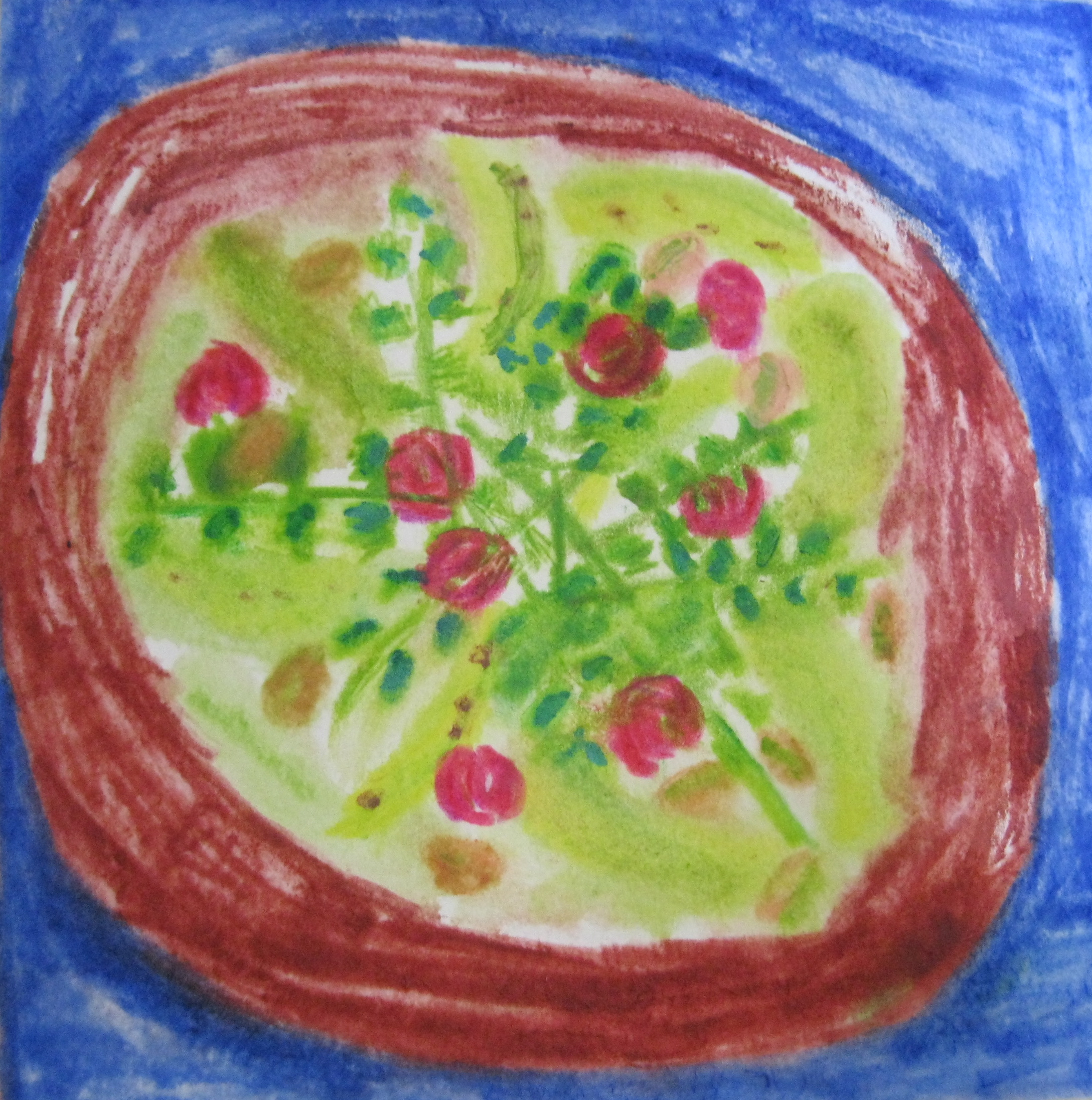
Original watercolor shows salad of pears, arugula, cranberries, feta, pistachios.

Pear-Arugula Salad. 6″ x 6″ watercolor pencil on paper. Sharyn Dimmick.

Two nights ago I wanted a light dinner. I had some arugula I needed to use. I had pears. I decided to make a salad. I washed and spun the arugula in the salad spinner. Then I went out to pick a ripe Meyer lemon from our tree. Returning to the cutting board, I squeezed both halves of the lemon into the bowl and then cored and sliced three greenish pears lengthwise, leaving the skins on. I tossed the pears with the lemon juice to prevent browning. Then I added a small splash of olive oil and tossed the arugula and pears again. Next I shelled some pistachios and grabbed a handful of dried cranberries.

I was thinking of shaving Parmesan or Pecorino Romano into the salad, but feta won out: I crumbled a small block of feta over the greens, fruit and nuts, then tasted to adjust seasoning. The only thing it needed was a bit of honey to bring out the sweetness. I drizzled a little on top and tossed the salad again.

This is a wonderful salad for the first few days of fall weather when it is sometimes warm enough to eat a salad for lunch or dinner. I served it again last night as a side salad with a dinner of turkey chili, cornbread and Gravenstein apple pie. The second time I made it I used roasted pistachio oil instead of olive oil. By the time I cooked and ate I didn’t have enough time to finish my painting, which is why this post is a day later than usual.

If you should live somewhere where pears and arugula are available in late November, this would make a lovely Thanksgiving Day salad. If not, make it and eat it while pears and arugula are to be had.

“Some of the time, not all the time” says the Dylan song “Hanging Out the Clothes.” That’s how I feel about cooking. Sometimes I love thinking about cooking, perusing cookbooks, thinking about flavors. Sometimes I am inspired by a particular ingredient from the Farmers’ Market down in Berkeley or a glut of foraged blackberries. Sometimes I just want to put the closest thing in my mouth and be done with it.

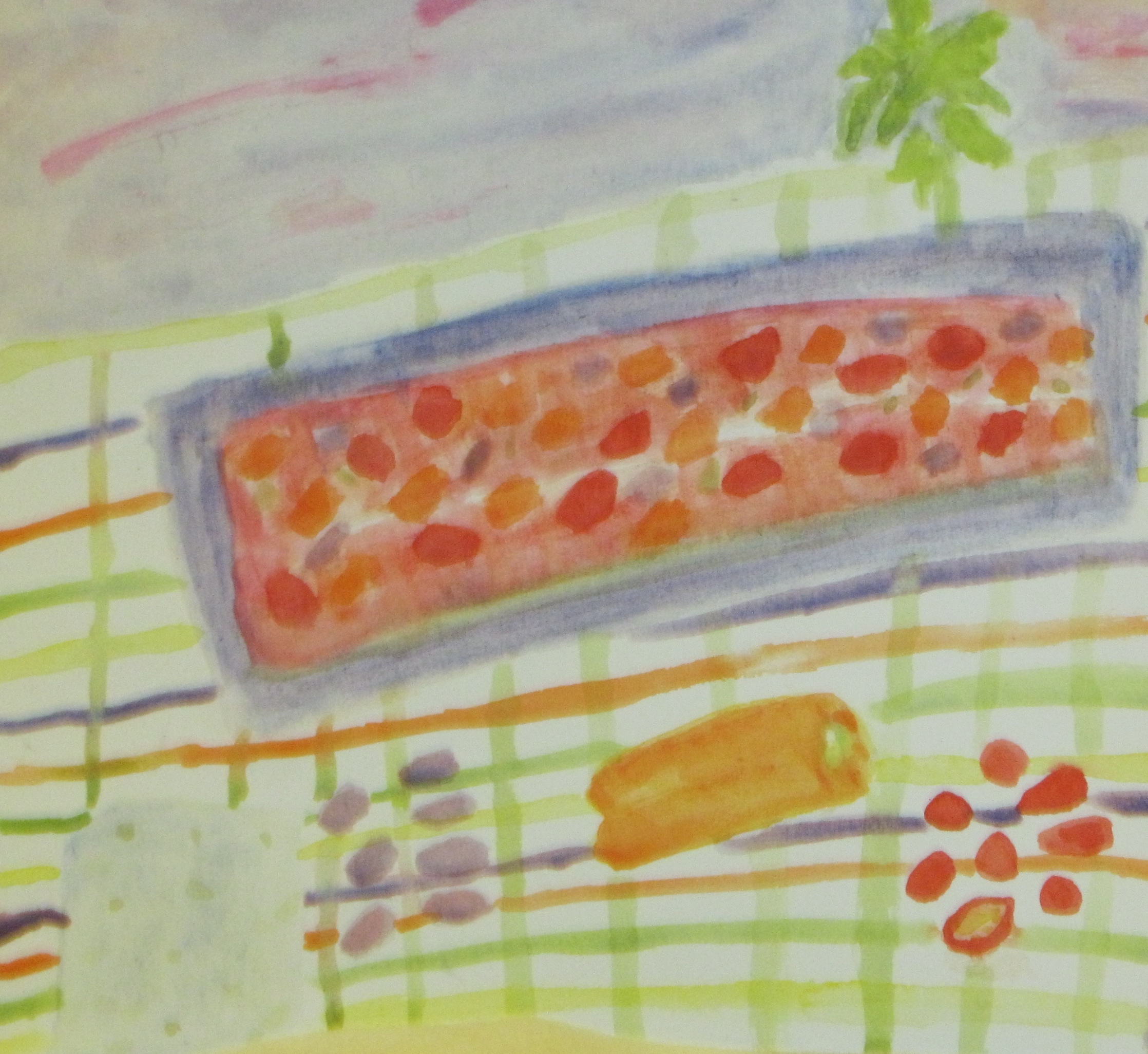
Original watercolor painting shows Greek-style salmon and ingredients.

Greek Salmon. 12″ x 12″ gouache on paper. Sharyn Dimmick.

There is a special pleasure in cooking for someone when you want to please them. Our most recent foray to Canned Foods Grocery Outlet fetched us some wild caught salmon from Washington State. Standing over the freezer case, eying the fish, I ask Mom, “Does Bryan eat salmon?”

“I think so,” she says. “Does Johnny eat salmon?”

It is rare for Mom to bring up Johnny in conversation. He’s only been over to the house in the past three weeks: although I’ve known him much longer than that, he never had reason to come up here before last month.

“I don’t know,”I said. “I’ll ask him when I see him.” In the meantime we bought the salmon filet, enough to feed at least four people.

Johnny and I schedule our visits in advance. We live a good distance away from one another and public transit schedules are not conducive to spontaneous trips to see one another, so, instead of dropping in on each other all of the time we schedule visits and try to spend a significant amount of time together when we get together.

We bought the salmon on Tuesday and Johnny was coming over on Thursday night. When he told me he liked salmon, I made a dinner plan: I would make the pear tart tatin that he once wanted to elope with (He’s mine, pear tart!), microwave some fresh green beans, bake some red potatoes and cook the salmon in foil topped with seasonal vegetables: cherry tomatoes, orange bell peppers, kalamata olives, basil, a little feta — basically a Greek salad without cucumber thrown on top of the fish. Everything except the green beans could cook in the same oven and, with a little prep work I could have an easy dinner that was festive and delicious.

In the morning I made pie crust for the tart and put it to chill. In the afternoon I took the salmon out to thaw, laid it on foil on baking sheet and oiled the skin-side with a little olive oil. Then I went to work on the pears, peeling, coring, slicing, putting them to soak in a little dark rum, sprinkling ground cardamom over them. I made the caramel in a cast iron skillet, arranged the pears on top, rolled out the top crust. I preheated the oven, adding a handful of potatoes on the side. Then I snapped beans and cut up half a basket of red cherry tomatoes, and a large orange bell pepper. I tore up a few basil leaves, plucked a handful of pitted olives from a jar, diced a small cube of feta and I was ready to go, scattering all that on top of the salmon. The minute Johnny arrived I put the tart and the salmon in the hot oven and told him we had a half hour to ourselves before I had to mess with food again.

I can’t remember what we did for that half hour. He might. He set table for me in the dining room because the breakfast room was a mess and I did not want to excavate the table. I had him test the fish a few times because I don’t cook salmon often. All told, we cooked the fish for perhaps 40 minutes in a 400 degree oven. Brother Bryan arrived home just as it came out and we all sat down to eat.

Johnny and I liked the salmon so much that I scrambled the leftovers for breakfast with eggs and we ate them with the last slices of the pear tart tatin — have to get rid of that stuff quickly since Johnny has threatened to run off with it.

I still have a lot of pears in the house from my friend Margit’s tree, sitting in a brown bag in the back of the refrigerator so that they will stay as green as possible for as long as possible: my mother only eats pears when they crunch — I’ll eat them slightly softer than that, but I do not enjoy pears that have turned yellow (It’s that mushy texture).

Yesterday I pulled out the pears and found about five yellow ones, two large and three small. I had volunteered to make a dessert last evening — my mother has a sweet tooth and is eating soft foods until her current round of dental work is over. Plus, I had done something that made her uncomfortable and needed to work my way back into her good graces.

Original watercolor painting shows pear clafouti, dried cranberries, pears.

Pear Clafouti with Cranberries. 6″ x 6″ watercolor pencil on paper. Sharyn Dimmick.

What to make? I could roll out pie crust and make another pear tart tatin. But Johnny once said he wanted to elope with that when I served it at Ballad group, so it would be better to make that when he is around to enjoy it. Carly Sullivan had posted a recipe for clafouti that I had saved. I took a look at it again, and then adapted it for ingredients we had. Basically, I used white sugar instead of honey, milk and half and half instead of buttermilk, omitted the vanilla and added dried cranberries to the fruit layer, browned the butter and cooked the pears in it, throwing the sugar on top to caramelize, cooking it down until the mixture was fairly dry, giving the pears time to absorb butter, sugar, lemon, ginger and cranberry flavors. The cranberries made it pretty, too.

To make the clafouti I just made:

Preheat oven to 375 degrees.

Select 2 large yellow pears (or 3 smaller ones). Core and slice them thinly, but do not peel them: the skins help hold the pear slices together.

Melt 2 Tbsp butter over medium heat in a skillet, allowing the butter to brown, but not burn, before adding the sliced pears.

Sprinkle about 1/4 cup sugar over the top and jerk the skillet a few times so that the sugar gets distributed among the pears.

Allow mixture to cook down until the pears have released their liquid and the liquids have reduced to a thin caramel.

Turn off heat.

Add the juice of half a lemon, a generous grating of fresh ginger (use your microplane and grate directly over the fruit), a small handful of dried cranberries.

Pour the fruit mixture into a tart pan or pie plate.

Now make the batter:

Crack 3 eggs and whisk them.

Add 1/3 cup granulated sugar and whisk again.

Whisk in 1/2 cup whole wheat pastry flour

Add 1/4 cup half and half and 3/4 cup milk*

Add vanilla extract (I poured it into the cap from the vanilla bottle and used about half a capful).

Whisk until just blended.

Pour batter over prepared fruit in pan.

Bake for thirty-five minutes. Serve warm or cold, cut in pie-like wedges.

* Our standard milk is 1%. If you have whole milk, like Celi, just use a cup of whole milk — I added the half and half to make the milk richer, but you can make it with any kind of milk you have, including soy milk, nut milk or coconut milk.

Food Notes: This made a easy, delicious dessert, creamy and custardy with crisp, buttery edges. Cooking the fruit first on the stove meant no watery flavors. This would make an excellent Thanksgiving dessert if you are not utter traditionalists like we are, having to have pumpkin pie with whipping cream, made from the recipe on the Libby’s can, slightly modified. (We also make fruit pie of some description, cherry or apple or blueberry or mixed berry, depending on what is around).

The Lauren Project: Lauren is back in Santa Fe, still cooking up your recipes. Please be patient: we will announce the prize winners by the end of this month.

Watercolor painting of bowls of polenta, tomato, Martin guitar in green chair.

Johnny’s Polenta. 6″ x 6″ watercolor pencil on paper. Sharyn Dimmick.

Some of you know that I frequently eat polenta as a breakfast cereal during summer and early fall, cooking it in milk, stirring in a fresh peach or a handful of wild blackberries. Some of you know I have spent part of the summer flirting with a guitar player, wondering how much he liked me, being alternately elated and crushed as I went to play music at his house, attended band rehearsal, sang at a small festival in Santa Rosa, followed him up to another festival called Cur-Ville. You’ve seen me donning red dresses and trying to let go.

That phase has ended: the guitar player is mine now and, to prove it, spent the better part of the long weekend at my house. Mornings found us in the kitchen, brewing coffee, figuring out what to eat for breakfast. I cooked him eggs twice, scrambled with cheese and Gypsy peppers, served with sourdough toast. This morning I asked him what he ate for breakfast besides eggs. He mentioned a dish of polenta and various cheeses, topped with tomato and avocado.

We always have cornmeal, so I put on a pot of  salted water to boil and put out the cheese collection for Johnny to look at while I measured out a cup of cornmeal. He selected Red Leicester, a cheddar, and chopped it into small pieces.  I added some grated pecorino Romano. While the polenta was warm I added a chopped tomato. We tasted the polenta. He added a bit more cheese, I added a pinch of kosher salt and a healthy sprinkle of paprika and we had a beautiful golden breakfast, flecked with tomato red, Johnny’s gift to me and my gift to you.

After we ate, I did the dishes, dancing at the sink while Johnny sat in a green chair and played me Bruce Springsteen’s “Fire.” Occasionally, I turned around to look at him to sync my back-up vocals to his lead. Dishes have never been this much fun — who knew? All you need is a guitar-player in your kitchen to play songs for you while you wash and rinse. But you can’t have mine — he’s taken. Sorry.

If you want to make Johnny’s Polenta, measure water and cornmeal in a four-to-one ratio (I used four cups of water to one cup of cornmeal, but you could use one cup of water to a quarter cup if you want only one serving).

Add a bit of salt to the water — not too much, since you are going to be adding cheese later.

Boil polenta and water mixture until it has thickened to your liking. Remove from heat and stir in

Chopped and grated cheeses to taste : I used about 3 ounces of cheddar and 1 ounce of pecorino Romano.

Add one large chopped tomato.

Add 1/2 tsp of either sweet or hot paprika, depending on your proclivities: this adds wonderful color as well as a subtle flavor.

Taste and season as necessary. You will have to provide your own soundtrack for dish-washing.

Food Notes: You can make this with cornmeal or polenta, or even grits — whatever cereal-like corn product that you have hanging around. Lauren, if you are listening, you could swap some permitted vegetable for the contraband tomato and eliminate the cheddar, substituting some cheese you like, such as the cumin cheese we ate in France.

The Lauren Project: Thanks from Lauren and from me to all who sent recipes to the Lauren Project. Lauren is out in California, cooking up test batches of recipes. She and I will confer soon and announce the prize winners in an upcoming blog post. Before we complete the winners’ post we will contact our winner to ask what prize he or she desires. Then we will contact the second place finisher, third-place contestant, etc. until all prizes are awarded. Those of you who did not win will still be eligible for free shipping on any Kale Chronicles’ painting purchased by midnight December 31st, 2012.

First of all, let me remind you that The Lauren Project recipe contest will close at midnight Pacific time on August 31st. There is still time to get your entries in and become eligible for a potholder, a painting, a music CD, a cookbook. We have received a lot of exciting entries — Lauren may be testing some of them as I write this.

This has not been a big cooking week for me: I had two days of jury duty, getting up early and packing lunches of peanut butter on raisin bread, or turkey and cheese on whole wheat, chopping up watermelon to fit into Tupperware containers, gulping my morning coffee at the bus stop after spilling half of it on my way down the hill. When I got home I would be famished for tea, having missed our traditional afternoon tea break. My teeth are fine now, but Mom has a temporary cap, bridging three front teeth, and is eating soft foods again. Mom made chicken and noodles. Mom and I made ranger cookies, throwing in a little peanut butter that did not meet our standards for eating in sandwiches. The weather flip-flopped, cold one day and hot the next. Today I made two breakfasts, one for me and one for a guest: I ate rye flakes cooked with granola in milk; he got scrambled eggs with cheese and Gypsy peppers and sourdough toast (We had two eggs left and a heel of sourdough — otherwise I would have eaten eggs, too). Then, before lunch I roasted and chopped things for Baingan Bharta, which we had for dinner with basmati rice and plain yogurt. Lunch was a toasted whole wheat tortilla with cheese and chile paste — I hardly need to tell you how to make that.

Original watercolor painting shows Muhammara and ingredients.

Muhammara. 8″ x 8″ gouache and watercolor pencil on paper. Sharyn Dimmick.

The fall food palate includes corn and tomatoes still, green beans and cucumbers. Eggplant is in, along with plenty of peppers, both hot and sweet types. Is it cheating to tell you about something I will surely cook soon? Let’s talk about Muhammara.

Muhammara is a Middle Eastern spread of roasted peppers and walnuts, thickened with bread and flavored with cumin, garlic and pomegranate molasses. I make it in the fall when peppers come in and I still have fresh walnuts. Muhammara is good with toasted pita bread, grilled lamb sandwiches, celery sticks. I’ll eat it by the spoonful and run my finger along the empty bowl.

I first ate Muhammara at Zatar restaurant in downtown Berkeley. Muhammara has a lovely red-orange color and an intriguing flavor from the molasses, essentially pomegranate juice boiled down into a thick sweet and tart syrup. I learned to make it myself from Epicurious.com, but I messed with it a little.

If you have a glut of red peppers in your kitchen, roast them in the oven, rubbed with a little olive oil. Slip the skins by putting them in a glass bowl covered with a dish towel, letting them steam in their own heat.

Otherwise, open

1 jar of roasted red peppers. Discard the liquid and put the peppers into your blender.

Add 1 slice of bread. (French bread is good for this  — don’t use rye or raisin bread).

Chop and toast 1/3 cup walnuts

Add walnuts to the blender with

juice of 1 lemon

2 tsp pomegranate molasses

1 tsp ground cumin

1/2 tsp red pepper flakes

Mash 2 to 4 cloves of garlic with 1/2 tsp salt. Add to blender

Add enough olive oil to blend. The original recipe I found on Epicurious calls for a horrifying 3/4 cup. I would use 1/3 cup max, but suit yourself.

Whirl in blender until you have a thick red paste. Try to get it out of the blender before you actually start eating it!

I recently had some dental work done — after I lost my job a couple of years ago it didn’t seem too important to keep up visits to the dentist. I went last week. And I paid for it because Dr. Liu found a cracked tooth, a broken tooth and a cracked filling (but no tooth decay!). Last week he set to fixing all that. He adjusted a crown while he was at it. I have to go back to have the cracked tooth fixed after I get through with jury duty, which starts today. So, following on my anniversary post about The Lauren Project, I share with you some of the things I ate  — um, drank, since I could neither bite nor chew. It does give me empathy with those on restricted diets.

The first night following surgery I had a coffee milkshake, coffee ice cream whirled up in the blender with a little one percent milk. I was feeling pretty happy that I had an excuse to have one for dinner and even forbore to put Kahlua in it. By 9 PM I was hungry, however, and had to resort to a serving of coconut yogurt.

The next morning I was determined to eat something normal, so I cooked my usual breakfast of rolled oats in milk with a pinch of kosher salt, four walnuts and two teaspoonfuls of rhubarb compote (remember the rhubarb experiments?). I found even the amount of chewing required for oatmeal and walnuts to be unpleasant so I resolved to have liquid lunches and dinners for another day.

I got hungry again before 11:00 AM — I was up at 5:30 AM and had eaten at around 7:30 and had taken a little walk at 10:00. This time I set to work on a smoothie, consisting of a fresh mango and a container of strawberry yogurt with a pinch of crushed cardamom. Delicious, but after I had had a few sips I realized I was going to get tired of sweets fast.

What to do? I put aside the mango smoothie, rinsed the blender and decided it was time to try gazpacho.

This was kind of a big deal to me because have never liked tomato juice, Snappy-Tom, bloody Mary’s, or V-8 — can you say yuck? So I didn’t look up anybody’s recipe for gazpacho. We had cold soups when I was in France: my favorite one there incorporated melon, bacon and cream: it sounds gross, but it was really good.

Original watercolor painting shows tomatoes, cucumbers, gypsy peppers and lemon.

Greek Salad Vegetables, 6″ x 6″ gouache and watercolor pencil on paper. Sharyn Dimmick.

Anyway, then I thought of the delicious liquid that hangs out at the bottom of a bowl of Greek Salad. I decided my best shot at gazpacho was to make a Greek salad and liquify it. I proceeded to chop 2 heirloom tomatoes, 2/3 of a large, peeled Armenian cucumber, 2 Gypsy peppers (ranging from yellow through orange to red). I added 1 large pressed clove of garlic and a small handful of chopped, pitted Greek olives. Then I went out to front yard and picked the ripest Meyer lemon I could find on the tree.

I blended all that up. I tasted it cautiously, with the intention of adding feta cheese. But you know what? It didn’t need the cheese. It didn’t need oil or black pepper or salt or red pepper flakes or red wine vinegar. It didn’t need a single blessed thing. I encourage you to try it, even if you are afraid of all of those red, cold, tomato-based drinks, especially if you like Greek salad.

I had a glass of Greek gazpacho for lunch, followed by the rest of my strawberry-mango smoothie. I have another glass of gazpacho left for later, waiting for me in the refrigerator. And tonight I’ll probably indulge in another coffee shake — the only thing that would make it better would be if I had a stash of malted milk powder, but we haven’t seen it lately at Grocery Outlet.

What are your favorite things to eat when you have dental work? C’mon. ‘Fess up.

Original painting shows cherry plums, plum cake, plum caramel.

Plum Cake. 9″ x 12″ Gouache and Watercolor Pencil on Paper. Sharyn Dimmick.

Sometimes circumstances conspire to create an end. Today is my sister-in-law’s birthday and she is coming over to go out to lunch with my mother in Walnut Creek. Barbara likes plum cake. I had half a colander of fresh cherry plums on the counter and a jar of wild plum jam that I needed to use. I had just read David Lebovitz’s blogs on butterscotch sauce (which I am dying to make) and peach cobbler, plus a post on plum cake made with cornmeal from Two Peas and Their Pod. Barbara loves whipped cream. So what would I do? I would make the cornmeal-plum cake, adapting it a little to give it a more butterscotch-y flavor by substituting some evaporated cane juice for half a cup of the white sugar and I would use the jam to make some plum caramel to serve with the cake.

For the plum caramel, I followed a recipe from Chez Panisse Desserts, except, instead of cooking fresh plums, I just added plum jam (aka cooked plums) to the caramel base, cooked it for a few minutes and strained the results. You can make simple caramel by putting 1/2 cup of sugar in a saucepan with 2 Tbsp water and melting it over high heat, shaking the pan every now and then (do not stir). When it takes on a pale golden color, remove it from the heat and carefully add 1/4 cup water, not getting too close to the pan. You can stir now. If you are adding fruit puree to the caramel, add it now (this works with any berry or stone fruit), add it now and cook for a few minutes over medium heat. Strain out any solids or seeds that have slipped through, put your caramel in a clean jar in the fridge and you are good to go for later. Fruit caramel is less acidic and more complex than simple purees and is perhaps my favorite recipe I learned from this cookbook.

Now the cake. You can see the original here. Since cakes are not my favorite things I followed the recipe closely with just two substitutions (okay, three). First, I had medium eggs rather than large — they were organic and brown — so I threw in an extra one. Then, I had lots of cherry plums rather than the four or five large plums cited in the recipe. I already told you I put in 1/2 cup of evaporated cane juice for 1/2 cup of white sugar. Oops. Um. Four substitutions. I substituted a quarter cup of sour half and half for some of the buttermilk because, you know, we had it, and it is similar, but richer.

So, this is what you get when you put together all of those substitutions with the original recipe:

Barbara’s Birthday Plum Cake

Pit the cherry plums you are using (Or pit and chop larger plums into bite-sized pieces). Set aside.

Preheat oven to 350.

Measure 1 and 1/2 cups unbleached flour. After measuring sift it into a small mixing bowl.

Whisk into flour 1 tsp baking powder,

1/4 tsp cinnamon

1/8 tsp kosher salt

1/2 cup corn meal

Then soften 1 and 1/2 sticks of unsalted butter (12 Tbsp)

Cream butter with 1/2 cup granulated sugar and 1/2 cup evaporated cane juice until light and fluffy.

Add — one at a time — 4 medium eggs (or use three large), incorporating egg fully before next addition.

Measure 1/2 cup buttermilk (or 1/4 cup sour cream or sour half and half, plus 1/4 cup buttermilk, which is what I used).

Alternate flour mixture and buttermilk, in increments, starting and ending with flour.

Butter and flour a cake pan. I used a bundt pan because it looks festive.

Scrape half of the batter into the pan. Scatter plums over batter. Top with remaining batter.

Bake for fifty minutes. Test to see if it is done. In a bundt pan, my cake took one hour and five minutes to show some browning on the top and to pass the toothpick test.

Cool by hanging bundt pan on a glass bottle. This is fun. Trust me.

Serve with barely sweetened whipped cream and a pool or drizzle of plum caramel. If you are my sister-in-law, add more whipped cream. Enjoy.

Food Notes: Keeping to the art of substitution, you can use any sour thing for the buttermilk — yogurt, sour cream, creme fraiche, even sour milk. You can make the cake as originally suggested with all white sugar, or use all evaporated cane juice. You can probably use some other fruit for the plums, although the plums (with skins) provide a beautiful color and a nice tartness that plays well against the cake. The whipped cream provides yet another contrast (and besides, we like whipped cream when we are celebrating).

Watermelon pickle: I had a problem with the watermelon pickle — it wasn’t the recipe — it was me. so I’ll be trying it again with this week’s watermelon and report back on that later.

Photo of ripe red watermelon in steel bowl.

The one that got away — part of the watermelon that rolled off the counter.

On Wednesday I received a small watermelon from my Riverdog Farm CSA. Grown eighty-some miles away in summer heat, the melon was sweet and pink — I know because five minutes after I set it on the counter I heard an odd thunk: it had rolled off the counter and split open when it hit the floor. There would be no saving this watermelon for later. I picked it up, washed it off and tasted it. Good. Then I set it aside for a few days as the temperature took a nosedive and the fog rolled in to stay — who wants to eat watermelon in fifty-degree weather?

Fortunately, I had a plan for some of this watermelon: when I bought my Nesco American Harvest dehydrator the booklet contained this sentence: “Cantaloupe and watermelon slices become candy-like when dried.” Candy-like. Hmm. Then Krista and Jess reported on their dried watermelon chips. I knew I had to try it when watermelon came along again.

I spent an hour in the kitchen this morning, cutting 1/2 inch thick slices of watermelon, removing the seeds and cutting the rind away. The easiest way to do this proved to be to cut a slice and then slice through the melon perpendicular to the rind to produce small batons or wedges and then to cut the rind away. After half an hour of this, I noticed that I was developing a neat pile of watermelon rind.

Now, I am one of those people that, if you give her a slice of watermelon, will eat deep into the rind. Watermelon rind reminds me of cucumber with no bitterness and no seeds. And yet, because Mom doesn’t can, I have never made watermelon rind pickles. I called her into the kitchen and asked, “Back in the day when you ate watermelon pickles, were they sweet or sour?”

“Not sweet enough,” she said.

“Sort of like bread and butter pickles?” I asked.

“Not as good,” she said.

She told me to look in the old Mowequa cookbook, but I headed upstairs to check my saved blogs file. Not too far into the seven hundred recipes I had saved was Natalie’s recipe for watermelon pickle. I have started to make it and will report on the results on Wednesday.

Painting depicts apple pie ingredients: flour, butter, apples, cinnamon, nutmeg.

Gravenstein Apple Pie 8″x8″ gouache and watercolor pencil Sharyn DImmick

Things to make right now: Gravenstein apples are in! Ann and I picked a big bowlful of them from a yard in Berkeley and Mom made our first Gravenstein apple pie of 2012. I cannot say enough good things about this pie so if you are lucky enough to live within range of Gravenstein apples, by all means, get some. Bernie at the Berkeley Farmers’ Market has them right now if you don’t want to forage for them, or if you need more. I also made zucchini-feta pancakes this week. This time I threw a little leftover pesto with the fresh herbs and feta — it’s a delicious variation. As I write this I have another peach and plum crisp in the oven, this time made with white and yellow peaches and little cherry plums from someone’s backyard tree. And two days ago I made this tomato tart, again with lemon cheese, but with brown mustard and shredded tarragon. And of course this is a good time for Deborah’s somewhat famous tomato platter or Greek salad, with tomatoes and cucumbers in the market and peppers beginning to come in.

Photo of watermelon candy, aka dried watermelon

Watermelon candy in the dehydrator.

The watermelon candy is small and sticky — it reminds me of dried tomatoes, only sweeter and pinker. I was catching up on my sleep today after nearly a month of periodic insomnia so I didn’t take the time to do a new painting. Instead I offer you photos of watermelon and watermelon candy.