Archives for posts with tag: The Kale Chronicles

“Spring green” is a common phrase and color name. The spring in California is rich with greens: before we get to the reds, blues and yellows of summer we have pea green, asparagus green, artichoke green. And in the farm box we have beet greens, Swiss chard, kale, green garlic, spring onions, lettuce,  bok choy and peas. It is little wonder I was drinking my greens recently, shoving some spinach into a smoothie to make way for new rounds of greens.

Painting shows calzones on pizza pan and ingredients.

Green Calzones. 8″ x 8″ Gouache on paper. Sharyn Dimmick.

I have made pizza for many years and somehow never made the leap to calzones. The dough is the same, the famous Cheese Bread sourdough recipe made with a cupful of whole wheat flour. The technique for shaping calzones is the same: you begin with eight small disks instead of three larger ones and go through the dimpling and pulling process.

I might have gone another few years without making calzones, except that Betsy’s recipe for calzones caught my eye and lingered in my imagination. Betsy made hers with fresh kale. I made mine with leftover cooked chard. I followed Betsy’s guidelines for the cup of feta and the 1/4 cup of dry cheese, but I used pecorino Romano where she used Parmesan.

Most of you know the drill for sourdough by now: if you want sourdough pizza, bread, waffles or biscuits you have to make up a sourdough starter. You need to feed it occasionally, but if you use it once a week or more it doesn’t take much care and feeding. I fed my starter yesterday morning with a half cup of water and a half cup of unbleached flour, shook it a few times and left it out on the counter. Come afternoon I came back and made pizza dough with a half cup of starter, 2 and 1/4 cups flour, 1 cup whole wheat flour and a generous teaspoon of kosher salt. Read the gory details here.

This morning I took my pizza dough out of the fridge at eight. At 10:22 I removed its dish towel, formed the dough into eight small rounds, floured the damp towel and let the dough sit while I made filling. I also put my pizza stone in the oven and cranked the heat up to 450, deploying three racks: one for the pizza stone, two for the trays of calzones.

First step: dump cooked chard from frying pan into pizza dough bowl (Why do more dishes than you have to?). Heat same frying pan over medium heat while you slice the white of a small leek and the shoots of some green garlic, wipe 3/4 of a pound of mushrooms with a clean damp cloth and slice them. Add olive oil to the skillet and saute your leeks and garlic while you continue to slice mushrooms. Add leeks and garlic to chard. Saute mushrooms in two batches, adding oil as necessary. While you have the oil out, lightly oil two pizza pans. Add sauteed mushrooms to chard, leeks and garlic. Crumble 1 cup of feta into the vegetables. Use microplane to grate 1/4 cup dry cheese over top. Grate some nutmeg to taste and add a sprinkle of red pepper flakes.

At this point, the faint-hearted or fanatically germ-phobic might give this mixture a stir, but I like to work with my hands, so I plunged my hands into the bowl and mixed. Then I washed and dried my hands before turning to the dough.

Using the dimpling and stretching techniques detailed in the pizza post I made my eight disks into eight five-inch circles, one at a time, so that I could fill and fold each calzone before making the next one. Again, I used my hands to scoop filling onto half of each calzone, but the fastidious may use a spoon and the precise may use a scoop or measuring cup, but you will need to use your hands to fold the crust over the filling and seal the edges.

Once your calzones are filled, folded and sealed, give each one slash with a sharp knife to allow steam to escape. I use a stainless steel steak knife. If you keep a clean razor in your kitchen that will work, too.

I put one tray of calzones in while I filled the others. When the second batch was filled and folded I switched the first tray to a higher rack and started the second one on the middle rack. In ten minutes, I switched them again. We like things toasty and brown so the first tray was probably in the oven about thirty minutes. When I took the first tray out I turned off the oven and let the second tray finish cooking from the residual heat of the oven and the pizza stone.

By the way, I did not make the dough green. It is not St. Patrick’s Day. If you eat your spring greens you will see plenty of that color.

Food Notes: Betsy serves her calzones with marinara, which I’m sure is good. We ate ours plain to get maximum crust effects. Variations are legion: you can use any cheese you like, although the combination of a creamy one and a dry one produces a nice texture and flavor without a grease factor. If I could only have two cheeses for cooking they would be feta and Parmesan so Betsy’s choice worked for me, but you could use goat cheese and dry Jack or ricotta and Asiago. If you won’t eat or drink your greens, stick to mushrooms or pile in some meat. I badly wanted to add some roasted red peppers, but I didn’t want the mixture to be too wet, and I would have added sun-dried tomatoes if I hadn’t eaten them all by March. The same dough that makes crisp thin crust pizza transforms into a breadier dough you can hold in your hand when stuffed in this manner. Enjoy.

Blog Notes: Twice in the last week kind persons have nominated me for the Liebster Blog Award, an award for blogs with under 200 subscribers. While “The Kale Chronicles” fits that size, it has been previously nominated more than once. Because it can be difficult to establish how large or small a blog is, I will merely encourage you to visit the folks who nominated me, Peri’s Spice Ladle (Indian specialties) and artratcafe. (original art and occasional wonderfully illustrated posts of food descriptions from literature). I will further encourage you to visit Susartandfood. (I go for the stories).

Maybe it was walking up hills for three days, which rendered me tired and lowered my resistance. Maybe it was reading the second installment of Jackie’s “What I Ate Last Week” at Marin Mama Cooks (It is fun to know the details of another person’s life and table). Maybe it was this hilarious account of food aversions called “Ten Gastric Ways of Making Me Talk.

It was lunch time. I was hungry. And on the way downstairs I decided to make my first green smoothie.

Some of you are saying “Oh no!” and thinking about cancelling your subscriptions. “She isn’t…” She’s gone too far.” “This is not going to make me love local, seasonal food.” “Run for the barf bag.” “Shh. You can’t say that on a food blog.”

painting of blender, fruit, spinach and the resulting green smoothie in a glass.

Green Smoothie. Sharyn Dimmick. 8″ x 8″ Gouache and Watercolor Pencil.

I had read about green smoothies. I had promised myself I would try one once when I had some strong-flavored ingredients on hand to offset the spinach.

In the refrigerator was a small bowl of fruit salad, that bowl that sits for days while you each wait for the other person to eat it: “Maybe she’ll eat it tomorrow….” And that fruit salad was made of fresh pineapple, organic strawberries rescued from the bargain bin and a few tangerines. Plus, I had a mango on the counter from our last visit to Grocery Outlet and I had a quarter of a bag of the fresh spinach that came last week. Green smoothie time.

I chucked the bowl of fruit salad into the blender with all of its juices. I cut open the mango, sliced and scored it, turning it inside out to release the mango cubes from the skin.

How much spinach? You didn’t think I was going to use a recipe, did you, or consult one? My guideline was not so much that it would be disgusting or overpower all of the other ingredients. Stripping off any thick stems I put in a small handful of leaves, maybe half a cup.

The blender whirred. When it was no longer chopping anything I got out a glass and poured a test taste.

First of all, it wasn’t green. It was orange- yellow with a green undertone and it was too thick to drink easily. But it didn’t taste bad at all.

Okay. Thinning. What was I going to use? I don’t like super cold drinks so ice was out. I have some indifferent raspberry sorbet in the freezer. Don’t need the sugar. Ah, yogurt — plain yogurt and more spinach.

I added two dollops of plain yogurt and another small handful of spinach, concentrating on the smallest leaves. The blender whirred it around again.

This time it was the color of an avocado face mask, the color of split pea soup. It was green. I poured it into the glass and tasted cautiously.

It did not taste like spinach. It still tasted faintly of mango and strawberries, more sweet than vegetal, with a tang from the yogurt. If I had had them, I would have added more strawberries, frozen raspberries or blueberries, or more pineapple. It was fine without them.

Since I don’t usually drink my lunch I wanted something to chew on (Where are the bar snacks?). I toasted a piece of sourdough bread to satisfy my teeth and jaws.

Should you make a green smoothie? I don’t know. Do you like wheat grass and other green things? Do you have a juicer, which will widen the ingredients you can put in it? Is it hot where you live and too late to cook lunch? Do you need to use a mango, some fresh spinach and some berries today? Do you have an appetite for all things new? Are you willing to try to drink your veggies because you refuse to eat them? Answering yes to any of those questions may predispose you to make a green smoothie at least once. I did it and lived to tell the tale.

Painting shows tea service on linen cloth in dining room.

Elegance. 6″ x 6″ Goauche and Watercolor Pencil. Sharyn Dimmick.

My friend Suzanne requested that I take on this topic, an essay on ease, elegance and economy. The story is that my mother was reading a book from the library, name and author now forgotten, on housekeeping (which activity Mom has never cared for) and the author stated that of the three desirable qualities, ease, elegance and economy, one could only have two of the three. The formula plays out something like this: if you are rich, with endless resources, you can buy elegance and ease. You can have servants to do all tasks you find unpleasant. You can buy the best of ingredients and have them served up on the finest china. You can even hire a chef or a cook to cook your meals for you: if you hire a good one, well-trained, with a fine palate and endless patience and high-dexterity, you can serve vol au vent and pastry swans filled with creme chantilly or whatever your elegant little heart desires.

If you are not rich, you may decide to go for economy and ease. That is the American way of processed foods, the middle aisles of the supermarket containing all of those frozen things in bags and boxes: prepared pies and lasagna and pizza. Coupons in every newspaper and online will help you cut your costs further. The same supermarket features paper plates, paper napkins and plastic cups, as well as disposable roasting pans — you can cook and serve your meals on things you throw away — how easy is that?

Painting shows convenience foods, microwave oven, disposable utensils.

Ease. 6″ x 6″ Gouache and Watercolor Pencil. Sharyn Dimmick.

If you get excited when you see a recipe for altering your store-purchased roast chicken or cake mix, this way is for you. To be fair, the entry of Trader Joe’s into wider markets has increased the quality and selection of many packaged foods, although many of these items are heavier on salt than they should be. An easy and economical dinner option would be to heat up some Tasty Bites with some rice, or pop open the Prego and make spaghetti, as we occasionally do on nights when no one wants to cook. We all have our favored shortcuts. Just be aware that consistently choosing economy and ease has a high cost to the planet and to your health. Celi of The Kitchens Garden once suggested visualizing everything you discard going into a heap in your yard because, in a big sense, it does.

Then there is the middle way, the one where you strive for elegance and economy. In the absence of servants and cooks, you become the servant and cook yourself. The way to produce elegance out of economy is to work and to learn. With the help of cookbooks and food shows and now cooking blogs you can teach yourself to make puff pastry, croissants, sourdough pain au levain. You can practice flipping crepes and making elegant, seasonal marmalades and jams. You can make your own pestos, rather than buying them. You can make your own pasta and cheese like John from the Bartolini Kitchens. You can raise your own chickens like Suzanne and Scott and run your own sustainable farm like John and Celi. There is no end to the elegance to which you can aspire if you are willing to put in the labor. With this option, you cannot fire the cook, you can only start over and attempt to do better. We have pretensions to elegance and economy around here: we have the economy down and we struggle with the elegance, sometimes gracefully, sometimes humorously. We have learned to know our limits: deep-fried dishes and crepes are beyond my reach, so I reserve those dishes for restaurant dining, currently a rare treat.

Painting shows basket of fresh produce.

Economy: Market Basket. 6″ x 6″ Gouache and Watercolor Pencil. Sharyn Dimmick.

Many of you in the food blogosphere do better with elegant tables than I do. We do eat on china and use cloth napkins and I can manage a garnish on a good day, but I am generally more concerned with the taste and texture of the food than I am with the presentation. I do well on economy, although I could do better — I strive to use every bit of food that comes into our household: the Riverdog Farm chicory challenge is a good example of that and I have chronicled the ever-expanding list of things I make each citrus season. Using up all of that food is work and conversations around our house frequently begin with “We need to use up the sour milk” or “We need to think of something to do with the plum jam” or “What are we going to do with seven leeks?” The best starting point I can come from is that of love, when I want to make my own sourdough because I love it so much and can’t be down at the bakery everyday buying samples, when I have raspberries so special that I want to learn to make raspberry caramel to layer into a dessert. The combination of elegance and economy opens the door to challenge: can I make my own winter squash gnocchi? Will it be as good as what I have eaten in restaurants? It isn’t yet, but I have not given up trying.

I confess that I love to spend money on food and that I love to buy special, high-quality ingredients. When I walk through the Farmers’ Market in Berkeley I am often tempted to buy more than I can use easily, especially in the summer and early fall when the choices are so wide. If I had unlimited funds, I would buy more whipping cream, more organic milk and eggs and meat. I would experiment with coconut oil and almond flour and coconut sugar. I would buy raspberries every week during their season and eat them until I was sick of them. I would buy enough tomatoes in tomato season to have dried tomatoes for the other eight months of the year. With the economy I have been taught by my careful mother I scour the shelves at Grocery Outlet for true bargains: looking for great products at reduced prices is part of the work entailed in elegance and economy, as is limiting shopping to one trip a week and relying on creativity to devise appropriate substitutions and menu changes when we have run out of something.

This week I had the opportunity to visit what I affectionately call “the rotting rack” at Berkeley Bowl, the place where they put produce items reduced for quick sale. There I found several pounds of grapes for ninety-nine cents, organically grown fresh strawberries for the same price and a whole green papaya, which will soon become Thai green papaya salad (stay tuned). To find these items, I had to pick through many clam shells of moldy strawberries and under-ripe hothouse tomatoes. To turn these items into meals and snacks, I will have to contribute labor: my friend Elaine and I sat around last night removing the seeds from the grapes and arranging grape halves on the trays of my dehydrator where they became raisins overnight. I also had to sort and trim all of the strawberries to make sure no mold lurked about (There was none).

There are many paths through the maze of ease, elegance and economy. Eating things in their seasons is a good start. While seasonal delicacies such as lobster and raspberries may never become cheap, they are at their best and most plentiful in their time and when the supply goes up, the price goes down. Think of zucchini season when you have to do anything you can to refuse zucchini donations from overzealous gardeners. Good restaurants capitalize on seasonality, buying their produce from small farmers and varying their menus to serve the season’s treasures. Our local Chez Panisse built its reputation on foraging for the best ingredients each week and preparing them skillfully. Not everyone can eat at Chez Panisse, but we can do our best to shop locally, eat fresh food whenever possible and create our own experiences of elegance.

P.S. For the record: I will eat Prego marinara but I always make brownies from scratch.

photo depicts fresh lettuce in colander with Buddha looking on.

From the Winter Garden. Photo by Kuya Minogue.

Today The Kale Chronicles features a guest post from Kuya Minogue of Creston, British Columbia, who shares what she has learned about winter gardening in her locale. Kuya and I met at a Natalie Goldberg writing retreat in New Mexico. When I saw a Facebook post of hers on harvesting greens from her winter garden I asked her to share her garden story with you. Although it is May and not winter in the northern hemisphere now, perhaps it will allow some of you cold-climate gardeners to plan next year’s winter garden. You can find more of Kuya at zenwords here.

When it’s twenty below Centigrade outside and the garden is buried under four feet of snow, it’s hard to imagine that under the plastic cloches and row covers in the greenhouse beds, the spinach, lettuce, chard and cilantro that I seeded in late August are lying dormant, waiting for a warm day to awaken them from their winter hibernation. But it only takes a few warm days in mid-winter to bring them out of sleep and into a delicious and completely alive salad.

photo of spinach growing in Creston, B.C.

Spinach in January. Photo by Kuya Minogue.

Last year, we had a week of above zero sunshine in Creston, BC where my winter garden lives, and by the end of that week, when I removed the cloche from the spinach bed, I found salad ready greens. The leaves were thick and juicy. There’s nothing better than a garden fresh salad in January, and the amazing thing is that all it took was one plastic snow-covered cloche to keep the plants alive and a few warm days to make a salad. When the weather turned cold again, I recovered the spinach and it lived through another two months of frost.

In that January warm spell, when I looked at the lettuce under the row cover inside the greenhouse, the leaves were so withered that I thought that winter had taken them. But by the first week of March, the lettuce had revived, and by the second week of April, we were eating fresh spinach and lettuce salads straight out of the garden. I was afraid the lettuce would be bitter, but only the outside leaves had the taint of winter. The butterball at the centre of the plant was crisp and fresh, and tasted like summer.

I don’t like to mix my first collection of winter salad greens with store bought tomatoes, cucumbers or avocado. I prefer to sprinkle winter garden green onions and a handful of garden-fresh cilantro over the greens, and to make a lemon and olive oil dressing that has a squirt of liquid honey and tamari sauce, and a sprinkling of minced garlic from last year’s garden. From first bite to the last, I’m transported to the warm days of summer.

Hardy greens survive the winter too: chard, kale and a chinese vegetable whose name I don’t know are ready to eat by mid March. By mid April, they are so prolific that I invite anyone who comes to the Zen Centre to meditate or do some yoga to take a mixture of these greens and some winter garden onions home with them so they can clean them, cut them into bite size pieces and then stir fry them in sesame seed oil, lemon juice and tamari.  The cooking greens are also delicious if I simply steam them and eat them with a little butter.

painting of picked mixed greens in colander, Buddha image.

Buddha with Greens from the Winter Garden. 8″ x 8″ Gouache and Watercolor Pencil. Sharyn Dimmick.

I learned about winter gardening when one of my Zen students, a horticulturalist, offered to give a Winter Gardening Class at the zendo. Having lived through many years of Canadian winters, I was skeptical when we seeded the beds in late August and then put them under cover in mid-October. It just seemed impossible that anything as delicate as spinach or lettuce could survive the winter. But I was wrong. Even in Canada, we can grow greens in the winter and eat garden-fresh salad in the spring. If we can do it here, you can do it anywhere.


painting of pizza with red peppers and olives

Sourdough Pizza with Red Peppers and Olives. 8″ x 8″ Gouache. Sharyn Dimmick.

I mentioned in my last post, A Sunday in the Kitchen, that I had made sourdough pizza dough and put it in the refrigerator. Sourdough produces a thin, crispy crust as long as you don’t overburden it with too much sauce and cheese. Sourdough pizza dough needs to sit for around nine hours so the easiest way to make pizza is to make the dough the night before you plan to make the pizza. Monday afternoon I pulled it out at about 2 PM. At 4:30 I divided the dough into thirds and shaped each third  into a round. I then let it rest for twenty minutes, covered — sourdough is a lazy dough and it likes a lot of rests between steps. While the dough was resting I stacked up three racks in my oven from the lowest position to next to the highest, placed a pizza stone on the lowest rack and preheated the oven to 450. The oven needs 45 minutes for the stone to get good and hot.

Then I turned my attention to cheese. I sliced about a pound of mozzarella and then cut the small slices into small pieces. I could have grated it but my hand gets tired grating and it is just as easy to cut slices, stack the slices and cut small pieces from the stack. Plus, I don’t have to clean a grater. I then used my trusty microplane to grate Pecorino for flavor, 1/4 to 1/2 cup.  Don’t put it away yet — you’ll be grating some for the top as well. Parmesan is good, too. If you are out of hard cheese, consider adding some cubes of feta. A pound of mozzarella is enough for three ten-inch pizzas: you don’t want more, especially if you are trying to make thin crust pizza that stays in one piece.

By the time I have sliced all that and oiled some pizza pans, the dough is ready for shaping. I do this by hand, because it is fun. Take your first round and flatten it into a disc. Now poke your eight fingers into the dough as though you were typing, making concentric circles of dimples, leaving a small border at the edge. After your dough is flattened and dimpled, slide the backs of your hands under the dough and turn your hands, pulling the dough in the process. You will develop a feel for it. Stop before you make holes in it — it will need some thickness to support the toppings. Don’t pull it out to more than ten inches diameter, please. If you make a hole in it, it is best to collapse it, dimple it and pull it again rather than trying to patch it. Throwing it up in the air is completely unnecessary — I would only recommend doing this if you have worked in a pizzeria and are trying to impress your children. Place the pizza on the oiled pan.

Optional step: If you want a tiny bit of insurance that your pizza won’t leak or tear in the middle, you can put the pulled dough into the oven for a few minutes. I tried this for the first time the other day. The advantage is that my pizza did not tear. The disadvantage is that the crust rises a little and thus is thicker.

Now it is time to build your pizza. Sauce is optional. Sometimes I make pizza without it, sandwiching fresh vegetables between layers of cheese on the pizza crust. The advantage is that without the sauce you will have less likelihood of making a thin-crust pizza that develops a sink-hole in the middle when you try to transfer it between racks. If I am making a traditional pizza I usually take some sauce from the nearest jar of Prego marinara and spread it thinly on the pizza dough, thinly enough so that what I have is streaks of red with white crust showing. Do not glop on the sauce (Homemade marinara would perhaps be even better, but Prego is one of my shortcuts: my favorite is the Italian sausage flavor).

After I spread the sauce, I divide most of the cheese between the three pizzas, saving a little to drizzle on top of the toppings. For these pizzas I used sliced Spanish olives (the kind with pimentos inside), strips of roasted red bell pepper that I tore with my hands, and tiny cubes of ham from the freezer. I made one vegetarian pizza and two with ham. I sprinkled the reserved cheese over the vegetables and grated a little more Pecorino on top. I usually use whatever odds and ends of meats and cheese we have (ham, Canadian bacon, sausage) and vegetables, including peppers, cooked eggplant, mushrooms, olives or tomatoes. If you have parsley, cilantro or fresh basil, it is nice to garnish the pizzas with them when they come out of the oven.

To cook the pizzas, set the first pizza on the middle oven rack for ten minutes. Then rotate pizza number one to the top rack and start pizza number two on the middle rack. After another ten minutes, transfer the first pizza directly onto the pizza stone. I use a wooden peel to make the transfer and I pull the rack out a ways to make it easier. I highly recommend getting a peel and a pizza stone if you plan to make pizza frequently. Continue to bake the remaining pizzas in the same rotation. Please note: baking times are approximate — if your pizza is too soft to transfer to the stone, bake it a little longer before the transfer. If your pizza on the top rack is browning too fast, transfer it a little sooner.

Food Notes: You don’t need to buy fancy whole milk mozzarella for pizza. When I was first learning how to make it I asked the guy at The Cheese Board what cheese they used for their pizza. He sold me some plain part-skim mozzarella. Now I buy it in two pound blocks whenever I find it on sale and stash it in the freezer for pizza-making. I would normally caution you not to cook with cheese you would not eat out of hand, but I only use mozzarella in pizza and emergency cheese sandwiches and I always add some other cheese to add flavor.

I am not going to tell you what to put on your pizza. If you live in New York, you may choose to stick to cured meats, onions, peppers and mushrooms. If you live in California and you want to make pizza with gorgonzola and fresh figs or purple cabbage and walnuts, that is your privilege. It is nice to use fresh tomatoes in tomato season and things in jars in the winter.

I usually make all three pizzas at once. I like pizza a lot and it keeps well and reheats well. Sometimes I sandwich a cooled pizza between pieces of cardboard and put in in the freezer for later.

If you do not have sourdough starter, you can make pizza dough with yeast, water, flour and olive oil. I use The Cheese Board’s recipe from The Cheese Board Collective Works. You will find that recipe here. And, as I mentioned on Sunday, I like to substitute whole wheat flour for part of the flour. I learned a good deal of what I know about pizza-making from this book: if you would like step-by-step photos, plus several recipes for pizza, master sourdough, yeast breads and assorted bakery goods, I highly recommend purchasing the book. And, no, I am not on the payroll — I’m just a happy customer. If you can buy it from your local independent bookstore, I’ll be even happier.

Painting shows lime, mint leaf, ginger root and glass.

Lime-Ginger-Mint Cooler. 4″ x 6″ Gouache and Watercolor Pencil. Sharyn Dimmick.

What season is it anyway? I am in the kitchen, trimming cabbages, peeling rutabaga, cutting the tops off carrots. I was going to make Caesar Salad with baby romaine to celebrate the first warm, bright Sunday of May, but all of the lemons on our tree are small and green, so instead I trim the remaining winter vegetables. The rutabaga has that hot taste it sometimes gets and some of the carrots are watery. They don’t know what season it is supposed to be either.

I start slicing fennel, thinking I’ll stir up some kind of mustardy vinaigrette for it. I go back upstairs for a recipe that is surely in my saved blogs folder and can’t find it. I search two or three blogs I read for fennel salad and come up empty-handed. Yes, I make a fennel salad, but I want to make a different one. I mix some whole-grain mustard with some red wine vinegar and put that on the sliced fennel. I eat quite a lot of that while I’m thinking (I haven’t had lunch).

I go back upstairs and find an intriguing recipe for rutabaga, which I have all of the ingredients for. I look for the Mario Batali original, but can’t find it. Do I really want to make rutabaga home fries? Not before I eat something. But what am I going to eat? There on the toaster oven is the dry French bread I was going to make into croutons for the salad. When in doubt, eat bread and cheese. I cut the bread into three slices. Our cheese supply is limited today: we are down to mozzarella, Pecorino and those crusts of Parmesan that you throw into vegetable soup, so I cut a few slices of mozzarella, add some Pecorino for flavor, pile fennel shards on top of that and put the whole thing in a 400 degree oven. Fifteen minutes later the cheese is browned in spots the way I like it, the fennel is warmed through. I eat a cheese toast. I go upstairs. I eat another one. In ten minutes I am back downstairs for the last piece.

This time I stay long enough to make pizza dough. I keep sourdough starter in the fridge and try to use it once a week. Mozzarella and Pecorino are perfect pizza cheeses, so I mix together 3 cups of flour*, and 1 and 1/2 cups of water and let it rest for ten minutes. Then I add 1/2 cup of sourdough starter and a little over 1 tsp kosher salt. I let the KitchenAid mix that several minutes with a dough hook while I add flour, tablespoon after tablespoon after tablespoon, waiting for the dough to leave the sides of the bowl, which it doesn’t want to do today. Eventually, I move it to a floured board and knead by hand as it absorbs all of the flour from the board. We do this dance for quite awhile and then  I smear a little olive oil in the bread bowl, cover it with a dish towel and consign it to the refrigerator: I will make the pizza tomorrow. The arcane pizza-making instructions come from The Cheese Board Collective Works, one of my favorite cookbooks for pizza and sourdough bread.

Now, some people I know make delicious pizza. They seem to plan what they will put on it. Around our house, we make pizza because we have a lot of odds and ends of cheese and meat, or half a jar of olives to use or some leftover pasta sauce or eggplant that needs to come out of the freezer. Or we make pizza because it will use the mozzarella we have in the house. I spied some green olives on the door of the fridge that I suspect will become pizza ingredients and I believe I have some roasted red peppers in the cooler.

The cooler, by the way, is a cabinet that more houses should have. It is a cupboard built next to an outside wall of the house. Part of the wall has been replaced with a screen. Because fresh air cools the cabinet, you can keep oil, vinegar, mustard, ketchup — things that might otherwise take up space in your refrigerator — in the cooler. We store canned goods in there, too, both homemade and store-bought, and things like Karo syrup.

The day slips away after that in another round of phone calls and emails about hotels in France. Sigh. I whir 1/4 cup of minced candied ginger in the blender with the juice of two limes and a handful of fresh mint leaves. I pour most of it into a glass and add sparkling water. I call that dinner. Without the water this makes a great dressing for fruit salad: you can add more lime if it is too paste-like, but the fruit will give off juice. It’s a good alternative to dairy-based dressings and mayo (shudder). I’ve been known to dress carrot salad with it, too.

What do you do with “hot” rutabagas and watery carrots? I expect some gardeners or farm cooks will have some answers.

*I like to use part whole wheat flour in pizza dough, usually at least 1/2 a cup.

I have been distracted this week, planning my life in advance, spending untold hours on the internet booking flights to and from Paris, reserving train seats, surveying my distinctly non-chic wardrobe with dismay and bemusement. It is odd spending the first few days of May madly thinking about mid-to-late June, when I will be at a writing retreat in Limousin with Natalie Goldberg and then in Paris itself.

Meanwhile, here in Kensington, our lone apple tree is in full bloom and spring crops slowly make their way into the farm box. Today I got snow peas and strawberries, asparagus and baby romaine lettuce, carrots and spring onions and braising greens. The breeze has blown all day. The sky is pale blue with wide filmy streaks of clouds.

The fruit and vegetables remind me of a meal I had last May in New York. Natalie had invited me and my friend and host Dorotea to lunch at her friend’s Manhattan apartment. Natalie and her friend had gone to a farmers’ market and come back with the first asparagus and strawberries of the season. Natalie fried up some gluten-free pancakes and set the berries and stalks on the table for our spring feast high over the Hudson River. Everybody but me tucked into the asparagus while I ate strawberries and pancakes for lunch.

May has come again and I am in my own kitchen. This morning I opened a bag of whole-grain blue corn that I stashed in the refrigerator when I last came back from New Mexico. The corn is fine-milled, pale blue with flecks of darker blue. I cooked up a quarter cup of it as a simple mush, boiling it in a cup of milk with a few grains of kosher salt and a small handful of dried sour cherries. The corn turned a lovely pale lavender color when cooked. I added a few drops of vanilla and stirred, then spooned up my breakfast, satisfied.

Blue Cornmeal Pancakes with Strawberries. 4″ x 6″ Gouache and Watercolor Pencil. Sharyn DImmick.

For tomorrow, I plan a simple elaboration. Tomorrow I will cook another pot of blue cornmeal mush, eliminating the cherries. I will beat in an egg or two, some flour, some milk, a few tablespoons of sugar and some baking powder. I will stir in 1 tsp of vanilla last. I will heat a skillet on medium heat, drop in some butter, swirl it in the pan and drop quarter-cupfuls of pancake batter onto the hot metal.

Before I prepare the pancakes, I will wash and hull the strawberries. I will taste one and decide whether or not they need sugar. Since I will probably be eating them with maple syrup I may not sugar the berries unless Mom insists.

I first learned to make these pancakes from a Mark Bittman recipe reprinted in a local newspaper. You can read it here. Then I realized a couple of years later that I could wing it by using leftover polenta or cornmeal mush from dinner and adding basic pancake ingredients. I felt like a genius, but I never would have thought of it had I not made Bittman’s wonderful recipe many times. The pancakes are filling, but not heavy, and have become one of my favorite breakfasts for the warmer months when fresh fruit becomes abundant. I like them best with berries or peaches –any berries, but strawberries are the berries of the moment in my neighborhood.

Food Notes: Blue corn, if you can get it, is wonderful. It contains more protein than yellow or white corn. Also, Monsanto, developer of much genetically-modified corn, reputedly does not bother with blue corn, concentrating its research on yellow hybrids. I don’t know about you, but I would prefer not to ingest Monsanto’s experiments or products if I can avoid doing so. Vanilla adds a lovely flavor to corn, dare I say je ne sais quoi? I urge you to try it next time you make a sweet corn recipe.

Travel Notes: I am currently looking for hotels in Paris. Nothing expensive. Cheap is good. The room can be simple and I don’t care if the building is old. The hotel needs to be safe and near a Metro stop. If anyone has suggestions, or suggestions about how to find what I need please comment below or contact me. Merci beaucoup. — Sharyn

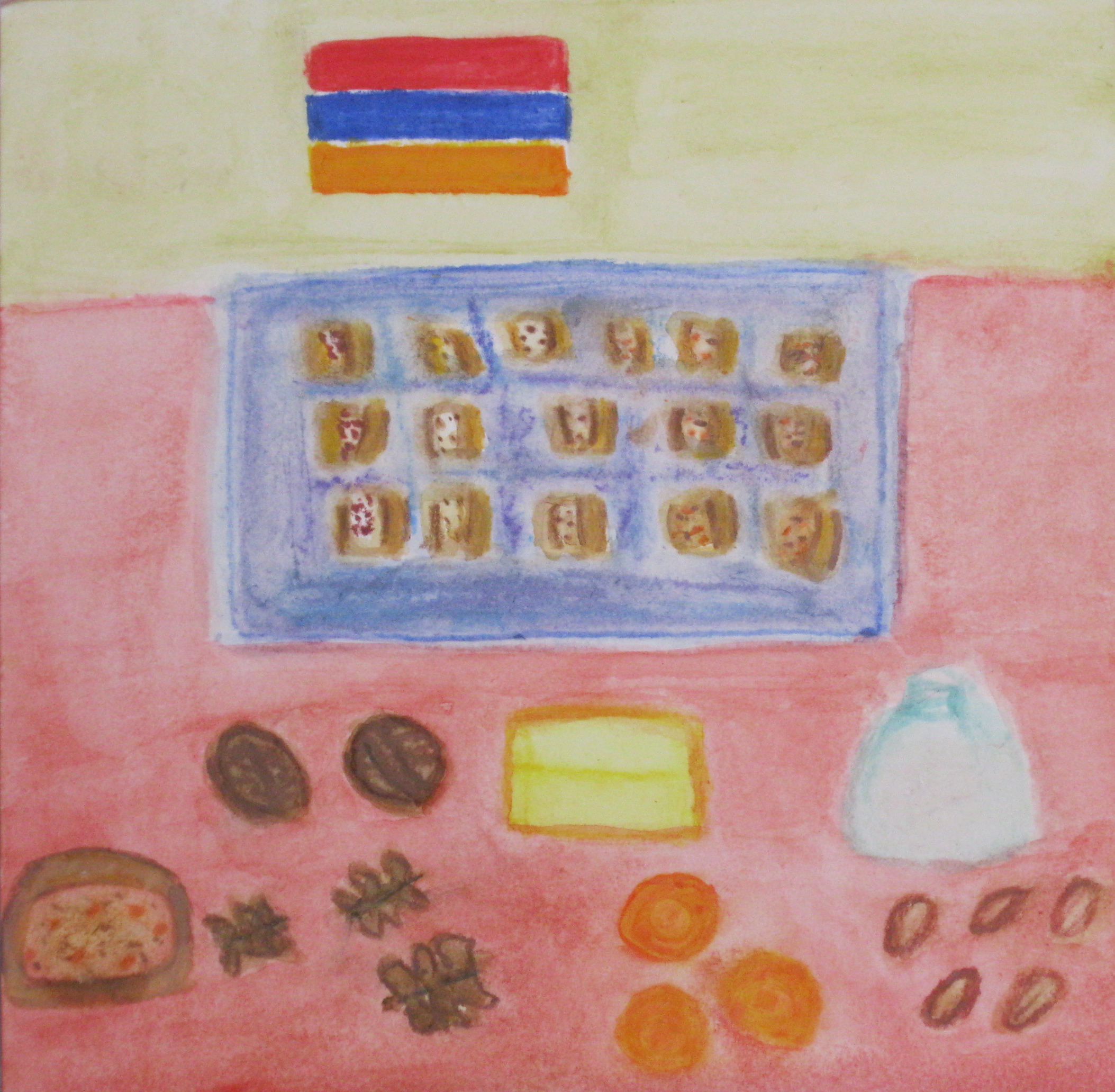
Painting depicts tray of nazook, a filled Armenian pastry.

Nazook. 8″ x 8″ Gouache and Watercolor Pencil. Sharyn Dimmick.

The Daring Bakers’ April 2012 challenge, hosted by Jason at Daily Candor, were two Armenian standards: nazook and nutmeg cake. Nazook is a layered yeasted dough pastry with a sweet filling, and nutmeg cake is a fragrant, nutty coffee-style cake.

Now that the required opening paragraph is out of the way, I’ll tell you about the baking. Although I was excited to see two baked goods that I had never heard of, I was distressed when I read the ingredients: both recipes contain an awful lot of butter and sugar. I decided that nazook was the lesser of the two evils, nudged by the fact that Mom generally likes yeasted pastries and doesn’t like cakey coffee cakes.

I made a half-recipe of nazook pastry dough as instructed:

Nazook Pastry Dough

Stir together 1 packet of dry yeast (not proofed) and 1 and 1/2 cups sifted flour.

Cut in 1 stick (8 oz.) of soft butter.

Stir in 1/2 cup sour cream (I made mine from the cream leftover from last week’s strawberry shortcake, soured with a teaspoon or so of buttermilk)

Knead until well-mixed.

Wrap and refrigerate overnight — I left mine in a metal mixing bowl, and secured a tea towel over it with a rubber band.

Then make the filling. Right. The traditional nazook filling given was full of flour, sugar and more butter, but Jason did say you could fill it with anything but chocolate and he even gave the chocolate lovers a dispensation to use that. I couldn’t bring myself to make it. Instead, I made some rustic almond paste by pounding 1 cup of granulated sugar with two cups of raw almonds in a mortar and pestle and adding 1 tsp each of vanilla and almond extract. Almond paste takes egg white and the pastry called for egg wash made from an egg yolk, so I added 1 egg white to the almond paste just before I filled the pastries.

The next morning I was in the kitchen before breakfast to divide the dough in half and to roll each half into a long, thin rectangle. The pastry resisted rolling and I had to work quite hard and patiently to get the long rectangle. After you get the rectangle rolled out, you spread the filling on it and roll it up long side to long side — the opposite of how you would make cinnamon rolls. Flatten the roll slightly with your hands, brush it with egg wash, which also helps seal the edges and cut it into smaller pieces. I cut eight from each roll — I could have cut ten from the first one. The second “half” of the dough proved to be a little smaller.

But you see, I can’t leave anything alone. When I saw that the almond paste was running a bit low after the first batch, I quickly cut up some dried apricots and soaked them in a little hot water. I mixed those in with the remaining almond paste for the second batch. I had trimmings left from the ends of each roll and some edges that I squared up, so I rolled those into a small rectangle, cracked some walnuts, spread this dough with a tablespoon of butter, a sprinkle of sugar and cinnamon and some walnut pieces.

Place filled pastries on baking sheet. Bake at 350 for about twenty-five minutes

The results: Nazook turns out to be a tender pastry, dark and shiny from the egg wash. Our favorite filling turned out to be the last one: butter, sugar, cinnamon and walnuts, but I liked the almond paste with apricots, too, and my sister-in-law liked the ones with the almond paste. Next time I would make classic almond paste, by blanching the almonds, mixing them with confectioners’ sugar, egg whites and extracts and grinding it all in the blender.

Proper almond paste:

Blanch 1 and 1/2 cups almonds by boiling them in water for a few minutes. Drain, cool slightly and slip off the skins with your fingers.

Sift 1 and 1/2 cups confectioners’ sugar

Add 1 egg white and 1 tsp almond extract.

Blend all ingredients in blender until combined.

Food notes: I wish I had had some cream cheese, quark or cottage cheese in the house because I think Nazook would be lovely with a sweetened cream cheese (or ricotta) filling. I might try mixing dried cherries into almond paste as well since I liked the apricot-almond combination. Because the dough for Nazook contains no sugar and produces tender pastry, I am tempted to try making savory pastries with it some time, using mushrooms, sun-dried tomatoes, chard and cheese.

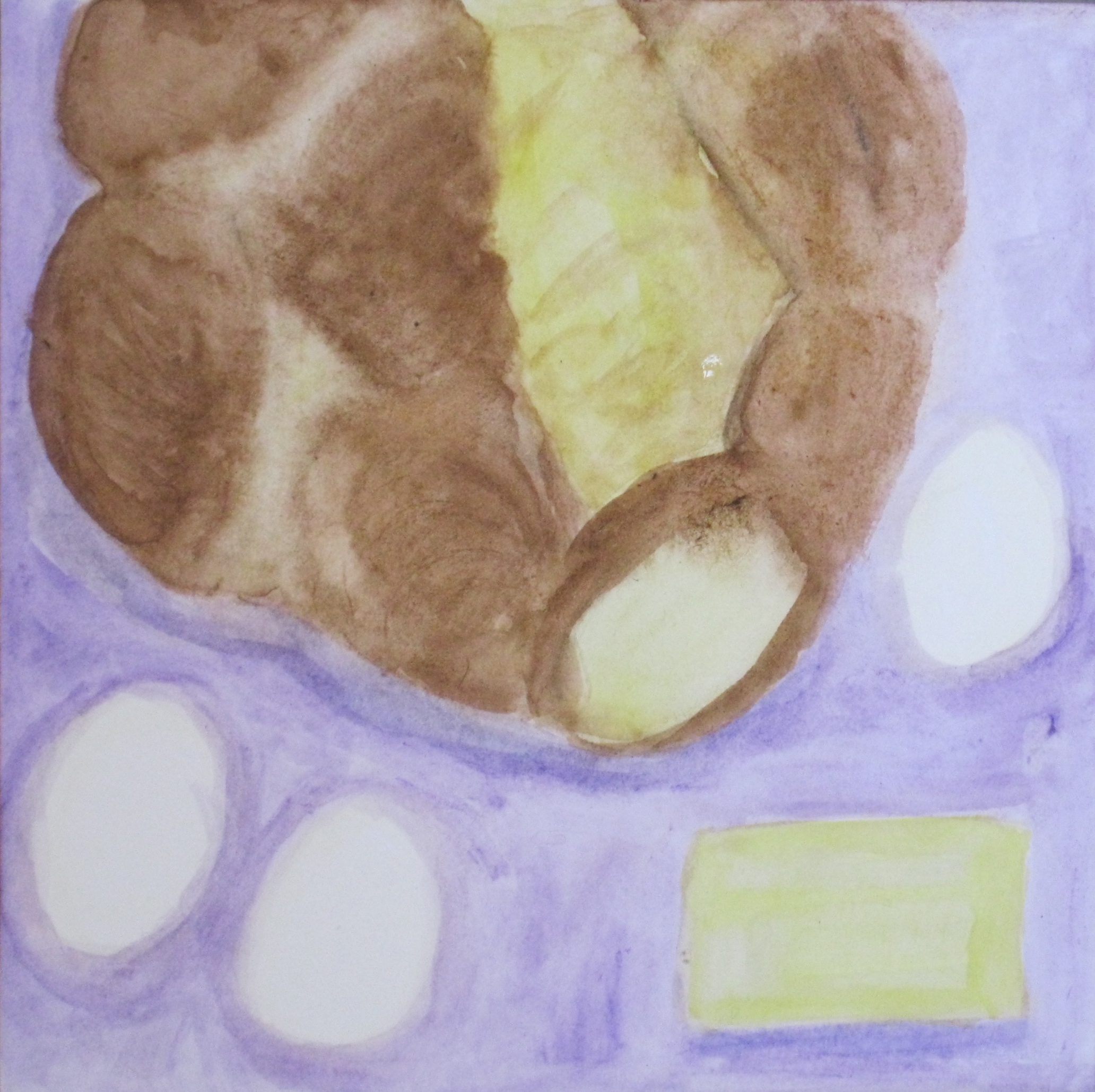
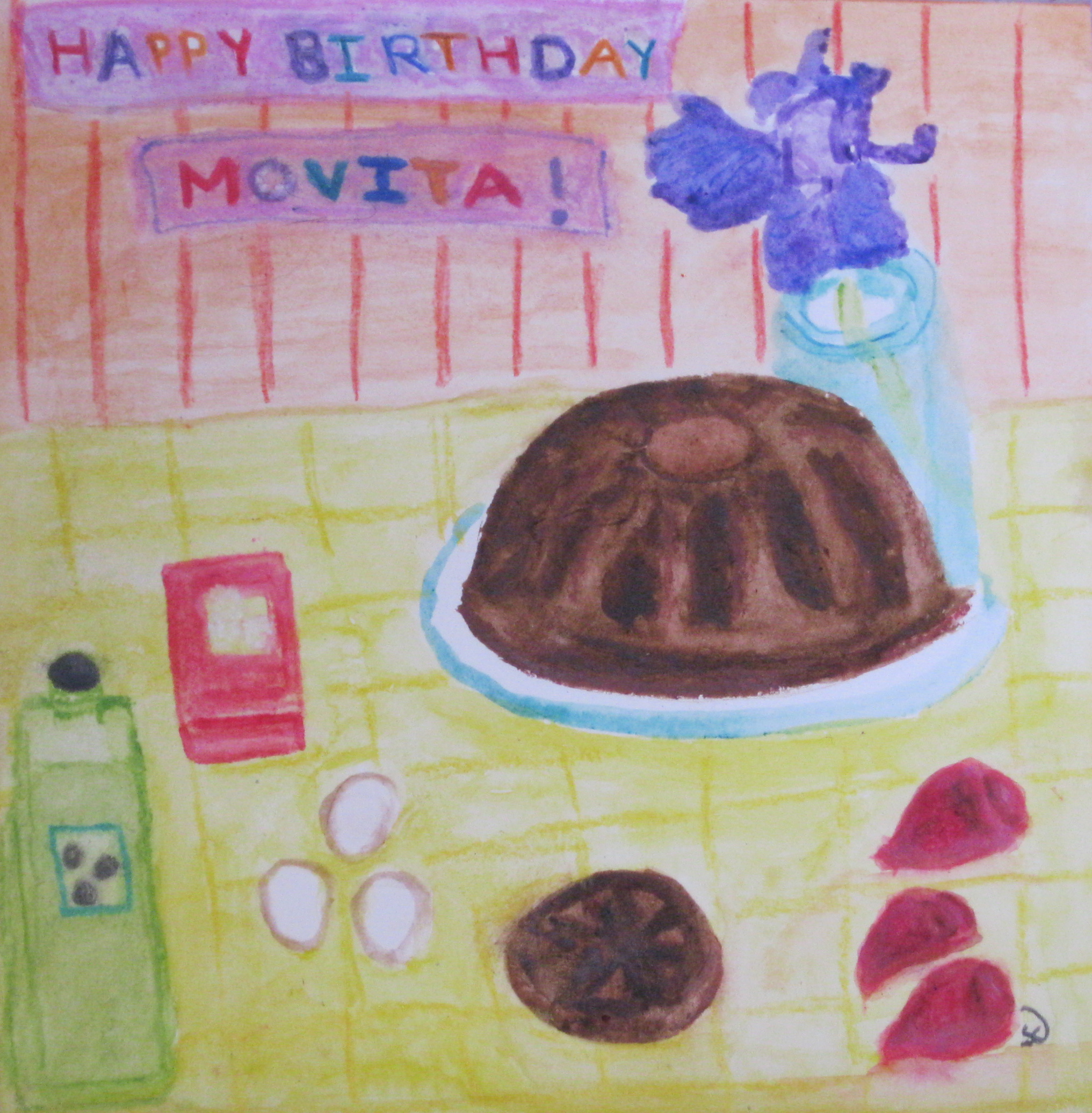
painting shows a Mexican chocolate beet bundt cake with birthday banner.

Mexican Chocolate Beet Cake. 8″ x 8″ gouache and watercolor pencil. Sharyn Dimmick.

Sometimes I think I am wacko. Having gotten up to roll and fill Nazook, an Armenian pastry, before breakfast, I lingered in the kitchen to make a cake for someone who isn’t here and isn’t going to be here — isn’t a definition of whacked doing things at the behest of people who aren’t there?

Let me explain. There is this blogger who goes by the name of Movita Beaucoup. She challenged all comers to bake her a birthday cake and send her a photo by midnight. She promised us prizes. If you are reading this before 10 PM on Friday you still have time to get in on the action: just bake a cake and submit a photo of it to Miss Movita by midnight in your time zone.

Anyway, cakes are not my thing. How many times in the life of this blog have I said I prefer pie to cake? Many. I like to bake. I like to bake bread and pie and pastry as long as it is not too fiddly. But I couldn’t resist baking a cake for Miss B. because she makes me laugh and because she has said that someday she would like to own a Kale Chronicles painting. Besides, she writes about running from bears and worrying that the bathtub will fall through the floor.

When I met Movita (Well, I haven’t actually met her) here in the blogosphere she was carrying on about her need for an iPhone, I believe — some fool bit of modern technology to help her through culinary school. I joined in the chorus of readers offering her congratulations on signing up for a culinary program and informing her husband, charmingly called “2.0,” that she needed an iPhone. I don’t even have a cell phone of my own.

In my childhood, Mom baked us birthday cakes or cupcakes, any flavor we requested. I used to look at all of the cake pictures in our trusty Betty Crocker Picture Cookbook to think about what I wanted. That was before I figured out that I could request a birthday pie instead, and before my brothers figured out that they could have a fancy whipped cream cake from Virginia Bakery or an ice cream cake from Baskin-Robbins. I remember relatively few cakes from those days, chiefly the igloo cake Mom made for Kevin’s birthday, an excuse to cut cake layers in half, frost the cake with white icing and upholster it with the cocktail sugar cubes my Dad kept in a secret location. This cake was the stuff of kid dreams, an entire cake covered with cubes of sugar meant to look like blocks of ice.

I have more sophisticated cake dreams now: I have eaten cakes from Tassajara bakery full of mocha buttercream. I have made genoise soaked in rum (twice). But I am still not a cake baker: I don’t own a piping bag and I don’t think fooling with frosting is fun. Plus, I write a blog featuring seasonal cooking and I’m not about to declare it Cake Season.

One of my pet peeves in baking fads is the popular red velvet (or blue velvet or green velvet) cake, which requires one to use vast amounts of red food coloring to produce a chocolate cake that was more appealing when it was left to look like chocolate instead of a vampire’s breakfast. What can I say? I have gray hair and I don’t think ingesting food dye is good for you. Many people, including my late brother, are allergic to food dye, or go berserk when they get it (No, I have not been sipping from the Schilling bottle). Now watch me find out that Movita’s favorite cakes are velvet cakes….

Fortunately, it is beet season, and I have learned to make a cake featuring a dark red batter, owing to the presence of pureed beets. Before you get upset, please remember that beets are often grown to make sugar and sugar is a valid ingredient in cake. This cake is chock-full of things people call superfoods, including beets, chocolate, cinnamon and extra virgin olive oil, as well as the usual suspects of eggs and flour. I considered making it with ground almonds to make it gluten-free, but I am not having the kind of a week that bodes success with those sorts of experiments.

I first made this cake from a recipe at recipezaar, reprinted in my farm newsletter by the folks at Riverdog Farm, but I have messed with it — you knew I was going to, didn’t you? I incorporated part of an egg yolk I had left from this morning’s egg wash and I wanted to use Mexican chocolate for its distinct flavor. Then I needed to add cocoa because Mexican chocolate is sweeter than the chocolate the recipe called for and I scanted the sugar. I added some cinnamon as well.

To make this cake, you will need at least a cup of pureed beets. I recommend preparing them ahead of time: you can boil or steam or roast them. Let them cool, remove their skins, and whirl them in your blender or food processor. I will not go into the five times I had to clean the stove or the seventeen times I washed my hands while preparing this recipe — if you need to have your all-white kitchen white at all times, do not make this cake.

For the brave, fun-loving and vegetable-minded, read on:

Mexican Chocolate Beet Cake

Preheat oven to 35o.

Rub a bundt pan with olive oil and dust it with a mixture of cocoa powder and ground cinnamon in lieu of flour

Cook, peel and puree 1 cup of beets (I used five small red ones) until completely smooth.

Melt one tablet of Mexican chocolate (3.15  oz) in your microwave and combine with beet puree.

Measure 1 cup olive oil, 1 and 1/4 cup sugar, 1 tsp vanilla and 1/2 tsp ground cinnamon into a large mixing bowl and blend until light-colored.

While you wait, sift 1 and 3/4 cup flour and 1/4 cup cocoa into a small bowl with 1/2 tsp kosher salt and 1 and 1/2 tsp baking soda. Whisk to blend.

Add to oil mixture 1 egg yolk, then 3 eggs, one at a time, beating smooth between each addition.

When eggs are fully incorporated, add the chocolate-beet mixture. Then add flour-cocoa mixture in two or three additions.

Pour batter into prepared bundt pan. Place on middle oven rack and bake until a toothpick comes out clean. This is a moist cake: mine took forty minutes to bake through.

Now the hard part: for best results, let the cake sit covered overnight. This helps the flavors blend. Olive oil cakes tend to get better as they age, so age it for twenty-four hours before digging in. I’ll be taking mine to a potluck tomorrow afternoon.

To Movita Beaucoup: I made this healthy for you, within reason. But I am not there to stop you if you want to eat it with a little cacao nib whipped cream or a puddle of caramel sauce. Just saying. Happy Birthday!

Food notes: I used plain old red beets in this cake, but you can fiddle with the color by using mixtures of red and yellow beets. The batter is a dark, vibrant purple-red, but the cake bakes up red-brown. If you don’t have the extra egg yolk, leave it out — no one will miss it. Cinnamon is fat-soluble — that’s why I put it in with the oil — if you want to incorporate it more smoothly, you could mix it with the sugar before adding the sugar to the oil.

Photo shows green corn worm in ear of organically grown yellow corn.

Unseasonal corn worm.

It’s been that kind of week. The kind of week when you flush the toilet and it doesn’t work the first time. The kind of week when your browser refuses to work on the day you plan to book your airfare to Europe. The kind of week when you make a carrot and fennel soup from a recipe in the newspaper. You use the freshest of ingredients and the best of milk and the soup is blah, boring, and an unattractive color. By your third bowl of it in three days you steam some beet stems and puree them to add to the soup and that fixes the color issue, but not the taste.

You make one of your favorite breads and one loaf is fine and the other is gummy in the middle. Your mother hangs out three loads of clothes and you look up from a dinner of shrimp diablo and beet greens with cumin, only to find out that it is raining.

You are planning to make a birthday cake. You thought you would get it done today, but the beets you are cooking on the stove release beet-colored steam all over just as you are about to leave the house to catch the bus to get your weekly vegetables. Fortunately, the birthday girl lives far away and you only promised to email her a photo of the cake by Friday midnight.

You didn’t think when you started this blogging gig that you would ever miss a post. That is until you got norovirus in February, which slowed you down for three awful days. You don’t have norovirus now, but you might as well have because it would fit right in with this kind of week. You try to add a new scan of a painting to this apology post and your scanner has apparently lost its ability to communicate with your computer or vice versa.

So what can I say? I’m sorry. Nothing new I have made this week has worked out well yet and I’ve already given out the recipes for the other things we have been eating. I’ll be back in a few days, I expect, perhaps with that cake.