Archives for category: desserts

I began my week of frugal eating on Saturday morning with coffee and baked French toast with blueberries to fuel me for a trip to the farmers market. Breakfast is one of the meals I reliably cook for myself: I am a morning person — by dinner time I often do not care what I eat. The other thing I will almost always do is make a bowl of salad every time I run out of it: because I have been eating kale salad, which is pretty much indestructible no matter how long it sits around, I usually make salad twice a week.

By Thursday last week I was out of greens and jonesing for them, so I bought two bunches of kale and one bag of Brussels sprouts. Total spent: $17.00. I had just run out of eggs, so I picked up a dozen farm fresh eggs for $7.00. Lastly, I stopped by Pane D’Amore bakery for my new Saturday lunch treat: a slice of focaccia and a chocolate-walnut cookie for $7.25 — I am particularly liking food-to-go on these busy Saturdays of demonstrations. On days other than Saturdays, I am likely to pack up salami, cheese, crackers, containers of homemade kale salad, nuts and/or oranges to keep me fueled while I stand in public spaces holding signs.

I was out all morning — at the bank, at the market, at Hollywood Beach for a native American water blessing ceremony and march. Once home, I ate my focaccia before running off to the library sale. The focaccia is filling and I rested and napped most of the afternoon and evening. I don’t like to eat heavily in the evening, so I nuked a bowl of Brussels sprouts, added a spoonful of pesto, followed that with a homemade pumpkin blondie for dessert and called that dinner.

Saturday meals: Breakfast: cardamom French toast with frozen blueberries, coffee; lunch: focaccia; dinner: Brussels sprouts with pesto, pumpkin blondie.

Sunday meals: Breakfast: homemade pumpkin pancakes with blueberries, coffee; Lunch: leftover homemade pizza with pesto, kalamata olives, roasted peppers; black tea with evaporated milk; Dinner: kale salad with feta, dried cherries, roasted almonds and lemon-tahini dressing.

Monday breakfast: pumpkin pancakes with blueberries, coffee; lunch: kale salad, homemade pizza, half chocolate walnut cookie, black tea with evaporated milk; dinner: whole wheat burrito with refried beans, salsa and sour cream.

Tuesday breakfast: pumpkin pancakes with blueberries; lunch: kale salad, homemade pizza with arrabiata sauce, feta, kalamata olives and roasted peppers, black tea, pumpkin blondie; dinner: burrito; snack: dried cherries, roasted almonds.

Wednesday breakfast: pumpkin pancakes with blueberries; lunch: Brussels sprouts with pesto, homemade pizza, pumpkin blondie, green tea; dinner: homemade burrito; snacks: chocolate with nuts, roasted almonds, dried cherries.

Thursday breakfast: pumpkin pancakes with blueberries, coffee; lunch: kale salad, roasted strawberry shortcake*, black tea; dinner: pizza, kale salad, whole wheat tortilla.

Friday breakfast: pumpkin pancakes with blueberries, coffee; lunch: kale salad, homemade pizza, roasted strawberry shortcake, black tea; dinner: pasta with Brussels sprouts and pesto.

* If you should find yourself with underripe strawberries, you can cut them up, sprinkle them with a bit of sugar and roast them in a 350-degree oven to concentrate their flavor. You lose the raw character, but they taste better. I made the shortcake biscuits with 2 and 1/2 cups of whole wheat flour, 1 cup of rolled oats, 1/3 cup brown sugar, 1/2 cup butter 3/4 cup evaporated milk, a pinch of salt and 2 and 1/2 teaspoons of baking powder.

Total weekly food spending: $31.25, including my Saturday lunch treat.
This post is a throwback to my old style of blogging when I posted recipes each week. As I mentioned recently, I am doing a lot of cooking these days, just to get three meals on the table and to provide food that my aged mother might eat.

The hit of the summer has been a simple fruit crisp. I make it with whatever stone fruit is languishing here: I’ve used cherries in every one, along with white or yellow nectarines, peaches, apricots that are too mushy to eat out of hand. You can use plums if you like them (I don’t, but if someone gives me plums or pluots they are probably going into fruit crisp). You can supplement with frozen fruit or canned fruit as stone fruit season fades, but it is glorious right now made with fresh fruit.

Here is how I make it:

I get out an 8″ x 8″ Pyrex pan and make sure the middle rack in my oven is available. I assemble all eligible fruit on the counter by the cutting board, giving cherries a quick rinse in a bowl of water. Keep that bowl handy — you will use it again.

I put the 8″ x 8″ pan on the counter and start slicing fruit into it. I start with cherries, halving them, removing the pit with my thumb and dropping the halves into the pan. When I have used up whatever cherries I have, I cut up nectarines, apricots or peaches into the same pan, in chunks or wedges — it doesn’t matter. I do this until the pan is three-quarters full of fruit — I don’t measure the fruit: if you don’t have enough, you can add a can of sour cherries or peach slices or apricots, or some handy frozen fruit.

When I have cut up all of the fruit I turn the oven on to 375 degrees F. While it heats, I make the topping.

I empty the cherry-washing water into our waste-water bowl. I take the now empty, damp bowl and add

1/2 cup rolled oats

1/2 cup almond flour

1 Tbsp unbleached flour

2/3 cup brown sugar

Dashes of cinnamon and freshly-grated nutmeg. Sometimes a dash of ginger.

Using a pastry blender, I cut in 1/3 cup unsalted butter. That I measure using the handy-dandy guide on the butter wrapper. I blend the butter and dry ingredients until the topping looks uniformly crumbly. I drop the topping by large handfuls on top of the fruit, trying to cover the whole top. It always works — this is an easy recipe.

Carry your assembled crisp to the preheated oven. Bake on the middle rack for 35-45 minutes, depending on how much browning you like: we like ours brown.

Some notes: I use almond flour here because I think the flavor enhances stone fruit and also because it adds a bit of protein to dessert. You can use white or whole wheat flour instead if you like. I add the tablespoon of unbleached flour for binding the topping — you may not need it. I use unsalted butter because that is what we buy. I like cinnamon and nutmeg with fruit. I also like ginger. I haven’t tried cardamom, but it’s only a matter of time.

For me, the level of sweetness in this crisp is ideal. You don’t have to sweeten the fruit because some of the topping sifts down during baking and does it for you. Similarly, the topping thickens the juices. I like the crisp warm or cold. I usually eat it plain, but you could eat it with ice cream, whipped cream, yogurt. I’ve been known to reheat it topped with milk in the microwave, or stir a serving into oats as I cook them. If you like fruit desserts, give it a try.

Just a reminder: I still have openings in my July 15-16 Natalie Goldberg-style writing practice retreat, so, if your idea of a treat is two days devoted to writing, reading aloud and meditation, please consider joining us for $80.00 USD. I also welcome new students to my ongoing Monday AM Practice Group for either July 10, 17, 24 and 31 or August 7, 14, 21 and 28. Each four-week session costs $100.00 USD payable via PayPal at PayPal.Me/yourbusker. Yes, you can sign up for both July and August and the retreat as well if you are hot to write this summer. And no one says you can’t eat stone fruit crisp during your meal breaks!

In February I started a garden in bare, neglected ground. Over five months I dug out green plastic netting, dog shit, pieces of asphalt, mallows, too many weeds to count. I added compost, coffee grounds, egg shells, vegetable scraps. I carted home pine boughs and pine needles, sticks and leaves I found in the gutters. I bought plants, I was given plants. I raised tomatoes and peppers from seed. I planted squash and beans, basil and tomatoes. The Sun Gold tomato took over almost an entire fence line. I added sunflowers and blue sweet peas.

With the miracle of sun and water, things grew. Two-inch squash appeared on the butternut vines, more than one, more than two, as the vines reached out into the yard for more sun. The beans and tomatoes were awash in blossoms, the green beans too tiny to pick yet, the shelling beans swelling. I was so happy and proud of my first home vegetable garden in sunny San Leandro. I fed friends chard and kale and gave away extra tomato seedlings.

And then I had to leave, not an easy decision. A situation arose that I could not live with and we could not come to an agreement about it. There is plenty of love left, but nothing to do with it at present, just as there were plenty of vegetables in the garden when I left and no one to tend them. Unless my ex-landlord or someone Johnny knows steps in to take care of it, the garden will die. In its death as in its life the bean roots will nourish the soil, fixing nitrogen. The plants will go back to the soil which gave them part of their life. I had custody of the garden for a brief time, enough time to grow things, but not enough time to gather in the entire harvest.

June finds me back at my mother’s house, sleeping on a sofa, my belongings in the capacious living room in boxes and bins and garbage bags. My mother and brother have been working on the never-refinished hardwood floor of my old bedroom and I can’t move my stuff in there yet. I brought with me several tomato seedlings and three pepper plants. One of the pepper plants appears to have a broken stem and may die soon. The other two are sitting outside in a copper bowl, waiting for me to find somewhere to plant them. My sister-in-law brought a large, healthy-looking tomato seedling from her house and we must find a place for that, too. We put three tomato plants in cages in two large buckets. I have many seeds left, but nowhere to plant them: I’ll find a pot for some Thai basil and perhaps some other herbs, but I will be beginning again in the foggy land in the path of the Golden Gate.

Meanwhile, I blanch and scrape citrus peel — I had saved peel for five months in the freezer and there is no room for it here. To save it, I have been working for three days, blanching and scraping lemon, lime, orange and grapefruit rinds. As I write, the orange peel is done and beginning to dry, the lemon and lime simmers on the stove and the grapefruit in the refrigerator awaits its hour-long sugar bath. The methodical scraping of pith with a steak knife was meditative, the long hours of labor calming the mind: it was good to have something simple to do, although after twelve hours or so I would be glad to see the labor ended. I thought I might be canning tomatoes and beans this summer — instead I am harvesting citrus peel for baked goods. As I blanch and scrape, perhaps I will leach any bitterness from my soul and let my heart rest in the sweetness of life, the sweetness of each tiny blessing. I am grateful to be able to read and write, to smell the clean, sharp citrus in the air. I am grateful for my readers, friends and family and grateful for a sweet life that I had for nearly two years.

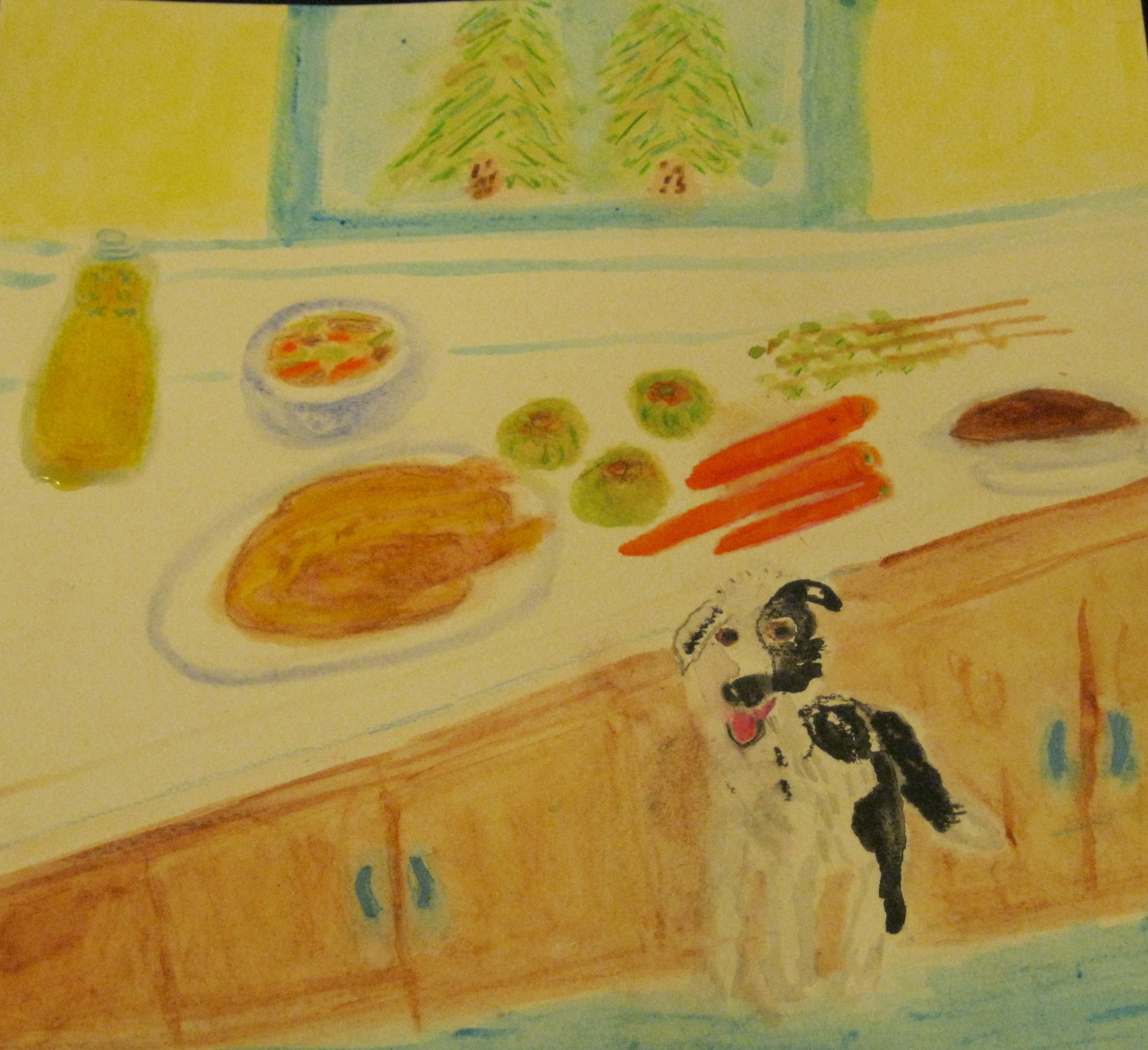
Painting shows ingredients for turkey-apple stew, plus a border collie.

Turkey-Apple Stew. 12″ x 12″ gouache and watercolor pencil. Sharyn Dimmick

Thanksgiving Day found me with my family in the house where I grew up, preparing traditional Thanksgiving dishes with my mother. At eighty-three Mom still does the heavy lifting, so to speak: she makes the dressing, stuffs it into the turkey. She makes her never-fail pie crust, which we fill with pumpkin, eggs, evaporated milk, brown and white sugars and spices and with sliced Pippin apples (The Gravensteins are long gone by Thanksgiving Day). I make rolls from my Grandmother’s recipe, only pausing to sneak a half cup of healthy whole wheat flour into the dough. Wednesday afternoon we peel potatoes and snap the ends off fresh green beans from the Bay Fair Farmers’ Market and boil and peel chestnuts for the dressing, cook whole cranberries with a little sugar and water. Thursday afternoon I make salad dressing and whip cream while Mom prepares a simple brown gravy from pan drippings, flour and water. We roast yams in the oven after the pies come out, cook the green beans in the microwave and the potatoes on the stove. I scoop the dressing from the bird. Bryan carves the turkey and lays slices on a platter.

Original watercolor painting shows ingredients for apple pie

Gravenstein Apple Pie. 8″ x 8″ gouache and watercolor pencil. Sharyn Dimmick.

At two o’clock we sit down to a bountiful table, the three remaining Dimmicks and our guests Johnny Harper and Art Peterson, who will play music in the living room after they have eaten their fill. This year I am struck by how long this has been our family tradition, how many years Mom and I have made this meal together, dividing our tasks and cooperating to get the food on the table in a timely fashion. We do have skirmishes: I am a careful baker, sifting the flour into a cup on a flat surface, heaping it high and leveling it off with my hand, but I find that I cannot sift easily with my recovering wrist. When I ask Mom to sift, she holds the cup in the air, occasionally shaking it to settle the contents, and hands me cups that I don’t think are full enough to level. We laugh about this later, after I have told her how much I like making this meal with her every year. We are the last two generations of our family and we do not know how much longer we will get to do this together. I enjoy the simplicity of a day spent preparing a feast and the routines we have developed.

The day after the holiday finds me with many fall tasks undone, due to a thirteen-week hiatus with a compromised right hand. My winter sweaters need hand-washing. It is time to start making cookies for Christmas and for an early Chanukah party. Add to my schedule three hours of hand and wrist exercises per day and I wonder, like many of you, how I will ever get everything done. The only answers I can come up with are to keep it simple and to just do the next task, to jettison things that seem too much for this year, as I work to transform my injured hand and wrist to new strength and health.

At the same time as I celebrate old family traditions, a new opportunity has arrived: my friends Maia Duerr of Liberated Life Project and Lauren Ayer of Quilts of Change have put together a Virtual Holiday Faire for 2013, where you can purchase my Paris CD and two original watercolor paintings, plus notecards, quilted bags, coaching services and other offerings. Please visit the Faire to have a look for yourself. Your purchase will help support independent artists and consultants.

Last, but not least, Susan of Susan Eats London, kindly sent me a care package to raise my spirits: she went to her favorite bulk bins and picked out aleppo pepper, dukkah, farro, Puy lentils and Nigella seeds, none of which I have ever used, plus blue cornmeal, fresh fig jam and three kinds of chocolate! I shall be having some cooking adventures in the future. If any of you want to provide suggestions or links for using these ingredients, the Comments field is open. I am thankful for all who enjoy reading The Kale Chronicles and grateful that my hand will allow me to type a blog post for you.

So, you know I’ve been on a “Work With What You Got” kick for October at The Kale Chronicles. You know that I have been eating rye flakes, rolled oats and granola cooked with dried apples and milk, and then with Tropical Traditions Coconut Oil and peanut butter: when we ran out of peanut butter I substituted cashew butter and somehow breakfast keeps rolling along. So does dinner: Mom bought some black cod at Trader Joe’s on Wednesday and with Johnny coming over for dinner on Friday night (Yay!) I prepared the fish by baking it in a foil packet (similar to the baked salmon I made here) with roasted red bell peppers and kalamata olives from jars, fresh basil from the basil plant on the breakfast room table and a squeeze of Meyer lemon from our front yard tree. I made another round of my version of Shira’s Brussels sprout salad with toasted hazelnuts and dried cranberries, put some red potatoes in the oven to bake with the fish and spent some time in the kitchen with my mother concocting a family favorite dessert, a baked lemon pudding.

Original watercolor painting shows baked lemon pudding and ingredients.

Lemon Pudding. 8″ x 8″ Gouache and Watercolor Pencil on Paper, Sharyn Dimmick.

The lemon pudding began, as things often do at our house, with substitutions: the classic recipe, culled from an index card in one of my mother’s recipe files calls for Wheaties (“Breakfast of Champions”) cereal in the topping. Mom’s search of our high storage cupboards revealed that the orange boxes she thought contained Wheaties were in fact Bran Flakes. Oh. She decided to combine Bran Flakes and Corn Flakes to approximate the missing Wheaties.

I went out to the yard to gather lemons from the tree, bringing in four of the ripest ones I could reach. I asked Mom about quantity. She said, “The recipe calls for the juice of two lemons, but these are bland — maybe add an extra one.”

I zested and juiced three lemons, squeezing each half through my hand. This resulted in just a quarter-cup of juice.

“That’s only a quarter-cup,” I said.

“Maybe do the other one,” she replied.

I juiced the fourth lemon, but did not zest it, mainly because I had absentmindedly cut it in half to squeeze instead of picking up the microplane. Life is imperfect and I one of its imperfect creatures.

I reminded Mom that the topping for this pudding is usually tooth-ache-ingly sweet. I was working on the lemon filling while she worked on the topping and we agreed to scant the sugar in our respective parts. She reduced the brown sugar in the recipe that doubles for crust and topping and I scanted the 3/4 cup white sugar in the filling. The result of the combined sugar reduction was a more delicious pudding than usual, which we ate with the leftover sweetened mascarpone from last week’s strawberry shortcake. I present to you the modified recipe with additional observations in the Food Notes.

Homey Lemon Pudding

For lemon filling:

Juice and zest 2 ordinary Eureka lemons or 4 Meyer lemons. Set aside.

Place in saucepan:

Scant 3/4 cup sugar

2 Tbsp flour

1/8 tsp kosher salt

Stir in gradually:

1 cup very hot water

Bring sugar-flour-water mixture to boil over direct heat, stirring constantly for ten minutes.

Remove from heat.

Beat 2 eggs until smooth.

Temper the eggs by drizzling a little of the liquid into the eggs and whisking with a fork. Drizzle a little more liquid and whisk again. Repeat two or three more times until the eggs are perceptively warm before adding the eggs to the filling and whisking to combine. Tempering the eggs prevents having bits of cooked eggs in your lemon filling.

Add reserved lemon juice and zest to filling and stir to combine. Let filling cool while you make the topping (which also serves as the pudding’s base). At this time, also preheat your oven to 325.

In a mixing bowl combine:

1 cup flour

3/4 cup brown sugar

1/2 tsp baking soda

a pinch of salt (unless using salted butter)

Cut in 1/3 cup shortening (Mom uses part margarine and part unsalted butter)

Add:

3/4 cup lightly crushed Corn Flakes

3/4 cup lightly crushed Bran Flakes (OR 1 cup Wheaties*)

1/2 cup shredded coconut

Press 2/3 of brown sugar mixture into the bottom of a square pan.

Pour cooled lemon filling over topping

Top with remaining 1/3 topping.

Bake for 40 minutes.

Serve with barely sweetened whipped cream (creme chantilly) or sweetened whipped mascarpone. If you use Cool Whip or whipped nonfat dried milk I don’t want to hear about it, although I am not in your kitchens to supervise what you do.

Food Notes: If you have Wheaties on hand you only need a cup of them: they are thicker and crunchier than the other cereals we substituted here. On the other hand, the recipe was formulated for “old Wheaties,” which had less sugar than the current product, so substituting Corn Flakes and Bran Flakes may more closely resemble the original recipe. Bran Flakes on their own lack the necessary crunch, which is why Mom opted to mix them with Corn Flakes here. If you use salted butter in the topping you can skip the pinch of salt — it will provide all of the salt you need. Mom uses commercial sweetened shredded coconut — you can use unsweetened if you like: the topping ingredients provide plenty of sugar! We like tart lemon fillings — if you like yours sweeter either don’t scant the sugar in the filling or use one fewer lemon than we did.

Johnny and I liked the pudding so much that we had another square apiece after breakfasting on scrambled eggs with roasted peppers and cheddar cheese and sourdough toast on Saturday morning…

California has a long growing season, so even in years when the crops are delayed, when fresh corn does not show up until after Fourth of July, when we are still pining for the first tomatoes, when we have a cold spring, we have certain foods longer than you have them in other parts of the country. Case in point: strawberries. In mid-October the strawberries from Lucero Farm are sweeter than they were in June and July. Go figure.

Original watercolor painting depicts biscuit-type strawberry shortcake.

Cowboy Strawberry Shortcake. 8″ x 8″ Gouache and Watercolor Pencil. Sharyn Dimmick.

I know many of you have moved onto apples, pumpkins and grapes for your desserts, but my friend Margit presented me with a basket of those strawberries this Saturday and we did not eat them immediately. In our refrigerator (which I have not yet discussed) there languished an unopened pound container of mascarpone cheese that Mom bought at Canned Foods Grocery Outlet and never used because she didn’t have any recipes containing it.

I hunted around through my saved blogs folder and found some lovely recipes, none of which called for more than a quarter cup of mascarpone. I eliminated other wonderful recipes requiring me to mix the mascarpone with whipping cream and line tins with ladyfingers (no tiramisu). I went to my favorite site of all things Italian, In the Bartolini Kitchens, and still found nothing I wanted to make tonight. I looked up a Joyce Goldstein recipe for a rum mascarpone mousse but could not find the lone packet of unflavored gelatin which I swear has been lurking in our kitchen for years.

Then I read somewhere about sweetened, whipped mascarpone. Aha! We would have strawberry shortcake again, this time with mascarpone rather than whipped cream. I would use the occasion to get out my sourdough starter and make biscuits for the shortcake base.

First I had to taste the mascarpone. Undeterred by the expiration date of August 2012 (our refrigerator is cold), I broke the plastic seal and dipped a teaspoon into the cheese. My tongue told me it was fine — it reminds me of the clotted cream they eat in England. I put it back in the refrigerator while I washed and hulled the strawberries, fed my starter some fresh flour and a little water to invigorate it, left it on the counter to get warm and put a steel bowl and beaters  in the fridge to chill.

At 5:00 I began to assemble the shortbread dough, aka sourdough “cowboy” biscuits with extra sugar. You can find a recipe for sourdough starter here. I keep a jar of starter in the back of the refrigerator and use it indiscriminately to make waffles, biscuits and, pizza and bread.

I have adapted the recipe for cowboy sourdough biscuits (which the authors call “Rocky Mountain Sourdough Biscuits,” but their story features a cowboy cook who bakes them) from The Book Lovers’ Cookbook.

Sourdough “Cowboy” Biscuits for Shortcake

Preheat oven to 425.

Whisk together:

1 cup unbleached flour*

1 Tbsp baking powder

1/4 tsp kosher salt

1/2 tsp baking soda

2 Tbsp sugar

Cut in 1/4 cup unsalted butter or shortening.

Stir in 1 cup sourdough starter.

A soft dough should form. Gather dough together and knead lightly, adding more flour by the tablespoon if it is really sticky.

Lightly flour a bread board, marble slab or other work surface. Roll out dough to 1/2 inch thickness

Cut dough with biscuit cutter or the rim of a glass. I like to use two cutters, one medium-sized and one small to make top hats. Roll together scraps to form more biscuits, handling dough as little as possible. Repeat until all scraps have become biscuits or top hats, forming the last scraps into a hat with your hands if necessary.

Transfer biscuits to ungreased baking sheet.

Melt 1 Tbsp unsalted butter and brush biscuit tops with it. Sprinkle with sugar (raw sugar is good) as desired. Let biscuits rest for fifteen minutes before baking them for ten to twelve minutes.

Split biscuits and top with prepared berries. Dollop with whipped, sweetened mascarpone.

Oh, I didn’t tell you how to make that? I told you to chill the bowl and beaters. Then beat your mascarpone with some sugar (suggested ratio: 2 and 1/2 tablespoons of sugar to one pound mascarpone), and vanilla extract as desired. I plan to eat the leftover mascarpone on biscuits after the strawberries are gone, perhaps with a nice cup of tea in the afternoons, unless Mom gets to it first — she says she will use it in pastry of some kind: sounds like a win-win to me.

I still have a lot of pears in the house from my friend Margit’s tree, sitting in a brown bag in the back of the refrigerator so that they will stay as green as possible for as long as possible: my mother only eats pears when they crunch — I’ll eat them slightly softer than that, but I do not enjoy pears that have turned yellow (It’s that mushy texture).

Yesterday I pulled out the pears and found about five yellow ones, two large and three small. I had volunteered to make a dessert last evening — my mother has a sweet tooth and is eating soft foods until her current round of dental work is over. Plus, I had done something that made her uncomfortable and needed to work my way back into her good graces.

Original watercolor painting shows pear clafouti, dried cranberries, pears.

Pear Clafouti with Cranberries. 6″ x 6″ watercolor pencil on paper. Sharyn Dimmick.

What to make? I could roll out pie crust and make another pear tart tatin. But Johnny once said he wanted to elope with that when I served it at Ballad group, so it would be better to make that when he is around to enjoy it. Carly Sullivan had posted a recipe for clafouti that I had saved. I took a look at it again, and then adapted it for ingredients we had. Basically, I used white sugar instead of honey, milk and half and half instead of buttermilk, omitted the vanilla and added dried cranberries to the fruit layer, browned the butter and cooked the pears in it, throwing the sugar on top to caramelize, cooking it down until the mixture was fairly dry, giving the pears time to absorb butter, sugar, lemon, ginger and cranberry flavors. The cranberries made it pretty, too.

To make the clafouti I just made:

Preheat oven to 375 degrees.

Select 2 large yellow pears (or 3 smaller ones). Core and slice them thinly, but do not peel them: the skins help hold the pear slices together.

Melt 2 Tbsp butter over medium heat in a skillet, allowing the butter to brown, but not burn, before adding the sliced pears.

Sprinkle about 1/4 cup sugar over the top and jerk the skillet a few times so that the sugar gets distributed among the pears.

Allow mixture to cook down until the pears have released their liquid and the liquids have reduced to a thin caramel.

Turn off heat.

Add the juice of half a lemon, a generous grating of fresh ginger (use your microplane and grate directly over the fruit), a small handful of dried cranberries.

Pour the fruit mixture into a tart pan or pie plate.

Now make the batter:

Crack 3 eggs and whisk them.

Add 1/3 cup granulated sugar and whisk again.

Whisk in 1/2 cup whole wheat pastry flour

Add 1/4 cup half and half and 3/4 cup milk*

Add vanilla extract (I poured it into the cap from the vanilla bottle and used about half a capful).

Whisk until just blended.

Pour batter over prepared fruit in pan.

Bake for thirty-five minutes. Serve warm or cold, cut in pie-like wedges.

* Our standard milk is 1%. If you have whole milk, like Celi, just use a cup of whole milk — I added the half and half to make the milk richer, but you can make it with any kind of milk you have, including soy milk, nut milk or coconut milk.

Food Notes: This made a easy, delicious dessert, creamy and custardy with crisp, buttery edges. Cooking the fruit first on the stove meant no watery flavors. This would make an excellent Thanksgiving dessert if you are not utter traditionalists like we are, having to have pumpkin pie with whipping cream, made from the recipe on the Libby’s can, slightly modified. (We also make fruit pie of some description, cherry or apple or blueberry or mixed berry, depending on what is around).

The Lauren Project: Lauren is back in Santa Fe, still cooking up your recipes. Please be patient: we will announce the prize winners by the end of this month.

Original painting shows cherry plums, plum cake, plum caramel.

Plum Cake. 9″ x 12″ Gouache and Watercolor Pencil on Paper. Sharyn Dimmick.

Sometimes circumstances conspire to create an end. Today is my sister-in-law’s birthday and she is coming over to go out to lunch with my mother in Walnut Creek. Barbara likes plum cake. I had half a colander of fresh cherry plums on the counter and a jar of wild plum jam that I needed to use. I had just read David Lebovitz’s blogs on butterscotch sauce (which I am dying to make) and peach cobbler, plus a post on plum cake made with cornmeal from Two Peas and Their Pod. Barbara loves whipped cream. So what would I do? I would make the cornmeal-plum cake, adapting it a little to give it a more butterscotch-y flavor by substituting some evaporated cane juice for half a cup of the white sugar and I would use the jam to make some plum caramel to serve with the cake.

For the plum caramel, I followed a recipe from Chez Panisse Desserts, except, instead of cooking fresh plums, I just added plum jam (aka cooked plums) to the caramel base, cooked it for a few minutes and strained the results. You can make simple caramel by putting 1/2 cup of sugar in a saucepan with 2 Tbsp water and melting it over high heat, shaking the pan every now and then (do not stir). When it takes on a pale golden color, remove it from the heat and carefully add 1/4 cup water, not getting too close to the pan. You can stir now. If you are adding fruit puree to the caramel, add it now (this works with any berry or stone fruit), add it now and cook for a few minutes over medium heat. Strain out any solids or seeds that have slipped through, put your caramel in a clean jar in the fridge and you are good to go for later. Fruit caramel is less acidic and more complex than simple purees and is perhaps my favorite recipe I learned from this cookbook.

Now the cake. You can see the original here. Since cakes are not my favorite things I followed the recipe closely with just two substitutions (okay, three). First, I had medium eggs rather than large — they were organic and brown — so I threw in an extra one. Then, I had lots of cherry plums rather than the four or five large plums cited in the recipe. I already told you I put in 1/2 cup of evaporated cane juice for 1/2 cup of white sugar. Oops. Um. Four substitutions. I substituted a quarter cup of sour half and half for some of the buttermilk because, you know, we had it, and it is similar, but richer.

So, this is what you get when you put together all of those substitutions with the original recipe:

Barbara’s Birthday Plum Cake

Pit the cherry plums you are using (Or pit and chop larger plums into bite-sized pieces). Set aside.

Preheat oven to 350.

Measure 1 and 1/2 cups unbleached flour. After measuring sift it into a small mixing bowl.

Whisk into flour 1 tsp baking powder,

1/4 tsp cinnamon

1/8 tsp kosher salt

1/2 cup corn meal

Then soften 1 and 1/2 sticks of unsalted butter (12 Tbsp)

Cream butter with 1/2 cup granulated sugar and 1/2 cup evaporated cane juice until light and fluffy.

Add — one at a time — 4 medium eggs (or use three large), incorporating egg fully before next addition.

Measure 1/2 cup buttermilk (or 1/4 cup sour cream or sour half and half, plus 1/4 cup buttermilk, which is what I used).

Alternate flour mixture and buttermilk, in increments, starting and ending with flour.

Butter and flour a cake pan. I used a bundt pan because it looks festive.

Scrape half of the batter into the pan. Scatter plums over batter. Top with remaining batter.

Bake for fifty minutes. Test to see if it is done. In a bundt pan, my cake took one hour and five minutes to show some browning on the top and to pass the toothpick test.

Cool by hanging bundt pan on a glass bottle. This is fun. Trust me.

Serve with barely sweetened whipped cream and a pool or drizzle of plum caramel. If you are my sister-in-law, add more whipped cream. Enjoy.

Food Notes: Keeping to the art of substitution, you can use any sour thing for the buttermilk — yogurt, sour cream, creme fraiche, even sour milk. You can make the cake as originally suggested with all white sugar, or use all evaporated cane juice. You can probably use some other fruit for the plums, although the plums (with skins) provide a beautiful color and a nice tartness that plays well against the cake. The whipped cream provides yet another contrast (and besides, we like whipped cream when we are celebrating).

Watermelon pickle: I had a problem with the watermelon pickle — it wasn’t the recipe — it was me. so I’ll be trying it again with this week’s watermelon and report back on that later.

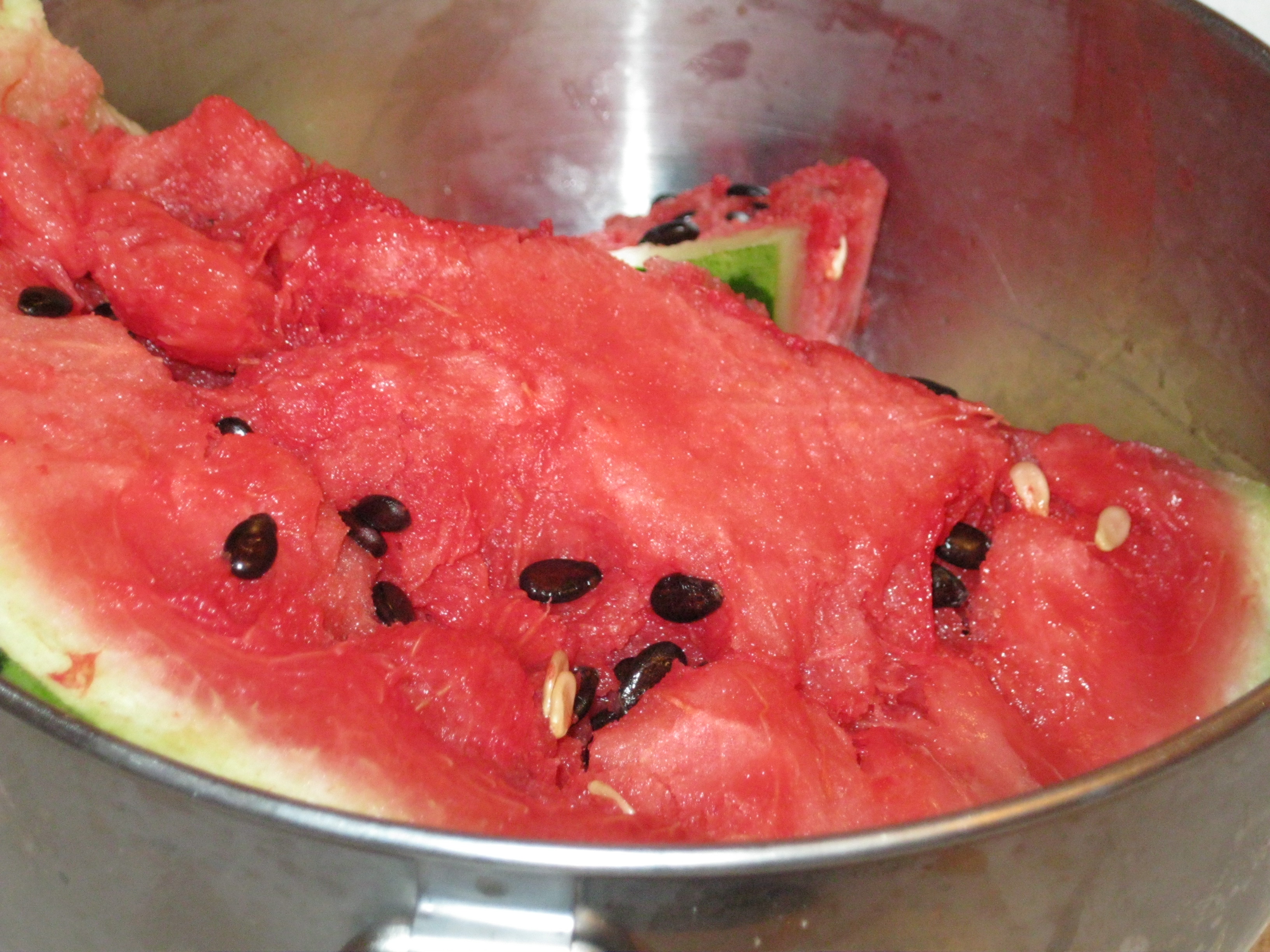
Photo of ripe red watermelon in steel bowl.

The one that got away — part of the watermelon that rolled off the counter.

On Wednesday I received a small watermelon from my Riverdog Farm CSA. Grown eighty-some miles away in summer heat, the melon was sweet and pink — I know because five minutes after I set it on the counter I heard an odd thunk: it had rolled off the counter and split open when it hit the floor. There would be no saving this watermelon for later. I picked it up, washed it off and tasted it. Good. Then I set it aside for a few days as the temperature took a nosedive and the fog rolled in to stay — who wants to eat watermelon in fifty-degree weather?

Fortunately, I had a plan for some of this watermelon: when I bought my Nesco American Harvest dehydrator the booklet contained this sentence: “Cantaloupe and watermelon slices become candy-like when dried.” Candy-like. Hmm. Then Krista and Jess reported on their dried watermelon chips. I knew I had to try it when watermelon came along again.

I spent an hour in the kitchen this morning, cutting 1/2 inch thick slices of watermelon, removing the seeds and cutting the rind away. The easiest way to do this proved to be to cut a slice and then slice through the melon perpendicular to the rind to produce small batons or wedges and then to cut the rind away. After half an hour of this, I noticed that I was developing a neat pile of watermelon rind.

Now, I am one of those people that, if you give her a slice of watermelon, will eat deep into the rind. Watermelon rind reminds me of cucumber with no bitterness and no seeds. And yet, because Mom doesn’t can, I have never made watermelon rind pickles. I called her into the kitchen and asked, “Back in the day when you ate watermelon pickles, were they sweet or sour?”

“Not sweet enough,” she said.

“Sort of like bread and butter pickles?” I asked.

“Not as good,” she said.

She told me to look in the old Mowequa cookbook, but I headed upstairs to check my saved blogs file. Not too far into the seven hundred recipes I had saved was Natalie’s recipe for watermelon pickle. I have started to make it and will report on the results on Wednesday.

Painting depicts apple pie ingredients: flour, butter, apples, cinnamon, nutmeg.

Gravenstein Apple Pie 8″x8″ gouache and watercolor pencil Sharyn DImmick

Things to make right now: Gravenstein apples are in! Ann and I picked a big bowlful of them from a yard in Berkeley and Mom made our first Gravenstein apple pie of 2012. I cannot say enough good things about this pie so if you are lucky enough to live within range of Gravenstein apples, by all means, get some. Bernie at the Berkeley Farmers’ Market has them right now if you don’t want to forage for them, or if you need more. I also made zucchini-feta pancakes this week. This time I threw a little leftover pesto with the fresh herbs and feta — it’s a delicious variation. As I write this I have another peach and plum crisp in the oven, this time made with white and yellow peaches and little cherry plums from someone’s backyard tree. And two days ago I made this tomato tart, again with lemon cheese, but with brown mustard and shredded tarragon. And of course this is a good time for Deborah’s somewhat famous tomato platter or Greek salad, with tomatoes and cucumbers in the market and peppers beginning to come in.

Photo of watermelon candy, aka dried watermelon

Watermelon candy in the dehydrator.

The watermelon candy is small and sticky — it reminds me of dried tomatoes, only sweeter and pinker. I was catching up on my sleep today after nearly a month of periodic insomnia so I didn’t take the time to do a new painting. Instead I offer you photos of watermelon and watermelon candy.

Original watercolor painting shows fruit crisp and ingredients.

Peach and Plum Crisp. 8″ x 8″ Gouache and acquarelle on paper. Sharyn Dimmick.

I am not the most informed person in the world: I find that reading a daily paper depresses me and paralyzes me with all that I don’t know and all that I can’t do about things. I watch Bill Moyers on PBS and occasionally dip into The Newshour. I read a local weekly rag, The East Bay Express, sometimes focusing on the astrology column and the restaurant reviews, although I usually read the cover story. Other than that, I get my news from Facebook updates and a few chosen sources that I subscribe to.

Because of that, I learned about the movie theater shootings in Colorado on Facebook on Friday afternoon. A friend of mine, Deby Dixon, posted a link to a blog she wrote about the brevity of life and the importance of following your dreams while you have time and health because none of us know when our life will be cut short, when our health will fail, when life or death will intervene in some unexpected fashion. Deby wondered if some of the people in Colorado died wishing that they had gotten to some dream of theirs. Deby’s story and her reflections moved me to tears and I asked permission to share it with you. You’ll find her post here, along with some of her photographs: Deby is traveling and photographing the beauty and majesty of our national parks.

What do you do when life smacks you down, when you suffer a loss? You grieve. You tell the story to others. You seek comfort. Perhaps you seek to comfort others. What comforts me in my most dire straits is beauty. Which is not to say that beauty makes me feel all better right way: beauty breaks open the heart, opening it up to the full catastrophe of grief, but beauty also helps you bear having your heart open in its pain. Beauty is a reminder that in the face of loss there are moments of great beauty and tenderness, that we are in this together, that the sun rises even on our worst day, scattering light through the atmosphere. Sometimes it doesn’t seem fair that the sun is shining — how can it be when we have suffered such a blow?

How to deal with a tragedy on a food blog? When you are grieving, it can be hard to eat. But you need to eat. In my hardest times I have found it was easier to eat with other people, that I could eat a few bites in the company of a trusted friend if I could not eat alone. So my recommendation for you this weekend is that you find some way to share a meal with someone else. It could be a version of David Lebovitz’s tomato tart.

You could go to a potluck and bring a loaf of bread, a dessert. a salad. What matters is that you eat with others to ease your hearts and theirs. And that someone puts something beautiful on the table: a vase of flowers, a special tablecloth, a rose from the yard, a silver pitcher, a photo of your best beloved.

Original ink and watercolor sketch of old Harmony guitar.

Harmony Guitar #3. 5″x 7″ ink and watercolor on paper. Sharyn DImmick

After I heard about the shooting in Colorado I spent a few hours sketching my old Harmony guitar that I got from a pawn shop in San Francisco. I listened to music as I worked. The Harmony is beat up, but has a sweet tone: to me it is beautiful. I share it with you and I urge you to look at Deby’s photographs and, possibly, to listen to some music you love, hymns or loud rock and roll — it matters only that you love it.

A simple seasonal dessert we have been eating lately around here is mixed peach and plum crisp. I’ve been making it with fresh Santa Rosa plums (both from the farm box and from my sister-in-law’s tree in Vallejo) and fresh peaches from Frog Hollow Farm. I usually use a Betty Crocker apple crisp recipe for the proportions of the topping ingredients and make the topping with rolled oats, unbleached and whole wheat flours, butter, brown sugar, nutmeg and cinnamon, but a few weeks ago I made a gluten-free version to take to a party: what I did was use more oats and substitute a couple of tablespoons of cornstarch for the flour (Oats are gluten-free if you make sure to buy oats that have not been processed in a facility that also processes wheat and other grains). You can make it either way. I usually make it in an 8″ x 8″ Pyrex pan, but sometimes I double the topping amounts, use more fruit and bake it in a 9″ x 13″ pan.

Gluten-Free Peach and Plum Crisp

Preheat oven to  350.

Slice enough fruit to cover the bottom of an 8″ x 8″ square pan. If you have small plums, it might take a whole bag; if you have average plums, use four or five, plus four or five peaches.

Combine 1 cup gluten-free rolled oats and 2 heaping tablespoons cornstarch.

Add 1/2 cup  brown sugar, plus nutmeg and cinnamon to taste.

Cut in 1/3 cup butter.

Sprinkle topping over fruit.

Bake for 35 minutes or until sufficiently browned to suit you.

Serve with creme fraiche, whipped cream, burnt caramel ice cream, or just with a little milk or cream drizzled on top. Share with someone.

For the standard version, use 1/2 cup of flour, 1/2 cup of rolled oats and the same amounts of butter, brown sugar and spices as above and follow the same baking and serving instructions.