Archives for category: home cooking

A few days ago my Mom came home with a package of bacon from Safeway at fifty percent off and we proceeded to make our second round of BLTs for the summer. I fried the bacon and sliced up tomatoes. Before I was done I asked, “Do you want me to pour the grease into the grease can, or save it?”

She said, “Oh. I want the grease.”

I got out a clean glass jar and decanted as much of the bacon fat as I could into it.

Bacon grease is a dividing line in our household. Mom likes it in waffles. She likes to fry potatoes in it, too. But her favorite thing is to put it in cornbread. And I say, “Blecch.” I do not want to eat bacon grease at all. Bacon, yes. Bacon grease, no.

Just the thought makes me launch into opinions about cornbread. A few months ago Lisa Knighton, my pal from Georgia, who brought you shrimp and grits and caramel cake, mentioned that she had made cornbread for our mutual friend Ann, who follows a gluten-free diet. She mentioned using fresh corn and chipotle peppers in the cornbread.

I wrote back to say, “I don’t like things in my cornbread.”

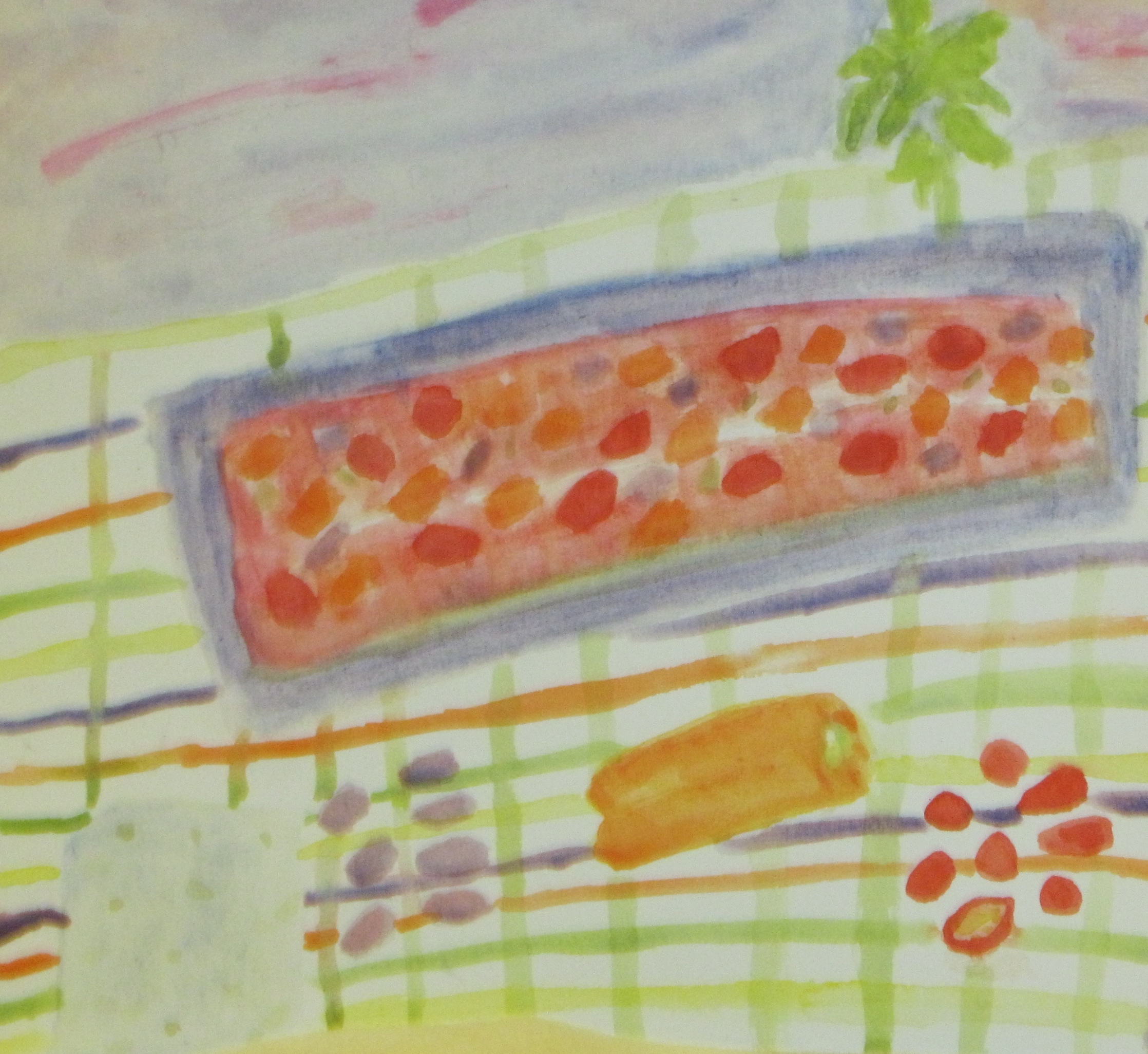
Original painting shows cornbread variations and ingredients.

Cornbread. 8″ x 10″ Gouache and watercolor pencil on canvas board. Sharyn Dimmick.

What I mean is, I don’t want cornbread to contain fresh corn, or onions, or peppers. I don’t want it to contain cheese. I want it to be a plain, cornmeal-flavored food with a smooth texture. I like it kind of cakey and a little sweet — even a lot sweet: I’ve made it with maple syrup. I’ve made it with butternut squash puree to give it a deep golden color and a different kind of sweetness. But, just like I don’t want cookie crumbs in my ice cream I don’t want foreign textures in my cornbread.

Mom calls what I like “corn cake.” She likes sour cornbread. It can’t get too sour for her: she’ll load it up with buttermilk and bacon grease, lots of cornmeal, little flour. She puts in 1/4 teaspoon of sugar — I don’t know why she bothers. Her cornbread is flatter than mine, more dense. She taught me to heat the grease (or butter or butter and oil) in the pan in the oven before pouring in the cornmeal batter: this step gets you crisp crust on the bottom and Mom is a crisp crust person: she wants the pie crust to shatter against your teeth, the croissants to fall into shards of pastry, the cookies to be thin and crisp. I like all of that crispness. I will eat her sour cornbread, but I have to eat it with jam or honey on it and I prefer the lighter, sweeter version that I make, made with all butter or with butter and corn oil, with or without buttermilk, with sugar. I also like spoon bread, a cornmeal pudding made with eggs and milk, egg whites folded in at the end, almost a corn souffle. With sugar in it.

If you want to make cornbread my way, start with a ten-inch cast iron skillet. Preheat the oven to 450.

Melt 3 Tbsp butter or  a mixture of butter and corn oil in the skillet on the stove. Turn off the heat.

Meanwhile, in a large bowl measure 1/2 cup flour, 1 Tbsp baking powder , 1 tsp soda, 2 Tbsp sugar and 1 tsp salt into a bowl and whisk them together. Add 1 cup cornmeal and whisk again.

Measure 1 cup buttermilk, plus 2 Tbsp, into a small bowl. Beat 1 egg into the buttermilk.

Put the butter/oil in the skillet in the oven to heat up.

Pour the liquid ingredients into the dry ingredients and fold until just combined (no flour pockets).  Then remove the hot skillet from the oven and carefully scrape the batter into the hot buttered skillet. This step produces a brown, crisp crust on the cornbread. Return skillet to hot oven and bake for about 20 minutes until the top has a few brown spots.

Cornbread is best eaten hot, but it can be nuked the next day for a few seconds in the microwave if there is any left — there probably won’t be.

Food notes: my cornbread recipe responds will to adaptations. You can use sour milk for the buttermilk. You can try using yogurt instead. You can eliminate the soda and make it with (regular) sweet milk. To make it cakier, try reducing the cornmeal by 1/4 cup and using unbleached flour instead: if you remove much more cornmeal than that it won’t be cornbread anymore. You could also add another egg to make it lighter, or an extra egg white if you have one hanging around. For a browner flavor, use brown sugar instead of white. You can use any kind of shortening or fat: I like the flavor of butter and corn oil amps the corn flavor slightly. In short, work with what you got.

And from Lisa:

My grandmother Eunice once told me about baking cornbread atop the car engine. As newlyweds she and my grandfather Oscar traveled often to Clearwater, Florida where she worked for the Studebakers as a cook and he set up cabanas and prepared beach-side barbecues.
“Now, Lisa,” she said settling into a seat at her kitchen table, “when your Big Daddy and I got hungry, he would pull the car off the road and I’d take out the picnic basket. I’d mix up some water with cornmeal, make little pones in the palm of my hand, then set them in a small pan. Daddy would raise the hood of the car and put the pan on top of the hot engine. Shortly, we’d have cornbread.”
Water and cornmeal, that’s all she used for making her roadway fast-food.
Now, unlike my grandmother and Sharyn, I like to put little bits of extra goodies in my cornbread. There’s whole kernel corn and chopped chipotle chili pepper. Or sauteed onions and garlic. Or leftover pimentos from making pimento cheese. And even sugar or honey, although this is not traditionally acceptable in some Southern households.
In making cornbread, which my yankee-born husband Mark loves, I usually begin with a recipe of Margaret Lupo’s and taken from her famous restaurant: Mary Mac’s Tea Room.
Mary Mac’s, located for all these many years on Ponce de Leon Ave in Mid-town Atlanta, brings a basket of cornbread muffins and biscuits to the table as soon as you are given a menu. The restaurant is known to attract celebrities and dignitaries from the world-over. Even the Dalai Lama has eaten there. I can’t know for sure, but I bet he loved the cornbread.
I’ve taken Mary Mac’s basic recipe and tweaked it to make it gluten-free, too. Good cornbread to me is a bit rustic and crunchy, so I use at least one cup of medium grind cornmeal. If you prefer a smoother or softer bread, use fine ground cornmeal only.
The Spicy Mexican Cornbread recipe here is great with just about anything.
First thing, pre-heat your oven to 500 degrees.
Beat 3 eggs well, then place them in an extra-large mixing bowl and add 3 cups buttermilk.
To the milk and eggs, add 1 or 2 tablespoons sugar, 2 1/2 teaspoons salt, 4 tablespoons grapeseed oil or olive oil. Mix well.
Next, add 2 cups fine cornmeal, 1 cup medium grind cornmeal, 1/2 cup almond meal, 1/2 cup brown rice flour, 2 tablespoons baking powder, and 1 teaspoon baking soda.
For the goodies, what I call the real reason for making this cornbread, I like to add 1 1/2 cups whole kernel white corn and one medium-sized chipotle pepper cut into small bits.
If you are using canned corn, drain it first. My preference is to keep a large bag of corn in the freezer, using what I need. If you don’t have a whole pepper, use 1 heaping tablespoon of dried chipotle pepper.
Just mix all the ingredients with a light touch. You want to form a thick, soupy batter. Let the batter rest for ten minutes or so. Pour into two well-greased pans. Yes, this is enough batter to make 12 cornbread muffins and a 10 inch cast-iron skillet full, or 24 muffins, or two ten-inch skillets of bread.
Bake the muffins for 16- 18 minutes; bake the skillets for 20 -23 minutes.
When you pull the bread from the oven go ahead and eat it right then. What we don’t eat I freeze and Mark and I eat later on.
If you are interested in making other Southern dishes, buy your own copy of Margaret Lupo’s Southern Cooking from Mary Mac’s Tea Room: www.amazon.com/Southern-Cooking-Mary-Macs-Room/dp/0877972575
 
I recommend Bob’s Red Mill meals and flours, most likely found at your local grocery. If you want to dip into the Southern regions and get some meal from a few of our local mills, try a bag:
From Athens, Georgia there is Red Mule: www.redmulegrits.us/index.html
From Columbia, Alabama there is Hall’s Milling Company. Their telephone number is: (334) 696-2286
Lisa Knighton

Sometimes you have to make hard decisions. Due to my precarious income (ask any self-employed artist about this) I have decided to suspend my Riverdog Farm vegetable box subscription for the month of October. I had some medical and dental expenses in the last few months and need to retrench financially. Zen teaches me that things change all the time: sometimes life or love or money expands, sometimes it contracts: you all know that I recently won the love sweepstakes big time. Now it is time to pay more attention to income and spending.

What that means is that on The Kale Chronicles October will be the month of Work With What You Got, cooking what is in the fridge, what is in the freezer, what is in the pantry, what is in the garage. The seasonal element will continue since I will be utilizing lemons and apples from our trees and I can never resist foraging when I see edible fruit on the streets of Berkeley and Kensington. I will supplement judiciously with items from the Berkeley Farmers’ Market and write about the cooking decisions I make. I do have an exotic ingredient on hand because Tropical Traditions kindly sent me a quart of coconut oil, which I have yet to try. Many of us in this country have far more than we need and I will be mining the surplus that lurks in our household, jams, liquors, pastas, etc. When it occurs to me I will suggest variations on each recipe to make it easier for you to adapt my recipes to what is in your fridge, freezer and pantry.

October will not be Austerity Month, however, because October is the month of the Hardly Strictly Bluegrass Festival in San Francisco, a glorious weekend of good live music and a full range of food booths. This is my favorite music festival of the year: I sit on a blanket in the sun, sketching, drinking coffee, eating crawfish etouffee or gyros or an ice cream sandwich, listening to Guy Clark and Emmylou Harris and Kevin Welch and Kieran Kane. This year I will have the added pleasure of sharing the event with Johnny, my new love thing. And before we even get there, Johnny and I will be traveling up to Sebastopol where he will play at Suzanne Edminster’s reception for her Dionysia painting show.

So where shall we begin with Work With What You Got?

Original watercolor painting shows pita bread, tzatziki, baba ghanoush and muhammara.

Indian Summer Mezze. Gouache on paper. 12″ x 12″. Sharyn Dimmick.

Well, what we got is hot weather, weather in which the only things that make me happy are going down to the Marina to swim in open water and drinking Coke floats. I need to get a dinner on the table that we can eat while watching the Presidential debate and I don’t want to be using the oven or stove much today. I have an abundance of cucumbers, eggplants and peppers from last week’s vegetable box, but no tomatoes or kalamata olives — that means we won’t be having Greek salad, my go-to hot weather meal. I decide that we will have spreads based on roasted vegetables, spreads that we can eat at room temperature.

I start by roasting eggplant for baba ghanoush in a 400 degree oven (Yes, I’m using the oven, but it is 6:30 in the morning. When the eggplant is done, I pop in several red Jimmy Nardello peppers and an orange bell pepper to roast for muhammara. I leave all of the vegetables to sweat in a glass bowl covered with foil. Then I think of tzatziki: I pull all of the cucumbers from the vegetable drawer. peel and seed them and put them in a bowl to chill. I grab the yogurt, spoon some out, set it in a colander over a bowl to drain and get nice and thick. While I’m at it I put on a full kettle of water to make some orange spice black tea for iced tea later. The oven use is over by 7:30 AM.

Then I start hunting for a pita bread recipe, finding a simple one in Mollie Katzen’s Moosewood Cookbook. I adapt it to use sourdough starter rather than active dry yeast: it can rise all day while I swim and write. The slow rise will allow me to bake it when I return from the Marina and assemble the spreads.

Sourdough Pita Bread (adapted for sourdough starter from Mollie Katzen’s Moosewood Cookbook)

In a large mixing bowl, combine 1/2 cup sourdough starter, 1 cup room temperature water and a dash of honey.

Stir with a wooden spoon and let stand for five minutes.

Add 1 cup whole wheat flour, 2 cups unbleached flour, a drizzle of honey and a bit of kosher salt.

Stir together and then knead for at least ten minutes until the dough passes the windowpane test.

Oil bowl. Return dough to bowl. Cover with damp cloth and set to rise. You can leave it alone for six to eight hours now.

When you want to bake it, preheat oven to 475. While oven heats, divide dough evenly into six to eight balls and cover balls with a dish towel. Let stand for fifteen minutes. Then roll each ball into a 1/2-inch-thick disk and place breads on ungreased baking sheets. Bake breads on lowest oven rack for about ten minutes. Stack warm breads in a basket covered with a towel. Serve with dips or spreads of your choice or stuff for sandwiches.

The baba ghanoush and muhammara share a Middle Eastern palate. I will need lemon juice, garlic, tahini, pomegranate molasses, a slice or two of white bread for the muhammara. I will pick the lemons from the tree in the front yard. I have the other things in the refrigerator or pantry. Baba ghanoush is a blend-to-your-own taste puree of roasted eggplant, tahini, lemon juice, fresh garlic and (optional) olive oil. I like mine heavy on the lemon and garlic, light on the tahini, no oil added.

Food Notes: You need a few exotic ingredients for today’s menu, tahini and pomegranate molasses. You can attempt to make pomegranate molasses if you have a supply of pomegranate juice. If you neither have it, make it, nor buy it, you could eat the roasted vegetables cold as is, or put them in a marinade or salad of your choice. Tzatziki is pretty basic, mainly yogurt and seeded cucumber. Making your own pita is fun if you don’t have store-bought around the house, and it is especially nice to eat it warm right out of the oven. As I mentioned last week, I have run out of walnuts (I’ll buy some when the new crop comes in), so I will be using pistachios in tonight’s muhammara. You can make pita without sourdough — just use proofed dry yeast instead.

Song Notes: Fortuitously, Johnny Harper has a song called “Work With What You Got.” Listen for the verse about the gumbo cooks. Click on the song’s name: that will get you to Johnny’s Cur-Ville page. Look for the song there (it’s the third one, but you might want to listen to the others too).

It is definitely fall: shorter days, cooler nights, a brisk crispness in the air. Last night there were drifting wisps of fog and a big moon, but the air was balmy as I walked my two miles home from the closest bus stop. I got up early this morning — it doesn’t matter how late I get to sleep, I will wake in the morning when the light changes — wrote for half an hour and checked emails. Then I got back under a big pile of autumn covers, talked to Johnny on the phone for awhile.

Original watercolor painting shows gingerbread waffle and ingredients.

Gingerbread Waffle. 12″ x 12″ watercolor pencil and gouache on paper. Sharyn Dimmick

When I got up the second time, it was time to make breakfast and the first thing I thought of was gingerbread waffles. Fall flavors have been creeping into our menus — we had our first pumpkin pie of the season and a butternut squash waits on the counter for me to make my signature squash soup with ginger and thyme. I keep a big binder of clipped recipes and turned to the waffle section, taking out the plastic-enclosed recipe.

I often don’t include anything extra in news clippings, saving space and just keeping the recipe, but at the bottom of the column in tiny type this clipping says “Adapted from ‘Waffles from Morning to Midnight’ by Dorie Greenspan.” I present to you an adaptation of an adaptation: I couldn’t make this recipe without taking the chance to throw in half a cup of my neglected sourdough starter and without incorporating a quarter cup of whole wheat flour for depth, texture and health benefits — surely there despite the half stick of melted butter, three-quarters cup of brown sugar and the maple syrup I drizzled on top. I also doubled the eggs.

Sourdough Gingerbread Waffles.

Measure into a large bowl:

1/2 cup sourdough starter

1/4 cup molasses

1 cup buttermilk

Separate four large eggs, putting the whites into a small mixing bowl and adding the yoiks to the buttermilk-molasses-starter mixture.

Melt 1/2 stick butter (I used salted and omitted salt in the recipe. If you use unsalted you may want to add 1/4 tsp kosher salt to your dry ingredients)

Beat the egg whites until stiff.

Then beat the molasses mixture just until combined.

Into a separate bowl, measure and whisk together:

1 and 3/4 cups unbleached flour

1/4 cup whole wheat flour

3/4 cup packed brown sugar

1 Tbsp baking powder

3/4 tsp baking soda

1 Tbsp ground ginger

3/4 tsp cinnamon

1/2 tsp dry mustard

1/4 tsp cloves

1/4 tsp freshly grated nutmeg

Fold dry ingredients into molasses mixture until just blended.

Add melted butter and stir until combined

Fold in egg whites — batter should be streaky, not uniform in color.

Preheat waffle iron and prepare toppings: I melted some butter, sliced some peaches and heated some maple syrup. Tomorrow I will probably serve them with blackberries, fresh peaches and figs. Cook waffles according to the directions for your waffle maker.

Food notes: if you don’t have sourdough starter, omit it and increase buttermilk to 1 and 1/2 cups. If you don’t have buttermilk, you can use yogurt instead, or use regular sweet milk and eliminate the baking soda in the recipe. Or you can use 1/4 tsp of lemon juice or vinegar to sour your milk and proceed with the recipe as written. If you have whole wheat pastry flour you can substitute 1 cup of whole wheat pastry flour for 1 cup of unbleached flour: in that case, eliminate the regular whole wheat flour and use 1 cup of unbleached and 1 cup of whole wheat pastry flour. Serve waffles with whatever floats your boat: bacon, pears and blueberries (a la local restaurant La Note), fruit syrup, jam, cinnamon sugar, pecans and whipped cream.

“Some of the time, not all the time” says the Dylan song “Hanging Out the Clothes.” That’s how I feel about cooking. Sometimes I love thinking about cooking, perusing cookbooks, thinking about flavors. Sometimes I am inspired by a particular ingredient from the Farmers’ Market down in Berkeley or a glut of foraged blackberries. Sometimes I just want to put the closest thing in my mouth and be done with it.

Original watercolor painting shows Greek-style salmon and ingredients.

Greek Salmon. 12″ x 12″ gouache on paper. Sharyn Dimmick.

There is a special pleasure in cooking for someone when you want to please them. Our most recent foray to Canned Foods Grocery Outlet fetched us some wild caught salmon from Washington State. Standing over the freezer case, eying the fish, I ask Mom, “Does Bryan eat salmon?”

“I think so,” she says. “Does Johnny eat salmon?”

It is rare for Mom to bring up Johnny in conversation. He’s only been over to the house in the past three weeks: although I’ve known him much longer than that, he never had reason to come up here before last month.

“I don’t know,”I said. “I’ll ask him when I see him.” In the meantime we bought the salmon filet, enough to feed at least four people.

Johnny and I schedule our visits in advance. We live a good distance away from one another and public transit schedules are not conducive to spontaneous trips to see one another, so, instead of dropping in on each other all of the time we schedule visits and try to spend a significant amount of time together when we get together.

We bought the salmon on Tuesday and Johnny was coming over on Thursday night. When he told me he liked salmon, I made a dinner plan: I would make the pear tart tatin that he once wanted to elope with (He’s mine, pear tart!), microwave some fresh green beans, bake some red potatoes and cook the salmon in foil topped with seasonal vegetables: cherry tomatoes, orange bell peppers, kalamata olives, basil, a little feta — basically a Greek salad without cucumber thrown on top of the fish. Everything except the green beans could cook in the same oven and, with a little prep work I could have an easy dinner that was festive and delicious.

In the morning I made pie crust for the tart and put it to chill. In the afternoon I took the salmon out to thaw, laid it on foil on baking sheet and oiled the skin-side with a little olive oil. Then I went to work on the pears, peeling, coring, slicing, putting them to soak in a little dark rum, sprinkling ground cardamom over them. I made the caramel in a cast iron skillet, arranged the pears on top, rolled out the top crust. I preheated the oven, adding a handful of potatoes on the side. Then I snapped beans and cut up half a basket of red cherry tomatoes, and a large orange bell pepper. I tore up a few basil leaves, plucked a handful of pitted olives from a jar, diced a small cube of feta and I was ready to go, scattering all that on top of the salmon. The minute Johnny arrived I put the tart and the salmon in the hot oven and told him we had a half hour to ourselves before I had to mess with food again.

I can’t remember what we did for that half hour. He might. He set table for me in the dining room because the breakfast room was a mess and I did not want to excavate the table. I had him test the fish a few times because I don’t cook salmon often. All told, we cooked the fish for perhaps 40 minutes in a 400 degree oven. Brother Bryan arrived home just as it came out and we all sat down to eat.

Johnny and I liked the salmon so much that I scrambled the leftovers for breakfast with eggs and we ate them with the last slices of the pear tart tatin — have to get rid of that stuff quickly since Johnny has threatened to run off with it.

Watercolor painting of bowls of polenta, tomato, Martin guitar in green chair.

Johnny’s Polenta. 6″ x 6″ watercolor pencil on paper. Sharyn Dimmick.

Some of you know that I frequently eat polenta as a breakfast cereal during summer and early fall, cooking it in milk, stirring in a fresh peach or a handful of wild blackberries. Some of you know I have spent part of the summer flirting with a guitar player, wondering how much he liked me, being alternately elated and crushed as I went to play music at his house, attended band rehearsal, sang at a small festival in Santa Rosa, followed him up to another festival called Cur-Ville. You’ve seen me donning red dresses and trying to let go.

That phase has ended: the guitar player is mine now and, to prove it, spent the better part of the long weekend at my house. Mornings found us in the kitchen, brewing coffee, figuring out what to eat for breakfast. I cooked him eggs twice, scrambled with cheese and Gypsy peppers, served with sourdough toast. This morning I asked him what he ate for breakfast besides eggs. He mentioned a dish of polenta and various cheeses, topped with tomato and avocado.

We always have cornmeal, so I put on a pot of  salted water to boil and put out the cheese collection for Johnny to look at while I measured out a cup of cornmeal. He selected Red Leicester, a cheddar, and chopped it into small pieces.  I added some grated pecorino Romano. While the polenta was warm I added a chopped tomato. We tasted the polenta. He added a bit more cheese, I added a pinch of kosher salt and a healthy sprinkle of paprika and we had a beautiful golden breakfast, flecked with tomato red, Johnny’s gift to me and my gift to you.

After we ate, I did the dishes, dancing at the sink while Johnny sat in a green chair and played me Bruce Springsteen’s “Fire.” Occasionally, I turned around to look at him to sync my back-up vocals to his lead. Dishes have never been this much fun — who knew? All you need is a guitar-player in your kitchen to play songs for you while you wash and rinse. But you can’t have mine — he’s taken. Sorry.

If you want to make Johnny’s Polenta, measure water and cornmeal in a four-to-one ratio (I used four cups of water to one cup of cornmeal, but you could use one cup of water to a quarter cup if you want only one serving).

Add a bit of salt to the water — not too much, since you are going to be adding cheese later.

Boil polenta and water mixture until it has thickened to your liking. Remove from heat and stir in

Chopped and grated cheeses to taste : I used about 3 ounces of cheddar and 1 ounce of pecorino Romano.

Add one large chopped tomato.

Add 1/2 tsp of either sweet or hot paprika, depending on your proclivities: this adds wonderful color as well as a subtle flavor.

Taste and season as necessary. You will have to provide your own soundtrack for dish-washing.

Food Notes: You can make this with cornmeal or polenta, or even grits — whatever cereal-like corn product that you have hanging around. Lauren, if you are listening, you could swap some permitted vegetable for the contraband tomato and eliminate the cheddar, substituting some cheese you like, such as the cumin cheese we ate in France.

The Lauren Project: Thanks from Lauren and from me to all who sent recipes to the Lauren Project. Lauren is out in California, cooking up test batches of recipes. She and I will confer soon and announce the prize winners in an upcoming blog post. Before we complete the winners’ post we will contact our winner to ask what prize he or she desires. Then we will contact the second place finisher, third-place contestant, etc. until all prizes are awarded. Those of you who did not win will still be eligible for free shipping on any Kale Chronicles’ painting purchased by midnight December 31st, 2012.

Original painting of many-leaved tree with roots.

The Lovely Blog Award. 6″ x 6″ watercolor pencil on paper. Sharyn Dimmick.

Last week Shira of In Pursuit of More tagged me in a relay, charging me with writing about hope and John Clinock of artratcafe generously bestowed on me the one lovely blog award. I am honored by the kind intentions of my fellow bloggers and will do my best to live up to their trust.

A major tenet of the two forms of Buddhism I have practiced is the practice of letting go, letting go of outcomes, letting go of expectations, letting go of desires. This does not immediately sound like fun, does it? That’s because we want what we want, even if wanting it is causing our suffering. I am personally undertaking a course of consciously letting go these days because I find myself falling in love. First I fell in love with a city, a country, a way of life, when I went to France. Then I fell in love with my guitar again, starting to play daily after a hiatus of a year.  I fell in love with my room, starting to see ways that it could be improved. Every summer I fall in love with open water swimming when the days get warm enough to swim at the cove down in the Berkeley Marina. And, as you might have expected, I am somewhere on the continuum of falling in love with another person with all of that continuum’s abundant symptoms: sleeplessness, excitement, fear of the unknown. There is pleasure in falling in love and there is pain. There is fantasy and reality, hope and dread. I find that the easiest approach, although it is hard to put into practice, is to treat the entire experience as a practice, to work with whatever it brings to me in any given moment: if I am sleepless, get up and read or write. If I am inspired to write a love song, write a love song. If I am scared, feel the fear.

One aspect of treating life as a continuous practice is that there is no room for hope. Hope causes us to leap into the future, into some better world that is different from what we are experiencing right here, right now. When I am right here, I can respond to my fear or excitement as it occurs; when I am jumping into hope, I lose my opportunity in the present moment. My teacher is fond of saying “The love you want is no other place.” And, I, of course, am hoping that she is wrong, that there will be glorious love in a field of flowers some other day. But I know what she means: our only chance is this moment, what we find there now, where we find ourselves now. We can’t count on having another moment, better or worse.

What we can count on is that things will change: if I am sleepless for three weeks running, during week four I will fall into a deep sleep when the body needs it. The foods of the changing seasons that I highlight on The Kale Chronicles reveal this in a beautiful way: now there are Gravenstein apples and gypsy peppers, summer squash and tomatoes, cucumbers, green figs, the first grapes, blackberries, melons. Soon eggplants will come in and peaches will begin to fade away until next summer brings the new crop. I stir a couple of spoonfuls of apple crisp into my morning oatmeal and plan another round of zucchini-feta pancakes for lunch, topped with Sun Gold cherry tomatoes. Next month, perhaps next week, I will be eating something different. Food becomes more satisfying when you are not reaching for raspberries in December and tomatoes in February, when you eat what there is now, choosing your favorites, perhaps, but working with what you’ve got.

Love cannot resist reaching into the future, imagining scenarios, conjuring kisses out of the air. So let it. Just know that the fantasies, the daydreaming are a current and temporary state: mine them for their images and ideas, laugh at them and at yourself, an ingenue in a fifty-four year-old body. Watch as your mind tosses up Loggins and Messina songs (Where did they come from?). Sing them if you want — no one needs to know.

What do I hope for? I hope for the courage to face my life, the courage to be in whatever state I find myself in until that state changes. I hope for the courage to respond authentically to whatever I need to respond to. Today I thank Shira (who is in La Belle France) for encouraging me to meditate on hope and John who says lovely things about The Kale Chronicles. With my one-year blogging anniversary coming up fast (next Sunday) I tell you that I had some hopes for the blog: I hoped a few people would like my recipes. I hoped my writing would acquire a wider platform. I hoped a few people would buy my paintings and maybe even my music CDs. I hoped that I would find some writing students who want to do writing practice. Some of that has happened. But writing The Kale Chronicles has become much bigger than that because I have discovered an entire community of like-minded souls, people who care passionately about what they eat and where it comes from, but, beyond that, care about how they live their lives, treating each other with kindness and humor. I started a blog and found myself in a whole new community. I am made welcome here as I am made welcome in my communities of writers and singers and artists. And I will be calling on you soon with a special anniversary challenge, The Lauren Project — I know you will step up to the plate. There will be prizes and glory and the opportunity to help a lovely young woman find more joy in the kitchen.

Original watercolor painting shows ingredients for cucumber raita.

Cucumber Raita. 6″ x 6″ watercolor pencil on paper. Sharyn Dimmick.

In the meantime — back to the present — a simple raita recipe for cucumber season, courtesy of Padma, my Indian roommate in college, who taught me how to make it. The secret to good raita is no shortcuts — you must cut the cucumber into spears and de-seed it with a knife and then you must slice each spear into small bits with the knife — if you grate it, the cucumber turns watery. Raita is all about texture. So set aside an hour to make raita — you won’t be sorry.

Cucumber Raita

Peel 2 cucumbers (or use an Armenian cucumber, which requires no peeling). Slice each cucumber lengthwise into quarters, sixths or eighths, depending on its circumference. Remove all of the seeds. Slice the now seedless cucumber into small pieces and put in a steel or Pyrex bowl. Grate 1/2 of a fresh coconut into cucumbers. Add one bunch chopped cilantro.

Heat a small amount of peanut oil in a small skillet. When oil shimmers, add 1 tsp of mustard seeds and 1 dry red chile. Fry for a few seconds until mustard seeds pop and add chile, mustard seeds and oil to cucumber mixture to season it. Add plain yogurt and salt to taste, making it as creamy or as light as you like.

Food notes: You can, of course, make this with dessicated coconut — it’s just not as good as when you use fresh. Make sure your coconut is unsweetened — sugar in raita is gross. You can eat the raita as a salad, as a side dish with an Indian meal, or simply mixed with rice.

One Lovely Blog Award: I’m supposed to give you seven random facts about me. Here goes:

1) I’ve written two new songs in the last week, “Ingenue” and “The Werewolf.”

2) I like to eat pie for breakfast, although I usually eat oatmeal or polenta cooked with milk and sweetened with seasonal fruit.

3) My favorite color is kelly green. I also like lavender and blue, crimson, claret, raspberry, all balanced with plenty of black.

4) I am a Pisces, Sagittarius rising, Gemini moon, Venus in Aquarius.

5) Although I am a folk musician and will always be one, I have always (always?) had a fantasy of singing with a rock band.

6) If I could only eat one type of food for the rest of my life, it would be Indian food.

7) This bull needs a big meadow: don’t put me in a pigeonhole — I won’t fit.

Now I need to pass the award to fifteen of you. In no particular order

1) Celi at The Kitchen’s Garden — Celi writes about sustainable farming, a subject dear to my heart. Beyond that she is fun and knows how to tell a story.

2) Shira at In Pursuit of More has endeared herself to me by her generosity and her commitment to simplicity.

3) The Caerus blog, a brand new blog, showcases the artful thoughts of Suzanne Edminster, Karina Nishi Marcus and a growing cadre of guest artists. Look for it on Thursday mornings and go back to read the back archives.

4) The Literary Jukebox. I found this one this morning. Maria Popova posts a literary quote and a song everyday. Great for literate music junkies.

5) Debra at Breathe Lighter. Debra shares all aspects of her life in San Gabriel — recipes, photographs, pet stories, field trips, music, all accompanied by her enthusiasm for life.

6) John at artratcafe provides an art education by featuring the work of many diverse artists. He writes poems, too. Foodies will like his brilliant posts on food that combine illustrations, literary quotes and recipes with a certain je ne sais quoi.

7) John at From the Bartolini Kitchens writes an ongoing love letter to his Italian family and the foods of his culture. Want to make cheese or fresh pasta? See John.

8) Eva Taylor of Kitchen Inspirations  knows how to put it all together: the dress, the shoes, the place settings. Lately she has been experimenting with healthier, lighter versions of favorite foods, keeping to a low-carb diet.

9) Betsy of Bits and Breadcrumbs cooks food I want to eat — I’ve said it before and I’ll say it again.

10) My writing pal Bob Chrisman has branched out and now writes a memoir-type blog called swqm60. Check it out.

11) Jane Robinson at Art Epicurean posts abstract paintings and encouragement for creative types.

12) My old friend Maura writes theonceandfutureemptynest about her life with husband, children, grandchildren, parents, dogs, running shoes, kayaks and literary ambition. A graceful writer, her thoughts will resonate with the sandwich generation.

13) I’ve already sent you to look at Deby Dixon’s photos on Deby Dixon Photography.  Have another look, please.

14) Can’t leave out my pal, Movita Beaucoup! This chick is funny. And an incredible baker when she leaves off the Crisco frosting. And someday she is going to buy a painting (but you could beat her to it and buy up all of the best ones first. Just saying…)

15) Your nominee. Please use the comments to tell us all about the blogs you love the most, the ones you open first everyday, among other things. We have free speech here.

Original watercolor self-portrait with produce and guitar. Sharyn Dimmick.

Self Portrait with Wanting Mind. 8″ x 8″ Gouache and acquarelle.

Recently, I have been reintroduced to wanting mind. You know, the voice in your head that says life would be glorious if the day were sunnier, if there were more space in the freezer, if he would call. Wanting mind is a tremendous source of suffering because when you are listening to its siren song that something different would be better you can miss the opportunities that surround you right now, at this moment. Wanting mind likes to whine about the small thing that it has focused on like a high-powered laser directed at a spot of brain cancer, but whereas the laser may do you good, wanting mind will not.

It does no good to whine about what you don’t have or what you wish you had, dreaming up imaginary improvements to the present moment. You can put those on the page or the easel: often I paint things to look better than they actually do: my favorite is inventing backgrounds so that I don’t have to paint the same walls and windows over and over — I create wallpaper, wooden counters, checkered floors never seen in my actual house. It is alright to imagine improvements that you can create, but it is better if they don’t depend upon the actions of others or require removal of reality: thirty years of wishing I did not have cerebral palsy did nothing to remove it; accepting that I have it has been much more helpful.

What could I find to want in the middle of glorious summer? The farmers markets are overflowing with peaches, corn, tomatoes, ripe strawberries, blueberries and blackberries. My beloved Gravenstein apples will come in in two or three weeks says the apple man. Frog Hollow Farm had a sale on “cosmetically challenged peaches” Saturday, three dollars a pound for organic gold, and I took home a big sack. Fresh green figs came in the Riverdog Farm box, along with tiny green beans, cucumbers, lettuce, the first orange cherry tomatoes, fresh basil. For breakfast this morning I could have peaches, ollalieberries, blueberries or all three.

So what am I complaining about? I’m not complaining, I’m making a point: humans can always find a way to wish something was different, whether it is the weather, the menu, the president. Corporations make it their business to supply us with everything we want, things we don’t want and things we hadn’t even thought of wanting. Do you want tomatoes in December? Someone will ship them across the world for you. They won’t taste good. They will vaguely resemble tomatoes. And then you will think  what you need is fresh basil to go with them. But you don’t. What you need to do is wait for summer to taste the ripe, heirloom tomatoes on Deborah’s platter or pick them with Claire out of her allotment in England. Whenever summer comes where you live there will eventually be tomatoes and that is the time to eat them.

Seasonal eating is a voice speaking against the utterances of wanting mind. Seasonal eating tells you to go out and buy the peaches now because they will never get any better than on this July day in California. You eat them for breakfast with polenta cooked in milk and vanilla extract, sometimes a sprinkle of almonds. Seasonal eating says “Buy all of the ripe fruit you can eat — it’s better for you than other things, anyway.” The key is “ripe fruit,” whatever is coming off the trees and bushes in your neighborhood right now. If you are handy at preserving, you can buy extra and save some to freeze or can to tide you over in the winter months of potatoes, carrots, winter squashes and hardy greens. I always dry tomatoes. I never dry enough to last until the next tomato season, but I keep at it.

Two nights ago I took six bags of citrus peels from the freezer (We did need freezer room) and began the laborious process of scraping pith from them with a steak knife and a teaspoon. My hours of work will be rewarded with long-keeping candied peel from the lemons, oranges, limes and grapefruit we ate in the long winter months: the candied peel will enhance Christmas pfefferneusse, flavor muffins, serve as sweet snacks when this year’s peaches and berries are long-gone. This morning I took the thrice-boiled peels and scraped the white pith from them, watching the thin-bladed knife slide under the loose pith, left hand reaching into the pot for a new peel, right hand wielding the blade. And I realized I was out of time, that the only objects in the world were the citrus peels, the knife, the motion, the smell drifting up from the cutting board, that I no longer knowed or cared what time it was. This is the opposite of wanting mind and the cure: become absorbed in something simple.

The best way to make friends with seasonal eating is to visit farmers’ markets. Go every week for awhile to become familiar with what is in season now. Choose your foods and plan your menus around what is available. Or you can look for a CSA box, a community-supported agriculture program, that serves your area. For a flat fee, you get a box of fresh-picked produce each week, helping you to eat what is at its best now (My CSA also gives us some preserved things, precious bags of dried tomatoes and peaches during the winter or early spring).

Gardeners and farmers know that many things taste their best right out of the ground, warmed by the sun, eaten before the natural sugars can turn to starch. Nutritional studies now tell us that organically grown fresh-picked produce has more vitamins, minerals and micronutrients than produce that has been trucked across continents or oceans in refrigerated containers. Biting into just-picked local produce can even quell the wanting mind for a few minutes, stop it dead as it thinks instead “This is marvelous.” Unfortunately, its next thought will be, “How can I get more?”

Eating seasonally keeps me experiencing the pleasures that can be had on any given day. In the fall I might enjoy mushrooms. Every winter I make butternut squash soup with ginger. In the warm days of midsummer and early autumn I cannot eat enough Greek salads, enjoying the convergence of cucumbers, bell peppers and tomatoes. The first big treat of spring is strawberry shortcake. And we are all happier when we reach for the pleasures that we can have: when it is too cold to swim, light a fire and curl up with a book, bake some biscuits, make some gumbo, or get out a big pot and those citrus peels And when he is busy doing whatever he is doing it is a good time to pick up the guitar, the pen, the saucepan, the cookbook, the paintbrush — even the vacuum cleaner — and just do the next thing. He’ll call in his own time and the moment is about what to do when you feel that longing tugging at your sleeve.

Food Notes: As a bonus for soaking, scraping and boiling all of those peels, I got, besides the candied peel and the moments of peace, a lovely citrus-flavored simple syrup for cake, iced tea, baklava?

Painting Note: This week and last I have been participating in a new do-it-yourself artist residency, the Caerus Artist Residency, started by my friend Suzanne Edminster and her friend Karina Nishi Marcus. For a peek at my current sketchbook (including a slide show), please visit the Caerus blog.

Warning: this post may contain an embedded rant or two.

In the kitchen this morning, I have two large dry crusts of French bread, three eggs and several heads of baby romaine lettuce from the farm box. This late spring day appears to be one of the warm variety. I don’t know if these ingredients suggest anything to you: to me they suggest Caesar Salad.

My mama told me that Caesar Salad contains anchovies in the dressing. Cursory internet research suggests that Cesare Cardini used Worchestershire sauce rather than anchovies. I don’t even like anchovies, but I was taught to chop them finely and put them in the dressing for a Caesar Salad, so I do. I would not eat them on pizza. I would not snack on them out of the tin. I have never dared to make a pasta puttanesca because of the anchovies in it, but I keep anchovies in a jar of olive oil just so that I can make this salad when the mood strikes or when the ingredients are sitting around in the kitchen.

Furthermore, I do not care for any egg preparation that involves soft egg yolks — or hard egg yolks, for that matter. That leaves out poached eggs, fried eggs, eggs sunny side up, deviled eggs, hard-boiled eggs and Easter eggs. But I make an exception for Caesar Salad dressing, which calls for a coddled egg, cooked for one minute before you mix it with the other dressing ingredients.

Painting shows Caesar Salad and ingredients.

Caesar Salad. 8″ x 8″ Gouache and Watercolor Pencil. Sharyn Dimmick.

The salad that makes me set aside my food aversions is truly magical. You put in anchovies and barely cooked egg yolk, garlic, olive oil and lemon juice, black pepper. You toss the dressing with croutons, Romaine leaves and freshly grated Parmesan cheese and you have a crunchy, green refreshing salad with adequate protein from fish, egg and cheese. There is no need to add shrimp or grilled chicken to this salad as many American restaurants do.

First, make garlic-infused olive oil. Heat some garlic cloves in olive oil and allow the garlic and oil to sit while you do other things. While you are at it, halve a raw clove of garlic and rub it onto your wooden salad bowl. If you like raw garlic, set aside a couple of cloves to squeeze into the salad, or pound them in a mortar or mince them with a knife. I actually like minced or pressed raw garlic better than the more subtle garlic oil.

Then make croutons. Chop your leftover French bread into cubes. We like to use stale sourdough. You can saute them in a little of your garlic oil, or you can toss them with some of it and bake them in your oven for a few minutes at 300 degrees. I usually bake my croutons. Sometimes I just bake sourdough bread without any oil: the croutons will absorb dressing from the salad anyway.

Then wash your romaine lettuce and dry it thoroughly in a dish towel or a salad spinner.Tear into bite-sized pieces unless you particularly enjoy the exercise of cutting lettuce with your fork. Place lettuce in your garlic-rubbed salad bowl.

Take two or three anchovies from a tin and mince them finely — no one wants a big bite of anchovy in this salad — we just want the flavor. Set them aside for now.

Grate some Parmesan cheese. 1/4 cup will do in a pinch, but you might want to use more to get the snow drift effect.

Halve one lemon and get ready to squeeze it.

Dress your lettuce with a small amount of garlic olive oil. Add minced garlic if using.

Now coddle an egg: boil it for one minute only. Remove it from the pot. Crack it right into your salad bowl and toss with the lettuce.

Add the minced anchovies and toss again.

Squeeze lemon directly onto the salad. Toss again.

Add croutons and grated Parmesan. Toss again.

Grind some fresh black pepper over the salad. Toss again.

Taste and adjust seasonings.

Food notes: If you can’t stand handling anchovies, you could try using anchovy paste in a tube. I have never used it. Please do coddle the egg and use it in the dressing: the slightly-cooked egg, anchovies and lemon are what creates the distinctive Caesar dressing. You cannot get the proper effect without the egg. You cannot get the proper effect without some form of anchovies — if you are afraid of them, try using a little less — start with one anchovy if you are squeamish and work your way up. You cannot skip the cheese either, or the croutons — if you do, you have not made a Caesar salad, but some other kind of romaine salad. You cannot make a vegan Caesar — don’t even try. If you are a vegan, find some other way to eat your romaine. You cannot make a kale Caesar either: by definition, Caesar salad is made of romaine lettuce. Got it? You have latitude with the garlic, the oil, and the croutons and the amount of anchovy you use. For the Parmesan, you need to get the good stuff and grate it yourself: this is not the time to use stale, pre-grated cheese or the stuff in the green can: when you are only using a few ingredients, they need to be the freshest and finest you can get. That chicken and shrimp? Save them for another entree or cook and serve them on the side, please. Once you try the real Caesar salad, you will love it or hate it, but at least you will know what it is, that you have tried Caesar salad and not one of the many abominations that blacken and borrow its name.

If you’ve made it through the rant, you may notice that I put no salt in the dressing: both anchovies and cheese pack a lot of salt and I don’t miss it. But I did say you could adjust seasonings: that is code for add lemon, salt, pepper, garlic or cheese to taste. Enjoy. And if you experience any revelations after making proper Caesar salad, please come back to testify in the Comments section.

On Saturday my friend Margit and I walked through the Berkeley Farmers’ Market. I had been the week before and bought my first Brooks cherries of the year, walnuts in the shell, brown mushrooms. Stone fruit is beginning to come in: I saw apricots and bought a couple of baskets of cherries from Kaki Farms. Strawberries continue strong. Blueberries are here. Some vendors had bins of summer squash and the first beautiful broccoli was beginning to peep its heads out of baskets. But the thing that made me happiest was the bunch of basil I bought for two dollars.

Ah, basil. I didn’t even like the stuff when I was a child: it was just another mysterious seasoning in a Spice Island jar, dried and weird. It didn’t remind you of turkey stuffing like sage or pizza like oregano. Fresh basil was not seen or smelt at my house.

painting shows mortal and pestle, basil, basket of walnuts.

Making Pesto. 8″ x 8″ Gouache and Watercolor Pencil, Sharyn Dimmick.

All that has changed now. All late spring, summer and early fall, I buy basil by the bunch and set it like a bouquet in a glass of water on the kitchen counter next to the olive oil. I chiffonade it over green beans and steam them, tuck it into ears of corn before roasting them, add it to Greek salads, put it in turkey meatloaf or burgers. It is probably the herb I use most during the summer. Today and many other days will find me sitting at the breakfast room table, pounding torn basil leaves, salt, garlic, walnuts and grated cheese in my large Vietnamese mortar with a little olive oil.

Did I say walnuts? I did. Classic pesto is made with pine nuts. I have nothing against pine nuts except the cost. If I lived in New Mexico or Italy I might make pesto with pine nuts. Since I live in California I make it with walnuts and have come to love the combination of bitter and sweet freshly cracked nuts with pounded basil leaves and garlic (I also use walnuts to make a cilantro pesto, flavored with lime).

The first pesto I tasted was served in a restaurant (I no longer remember which one). When I lived in San Francisco I used to buy little plastic tubs of Armanino pesto. Then for awhile I made my own in a blender, until my friend Leila mentioned that pounded pesto had a superior texture. Because our blender is old and cranky I was spending lots of time mincing basil and garlic before feeding its maw and I decided to get a mortar and pestle.

My friend Elaine and I went mortar hunting in Oakland Chinatown and I brought back not one mortar, but two: I have a small marble mortar that I use to crush spices and small amounts of nuts and I have my big wooden Vietnamese mortar for pesto duty each summer.

I start in the kitchen, smashing garlic cloves with the side of a knife and peeling the skins away. The garlic goes directly into the mortar and gets a sprinkle of kosher salt, which helps the pestle break down the garlic fibers. Then I take a utility bowl, my basil bouquet and the big mortar and pestle into the breakfast room. I inhale the spicy green scent of the basil as I pick leaves, discard stems, and tear each leaf into smaller pieces. I pick and tear for awhile, then I pound for awhile, then pick and tear another layer of leaves. The aroma gets richer. When I have torn and pounded every last leaf I take the basket of walnuts and nutcracker from the sideboard and start cracking and shelling. There is no measuring involved: the pesto comes together and is done when its taste and texture suits me — the size of the bunch of basil is the determining factor: I will add enough other ingredients to blend with it, to complement it, but the basil is the star, so I start with garlic and salt, add all the basil, then add walnuts. The last step is grating Parmesan or pecorino with my microplane and stirring in a little olive oil.

If I need a break while I am pounding basil I will pour a little olive oil over the top. This helps keep the color bright. I do not care for oily pesto and have a light hand with the oil: I am not too fussy about whether the final product is bright green: I know it will be delicious and we are going to eat every spoonful and scrape the jar besides.

I never get tired of pesto. When the basil really gets going in mid-summer I try to make enough of it to freeze to last all year. I am never successful because if I have fresh pesto on hand I want to eat it on pasta, on sandwiches, in salad dressing, on green beans, on broccoli, on broiled portobello mushrooms, dolloped on the top of a pizza just out of the oven, or added to a winter vegetable soup. Every year I manage to freeze a few small jars or a bag of pesto cubes made in an ice cube tray, but I am dipping into my stash practically as soon as basil disappears from the Farmer’s Market. At the same time, I have days when I wonder why I have bought yet another bunch (or two, if they are on sale), condemning myself to a few more hours of sitting at the table, pounding away when I could be walking or swimming or reading or whatever else it is that people do on long summer days, instead of inhaling basil fumes and oil of walnut rising from warm wood.

We ate our pesto with whole wheat rotini, fresh sugar snap peas and some roasted red peppers from a jar.

Food notes: You can, of course, make pesto with any fresh  leafy herb and any nut. Some people use seeds instead — pumpkin seeds, sunflower seeds. Margit is allergic to walnuts and pecans so she can make hers with almonds. Elaine has used Brazil nuts successfully. Pine nuts are delicious. You can make pesto from arugula or from soaked sundried tomatoes. Some people make it with spinach or kale. You can mix herbs, too: basil, cilantro and mint is nice, or arugula and mint. You can make it in a blender or a food processor if you have one.

Blogging notes: Susie of SusArtandFood very kindly nominated me for another blogging award, the illuminating blogger award. I love it when people read The Kale Chronicles and I love it when they like it and I really like it when they find something useful here for themselves. What I don’t like is posting blog award patches on my site — I don’t think they look nice. And while I’m happy to let you know what blogs I enjoy reading I am not much good at making lists of them on the spot: I do have lists of links, although I probably should update them — perhaps at my one-year anniversary. You will find more details about me and my life in the posts than you perhaps want so I don’t think you need to know that my favorite color is green or that my favorite ice cream is coffee ice cream. My emphasis is seasonal home-cooked food. I’m quite happy when you read and comment on The Kale Chronicles and I do my best to respond to every comment I receive. Thank you all.

May’s Daring Bakers’ Challenge was pretty twisted – Ruth from The Crafts of Mommyhood challenged us to make challah! Using recipes from all over, and tips from “A Taste of Challah,” by Tamar Ansh, she encouraged us to bake beautifully braided breads. Although I have made pretty challah many times, I was tired this morning. I have recently undertaken a vigorous exercise program, involving walking up hills at the crack of dawn. Yesterday I followed that walk and subsequent breakfast with a walk through the Berkeley Farmers’ Market, and Andronico’s grocery store, came home to put away the groceries and construct a Caesar salad with kale (note to self: leave the kale out of Caesar salads — remember those tests asking “Which one does not belong?” Can you spell k-a-l-e? It was a noble effort).

Despite taking a day off of hill-walking, I dragged myself to the grocery store (on foot) because I needed milk to make challah, Mom had grossly underestimated our milk supply and I didn’t want to use canned milk or buttermilk sweetened with soda. When I got back to the kitchen the dishwasher was on the dry cycle and I unloaded that.

photo of misshapen loaf of Challah bread

Trolls’ Challah.

Only then could I begin the business of making challah: scalding milk and beating eggs, sifting flour, proofing yeast. I briefly considered embellishments: candied orange peel sounded good, but I have not yet candied my annual supply of citrus peel — the peels are sitting in the freezer, awaiting the day when I feel like doing it. I thought of making some kind of cinnamon glaze, but then I considered how tired I was and the kind of day I was having and decided to make plain old challah, the eggy, braided bread. I would use the recipe from our old Betty Crocker Picture Cookbook because I have used it before and was in no mood to mess around. Plain challah is the most versatile flavor: it can become French toast or bread pudding or croutons and will work for both sweet and savory sandwiches.

Rather than tell you what I did or what the cookbook says to do I will tell you a better way.

Film a saucepan with water.

Add 1 and 1/2 cups milk.

Set on medium heat until scalded (You’ll see small bubbles at the edges and a faint wrinkled skin on top of the milk).

Remove from heat.

In the measuring cup the milk has recently vacated mix 1/2 cup warm water and 4 and 1/2 tsp active dry yeast (2 packets). Whisk together with a fork.

Now measure 3 cups sifted unbleached flour into a large mixing bowl.

Add 1/2 cup whole wheat flour.

Add to cooling milk 1/4 cup butter (half a stick), 1/4 cup sugar and a teaspoon of kosher salt.

When the milk mixture is lukewarm, pour it into your bowl of flour and stir. Add the proofed yeast.

Beat 3 eggs until smooth in your much-used liquid measuring cup. Add to dough mixture.

Now begin adding more sifted flour, most likely about 3 cups plus.

painting shows misshapen loaf of Challah, eggs and butter.

Troll Challah. 8″ x 8″ Gouache on Paper. Sharyn Dimmick.

The Betty Crocker recipe calls for 7 to 7 and 1/2 cups total sifted flour. You have now used half of that. When I got to this stage I sifted the additional flour 1 cup at a time, adding it to the dough in quarter cup increments. Today, cold and overcast, the dough took a total of 6 and 3/4 cups flour, including the half cup of whole wheat. Although I sometimes knead light doughs by hand, I used my Kitchen Aid for the mixing and basic kneading because challah calls for a large amount of flour. When the dough was smooth and elastic and pulled away from the sides of the bowl I transferred it briefly to a lightly-floured board to rest while I buttered the mixing bowl, preheated the oven to warm and heated a damp linen towel for twenty seconds in the microwave. I gave the dough a couple of quick turns and deposited it in the buttered bowl, covered the dough, turned off the oven and set the bread to rise.

Then I gratefully escaped upstairs for an hour and lay on my bed reading my copy of The Sun, the only magazine I subscribe to. After an hour I rose reluctantly to check the dough which had risen enthusiastically and begun gluing itself to the tea towel.

Prying the dough strands away with my fingernails, I deflated the challah dough and set it for its second rise. I glanced at the clock to determine that it would probably be ready for braiding just as I was ready to eat lunch.

The thing about being tired when you are a scratch cook and stock mostly raw ingredients is that there are no quick and easy lunches unless you have previously made the components. We swing from fresh-prepared meals to meals from leftovers in a regular rotation. I grabbed the nearest carrot and a handful of fresh cherries and put on a kettle for tea. The quickest sandwich I could come up with was cashew butter on store-bought raisin bread toast. True to form the tea was steeping, the toast was toasted and I had just spread the cashew butter on the warm bread when the challah once again threatened to overflow its mixing bowl.

Mom had come down for tea.”I have to braid the challah right now,” I told her and watched as she proceeded to cover the bread board I needed with lettuce and mayo for a cottage cheese salad. She finished, wiped the board cursorily and shoved it back in. I no sooner dried it and gave it a light dusting of flour when she came back and said, “I just need to get in here one more time.”

“What do you need?” I asked.

“Paprika” she answered, reaching for it.

While my toast cooled, although I shoved it back in the toaster oven, I braided the challah into three strands, tucking the ends under. I thought the braid was too long, so I double the loaf back on itself, giving it a double-braided look in the center, re-tucking the ends. I slathered a baking sheet with butter and cranked up the oven to 425 while I rummaged in the freezer for sesame seeds. I found white poppy seeds first. Fine. That would do. As an afterthought, the freezer spit four or five packages onto the floor.

I beat my last egg in the same old measuring cup, brushed it on the challah, dropped some poppy seeds on top and put it in the waiting oven, escaping upstairs with my toast and cherries. Mom turned on a program about the Buddha while I drank my tea (irony of ironies) and thought about how un-Buddha-like it is to snap at my mother. As she poured tea for herself, the lid came off the tea pot and tea fell on her robe. She was not hurt.

I carried the tea tray back to the kitchen to check the challah, In its fervor the yeast had risen magnificently but unevenly, bursting out in bulges, stretching the dough at the braid seams. In short, this was challah fashioned by trolls — it wouldn’t win any beauty contests. (No disrespect to any trolls lurking about).

photo shows cut end of Challah loaf to show crumb and color.

Troll Challah — crumb shot.

After letting it cool, I cut the end from the monster challah. I brought my Mom the coveted end slice and took a slice for myself. The bread showed its trademark yellow crumb and brown shiny crust, releasing its lightly sweet flavor in the teeth and jaws of the local troll population.

Food notes: the half cup of whole wheat flour improves the nutritive value of the bread without altering the characteristic pale yellow interior. I could see the wheat specks like tiny freckles in the raw dough, but all trace of brown disappears in the baked bread. You can, of course, make whole wheat challah, instead, but you will have to adjust the amount of flour used and knead it for at least twenty minutes to achieve any lightness. If you want pretty challah, strive to make your dough strands relatively short and entirely even, braiding with care and symmetry, just as you would braid your prettiest daughter’s hair.

In other news, even trolls, churls and snapping daughters sometimes receive blogging award nominations. More on this on Wednesday…