Archives for category: seasonal recipes

I still have a lot of pears in the house from my friend Margit’s tree, sitting in a brown bag in the back of the refrigerator so that they will stay as green as possible for as long as possible: my mother only eats pears when they crunch — I’ll eat them slightly softer than that, but I do not enjoy pears that have turned yellow (It’s that mushy texture).

Yesterday I pulled out the pears and found about five yellow ones, two large and three small. I had volunteered to make a dessert last evening — my mother has a sweet tooth and is eating soft foods until her current round of dental work is over. Plus, I had done something that made her uncomfortable and needed to work my way back into her good graces.
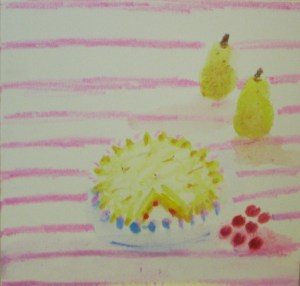
Original watercolor painting shows pear clafouti, dried cranberries, pears.

Pear Clafouti with Cranberries. 6″ x 6″ watercolor pencil on paper. Sharyn Dimmick.

What to make? I could roll out pie crust and make another pear tart tatin. But Johnny once said he wanted to elope with that when I served it at Ballad group, so it would be better to make that when he is around to enjoy it. Carly Sullivan had posted a recipe for clafouti that I had saved. I took a look at it again, and then adapted it for ingredients we had. Basically, I used white sugar instead of honey, milk and half and half instead of buttermilk, omitted the vanilla and added dried cranberries to the fruit layer, browned the butter and cooked the pears in it, throwing the sugar on top to caramelize, cooking it down until the mixture was fairly dry, giving the pears time to absorb butter, sugar, lemon, ginger and cranberry flavors. The cranberries made it pretty, too.

To make the clafouti I just made:

Preheat oven to 375 degrees.

Select 2 large yellow pears (or 3 smaller ones). Core and slice them thinly, but do not peel them: the skins help hold the pear slices together.

Melt 2 Tbsp butter over medium heat in a skillet, allowing the butter to brown, but not burn, before adding the sliced pears.

Sprinkle about 1/4 cup sugar over the top and jerk the skillet a few times so that the sugar gets distributed among the pears.

Allow mixture to cook down until the pears have released their liquid and the liquids have reduced to a thin caramel.

Turn off heat.

Add the juice of half a lemon, a generous grating of fresh ginger (use your microplane and grate directly over the fruit), a small handful of dried cranberries.

Pour the fruit mixture into a tart pan or pie plate.

Now make the batter:

Crack 3 eggs and whisk them.

Add 1/3 cup granulated sugar and whisk again.

Whisk in 1/2 cup whole wheat pastry flour

Add 1/4 cup half and half and 3/4 cup milk*

Add vanilla extract (I poured it into the cap from the vanilla bottle and used about half a capful).

Whisk until just blended.

Pour batter over prepared fruit in pan.

Bake for thirty-five minutes. Serve warm or cold, cut in pie-like wedges.

* Our standard milk is 1%. If you have whole milk, like Celi, just use a cup of whole milk — I added the half and half to make the milk richer, but you can make it with any kind of milk you have, including soy milk, nut milk or coconut milk.

Food Notes: This made a easy, delicious dessert, creamy and custardy with crisp, buttery edges. Cooking the fruit first on the stove meant no watery flavors. This would make an excellent Thanksgiving dessert if you are not utter traditionalists like we are, having to have pumpkin pie with whipping cream, made from the recipe on the Libby’s can, slightly modified. (We also make fruit pie of some description, cherry or apple or blueberry or mixed berry, depending on what is around).

The Lauren Project: Lauren is back in Santa Fe, still cooking up your recipes. Please be patient: we will announce the prize winners by the end of this month.
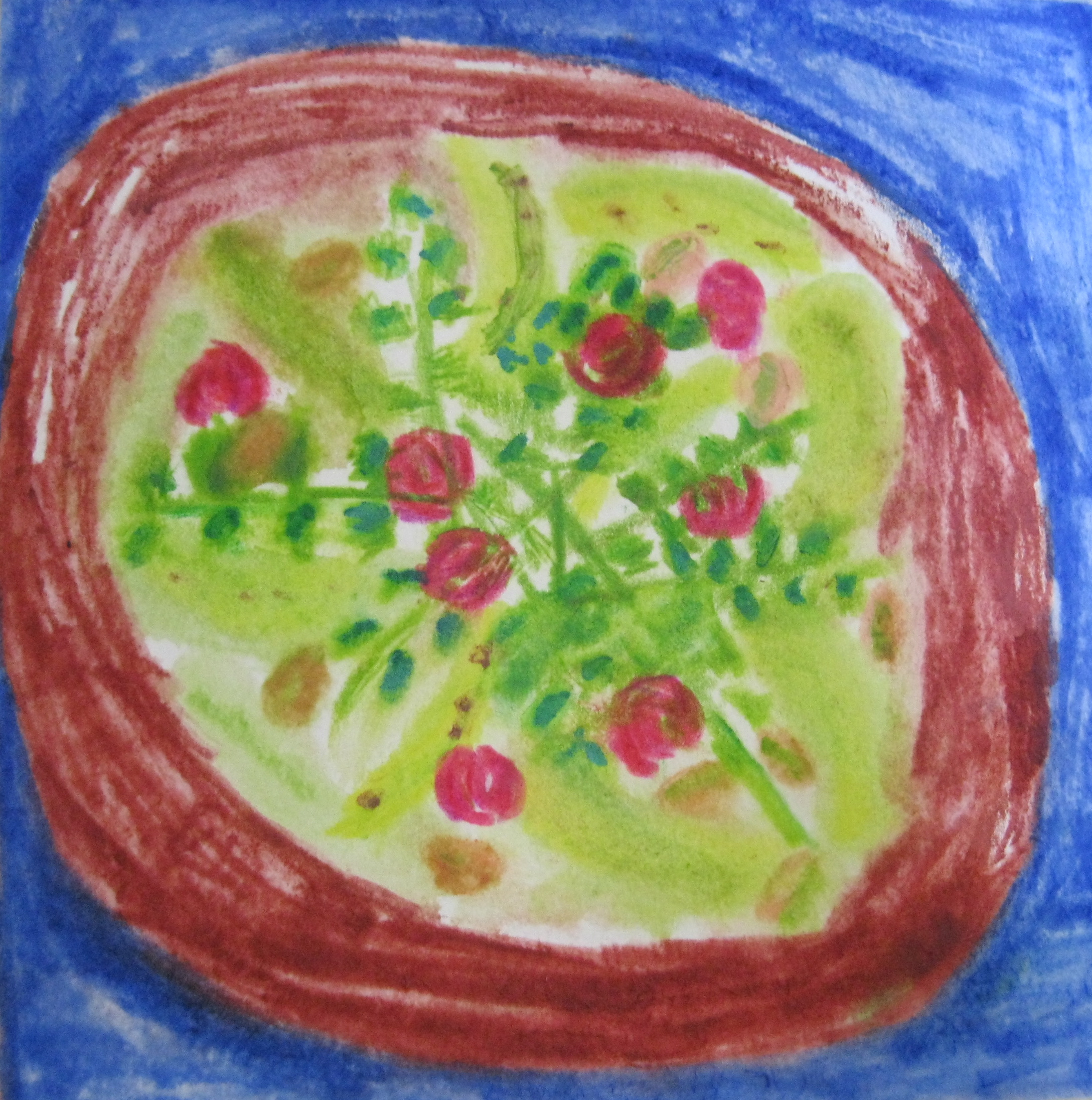
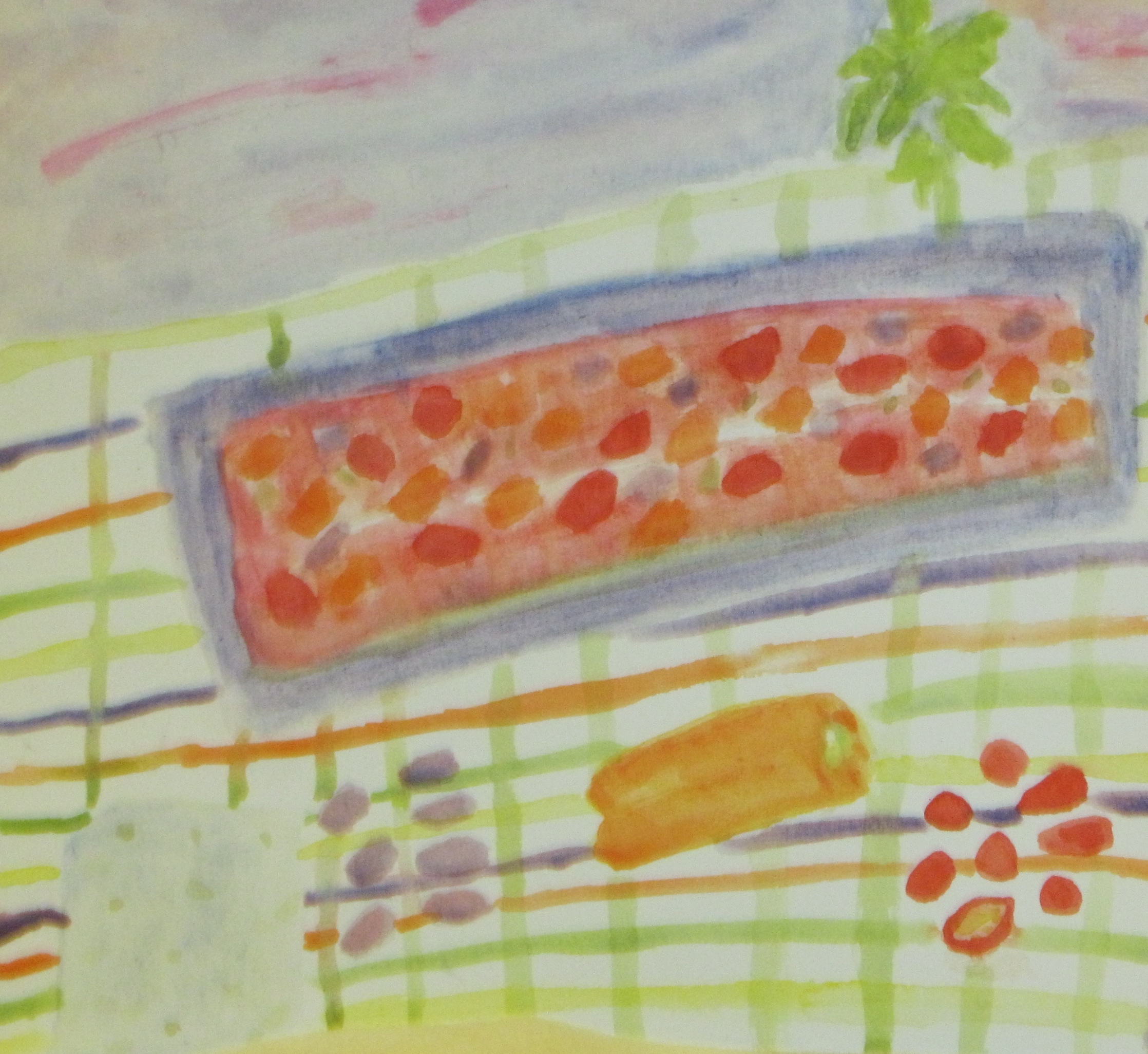
Watercolor painting of bowls of polenta, tomato, Martin guitar in green chair.

Johnny’s Polenta. 6″ x 6″ watercolor pencil on paper. Sharyn Dimmick.

Some of you know that I frequently eat polenta as a breakfast cereal during summer and early fall, cooking it in milk, stirring in a fresh peach or a handful of wild blackberries. Some of you know I have spent part of the summer flirting with a guitar player, wondering how much he liked me, being alternately elated and crushed as I went to play music at his house, attended band rehearsal, sang at a small festival in Santa Rosa, followed him up to another festival called Cur-Ville. You’ve seen me donning red dresses and trying to let go.

That phase has ended: the guitar player is mine now and, to prove it, spent the better part of the long weekend at my house. Mornings found us in the kitchen, brewing coffee, figuring out what to eat for breakfast. I cooked him eggs twice, scrambled with cheese and Gypsy peppers, served with sourdough toast. This morning I asked him what he ate for breakfast besides eggs. He mentioned a dish of polenta and various cheeses, topped with tomato and avocado.

We always have cornmeal, so I put on a pot of  salted water to boil and put out the cheese collection for Johnny to look at while I measured out a cup of cornmeal. He selected Red Leicester, a cheddar, and chopped it into small pieces.  I added some grated pecorino Romano. While the polenta was warm I added a chopped tomato. We tasted the polenta. He added a bit more cheese, I added a pinch of kosher salt and a healthy sprinkle of paprika and we had a beautiful golden breakfast, flecked with tomato red, Johnny’s gift to me and my gift to you.

After we ate, I did the dishes, dancing at the sink while Johnny sat in a green chair and played me Bruce Springsteen’s “Fire.” Occasionally, I turned around to look at him to sync my back-up vocals to his lead. Dishes have never been this much fun — who knew? All you need is a guitar-player in your kitchen to play songs for you while you wash and rinse. But you can’t have mine — he’s taken. Sorry.

If you want to make Johnny’s Polenta, measure water and cornmeal in a four-to-one ratio (I used four cups of water to one cup of cornmeal, but you could use one cup of water to a quarter cup if you want only one serving).

Add a bit of salt to the water — not too much, since you are going to be adding cheese later.

Boil polenta and water mixture until it has thickened to your liking. Remove from heat and stir in

Chopped and grated cheeses to taste : I used about 3 ounces of cheddar and 1 ounce of pecorino Romano.

Add one large chopped tomato.

Add 1/2 tsp of either sweet or hot paprika, depending on your proclivities: this adds wonderful color as well as a subtle flavor.

Taste and season as necessary. You will have to provide your own soundtrack for dish-washing.

Food Notes: You can make this with cornmeal or polenta, or even grits — whatever cereal-like corn product that you have hanging around. Lauren, if you are listening, you could swap some permitted vegetable for the contraband tomato and eliminate the cheddar, substituting some cheese you like, such as the cumin cheese we ate in France.

The Lauren Project: Thanks from Lauren and from me to all who sent recipes to the Lauren Project. Lauren is out in California, cooking up test batches of recipes. She and I will confer soon and announce the prize winners in an upcoming blog post. Before we complete the winners’ post we will contact our winner to ask what prize he or she desires. Then we will contact the second place finisher, third-place contestant, etc. until all prizes are awarded. Those of you who did not win will still be eligible for free shipping on any Kale Chronicles’ painting purchased by midnight December 31st, 2012.

First of all, let me remind you that The Lauren Project recipe contest will close at midnight Pacific time on August 31st. There is still time to get your entries in and become eligible for a potholder, a painting, a music CD, a cookbook. We have received a lot of exciting entries — Lauren may be testing some of them as I write this.

This has not been a big cooking week for me: I had two days of jury duty, getting up early and packing lunches of peanut butter on raisin bread, or turkey and cheese on whole wheat, chopping up watermelon to fit into Tupperware containers, gulping my morning coffee at the bus stop after spilling half of it on my way down the hill. When I got home I would be famished for tea, having missed our traditional afternoon tea break. My teeth are fine now, but Mom has a temporary cap, bridging three front teeth, and is eating soft foods again. Mom made chicken and noodles. Mom and I made ranger cookies, throwing in a little peanut butter that did not meet our standards for eating in sandwiches. The weather flip-flopped, cold one day and hot the next. Today I made two breakfasts, one for me and one for a guest: I ate rye flakes cooked with granola in milk; he got scrambled eggs with cheese and Gypsy peppers and sourdough toast (We had two eggs left and a heel of sourdough — otherwise I would have eaten eggs, too). Then, before lunch I roasted and chopped things for Baingan Bharta, which we had for dinner with basmati rice and plain yogurt. Lunch was a toasted whole wheat tortilla with cheese and chile paste — I hardly need to tell you how to make that.

Original watercolor painting shows Muhammara and ingredients.

Muhammara. 8″ x 8″ gouache and watercolor pencil on paper. Sharyn Dimmick.

The fall food palate includes corn and tomatoes still, green beans and cucumbers. Eggplant is in, along with plenty of peppers, both hot and sweet types. Is it cheating to tell you about something I will surely cook soon? Let’s talk about Muhammara.

Muhammara is a Middle Eastern spread of roasted peppers and walnuts, thickened with bread and flavored with cumin, garlic and pomegranate molasses. I make it in the fall when peppers come in and I still have fresh walnuts. Muhammara is good with toasted pita bread, grilled lamb sandwiches, celery sticks. I’ll eat it by the spoonful and run my finger along the empty bowl.

I first ate Muhammara at Zatar restaurant in downtown Berkeley. Muhammara has a lovely red-orange color and an intriguing flavor from the molasses, essentially pomegranate juice boiled down into a thick sweet and tart syrup. I learned to make it myself from Epicurious.com, but I messed with it a little.

If you have a glut of red peppers in your kitchen, roast them in the oven, rubbed with a little olive oil. Slip the skins by putting them in a glass bowl covered with a dish towel, letting them steam in their own heat.

Otherwise, open

1 jar of roasted red peppers. Discard the liquid and put the peppers into your blender.

Add 1 slice of bread. (French bread is good for this  — don’t use rye or raisin bread).

Chop and toast 1/3 cup walnuts

Add walnuts to the blender with

juice of 1 lemon

2 tsp pomegranate molasses

1 tsp ground cumin

1/2 tsp red pepper flakes

Mash 2 to 4 cloves of garlic with 1/2 tsp salt. Add to blender

Add enough olive oil to blend. The original recipe I found on Epicurious calls for a horrifying 3/4 cup. I would use 1/3 cup max, but suit yourself.

Whirl in blender until you have a thick red paste. Try to get it out of the blender before you actually start eating it!

I recently had some dental work done — after I lost my job a couple of years ago it didn’t seem too important to keep up visits to the dentist. I went last week. And I paid for it because Dr. Liu found a cracked tooth, a broken tooth and a cracked filling (but no tooth decay!). Last week he set to fixing all that. He adjusted a crown while he was at it. I have to go back to have the cracked tooth fixed after I get through with jury duty, which starts today. So, following on my anniversary post about The Lauren Project, I share with you some of the things I ate  — um, drank, since I could neither bite nor chew. It does give me empathy with those on restricted diets.

The first night following surgery I had a coffee milkshake, coffee ice cream whirled up in the blender with a little one percent milk. I was feeling pretty happy that I had an excuse to have one for dinner and even forbore to put Kahlua in it. By 9 PM I was hungry, however, and had to resort to a serving of coconut yogurt.

The next morning I was determined to eat something normal, so I cooked my usual breakfast of rolled oats in milk with a pinch of kosher salt, four walnuts and two teaspoonfuls of rhubarb compote (remember the rhubarb experiments?). I found even the amount of chewing required for oatmeal and walnuts to be unpleasant so I resolved to have liquid lunches and dinners for another day.

I got hungry again before 11:00 AM — I was up at 5:30 AM and had eaten at around 7:30 and had taken a little walk at 10:00. This time I set to work on a smoothie, consisting of a fresh mango and a container of strawberry yogurt with a pinch of crushed cardamom. Delicious, but after I had had a few sips I realized I was going to get tired of sweets fast.

What to do? I put aside the mango smoothie, rinsed the blender and decided it was time to try gazpacho.

This was kind of a big deal to me because have never liked tomato juice, Snappy-Tom, bloody Mary’s, or V-8 — can you say yuck? So I didn’t look up anybody’s recipe for gazpacho. We had cold soups when I was in France: my favorite one there incorporated melon, bacon and cream: it sounds gross, but it was really good.

Original watercolor painting shows tomatoes, cucumbers, gypsy peppers and lemon.

Greek Salad Vegetables, 6″ x 6″ gouache and watercolor pencil on paper. Sharyn Dimmick.

Anyway, then I thought of the delicious liquid that hangs out at the bottom of a bowl of Greek Salad. I decided my best shot at gazpacho was to make a Greek salad and liquify it. I proceeded to chop 2 heirloom tomatoes, 2/3 of a large, peeled Armenian cucumber, 2 Gypsy peppers (ranging from yellow through orange to red). I added 1 large pressed clove of garlic and a small handful of chopped, pitted Greek olives. Then I went out to front yard and picked the ripest Meyer lemon I could find on the tree.

I blended all that up. I tasted it cautiously, with the intention of adding feta cheese. But you know what? It didn’t need the cheese. It didn’t need oil or black pepper or salt or red pepper flakes or red wine vinegar. It didn’t need a single blessed thing. I encourage you to try it, even if you are afraid of all of those red, cold, tomato-based drinks, especially if you like Greek salad.

I had a glass of Greek gazpacho for lunch, followed by the rest of my strawberry-mango smoothie. I have another glass of gazpacho left for later, waiting for me in the refrigerator. And tonight I’ll probably indulge in another coffee shake — the only thing that would make it better would be if I had a stash of malted milk powder, but we haven’t seen it lately at Grocery Outlet.

What are your favorite things to eat when you have dental work? C’mon. ‘Fess up.

Original painting shows cherry plums, plum cake, plum caramel.

Plum Cake. 9″ x 12″ Gouache and Watercolor Pencil on Paper. Sharyn Dimmick.

Sometimes circumstances conspire to create an end. Today is my sister-in-law’s birthday and she is coming over to go out to lunch with my mother in Walnut Creek. Barbara likes plum cake. I had half a colander of fresh cherry plums on the counter and a jar of wild plum jam that I needed to use. I had just read David Lebovitz’s blogs on butterscotch sauce (which I am dying to make) and peach cobbler, plus a post on plum cake made with cornmeal from Two Peas and Their Pod. Barbara loves whipped cream. So what would I do? I would make the cornmeal-plum cake, adapting it a little to give it a more butterscotch-y flavor by substituting some evaporated cane juice for half a cup of the white sugar and I would use the jam to make some plum caramel to serve with the cake.

For the plum caramel, I followed a recipe from Chez Panisse Desserts, except, instead of cooking fresh plums, I just added plum jam (aka cooked plums) to the caramel base, cooked it for a few minutes and strained the results. You can make simple caramel by putting 1/2 cup of sugar in a saucepan with 2 Tbsp water and melting it over high heat, shaking the pan every now and then (do not stir). When it takes on a pale golden color, remove it from the heat and carefully add 1/4 cup water, not getting too close to the pan. You can stir now. If you are adding fruit puree to the caramel, add it now (this works with any berry or stone fruit), add it now and cook for a few minutes over medium heat. Strain out any solids or seeds that have slipped through, put your caramel in a clean jar in the fridge and you are good to go for later. Fruit caramel is less acidic and more complex than simple purees and is perhaps my favorite recipe I learned from this cookbook.

Now the cake. You can see the original here. Since cakes are not my favorite things I followed the recipe closely with just two substitutions (okay, three). First, I had medium eggs rather than large — they were organic and brown — so I threw in an extra one. Then, I had lots of cherry plums rather than the four or five large plums cited in the recipe. I already told you I put in 1/2 cup of evaporated cane juice for 1/2 cup of white sugar. Oops. Um. Four substitutions. I substituted a quarter cup of sour half and half for some of the buttermilk because, you know, we had it, and it is similar, but richer.

So, this is what you get when you put together all of those substitutions with the original recipe:

Barbara’s Birthday Plum Cake

Pit the cherry plums you are using (Or pit and chop larger plums into bite-sized pieces). Set aside.

Preheat oven to 350.

Measure 1 and 1/2 cups unbleached flour. After measuring sift it into a small mixing bowl.

Whisk into flour 1 tsp baking powder,

1/4 tsp cinnamon

1/8 tsp kosher salt

1/2 cup corn meal

Then soften 1 and 1/2 sticks of unsalted butter (12 Tbsp)

Cream butter with 1/2 cup granulated sugar and 1/2 cup evaporated cane juice until light and fluffy.

Add — one at a time — 4 medium eggs (or use three large), incorporating egg fully before next addition.

Measure 1/2 cup buttermilk (or 1/4 cup sour cream or sour half and half, plus 1/4 cup buttermilk, which is what I used).

Alternate flour mixture and buttermilk, in increments, starting and ending with flour.

Butter and flour a cake pan. I used a bundt pan because it looks festive.

Scrape half of the batter into the pan. Scatter plums over batter. Top with remaining batter.

Bake for fifty minutes. Test to see if it is done. In a bundt pan, my cake took one hour and five minutes to show some browning on the top and to pass the toothpick test.

Cool by hanging bundt pan on a glass bottle. This is fun. Trust me.

Serve with barely sweetened whipped cream and a pool or drizzle of plum caramel. If you are my sister-in-law, add more whipped cream. Enjoy.

Food Notes: Keeping to the art of substitution, you can use any sour thing for the buttermilk — yogurt, sour cream, creme fraiche, even sour milk. You can make the cake as originally suggested with all white sugar, or use all evaporated cane juice. You can probably use some other fruit for the plums, although the plums (with skins) provide a beautiful color and a nice tartness that plays well against the cake. The whipped cream provides yet another contrast (and besides, we like whipped cream when we are celebrating).

Watermelon pickle: I had a problem with the watermelon pickle — it wasn’t the recipe — it was me. so I’ll be trying it again with this week’s watermelon and report back on that later.

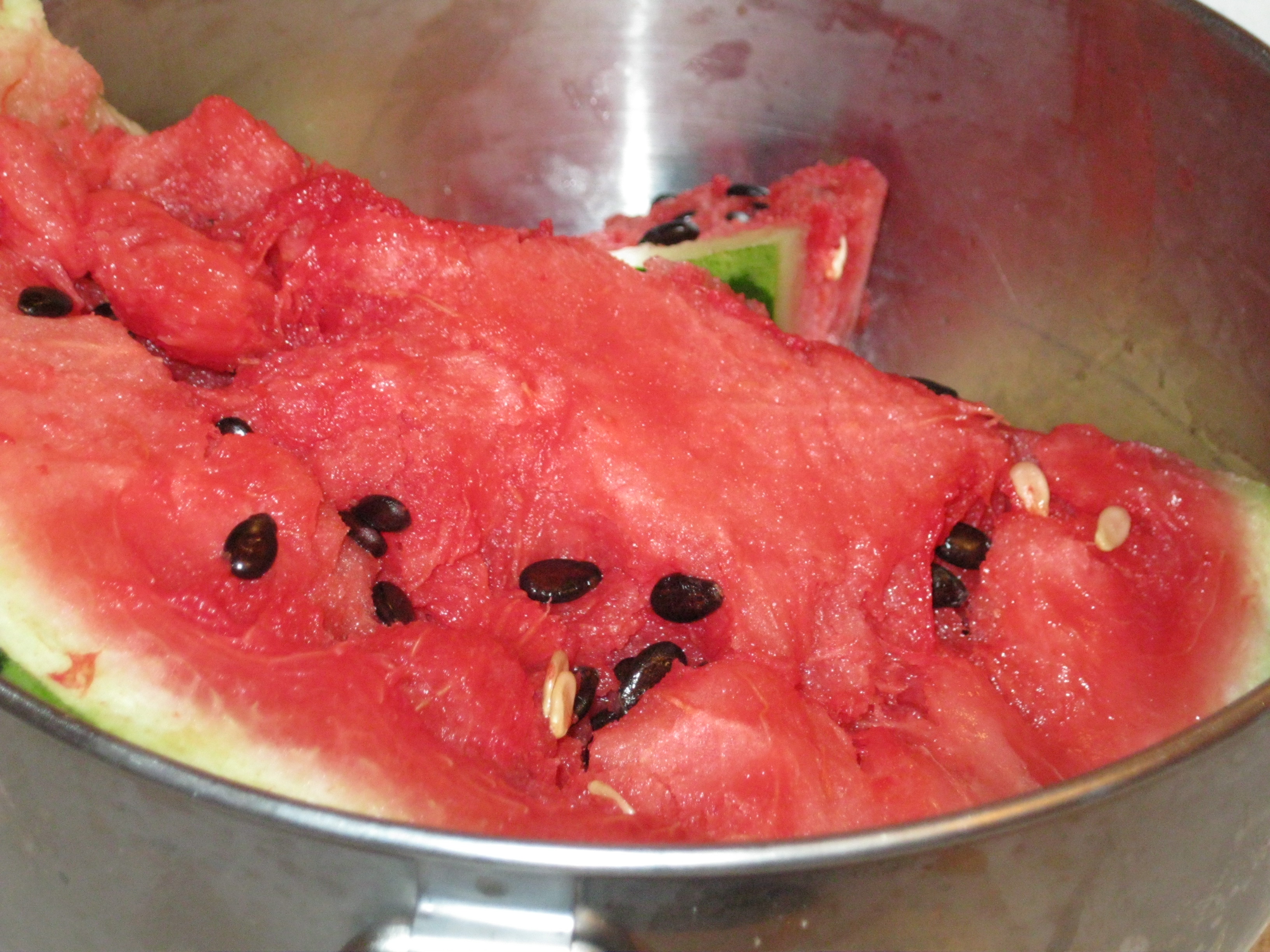
Photo of ripe red watermelon in steel bowl.

The one that got away — part of the watermelon that rolled off the counter.

On Wednesday I received a small watermelon from my Riverdog Farm CSA. Grown eighty-some miles away in summer heat, the melon was sweet and pink — I know because five minutes after I set it on the counter I heard an odd thunk: it had rolled off the counter and split open when it hit the floor. There would be no saving this watermelon for later. I picked it up, washed it off and tasted it. Good. Then I set it aside for a few days as the temperature took a nosedive and the fog rolled in to stay — who wants to eat watermelon in fifty-degree weather?

Fortunately, I had a plan for some of this watermelon: when I bought my Nesco American Harvest dehydrator the booklet contained this sentence: “Cantaloupe and watermelon slices become candy-like when dried.” Candy-like. Hmm. Then Krista and Jess reported on their dried watermelon chips. I knew I had to try it when watermelon came along again.

I spent an hour in the kitchen this morning, cutting 1/2 inch thick slices of watermelon, removing the seeds and cutting the rind away. The easiest way to do this proved to be to cut a slice and then slice through the melon perpendicular to the rind to produce small batons or wedges and then to cut the rind away. After half an hour of this, I noticed that I was developing a neat pile of watermelon rind.

Now, I am one of those people that, if you give her a slice of watermelon, will eat deep into the rind. Watermelon rind reminds me of cucumber with no bitterness and no seeds. And yet, because Mom doesn’t can, I have never made watermelon rind pickles. I called her into the kitchen and asked, “Back in the day when you ate watermelon pickles, were they sweet or sour?”

“Not sweet enough,” she said.

“Sort of like bread and butter pickles?” I asked.

“Not as good,” she said.

She told me to look in the old Mowequa cookbook, but I headed upstairs to check my saved blogs file. Not too far into the seven hundred recipes I had saved was Natalie’s recipe for watermelon pickle. I have started to make it and will report on the results on Wednesday.

Painting depicts apple pie ingredients: flour, butter, apples, cinnamon, nutmeg.

Gravenstein Apple Pie 8″x8″ gouache and watercolor pencil Sharyn DImmick

Things to make right now: Gravenstein apples are in! Ann and I picked a big bowlful of them from a yard in Berkeley and Mom made our first Gravenstein apple pie of 2012. I cannot say enough good things about this pie so if you are lucky enough to live within range of Gravenstein apples, by all means, get some. Bernie at the Berkeley Farmers’ Market has them right now if you don’t want to forage for them, or if you need more. I also made zucchini-feta pancakes this week. This time I threw a little leftover pesto with the fresh herbs and feta — it’s a delicious variation. As I write this I have another peach and plum crisp in the oven, this time made with white and yellow peaches and little cherry plums from someone’s backyard tree. And two days ago I made this tomato tart, again with lemon cheese, but with brown mustard and shredded tarragon. And of course this is a good time for Deborah’s somewhat famous tomato platter or Greek salad, with tomatoes and cucumbers in the market and peppers beginning to come in.

Photo of watermelon candy, aka dried watermelon

Watermelon candy in the dehydrator.

The watermelon candy is small and sticky — it reminds me of dried tomatoes, only sweeter and pinker. I was catching up on my sleep today after nearly a month of periodic insomnia so I didn’t take the time to do a new painting. Instead I offer you photos of watermelon and watermelon candy.

Original watercolor painting shows bowl of fruit salsa and ingredients.

Peach-Plum-Corn Salsa. 6″ x 6″ watercolor pencil on paper. Sharyn Dimmick.

I have my foot in several art camps: I hang out with writers at retreats. I meet regularly with groups of local folk musicians. And this past weekend I had the opportunity to attend to wrap-up party for the July 2012 Caerus Artist Residency in Sonoma County with my best friend (and Caerus co-founder) Suzanne Edminster.

I prepared a dish of fresh peach, plum and corn salsa, inspired by this recipe, and bought some blue and yellow gluten-free corn chips at the Santa Rosa Safeway. When I got to the party, the hostess gave me a bowl for the chips and I put my old, scarred Tupperware container on the table next to them. Other guests arrived, bringing fruit pies, buffalo wings, blackberry-apple crostata, pasta and green salads. The table held napkins, plastic forks and knives and paper plates.

I am used to folk music parties, which go something like this. Each person arrives and plunks something homemade or store-bought on a central table, greeting each other and often asking, “What did you bring?” Once people have dispensed with kitchen chores and stowed their instrument cases we take seats around the table and begin to chat and eat. It is only after we have served ourselves food and talked for awhile that someone will say, “Bill, do you have a song?” Or a late arrival will ask, “Have you been singing?” We say. “No, we’re still eating,” or “We haven’t sung a note.”

Musicians are always hungry. They congregate in kitchens where the acoustics are good, leaning against the counters. Opera singers cannot eat much before a performance, but feast afterwards — it doesn’t feel good to sing on an overly full stomach.  After a performance you are high on music, full of energy and ravenous.

Eventually at music parties everyone has had her fill and we start to sing, often taking turns going around the table. Some of us have tradtitional places or chairs we like to sit in. If it is big party, the tune-players will slip away to other rooms, leaving the singers to themselves. If it is a small gathering we will remain around the table all day.

The Caerus artists behaved differently. They sat their dishes on the table and started looking around. Some looked for places to display their art: an easel, a window seat, the edge of a wall. Most of them did not seem in a hurry to eat: they wanted to wander around and look at the art as though they were at an opening, carrying their small plates and congregating in groups of two or three. They ate alright, but they ate on the fly. My friend Suzanne says artists graze. I say that they are too busy to look around to eat seriously, but they will notice if the food is beautifully presented and admire serving dishes and particular utensils. These may be the people who say, “That looks too pretty to eat.” To a folk musician, there is no such thing as “Too pretty to eat” or “Too ugly to eat” either — if it is edible, someone will eat it.

At the Caerus party I parked myself in a chair next to the table (old habits die hard) and had conversations with whoever happened by. I stood out by not standing.

In case you are wondering what writers do at parties, in my experience they hug the table and yack: telling stories is the next best thing to writing them or reading them. And, in case you are waiting for a recipe, this is how I made the salsa.

Fresh Peach, Plum and Corn Salsa:

Chop 2 medium plums and 1 yellow peach into bite-sized pieces. Place in a medium-sized bowl.

Squeeze juice of 1 lime over the fruit.

Lightly steam two ears of corn and cut the corn from the cobs. Add corn to bowl.

Chop half a bunch of cilantro into mixture

Finely dice a small red onion. Add to bowl.

Cut 1 jalapeno pepper in half. Discard half of the ribs and seeds, reserving the other half. Mince the reserved ribs, seeds and jalapeno flesh. Mix thoroughly and allow several hours for the flavors to blend.

Food notes: I used Santa Rosa plums, a yellow peach and two ears of yellow corn, but you can use any plums, peaches or corn that you like. If jalapenos are too hot for you, discard all of the ribs and seeds before using and up the quantities of fruit and corn. If you freak out at cilantro or are allergic to it, substitute mint or fresh basil. And, of course, you can make it more acid by using more lime, more piquant with more onion. It would be delicious in a corn and cheese quesadilla or served alongside grilled chicken or fish. The original recipe calls for cumin, which I love — I just forgot to put it in this time.

Original watercolor painting shows fruit crisp and ingredients.

Peach and Plum Crisp. 8″ x 8″ Gouache and acquarelle on paper. Sharyn Dimmick.

I am not the most informed person in the world: I find that reading a daily paper depresses me and paralyzes me with all that I don’t know and all that I can’t do about things. I watch Bill Moyers on PBS and occasionally dip into The Newshour. I read a local weekly rag, The East Bay Express, sometimes focusing on the astrology column and the restaurant reviews, although I usually read the cover story. Other than that, I get my news from Facebook updates and a few chosen sources that I subscribe to.

Because of that, I learned about the movie theater shootings in Colorado on Facebook on Friday afternoon. A friend of mine, Deby Dixon, posted a link to a blog she wrote about the brevity of life and the importance of following your dreams while you have time and health because none of us know when our life will be cut short, when our health will fail, when life or death will intervene in some unexpected fashion. Deby wondered if some of the people in Colorado died wishing that they had gotten to some dream of theirs. Deby’s story and her reflections moved me to tears and I asked permission to share it with you. You’ll find her post here, along with some of her photographs: Deby is traveling and photographing the beauty and majesty of our national parks.

What do you do when life smacks you down, when you suffer a loss? You grieve. You tell the story to others. You seek comfort. Perhaps you seek to comfort others. What comforts me in my most dire straits is beauty. Which is not to say that beauty makes me feel all better right way: beauty breaks open the heart, opening it up to the full catastrophe of grief, but beauty also helps you bear having your heart open in its pain. Beauty is a reminder that in the face of loss there are moments of great beauty and tenderness, that we are in this together, that the sun rises even on our worst day, scattering light through the atmosphere. Sometimes it doesn’t seem fair that the sun is shining — how can it be when we have suffered such a blow?

How to deal with a tragedy on a food blog? When you are grieving, it can be hard to eat. But you need to eat. In my hardest times I have found it was easier to eat with other people, that I could eat a few bites in the company of a trusted friend if I could not eat alone. So my recommendation for you this weekend is that you find some way to share a meal with someone else. It could be a version of David Lebovitz’s tomato tart.

You could go to a potluck and bring a loaf of bread, a dessert. a salad. What matters is that you eat with others to ease your hearts and theirs. And that someone puts something beautiful on the table: a vase of flowers, a special tablecloth, a rose from the yard, a silver pitcher, a photo of your best beloved.

Original ink and watercolor sketch of old Harmony guitar.

Harmony Guitar #3. 5″x 7″ ink and watercolor on paper. Sharyn DImmick

After I heard about the shooting in Colorado I spent a few hours sketching my old Harmony guitar that I got from a pawn shop in San Francisco. I listened to music as I worked. The Harmony is beat up, but has a sweet tone: to me it is beautiful. I share it with you and I urge you to look at Deby’s photographs and, possibly, to listen to some music you love, hymns or loud rock and roll — it matters only that you love it.

A simple seasonal dessert we have been eating lately around here is mixed peach and plum crisp. I’ve been making it with fresh Santa Rosa plums (both from the farm box and from my sister-in-law’s tree in Vallejo) and fresh peaches from Frog Hollow Farm. I usually use a Betty Crocker apple crisp recipe for the proportions of the topping ingredients and make the topping with rolled oats, unbleached and whole wheat flours, butter, brown sugar, nutmeg and cinnamon, but a few weeks ago I made a gluten-free version to take to a party: what I did was use more oats and substitute a couple of tablespoons of cornstarch for the flour (Oats are gluten-free if you make sure to buy oats that have not been processed in a facility that also processes wheat and other grains). You can make it either way. I usually make it in an 8″ x 8″ Pyrex pan, but sometimes I double the topping amounts, use more fruit and bake it in a 9″ x 13″ pan.

Gluten-Free Peach and Plum Crisp

Preheat oven to  350.

Slice enough fruit to cover the bottom of an 8″ x 8″ square pan. If you have small plums, it might take a whole bag; if you have average plums, use four or five, plus four or five peaches.

Combine 1 cup gluten-free rolled oats and 2 heaping tablespoons cornstarch.

Add 1/2 cup  brown sugar, plus nutmeg and cinnamon to taste.

Cut in 1/3 cup butter.

Sprinkle topping over fruit.

Bake for 35 minutes or until sufficiently browned to suit you.

Serve with creme fraiche, whipped cream, burnt caramel ice cream, or just with a little milk or cream drizzled on top. Share with someone.

For the standard version, use 1/2 cup of flour, 1/2 cup of rolled oats and the same amounts of butter, brown sugar and spices as above and follow the same baking and serving instructions.

Yes, I am still here (I haven’t decamped for France again), but I thought you might enjoy a special tomato season treat, a guest post from my friend Deborah Sandler.

Deborah Sandler has enjoyed California’s bounty of fresh local food since arriving here in 1979, and swears never to live anywhere else because the food is so good.  She loves to cook and to feed people, and often tells her guests, “Nobody goes hungry at my house!” Deborah is a Farmer’s Market freak, often attending at least two a week, year round, rain or shine, on the lookout for whatever is in season and at its best.  Tomatoes are one of her favorite foods, and she shares one of her tomato recipes here.  When she isn’t cooking, she sings, and practices family law (while making sure to bring her office-mates lots of fresh food, because nobody goes hungry in her office either).

Original watercolor painting shows platter of tomatoes, olives, basil, feta cheese.

“My Somewhat Famous Tomato Platter.” (after Deborah Sandler). 8″ x 8″ Acquarelle on Paper. Sharyn Dimmick.

Tomatoes are finally in season!  I yearn for them during the winter, and sometimes am seduced into buying hothouse tomatoes that look lovely but do not have the texture or zing of the real thing.  When you bite into a tomato that has been locally grown, recently picked, and never refrigerated, the flavor is huge and unmistakeable.  When I was growing up on the East Coast, tomatoes came wrapped in plastic, colored a sickly pink, four to a package, all exactly the same size and shape, firm and tasteless.  I lived in the suburbs, and didn’t know anyone who was growing tomatoes, so it was quite rare that I got to taste a real tomato.  That changed once I moved to California.  Many of the restaurants featured amazing tomatoes in their salads, and friends actually grew some in their yards.  I had no idea a tomato could look, smell or taste like this!  In recent years, heirloom tomatoes have appeared all over the place, stunning in their profusion of shapes, colors and flavors.  Their names are poetic and whimsical – here are just a few examples from one web site that sells seeds for them, and from my  local Farmer’s Markets:  Arkansas Traveler, Banana Legs, Bloody Butcher (ew!), Cherokee Purple, Black Russian, Dingwall Scotty, Green Zebra (and yes, these have stripes), Halfmoon China, Hank (hey, that’s my dog’s name!), Jersey Devil, Berkeley Tie-Die, Brandywine, Mortgage Lifter, Mr. Stripey, Nebraska Wedding, Yellow Pear, and Stump of the World.

I live in Contra Costa County in the San Francisco Bay Area, about 30-45 minutes inland from the ocean and from San Francisco.  For those not in California, that means that the climate here is far different from that in San Francisco.  Where the City might be 62 degrees and foggy on a summer afternoon, here it may be over 100 degrees and sunny.  We get some of the San Francisco fog, but not much.  The down side is that our winters are colder, foggier, and danker than those in San Francisco.  We are only an hour from the Central Valley, which runs down through the center of the state, and where much of the nation’s produce is grown.  Even closer is Brentwood, a major agricultural area just to the east of us, that features plenty of U-Pick farms and orchards, as well as farm stands.  Because our local weather is so warm, plenty of people around here grow their own produce, and some even sell at the local Farmer’s Markets.  Here is a partial but by no means exhaustive list of Farmer’s Markets within 15-30 minutes of my house:  Martinez Sunday morning (I think this is now year-round), Martinez Thursday mornings, Concord Tuesday afternoons (year round), Concord Thursday evenings, Pleasant Hill, Lafayette, Moraga, Danville, Orinda, Walnut Creek Saturdays at The Shadelands and Sundays on Locust Street (more on these below), Martinez at the Contra Costa County Regional Medical Center, Walnut Creek Kaiser, Concord High School, and the list goes on.

My favorites are the Walnut Creek Saturday morning market at The Shadelands, and the Walnut Creek Sunday morning market on Locust Street.  Both are very large, with over 40 vendors,  and both are year-round.  The Saturday market is only a few years old but already bustling with happy patrons.  The Sunday market has been there over 20 years, and most of that time I’ve been there.  The vendors there have watched my kids grow up, and know me well as one of their regulars.  At The Shadelands, my favorite tomato vendor is Swank Farms, which has several tables strewn with all sorts of heirloom tomatoes every week.  At the Sunday market, I like Roseland Farms, where the seller has numerous flat boxes of heirlooms sorted by color.  He also is one of the very few vendors that sells San Marzano tomatoes, one of the world’s best cooking tomatoes.  These last weeks sitting out on the table, cook into very flavorful sauces and soups, or can be sliced into salads as firm yet flavorful dependable little oblong beauties.  Roseland Farms also has a big pile of cherry tomatoes of all kinds, and you can grab them by the handful or pick them out one by one.  The Shadelands market had a map with push pins, showing the location of each vendor, and how far away their farm is from the market site.  The average distance they come is only 89 miles.  The average distance food travels to our supermarkets is 1,500 miles.  The map had a sign on it reading, “Choose the food less traveled!”

Here is one of my favorite things to do with tomatoes.  This is my somewhat famous tomato platter.  Amounts are approximate.  I made this up, and it doesn’t have official amounts of anything.  Mess around with this as much as you want, and change it to your taste. The secret is the freshness of the ingredients.  And do not ever refrigerate tomatoes – it destroys their flavor!  Slice several heirloom tomatoes (as many colors as possible) onto a large platter in several layers.  You can make patterns of color or just do it randomly.  Chop up a handful or two of feta cheese and sprinkle that over the tomatoes.  Then sprinkle a generous handful or two of olives over that.  Lately I use mixed Greek olives from Whole Foods, and I recommend you not use olives from a jar – get fresh ones from an olive bar if you can.  If you have fresh heirloom cherry tomatoes in several varieties, sprinkle a handful of those over the top. Then chop up a generous handful or two of fresh basil leaves and sprinkle that over the top and around the platter.  The vinaigrette I use is homemade, and is quite tart, so you may want to try it separately before using it here, to adjust for taste if you want. This reverses the usual proportions in a vinaigrette, and has 2 parts vinegar to 1 part oil.  1-1/2 T best quality olive oil, 3 T red or white wine vinegar, 10-15 shakes of salt, 10-15 grinds of fresh ground pepper or 3 or 4 shakes of coarse ground black pepper, 2 or 3 shakes of granulated garlic, 2 or 3 shakes of dried mustard. Mix thoroughly and pour over the tomato platter, serve immediately.

I was excited to see rhubarb at the Berkeley Farmers’ market last Saturday — I think it is the first time I have seen it there. I had seen a delicious-looking recipe for a rhubarb-cherry crumble with fresh ginger on local kitchen, one of the blogs I always enjoy reading. Kaela preserves a wonderful variety of jams, pickles and marmalades. Here was a crisp that I could tackle easily with cherries in season.

I have had few encounters with rhubarb in my life. My mother never cooked it at home, although she ate it as a child in Illinois. Neither of us like cooked strawberries, preferring to eat them raw, so strawberry-rhubarb pie is not in our pie arsenal. I once ate some rhubarb pie at a doll class potluck — the baker thought its pink color was particularly appropriate for a group of women artists. While I didn’t have to choke it down, I didn’t jump for joy and ask for the recipe either.

Now, if rhubarb grew abundantly in our yard or if a neighbor left baskets of it on our porch I would figure out how to make it palatable or resort to ferreting out all of my rhubarb-loving acquaintances and foisting it on them. Riverdog Farm has not included it in a box in the last five years either. But a couple of years ago I had had my best encounter to date with rhubarb: Toni, who grows it in her Oakland yard, smothered it with brown sugar, dried fruit, nuts and sweet spices, popped it into the oven and roasted it. The result was brown and syrupy and sweet. But when I asked her for the recipe this year she could not remember ever making it that way, a brilliant improvised recipe lost to the world.

When I bought the rhubarb last week, I tasted it cautiously at the bus stop, breaking a small piece off the end of a raw stalk. How sour would it be? I am happy to report that it didn’t lock my jaw. The taste reminded me of chewing sour grass when I was a kid, faintly reminiscent of lemon and green plants. But rhubarb is one of those things like quince — most people do not eat it raw. Cooking transforms it, but tasting it raw does not help you plan how to cook it.

painting shows rhubarb in various preparations.

Rhubarb Experiments. 8″ x 8″ Gouache and Watercolor Pencil. Sharyn Dimmick.

This morning I turned to the guidelines of other cooks: what have they done with it? Well, they boil it with sugar, raw or white or brown. They stew it with prunes and apricots. They combine it with strawberries in pies and compotes and jam. Enterprising cooks use it in sauces for roast pork. I hunted through some cookbooks for awhile. Then I cut and measured my remaining rhubarb: I had three cups left.

Fine. Enough for three small experiments. Experiment #1, rhubarb roasted with vanilla bean and Creme de Cassis, suggested by The San Francisco Ferry Plaza Farmers’ Market Cookbook. Experiment #2, rhubarb cooked down to a syrup, a variation on Heidi Swanson’s Rhubarb and Rosewater Syrup recipe. Experiment #3, rhubarb cooked in a compote with dried fruit, adapted from the Eat Fresh, Stay Healthy cookbook, an offering from the used book sale at the Kensington Library.

Experiment #1, the roasted rhubarb, smelled wonderful, both before and after baking, from the perfume of the vanilla bean and the Creme de Cassis. This rhubarb, mostly pale green with red ends remained green after roasting. The syrup has a slight dark red tinge. I tasted the result cautiously, one piece on a small spoon. It is delicious. The white sugar, vanilla and black currant liquor have mellowed the rhubarb into something tasty: I could eat it straight from a bowl, topped with cream, milk, half and half or yogurt, or I could mix it into cereal.

Experiment #2, rhubarb syrup, essentially rhubarb simmered in a simple syrup to which I added a vanilla bean, tasted good, with just a hint of rhubarb flavor. I used 1 cup of rhubarb, 1 cup of sugar, 1 cup of water and 1/2 of a vanilla bean. I let the rhubarb marinate in the sugar for a couple of hours before I added the water and brought it to a simmer. I strained the syrup from the cooked rhubarb. It came out blush pink. I tried an ounce of it in about four ounces of sparkling water with lime. I also tried an ounce of it in some cold tea. I’ll eat the leftover sweetened rhubarb puree with some light cream for dessert some night this week, or stir it into my morning cereal. It is too early in the day to put some of the syrup in a glass of sparkling wine, but I may get to that.

Experiment #3, the compote, may be the least successful. I simmered 3/4 cup dried prunes and 1/4 cup dried apricots in a cup of water with some nutmeg, fresh ginger and 1/3 cup of sugar before adding the rhubarb for five or six minutes. The problem with this is that the rhubarb has not absorbed the flavors before it begins to break down. But it may taste better tomorrow after sitting — compotes often do. I tasted it warm.

I brought the rhubarb-cherry crumble to a singing session on Friday. Some people liked it. I was disappointed. The color was lovely: the rhubarb and cherries melded into a deep red. The fruit proved to be too sweet for my tastes (I was afraid to scant the sugar due to my inexperience with rhubarb preparations) and there was an off-putting flavor, which I believe was the taste of the rhubarb. I made a crumb topping with butter, homemade granola (not very sweet), brown sugar and a few tablespoons of flaked coconut. I thought the topping was also too sweet and will go back to using plain rolled oats in crisp topping (Local Kitchen’s recipe calls for a gluten-free topping with  brown rice flour, oats, butter, and flax seed).

Food notes: If you are a confirmed rhubarb lover and have no fear of canning, you might want to try Local Kitchen’s rhubarb prosecco jelly. It’s the sort of thing I would love to have a taste of, but would not want to commit to making it unless I had tasted it first. Disclaimer: I have been exercising a lot lately, which might be why the sweet rhubarb syrup, roasted rhubarb and puree suddenly tasted great…

P.S. I mixed rhubarb compote into my blue corn cereal this morning and it was just fine: with the heat of the cereal, the cooked rhubarb melts into the compote and what you get is a spicy syrup. And rhubarb syrup in water is nice on a hot day.