Archives for category: seasonal recipes

Yes, I am still here (I haven’t decamped for France again), but I thought you might enjoy a special tomato season treat, a guest post from my friend Deborah Sandler.

Deborah Sandler has enjoyed California’s bounty of fresh local food since arriving here in 1979, and swears never to live anywhere else because the food is so good.  She loves to cook and to feed people, and often tells her guests, “Nobody goes hungry at my house!” Deborah is a Farmer’s Market freak, often attending at least two a week, year round, rain or shine, on the lookout for whatever is in season and at its best.  Tomatoes are one of her favorite foods, and she shares one of her tomato recipes here.  When she isn’t cooking, she sings, and practices family law (while making sure to bring her office-mates lots of fresh food, because nobody goes hungry in her office either).

Original watercolor painting shows platter of tomatoes, olives, basil, feta cheese.

“My Somewhat Famous Tomato Platter.” (after Deborah Sandler). 8″ x 8″ Acquarelle on Paper. Sharyn Dimmick.

Tomatoes are finally in season!  I yearn for them during the winter, and sometimes am seduced into buying hothouse tomatoes that look lovely but do not have the texture or zing of the real thing.  When you bite into a tomato that has been locally grown, recently picked, and never refrigerated, the flavor is huge and unmistakeable.  When I was growing up on the East Coast, tomatoes came wrapped in plastic, colored a sickly pink, four to a package, all exactly the same size and shape, firm and tasteless.  I lived in the suburbs, and didn’t know anyone who was growing tomatoes, so it was quite rare that I got to taste a real tomato.  That changed once I moved to California.  Many of the restaurants featured amazing tomatoes in their salads, and friends actually grew some in their yards.  I had no idea a tomato could look, smell or taste like this!  In recent years, heirloom tomatoes have appeared all over the place, stunning in their profusion of shapes, colors and flavors.  Their names are poetic and whimsical – here are just a few examples from one web site that sells seeds for them, and from my  local Farmer’s Markets:  Arkansas Traveler, Banana Legs, Bloody Butcher (ew!), Cherokee Purple, Black Russian, Dingwall Scotty, Green Zebra (and yes, these have stripes), Halfmoon China, Hank (hey, that’s my dog’s name!), Jersey Devil, Berkeley Tie-Die, Brandywine, Mortgage Lifter, Mr. Stripey, Nebraska Wedding, Yellow Pear, and Stump of the World.

I live in Contra Costa County in the San Francisco Bay Area, about 30-45 minutes inland from the ocean and from San Francisco.  For those not in California, that means that the climate here is far different from that in San Francisco.  Where the City might be 62 degrees and foggy on a summer afternoon, here it may be over 100 degrees and sunny.  We get some of the San Francisco fog, but not much.  The down side is that our winters are colder, foggier, and danker than those in San Francisco.  We are only an hour from the Central Valley, which runs down through the center of the state, and where much of the nation’s produce is grown.  Even closer is Brentwood, a major agricultural area just to the east of us, that features plenty of U-Pick farms and orchards, as well as farm stands.  Because our local weather is so warm, plenty of people around here grow their own produce, and some even sell at the local Farmer’s Markets.  Here is a partial but by no means exhaustive list of Farmer’s Markets within 15-30 minutes of my house:  Martinez Sunday morning (I think this is now year-round), Martinez Thursday mornings, Concord Tuesday afternoons (year round), Concord Thursday evenings, Pleasant Hill, Lafayette, Moraga, Danville, Orinda, Walnut Creek Saturdays at The Shadelands and Sundays on Locust Street (more on these below), Martinez at the Contra Costa County Regional Medical Center, Walnut Creek Kaiser, Concord High School, and the list goes on.

My favorites are the Walnut Creek Saturday morning market at The Shadelands, and the Walnut Creek Sunday morning market on Locust Street.  Both are very large, with over 40 vendors,  and both are year-round.  The Saturday market is only a few years old but already bustling with happy patrons.  The Sunday market has been there over 20 years, and most of that time I’ve been there.  The vendors there have watched my kids grow up, and know me well as one of their regulars.  At The Shadelands, my favorite tomato vendor is Swank Farms, which has several tables strewn with all sorts of heirloom tomatoes every week.  At the Sunday market, I like Roseland Farms, where the seller has numerous flat boxes of heirlooms sorted by color.  He also is one of the very few vendors that sells San Marzano tomatoes, one of the world’s best cooking tomatoes.  These last weeks sitting out on the table, cook into very flavorful sauces and soups, or can be sliced into salads as firm yet flavorful dependable little oblong beauties.  Roseland Farms also has a big pile of cherry tomatoes of all kinds, and you can grab them by the handful or pick them out one by one.  The Shadelands market had a map with push pins, showing the location of each vendor, and how far away their farm is from the market site.  The average distance they come is only 89 miles.  The average distance food travels to our supermarkets is 1,500 miles.  The map had a sign on it reading, “Choose the food less traveled!”

Here is one of my favorite things to do with tomatoes.  This is my somewhat famous tomato platter.  Amounts are approximate.  I made this up, and it doesn’t have official amounts of anything.  Mess around with this as much as you want, and change it to your taste. The secret is the freshness of the ingredients.  And do not ever refrigerate tomatoes – it destroys their flavor!  Slice several heirloom tomatoes (as many colors as possible) onto a large platter in several layers.  You can make patterns of color or just do it randomly.  Chop up a handful or two of feta cheese and sprinkle that over the tomatoes.  Then sprinkle a generous handful or two of olives over that.  Lately I use mixed Greek olives from Whole Foods, and I recommend you not use olives from a jar – get fresh ones from an olive bar if you can.  If you have fresh heirloom cherry tomatoes in several varieties, sprinkle a handful of those over the top. Then chop up a generous handful or two of fresh basil leaves and sprinkle that over the top and around the platter.  The vinaigrette I use is homemade, and is quite tart, so you may want to try it separately before using it here, to adjust for taste if you want. This reverses the usual proportions in a vinaigrette, and has 2 parts vinegar to 1 part oil.  1-1/2 T best quality olive oil, 3 T red or white wine vinegar, 10-15 shakes of salt, 10-15 grinds of fresh ground pepper or 3 or 4 shakes of coarse ground black pepper, 2 or 3 shakes of granulated garlic, 2 or 3 shakes of dried mustard. Mix thoroughly and pour over the tomato platter, serve immediately.
I was excited to see rhubarb at the Berkeley Farmers’ market last Saturday — I think it is the first time I have seen it there. I had seen a delicious-looking recipe for a rhubarb-cherry crumble with fresh ginger on local kitchen, one of the blogs I always enjoy reading. Kaela preserves a wonderful variety of jams, pickles and marmalades. Here was a crisp that I could tackle easily with cherries in season.

I have had few encounters with rhubarb in my life. My mother never cooked it at home, although she ate it as a child in Illinois. Neither of us like cooked strawberries, preferring to eat them raw, so strawberry-rhubarb pie is not in our pie arsenal. I once ate some rhubarb pie at a doll class potluck — the baker thought its pink color was particularly appropriate for a group of women artists. While I didn’t have to choke it down, I didn’t jump for joy and ask for the recipe either.

Now, if rhubarb grew abundantly in our yard or if a neighbor left baskets of it on our porch I would figure out how to make it palatable or resort to ferreting out all of my rhubarb-loving acquaintances and foisting it on them. Riverdog Farm has not included it in a box in the last five years either. But a couple of years ago I had had my best encounter to date with rhubarb: Toni, who grows it in her Oakland yard, smothered it with brown sugar, dried fruit, nuts and sweet spices, popped it into the oven and roasted it. The result was brown and syrupy and sweet. But when I asked her for the recipe this year she could not remember ever making it that way, a brilliant improvised recipe lost to the world.

When I bought the rhubarb last week, I tasted it cautiously at the bus stop, breaking a small piece off the end of a raw stalk. How sour would it be? I am happy to report that it didn’t lock my jaw. The taste reminded me of chewing sour grass when I was a kid, faintly reminiscent of lemon and green plants. But rhubarb is one of those things like quince — most people do not eat it raw. Cooking transforms it, but tasting it raw does not help you plan how to cook it.

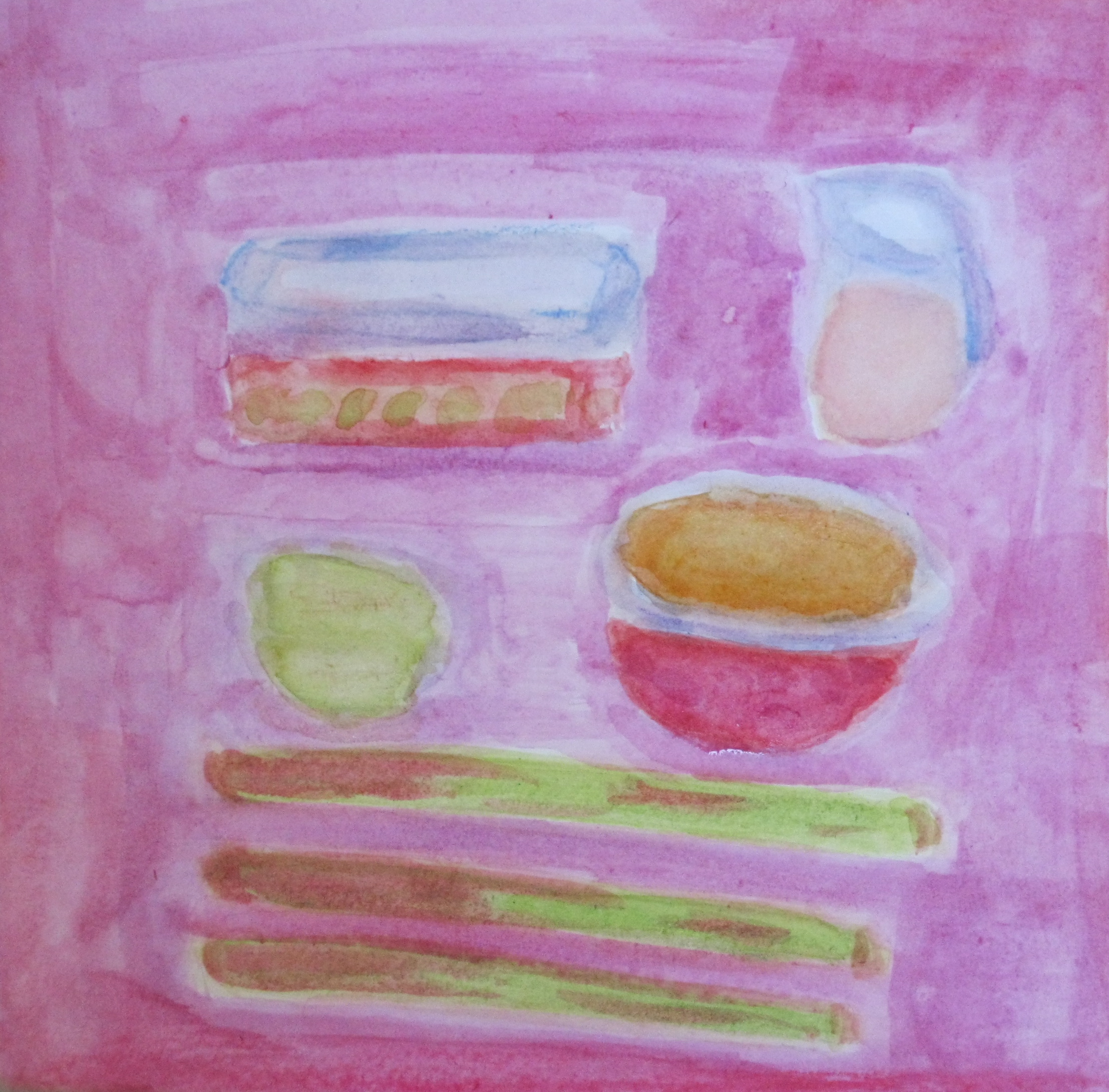
painting shows rhubarb in various preparations.

Rhubarb Experiments. 8″ x 8″ Gouache and Watercolor Pencil. Sharyn Dimmick.

This morning I turned to the guidelines of other cooks: what have they done with it? Well, they boil it with sugar, raw or white or brown. They stew it with prunes and apricots. They combine it with strawberries in pies and compotes and jam. Enterprising cooks use it in sauces for roast pork. I hunted through some cookbooks for awhile. Then I cut and measured my remaining rhubarb: I had three cups left.

Fine. Enough for three small experiments. Experiment #1, rhubarb roasted with vanilla bean and Creme de Cassis, suggested by The San Francisco Ferry Plaza Farmers’ Market Cookbook. Experiment #2, rhubarb cooked down to a syrup, a variation on Heidi Swanson’s Rhubarb and Rosewater Syrup recipe. Experiment #3, rhubarb cooked in a compote with dried fruit, adapted from the Eat Fresh, Stay Healthy cookbook, an offering from the used book sale at the Kensington Library.

Experiment #1, the roasted rhubarb, smelled wonderful, both before and after baking, from the perfume of the vanilla bean and the Creme de Cassis. This rhubarb, mostly pale green with red ends remained green after roasting. The syrup has a slight dark red tinge. I tasted the result cautiously, one piece on a small spoon. It is delicious. The white sugar, vanilla and black currant liquor have mellowed the rhubarb into something tasty: I could eat it straight from a bowl, topped with cream, milk, half and half or yogurt, or I could mix it into cereal.

Experiment #2, rhubarb syrup, essentially rhubarb simmered in a simple syrup to which I added a vanilla bean, tasted good, with just a hint of rhubarb flavor. I used 1 cup of rhubarb, 1 cup of sugar, 1 cup of water and 1/2 of a vanilla bean. I let the rhubarb marinate in the sugar for a couple of hours before I added the water and brought it to a simmer. I strained the syrup from the cooked rhubarb. It came out blush pink. I tried an ounce of it in about four ounces of sparkling water with lime. I also tried an ounce of it in some cold tea. I’ll eat the leftover sweetened rhubarb puree with some light cream for dessert some night this week, or stir it into my morning cereal. It is too early in the day to put some of the syrup in a glass of sparkling wine, but I may get to that.

Experiment #3, the compote, may be the least successful. I simmered 3/4 cup dried prunes and 1/4 cup dried apricots in a cup of water with some nutmeg, fresh ginger and 1/3 cup of sugar before adding the rhubarb for five or six minutes. The problem with this is that the rhubarb has not absorbed the flavors before it begins to break down. But it may taste better tomorrow after sitting — compotes often do. I tasted it warm.

I brought the rhubarb-cherry crumble to a singing session on Friday. Some people liked it. I was disappointed. The color was lovely: the rhubarb and cherries melded into a deep red. The fruit proved to be too sweet for my tastes (I was afraid to scant the sugar due to my inexperience with rhubarb preparations) and there was an off-putting flavor, which I believe was the taste of the rhubarb. I made a crumb topping with butter, homemade granola (not very sweet), brown sugar and a few tablespoons of flaked coconut. I thought the topping was also too sweet and will go back to using plain rolled oats in crisp topping (Local Kitchen’s recipe calls for a gluten-free topping with  brown rice flour, oats, butter, and flax seed).

Food notes: If you are a confirmed rhubarb lover and have no fear of canning, you might want to try Local Kitchen’s rhubarb prosecco jelly. It’s the sort of thing I would love to have a taste of, but would not want to commit to making it unless I had tasted it first. Disclaimer: I have been exercising a lot lately, which might be why the sweet rhubarb syrup, roasted rhubarb and puree suddenly tasted great…

P.S. I mixed rhubarb compote into my blue corn cereal this morning and it was just fine: with the heat of the cereal, the cooked rhubarb melts into the compote and what you get is a spicy syrup. And rhubarb syrup in water is nice on a hot day.

Warning: this post may contain an embedded rant or two.

In the kitchen this morning, I have two large dry crusts of French bread, three eggs and several heads of baby romaine lettuce from the farm box. This late spring day appears to be one of the warm variety. I don’t know if these ingredients suggest anything to you: to me they suggest Caesar Salad.

My mama told me that Caesar Salad contains anchovies in the dressing. Cursory internet research suggests that Cesare Cardini used Worchestershire sauce rather than anchovies. I don’t even like anchovies, but I was taught to chop them finely and put them in the dressing for a Caesar Salad, so I do. I would not eat them on pizza. I would not snack on them out of the tin. I have never dared to make a pasta puttanesca because of the anchovies in it, but I keep anchovies in a jar of olive oil just so that I can make this salad when the mood strikes or when the ingredients are sitting around in the kitchen.

Furthermore, I do not care for any egg preparation that involves soft egg yolks — or hard egg yolks, for that matter. That leaves out poached eggs, fried eggs, eggs sunny side up, deviled eggs, hard-boiled eggs and Easter eggs. But I make an exception for Caesar Salad dressing, which calls for a coddled egg, cooked for one minute before you mix it with the other dressing ingredients.

Painting shows Caesar Salad and ingredients.

Caesar Salad. 8″ x 8″ Gouache and Watercolor Pencil. Sharyn Dimmick.

The salad that makes me set aside my food aversions is truly magical. You put in anchovies and barely cooked egg yolk, garlic, olive oil and lemon juice, black pepper. You toss the dressing with croutons, Romaine leaves and freshly grated Parmesan cheese and you have a crunchy, green refreshing salad with adequate protein from fish, egg and cheese. There is no need to add shrimp or grilled chicken to this salad as many American restaurants do.

First, make garlic-infused olive oil. Heat some garlic cloves in olive oil and allow the garlic and oil to sit while you do other things. While you are at it, halve a raw clove of garlic and rub it onto your wooden salad bowl. If you like raw garlic, set aside a couple of cloves to squeeze into the salad, or pound them in a mortar or mince them with a knife. I actually like minced or pressed raw garlic better than the more subtle garlic oil.

Then make croutons. Chop your leftover French bread into cubes. We like to use stale sourdough. You can saute them in a little of your garlic oil, or you can toss them with some of it and bake them in your oven for a few minutes at 300 degrees. I usually bake my croutons. Sometimes I just bake sourdough bread without any oil: the croutons will absorb dressing from the salad anyway.

Then wash your romaine lettuce and dry it thoroughly in a dish towel or a salad spinner.Tear into bite-sized pieces unless you particularly enjoy the exercise of cutting lettuce with your fork. Place lettuce in your garlic-rubbed salad bowl.

Take two or three anchovies from a tin and mince them finely — no one wants a big bite of anchovy in this salad — we just want the flavor. Set them aside for now.

Grate some Parmesan cheese. 1/4 cup will do in a pinch, but you might want to use more to get the snow drift effect.

Halve one lemon and get ready to squeeze it.

Dress your lettuce with a small amount of garlic olive oil. Add minced garlic if using.

Now coddle an egg: boil it for one minute only. Remove it from the pot. Crack it right into your salad bowl and toss with the lettuce.

Add the minced anchovies and toss again.

Squeeze lemon directly onto the salad. Toss again.

Add croutons and grated Parmesan. Toss again.

Grind some fresh black pepper over the salad. Toss again.

Taste and adjust seasonings.

Food notes: If you can’t stand handling anchovies, you could try using anchovy paste in a tube. I have never used it. Please do coddle the egg and use it in the dressing: the slightly-cooked egg, anchovies and lemon are what creates the distinctive Caesar dressing. You cannot get the proper effect without the egg. You cannot get the proper effect without some form of anchovies — if you are afraid of them, try using a little less — start with one anchovy if you are squeamish and work your way up. You cannot skip the cheese either, or the croutons — if you do, you have not made a Caesar salad, but some other kind of romaine salad. You cannot make a vegan Caesar — don’t even try. If you are a vegan, find some other way to eat your romaine. You cannot make a kale Caesar either: by definition, Caesar salad is made of romaine lettuce. Got it? You have latitude with the garlic, the oil, and the croutons and the amount of anchovy you use. For the Parmesan, you need to get the good stuff and grate it yourself: this is not the time to use stale, pre-grated cheese or the stuff in the green can: when you are only using a few ingredients, they need to be the freshest and finest you can get. That chicken and shrimp? Save them for another entree or cook and serve them on the side, please. Once you try the real Caesar salad, you will love it or hate it, but at least you will know what it is, that you have tried Caesar salad and not one of the many abominations that blacken and borrow its name.

If you’ve made it through the rant, you may notice that I put no salt in the dressing: both anchovies and cheese pack a lot of salt and I don’t miss it. But I did say you could adjust seasonings: that is code for add lemon, salt, pepper, garlic or cheese to taste. Enjoy. And if you experience any revelations after making proper Caesar salad, please come back to testify in the Comments section.

It is cherry season in California. For a few short weeks in May or June fresh cherries appear at the Farmers’ Market in Berkeley. First there are Brooks, then Burlats. Later there are Bing cherries. I eat them all. Mostly, I eat them fresh, for a snack. Lately I have been sneaking them into my morning cereal: my current favorite concoction involves 1/3 cup blue cornmeal cooked in 1 cup of milk with a bit of salt, a small handful of raw almonds pounded in a mortar, a handful of stoned cherries and a couple teaspoons of shredded coconut. This is also good with rolled oats — if you use oats, use 1/2 cup.

Do any of you have binders full of recipes that you have clipped from the food sections of local newspapers? Do you have a lot of recipes you haven’t actually cooked? Me, too. Sometimes I try one and toss it out with a “What were they thinking?” gesture. Sometimes I learn something. Sometimes I just store them, loosely organized by main ingredient, in a huge binder that takes two hands to lift off the shelf, but I know they are there waiting for “someday” when I’ll cook them.

Cherry Focaccia with Chocolate.

One such recipe was Ed Murrieta’s recipe for cherry focaccia. A Google search for the original publication date in the Contra Costa Times informed me that I have been saving this recipe since June 7, 2004. I saved it because it has an irresistible photo of a golden brown round focaccia, dimpled with cherries, cut into wedges, with a pile of fresh cherries in the center. It looks so pretty that I wanted to make it “someday.”

Well, folks, today was someday. I made a trip on the bus to the Farmers’ Market yesterday to buy more basil for more pesto and to buy cherries for this bread. Insert disclaimers here. One, I don’t generally like focaccia — it is too thick, too bland, with the wrong ratio of toppings to crust: I think of it as failed pizza. Two, I think chocolate-covered cherries are revolting. My Grandmother liked them: nasty, sickly cherries in too sweet milk chocolate. And cherry cordials, worse, if possible: bad chocolate filled with wet cherry filling that squirts you when you bite into it. Yuck. Three, my favorite cherry recipes involve sour cherries, either canned or dried, since fresh sour cherries are hard to come by in this part of the world. Four, I can’t stand anything cherry-flavored: cherry flavor reminds me of medicine. This includes cherry Starbursts (why, oh why?). The only exception I can think of is Royal Crown Sour Cherry candy — do they still make it anymore?

But this cherry focaccia was calling my name. First of all, it is a filled focaccia: you make two circles of dough. You put fresh, pitted cherries on top of the first circle, sprinkle it with chopped bittersweet chocolate, and put the second circle on top. Then you push more cherries into the top layer and sprinkle it with raw sugar before it goes into the oven. Plus, you need a starter to make this and I keep a jar of sourdough starter in my refrigerator at all times. I fed the starter yesterday and let it sit out on the counter while I went to the market and bought cherries.

I wanted to send you to Ed Murrieta for the original recipe, but when I Googled him the first thing I found was an article about how his entrepreneurial business had failed, leaving him to live on food stamps. Then I found some recipes including marijuana. Wherever he is now and whatever he is doing I wish him well and thank him for this gorgeous focaccia recipe. I could send you to the newspaper site, but they seem to want you to activate a free trial subscription to let you read the recipe. What can I do? I can rewrite the recipe — I did make a couple of changes.

Here’s the bad kitty confession. Murrieta’s recipe calls for bread flour. In my heyday when I had a regular job and regular paychecks I would have gone out and bought bread flour. I would have insisted on bread flour. Now I am not so proud or so picky: I use what we have on hand. I am an experienced baker and can handle sticky doughs and doughs behaving badly. So I will tell you that Ed Murrieta called for 2 and 3/4 cups of bread flour, plus additional flour on the board during the kneading and shaping phases. I winged it with unbleached flour and some whole wheat flour to give it a more rustic quality. I’ll show you.

Murrieta called for a starter made  of 1/2 tsp dry yeast, 2/3 cup of water and 1 cup of bread flour. You mix this up in a glass jar with a wooden spoon, cover it with cloth and let it ferment on the counter for at least twelve hours (and up to 36). I skipped this, and just added 2/3 cup of my sourdough starter to the dough. If you already have a starter, you are good to go. If you want an official sourdough starter recipe, go here.

Focaccia stuffed with fresh cherries and chocolate.

Cherry Focacccia. 8″ x 8″ gouache on paper. Sharyn DImmick.

Fresh Cherry Focaccia with Chocolate

Make the dough first. You can pit cherries and chop chocolate while the dough rises. You can even go to the store for cherries and chocolate while the dough rises if you don’t go on the once-every-forty-five-minutes bus.

Dissolve 1 and 1/2 tsp yeast in 1 cup warm water.

While the yeast proofs, stir together in a large bowl 2 and 3/4 cups bread flour, 3 Tbsp sugar and 1 tsp kosher salt. If you do not have bread flour and are intrepid, start with 1/2 cup whole wheat flour and 3 and 1/4 cups unbleached flour (You will have to add more).

Make a well in the center of your dry ingredients. Add proofed yeast, 2/3 cup sourdough starter (or Ed’s starter, above), 1 cup lukewarm water and 3 Tbsp olive oil. Mix with wooden spoon until a light dough forms. If your dough is more of a batter than a dough, add flour 1/4 cup at a time.

Flour a bread board or other work surface and keep the flour handy! You might want to make sure your flour bin is at least half-full. Turn out the dough onto the board and attempt to knead it. If it sticks to the board badly, knead in more flour, dust more flour on the board, pry it up and try again. Eventually, you will work enough flour into the dough that it resembles roll dough and is smooth and uniform in appearance. If you are smart, you will oil the bowl before you put the dough back in it to rise. Cover the dough with a damp tea towel and let it rise until double — 1 and 1/2 to two hours.

Now, go away and amuse yourself or clean your counters and put away your ingredients except the flour — you are not done with that. Before the dough is risen you will need to pit 2 cups (one pound) of cherries and chop four ounces of chocolate. I used a 70% Lindt bar that had cherries and chili in it.

When your dough is risen, put it on your floured board and let it rest for five minutes. You can use this time to oil a pizza pan or baking sheet.

Divide dough into two equal portions. Ignore one while you flatten, dimple and pull the other into a ten inch circle. See pizza-pulling instructions here. (Murrieta rolls out his). Transfer first portion to oiled pan. Spread 3/4 of your cherries on it and top with chopped chocolate. Flatten, dimple and pull the second circle into shape and place it on top of cherry-chocolate filling. Pinch the edges to seal the dough. Then decorate the top with the rest of the cherries, pushing them cut-side down into the dough at attractive intervals. Let the dough rest for thirty minutes while you preheat your oven to 400 and do a round of clean-up. Just before you put the focaccia in the oven sprinkle it with raw sugar.

Close-up photo of Cherry Focaccia.

Cherry Focaccia Close-up. Photo by Sharyn Dimmick.

Bake for forty-five minutes or until top and bottom are browned to your liking. Murrieta says to let the focaccia cool and then cut it into wedges. Ha, ha, ha, ha, ha. I let it cool for approximately five minutes and then cut a small wedge, which I ate standing at the cutting board. Then I reached for the knife again, which was smeared with melted chocolate. I ate the second piece standing in front of the board. Then I cut a much smaller wedge. Then I stepped away from the cutting board, drank a glass of milk and made tea, which I took upstairs so that I did not stay in the kitchen eating focaccia.

It was that good. It was sort of like someone had taken my two favorite things, crusty bread and pie, and magicked them into a single entity. Crusty, gooey, chocolatey, not too sweet, with a fresh cherry taste on top.

Cherry season is short. If you like bread and pie, make this now. Now. And invite some friends over if you don’t want to stay in your kitchen eating the whole thing. You could just call it cherry Kryptonite.

Food notes. This recipe is perfect as is, once you get the flour right. But it is ripe for variations. Try other kinds of chocolate and other kinds of fruit: fresh figs? And then branch out and use almond paste or ricotta filling with cherries or peaches or blueberries. Yum.

On Saturday my friend Margit and I walked through the Berkeley Farmers’ Market. I had been the week before and bought my first Brooks cherries of the year, walnuts in the shell, brown mushrooms. Stone fruit is beginning to come in: I saw apricots and bought a couple of baskets of cherries from Kaki Farms. Strawberries continue strong. Blueberries are here. Some vendors had bins of summer squash and the first beautiful broccoli was beginning to peep its heads out of baskets. But the thing that made me happiest was the bunch of basil I bought for two dollars.

Ah, basil. I didn’t even like the stuff when I was a child: it was just another mysterious seasoning in a Spice Island jar, dried and weird. It didn’t remind you of turkey stuffing like sage or pizza like oregano. Fresh basil was not seen or smelt at my house.

painting shows mortal and pestle, basil, basket of walnuts.

Making Pesto. 8″ x 8″ Gouache and Watercolor Pencil, Sharyn Dimmick.

All that has changed now. All late spring, summer and early fall, I buy basil by the bunch and set it like a bouquet in a glass of water on the kitchen counter next to the olive oil. I chiffonade it over green beans and steam them, tuck it into ears of corn before roasting them, add it to Greek salads, put it in turkey meatloaf or burgers. It is probably the herb I use most during the summer. Today and many other days will find me sitting at the breakfast room table, pounding torn basil leaves, salt, garlic, walnuts and grated cheese in my large Vietnamese mortar with a little olive oil.

Did I say walnuts? I did. Classic pesto is made with pine nuts. I have nothing against pine nuts except the cost. If I lived in New Mexico or Italy I might make pesto with pine nuts. Since I live in California I make it with walnuts and have come to love the combination of bitter and sweet freshly cracked nuts with pounded basil leaves and garlic (I also use walnuts to make a cilantro pesto, flavored with lime).

The first pesto I tasted was served in a restaurant (I no longer remember which one). When I lived in San Francisco I used to buy little plastic tubs of Armanino pesto. Then for awhile I made my own in a blender, until my friend Leila mentioned that pounded pesto had a superior texture. Because our blender is old and cranky I was spending lots of time mincing basil and garlic before feeding its maw and I decided to get a mortar and pestle.

My friend Elaine and I went mortar hunting in Oakland Chinatown and I brought back not one mortar, but two: I have a small marble mortar that I use to crush spices and small amounts of nuts and I have my big wooden Vietnamese mortar for pesto duty each summer.

I start in the kitchen, smashing garlic cloves with the side of a knife and peeling the skins away. The garlic goes directly into the mortar and gets a sprinkle of kosher salt, which helps the pestle break down the garlic fibers. Then I take a utility bowl, my basil bouquet and the big mortar and pestle into the breakfast room. I inhale the spicy green scent of the basil as I pick leaves, discard stems, and tear each leaf into smaller pieces. I pick and tear for awhile, then I pound for awhile, then pick and tear another layer of leaves. The aroma gets richer. When I have torn and pounded every last leaf I take the basket of walnuts and nutcracker from the sideboard and start cracking and shelling. There is no measuring involved: the pesto comes together and is done when its taste and texture suits me — the size of the bunch of basil is the determining factor: I will add enough other ingredients to blend with it, to complement it, but the basil is the star, so I start with garlic and salt, add all the basil, then add walnuts. The last step is grating Parmesan or pecorino with my microplane and stirring in a little olive oil.

If I need a break while I am pounding basil I will pour a little olive oil over the top. This helps keep the color bright. I do not care for oily pesto and have a light hand with the oil: I am not too fussy about whether the final product is bright green: I know it will be delicious and we are going to eat every spoonful and scrape the jar besides.

I never get tired of pesto. When the basil really gets going in mid-summer I try to make enough of it to freeze to last all year. I am never successful because if I have fresh pesto on hand I want to eat it on pasta, on sandwiches, in salad dressing, on green beans, on broccoli, on broiled portobello mushrooms, dolloped on the top of a pizza just out of the oven, or added to a winter vegetable soup. Every year I manage to freeze a few small jars or a bag of pesto cubes made in an ice cube tray, but I am dipping into my stash practically as soon as basil disappears from the Farmer’s Market. At the same time, I have days when I wonder why I have bought yet another bunch (or two, if they are on sale), condemning myself to a few more hours of sitting at the table, pounding away when I could be walking or swimming or reading or whatever else it is that people do on long summer days, instead of inhaling basil fumes and oil of walnut rising from warm wood.

We ate our pesto with whole wheat rotini, fresh sugar snap peas and some roasted red peppers from a jar.

Food notes: You can, of course, make pesto with any fresh  leafy herb and any nut. Some people use seeds instead — pumpkin seeds, sunflower seeds. Margit is allergic to walnuts and pecans so she can make hers with almonds. Elaine has used Brazil nuts successfully. Pine nuts are delicious. You can make pesto from arugula or from soaked sundried tomatoes. Some people make it with spinach or kale. You can mix herbs, too: basil, cilantro and mint is nice, or arugula and mint. You can make it in a blender or a food processor if you have one.

Blogging notes: Susie of SusArtandFood very kindly nominated me for another blogging award, the illuminating blogger award. I love it when people read The Kale Chronicles and I love it when they like it and I really like it when they find something useful here for themselves. What I don’t like is posting blog award patches on my site — I don’t think they look nice. And while I’m happy to let you know what blogs I enjoy reading I am not much good at making lists of them on the spot: I do have lists of links, although I probably should update them — perhaps at my one-year anniversary. You will find more details about me and my life in the posts than you perhaps want so I don’t think you need to know that my favorite color is green or that my favorite ice cream is coffee ice cream. My emphasis is seasonal home-cooked food. I’m quite happy when you read and comment on The Kale Chronicles and I do my best to respond to every comment I receive. Thank you all.

photo depicts fresh lettuce in colander with Buddha looking on.

From the Winter Garden. Photo by Kuya Minogue.

Today The Kale Chronicles features a guest post from Kuya Minogue of Creston, British Columbia, who shares what she has learned about winter gardening in her locale. Kuya and I met at a Natalie Goldberg writing retreat in New Mexico. When I saw a Facebook post of hers on harvesting greens from her winter garden I asked her to share her garden story with you. Although it is May and not winter in the northern hemisphere now, perhaps it will allow some of you cold-climate gardeners to plan next year’s winter garden. You can find more of Kuya at zenwords here.

When it’s twenty below Centigrade outside and the garden is buried under four feet of snow, it’s hard to imagine that under the plastic cloches and row covers in the greenhouse beds, the spinach, lettuce, chard and cilantro that I seeded in late August are lying dormant, waiting for a warm day to awaken them from their winter hibernation. But it only takes a few warm days in mid-winter to bring them out of sleep and into a delicious and completely alive salad.

photo of spinach growing in Creston, B.C.

Spinach in January. Photo by Kuya Minogue.

Last year, we had a week of above zero sunshine in Creston, BC where my winter garden lives, and by the end of that week, when I removed the cloche from the spinach bed, I found salad ready greens. The leaves were thick and juicy. There’s nothing better than a garden fresh salad in January, and the amazing thing is that all it took was one plastic snow-covered cloche to keep the plants alive and a few warm days to make a salad. When the weather turned cold again, I recovered the spinach and it lived through another two months of frost.

In that January warm spell, when I looked at the lettuce under the row cover inside the greenhouse, the leaves were so withered that I thought that winter had taken them. But by the first week of March, the lettuce had revived, and by the second week of April, we were eating fresh spinach and lettuce salads straight out of the garden. I was afraid the lettuce would be bitter, but only the outside leaves had the taint of winter. The butterball at the centre of the plant was crisp and fresh, and tasted like summer.

I don’t like to mix my first collection of winter salad greens with store bought tomatoes, cucumbers or avocado. I prefer to sprinkle winter garden green onions and a handful of garden-fresh cilantro over the greens, and to make a lemon and olive oil dressing that has a squirt of liquid honey and tamari sauce, and a sprinkling of minced garlic from last year’s garden. From first bite to the last, I’m transported to the warm days of summer.

Hardy greens survive the winter too: chard, kale and a chinese vegetable whose name I don’t know are ready to eat by mid March. By mid April, they are so prolific that I invite anyone who comes to the Zen Centre to meditate or do some yoga to take a mixture of these greens and some winter garden onions home with them so they can clean them, cut them into bite size pieces and then stir fry them in sesame seed oil, lemon juice and tamari.  The cooking greens are also delicious if I simply steam them and eat them with a little butter.

painting of picked mixed greens in colander, Buddha image.

Buddha with Greens from the Winter Garden. 8″ x 8″ Gouache and Watercolor Pencil. Sharyn Dimmick.

I learned about winter gardening when one of my Zen students, a horticulturalist, offered to give a Winter Gardening Class at the zendo. Having lived through many years of Canadian winters, I was skeptical when we seeded the beds in late August and then put them under cover in mid-October. It just seemed impossible that anything as delicate as spinach or lettuce could survive the winter. But I was wrong. Even in Canada, we can grow greens in the winter and eat garden-fresh salad in the spring. If we can do it here, you can do it anywhere.


I have been distracted this week, planning my life in advance, spending untold hours on the internet booking flights to and from Paris, reserving train seats, surveying my distinctly non-chic wardrobe with dismay and bemusement. It is odd spending the first few days of May madly thinking about mid-to-late June, when I will be at a writing retreat in Limousin with Natalie Goldberg and then in Paris itself.

Meanwhile, here in Kensington, our lone apple tree is in full bloom and spring crops slowly make their way into the farm box. Today I got snow peas and strawberries, asparagus and baby romaine lettuce, carrots and spring onions and braising greens. The breeze has blown all day. The sky is pale blue with wide filmy streaks of clouds.

The fruit and vegetables remind me of a meal I had last May in New York. Natalie had invited me and my friend and host Dorotea to lunch at her friend’s Manhattan apartment. Natalie and her friend had gone to a farmers’ market and come back with the first asparagus and strawberries of the season. Natalie fried up some gluten-free pancakes and set the berries and stalks on the table for our spring feast high over the Hudson River. Everybody but me tucked into the asparagus while I ate strawberries and pancakes for lunch.

May has come again and I am in my own kitchen. This morning I opened a bag of whole-grain blue corn that I stashed in the refrigerator when I last came back from New Mexico. The corn is fine-milled, pale blue with flecks of darker blue. I cooked up a quarter cup of it as a simple mush, boiling it in a cup of milk with a few grains of kosher salt and a small handful of dried sour cherries. The corn turned a lovely pale lavender color when cooked. I added a few drops of vanilla and stirred, then spooned up my breakfast, satisfied.

Blue Cornmeal Pancakes with Strawberries. 4″ x 6″ Gouache and Watercolor Pencil. Sharyn DImmick.

For tomorrow, I plan a simple elaboration. Tomorrow I will cook another pot of blue cornmeal mush, eliminating the cherries. I will beat in an egg or two, some flour, some milk, a few tablespoons of sugar and some baking powder. I will stir in 1 tsp of vanilla last. I will heat a skillet on medium heat, drop in some butter, swirl it in the pan and drop quarter-cupfuls of pancake batter onto the hot metal.

Before I prepare the pancakes, I will wash and hull the strawberries. I will taste one and decide whether or not they need sugar. Since I will probably be eating them with maple syrup I may not sugar the berries unless Mom insists.

I first learned to make these pancakes from a Mark Bittman recipe reprinted in a local newspaper. You can read it here. Then I realized a couple of years later that I could wing it by using leftover polenta or cornmeal mush from dinner and adding basic pancake ingredients. I felt like a genius, but I never would have thought of it had I not made Bittman’s wonderful recipe many times. The pancakes are filling, but not heavy, and have become one of my favorite breakfasts for the warmer months when fresh fruit becomes abundant. I like them best with berries or peaches –any berries, but strawberries are the berries of the moment in my neighborhood.

Food Notes: Blue corn, if you can get it, is wonderful. It contains more protein than yellow or white corn. Also, Monsanto, developer of much genetically-modified corn, reputedly does not bother with blue corn, concentrating its research on yellow hybrids. I don’t know about you, but I would prefer not to ingest Monsanto’s experiments or products if I can avoid doing so. Vanilla adds a lovely flavor to corn, dare I say je ne sais quoi? I urge you to try it next time you make a sweet corn recipe.

Travel Notes: I am currently looking for hotels in Paris. Nothing expensive. Cheap is good. The room can be simple and I don’t care if the building is old. The hotel needs to be safe and near a Metro stop. If anyone has suggestions, or suggestions about how to find what I need please comment below or contact me. Merci beaucoup. — Sharyn

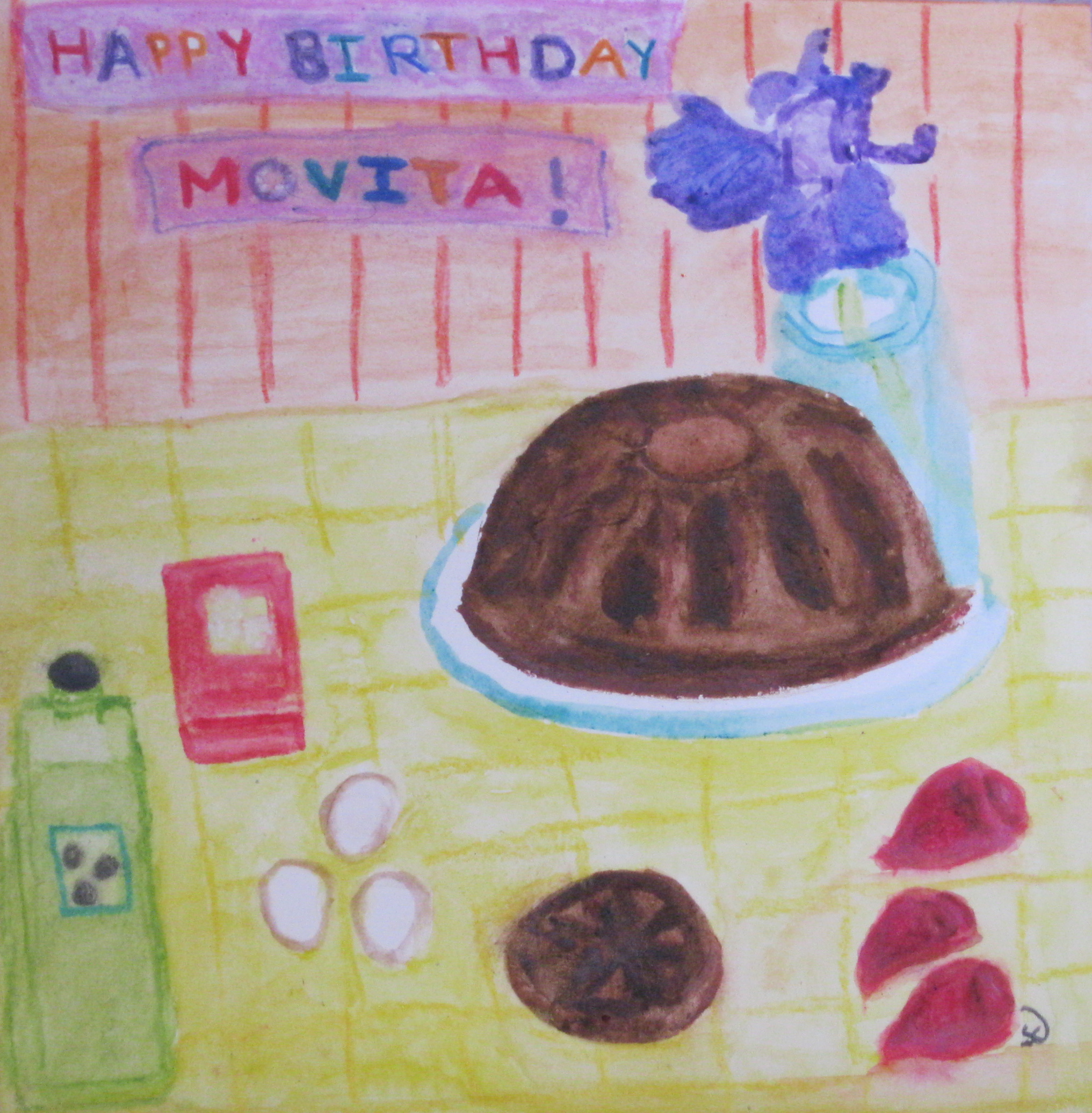
painting shows a Mexican chocolate beet bundt cake with birthday banner.

Mexican Chocolate Beet Cake. 8″ x 8″ gouache and watercolor pencil. Sharyn Dimmick.

Sometimes I think I am wacko. Having gotten up to roll and fill Nazook, an Armenian pastry, before breakfast, I lingered in the kitchen to make a cake for someone who isn’t here and isn’t going to be here — isn’t a definition of whacked doing things at the behest of people who aren’t there?

Let me explain. There is this blogger who goes by the name of Movita Beaucoup. She challenged all comers to bake her a birthday cake and send her a photo by midnight. She promised us prizes. If you are reading this before 10 PM on Friday you still have time to get in on the action: just bake a cake and submit a photo of it to Miss Movita by midnight in your time zone.

Anyway, cakes are not my thing. How many times in the life of this blog have I said I prefer pie to cake? Many. I like to bake. I like to bake bread and pie and pastry as long as it is not too fiddly. But I couldn’t resist baking a cake for Miss B. because she makes me laugh and because she has said that someday she would like to own a Kale Chronicles painting. Besides, she writes about running from bears and worrying that the bathtub will fall through the floor.

When I met Movita (Well, I haven’t actually met her) here in the blogosphere she was carrying on about her need for an iPhone, I believe — some fool bit of modern technology to help her through culinary school. I joined in the chorus of readers offering her congratulations on signing up for a culinary program and informing her husband, charmingly called “2.0,” that she needed an iPhone. I don’t even have a cell phone of my own.

In my childhood, Mom baked us birthday cakes or cupcakes, any flavor we requested. I used to look at all of the cake pictures in our trusty Betty Crocker Picture Cookbook to think about what I wanted. That was before I figured out that I could request a birthday pie instead, and before my brothers figured out that they could have a fancy whipped cream cake from Virginia Bakery or an ice cream cake from Baskin-Robbins. I remember relatively few cakes from those days, chiefly the igloo cake Mom made for Kevin’s birthday, an excuse to cut cake layers in half, frost the cake with white icing and upholster it with the cocktail sugar cubes my Dad kept in a secret location. This cake was the stuff of kid dreams, an entire cake covered with cubes of sugar meant to look like blocks of ice.

I have more sophisticated cake dreams now: I have eaten cakes from Tassajara bakery full of mocha buttercream. I have made genoise soaked in rum (twice). But I am still not a cake baker: I don’t own a piping bag and I don’t think fooling with frosting is fun. Plus, I write a blog featuring seasonal cooking and I’m not about to declare it Cake Season.

One of my pet peeves in baking fads is the popular red velvet (or blue velvet or green velvet) cake, which requires one to use vast amounts of red food coloring to produce a chocolate cake that was more appealing when it was left to look like chocolate instead of a vampire’s breakfast. What can I say? I have gray hair and I don’t think ingesting food dye is good for you. Many people, including my late brother, are allergic to food dye, or go berserk when they get it (No, I have not been sipping from the Schilling bottle). Now watch me find out that Movita’s favorite cakes are velvet cakes….

Fortunately, it is beet season, and I have learned to make a cake featuring a dark red batter, owing to the presence of pureed beets. Before you get upset, please remember that beets are often grown to make sugar and sugar is a valid ingredient in cake. This cake is chock-full of things people call superfoods, including beets, chocolate, cinnamon and extra virgin olive oil, as well as the usual suspects of eggs and flour. I considered making it with ground almonds to make it gluten-free, but I am not having the kind of a week that bodes success with those sorts of experiments.

I first made this cake from a recipe at recipezaar, reprinted in my farm newsletter by the folks at Riverdog Farm, but I have messed with it — you knew I was going to, didn’t you? I incorporated part of an egg yolk I had left from this morning’s egg wash and I wanted to use Mexican chocolate for its distinct flavor. Then I needed to add cocoa because Mexican chocolate is sweeter than the chocolate the recipe called for and I scanted the sugar. I added some cinnamon as well.

To make this cake, you will need at least a cup of pureed beets. I recommend preparing them ahead of time: you can boil or steam or roast them. Let them cool, remove their skins, and whirl them in your blender or food processor. I will not go into the five times I had to clean the stove or the seventeen times I washed my hands while preparing this recipe — if you need to have your all-white kitchen white at all times, do not make this cake.

For the brave, fun-loving and vegetable-minded, read on:

Mexican Chocolate Beet Cake

Preheat oven to 35o.

Rub a bundt pan with olive oil and dust it with a mixture of cocoa powder and ground cinnamon in lieu of flour

Cook, peel and puree 1 cup of beets (I used five small red ones) until completely smooth.

Melt one tablet of Mexican chocolate (3.15  oz) in your microwave and combine with beet puree.

Measure 1 cup olive oil, 1 and 1/4 cup sugar, 1 tsp vanilla and 1/2 tsp ground cinnamon into a large mixing bowl and blend until light-colored.

While you wait, sift 1 and 3/4 cup flour and 1/4 cup cocoa into a small bowl with 1/2 tsp kosher salt and 1 and 1/2 tsp baking soda. Whisk to blend.

Add to oil mixture 1 egg yolk, then 3 eggs, one at a time, beating smooth between each addition.

When eggs are fully incorporated, add the chocolate-beet mixture. Then add flour-cocoa mixture in two or three additions.

Pour batter into prepared bundt pan. Place on middle oven rack and bake until a toothpick comes out clean. This is a moist cake: mine took forty minutes to bake through.

Now the hard part: for best results, let the cake sit covered overnight. This helps the flavors blend. Olive oil cakes tend to get better as they age, so age it for twenty-four hours before digging in. I’ll be taking mine to a potluck tomorrow afternoon.

To Movita Beaucoup: I made this healthy for you, within reason. But I am not there to stop you if you want to eat it with a little cacao nib whipped cream or a puddle of caramel sauce. Just saying. Happy Birthday!

Food notes: I used plain old red beets in this cake, but you can fiddle with the color by using mixtures of red and yellow beets. The batter is a dark, vibrant purple-red, but the cake bakes up red-brown. If you don’t have the extra egg yolk, leave it out — no one will miss it. Cinnamon is fat-soluble — that’s why I put it in with the oil — if you want to incorporate it more smoothly, you could mix it with the sugar before adding the sugar to the oil.

In Northern California spring can start in February and continue through May. First we see daffodils, then flowering pear, plum, crab apple and quince trees. Spring crops come in slowly: green garlic, lettuce, then asparagus, followed by peas. On my last Farmers’ Market visit two weeks ago the strawberries had white shoulders and the grower I like to buy them from (Lucero Farms of Lodi) had not yet taken up a stall, but I had a feeling I would find strawberries today, and there they were, small red Seascape berries with long stems destined for the year’s first strawberry shortcake.

Painting shows a heart-shaped strawberry shortcake and baskets of berries.

Strawberry Shortcake. 8″ x 8″ Gouache and Watercolor Pencil. Sharyn Dimmick

There are many variations of strawberry shortcake: you can make it with angel food cake or lemon pound cake or sponge cake or olive oil citrus cake. I have tried them all, but my favorite recipe for strawberry shortcake is a biscuit base, split and covered with fresh strawberries, served with lightly sweetened whipped cream. To honor the ritual of spring I will use organically grown Farmers’ Market strawberries, and whipping cream from Straus Dairy in Marin County.

I will buy my cream at a local supermarket, but because it is Earth Day I want to think a bit about what it took to produce this traditional spring dessert. Someone had to plant the strawberries, tend them, water them, pick them, bring them to market. Someone had to raise sugarcane and refine it. Someone mined the salt, picked vanilla pods, raised wheat, ground it into flour. Someone had to raise the dairy cow, feed her on grass, milk her. Someone had to separate the cream, sterilize the bottles, fill and cap them. Someone had to drive the cream to the supermarket. Someone had to put it on the shelves. Someone had to drive the bus that takes me from market to market and home again. In a day gone by, members of my family, relatives from a few generations back, might have kept the cow and skimmed the cream and planted the strawberries in Illinois where they farmed, but my parents both moved to California as teenagers and never went back to the Midwest. Celia’s small farm at The Kitchens Garden might be something like the farms my mother knew in her youth, farms with hedgerows, vegetable gardens, small orchards, cows and chickens, diversified crops.

In California I now buy the bulk of my produce from an organic farm eighty-seven and a half miles from where I live. Someone drives to Berkeley each Wednesday and places boxes of vegetables and fruit on a front porch. I take a bus and walk several blocks, load the heavier vegetables into my backpack and the delicate items into a canvas bag. I have no choice in what goes into my produce box: someone at Riverdog Farm decides what is best each week and loads it up. I unpack the box and fold it: the farm driver will collect it the next week. I like the idea that I am getting produce picked that morning or the previous day and I like it that in a small way my food dollars are supporting small, diversified agriculture on a farm that uses organic growing methods: although I cannot farm myself I have farming roots. Small farmers are real to me,  people that raise food and think about how they are raising it. The Capay valley where my produce comes from has many small farms started by former students at U.C. Davis on land that agribusiness did not want.

I shop at the Farmers Market to supplement my produce box. There I can buy a flat of peaches in June, more corn in July, bunches of fresh basil in August, these first spring strawberries in April. Every week I can walk down the center aisle and look to see what has come in, compare prices, sniff the air perfumed by seasonal fruit. I am grateful to live in a state where the growing season is long and next to a city that supports three different farmers’ markets year-round.

Enough. Now it is time to go into the kitchen to make that special shortcake with the first strawberries.

First, shake the cream bottle to redistribute the fat evenly. Then pour the grassy-smelling cream into a small mixing bowl and set it into the refrigerator to chill, along with the beaters. The cream will triple in volume as you whip it, so make sure your bowl is not too small. If you wish, you may season it at this point: I like to add  2 and 1/2 tablespoons of sugar and 1 tsp. vanilla and, sometimes, the barest grating of fresh nutmeg.

While the cream chills, prepare the shortcake:

Preheat the oven to 425.

Sift together 2 cups of flour

1 Tbsp baking powder

1/2 tsp kosher salt

2 Tbsp sugar.

Cut in 1/3 cup unsalted butter (if you use salted butter, omit the kosher salt)

Add 1 cup milk

Stir just until combined.

Put into a buttered cake pan.

Bake for 12 to 15 minutes until lightly browned in spots.

While the shortcake bakes, prepare the strawberries: remove the hulls and stems and then wash berries in a minimum of water. Let them drain in a colander or pat them dry. Taste one. If your berries are ripe and sweet, you need not add anything, but if you are my mother you will insist on adding a few tablespoons of sugar so that the berries give off more juice — it’s your choice since Mom is not in the kitchen with you. You will also whip the cream now. We like ours moderately stiff so that we don’t have to whip it again the next day.

Once the shortcake is out of the oven, split it in half and pile berries between the layers and on top. Serve with whipped cream.

I will return the plastic strawberry baskets to the market next week for re-use (and perhaps buy more strawberries). I will return the cream bottle to the grocery store eventually, collect my deposit and try not to buy more cream for awhile.

Food Notes: Strawberry shortcake features two elemental foods, cream and strawberries. To make a delicious shortcake, start with the best cream and berries you can find: local dairy cream and organically grown berries will give you the best flavor. Some things are worth waiting for and it is better to make this with ripe, red strawberries that have developed their sugars than to use white-capped or green berries. If you cannot get local cream, choose cream from your market that has not been marked “ultrapasteurized.” Ultrapasteurized cream has been heated to a high temperature to give it a longer shelf life and has a cooked taste that you will want to avoid once you have tasted the alternative. We sweeten our cream with white cane sugar to keep the flavor pure, but you are free to use any sweetener you prefer as long as you do not introduce chemical sweeteners. Finally, you may use any sort of cake or biscuit base that you like, but I implore you to bake it yourself and eat it while it is warm from the oven.

Five years ago I cast my lot with Riverdog Farm in Guinda, CA, subscribing to receive their weekly vegetable box. I had been shopping at Farmers’ Markets since I lived in San Francisco, going to Saturday and Sunday markets to buy the bulk of what I cooked. When I moved back to the East Bay I took to frequenting the Berkeley Farmers’ Market. Although I love going to the market I had been interested in vegetables by subscription for a long time and when a friend recommended Riverdog’s program I signed up, initially splitting a box with my friend Elaine who lives in Berkeley.

My reading influenced me. I had read Barbara Kingsolver’s Animal, Vegetable, Miracle about how she and her family had endeavored to raise most of their food on their Virginia farm and to buy locally what they couldn’t grow themselves. This afternoon I refreshed my memory of Kingsolver’s first locavore spring as I contemplated what to write about today.

Spring has sprung by the calendar. The days are longer. Plane trees have leafed out. A few native freesias push themselves up in the yard. A full moon lit the mild, clear night on Friday as I walked the last two miles home from a Passover seder at Elaine’s, where we ate broccoli, roasted potatoes, duck, carrots in the matzo ball soup, charoset made of dried apricots and dates. Sun shone on the Berkeley market on Holy Saturday where people stood in line for green strawberries (I tasted one), berries with white shoulders, asparagus and globe artichokes. One patron snapped up the only box of snow peas. Spring produce is late this year in northern California, not as late as last year where unexpected ongoing rain slowed all of the crops, but this was a slim market on the day before Easter. I brought home a bottle of plum vinegar, two pounds of walnuts in the shell, a grapefruit for another round of Shrimp Diablo. I considered buying a large basil plant and plucking every leaf to make pesto.

This is the time of year when I wish I had preserved more during the summer and fall, roasted more red peppers and frozen them, dried more tomatoes and raisins, canned more dilly beans, made more pesto. I break out stores of canned tomatoes, jars of roasted peppers and chutney, condiments to lend flavor to our spring diet. We use frozen mozzarella, fresh spinach, cottage cheese, diced tomatoes and Prego marinara to make lasagna. I pile peach chutney, roasted peppers and fresh arugula on a broiled Portobello burger marinated in salad dressing. We make pies out of frozen peaches and canned cherries.

Painting shows leek-feta quiche and ingredients.

Leek-Feta Quiche. 8″ x 8″ gouache. Sharyn Dimmick

What I can rely on in March and April is an abundant supply of alliums: spring onions and leeks. Every week Riverdog sends us a pound or two. I use leeks instead of onions in carrot soup and find I do not care for the substitution: note to self — only white parts of leeks, which will not give the green tinge and the strong flavor. I slice one leek into rings in a bowl of water, separating each ring to let the sandy grit sink to the bottom. I heat a few teaspoonfuls of olive oil mixed with butter in a skillet, lift the leeks from the water, pat them dry and saute them. I preheat the oven to 325. I roll out pie crust, sprinkle the bottom with crumbled feta cheese, add the sauteed leeks. I cut a jarred roasted red pepper into squares and scatter them on top of the leeks and cheese. I add a few cubes of marinated feta, just enough to create a pleasant design on the red and green. I grate a few tablespoons of Pecorino over that.

Then I beat three eggs in a metal bowl and add a splash of milk, eyeball it and add a little more, whisking the custard together. I pour the custard over the vegetables and cheese and pop the quiche in the oven.

This is a rough recipe: I have made it many times and feel no need to make more than the roughest of measures. I’m going to guess slightly on the amounts I recommend (Sometimes I measure backwards, pouring out what I think I will need and then checking the amount for you by pouring liquid back into a measuring cup, for example). If you need to know exact amounts you might want to look up another recipe for that. I will refer you to my Mom’s recipe for pie crust because I can recommend it wholeheartedly as the pastry we use most often.

Make 1 recipe pie crust. Chill crust while you prepare the leeks.

Clean 1 leek by slicing it into thin rings and teasing each ring apart in a large bowl of water. Lift rings out with a slotted spoon or small sieve and pat them dry.

Heat 2 tsp olive oil and 2 tsp butter in a skillet. When combined, add leeks and saute.

While the leeks saute, you should have time to roll out your crust. Take 1/4 of your pie crust, flatten slightly and roll out on a floured board into a 10 inch circle. Fold and place in a 9-inch pie tin or tart pan.

Scatter feta cheese to taste on crust — I use enough to almost cover the bottom. Add sauteed leeks.

Slice 1 roasted red pepper into small squares. Scatter on top of leeks.

Sprinkle vegetables with additional feta, plus 2 Tbsp grated Pecorino or Parmesan cheese.

Beat 3 eggs. Add a splash of milk. Whisk. Pour custard over vegetables. if necessary, add milk to fill crust.

Bake quiche until top puffs and browns, at least half an hour.

Food Notes: You may, of course, substitute cheeses if you prefer something else to feta, substitute scallions or sauteed onions for leeks, substitute sun-dried tomatoes for the roasted red peppers. Quiche is, by nature, a flexible recipe. Because I was using feta, a salty cheese, I didn’t add any salt — if you choose a mild, sweet cheese, you might want to add some. If you want to eat this during Passover week, you could make it without crust.