“Some of the time, not all the time” says the Dylan song “Hanging Out the Clothes.” That’s how I feel about cooking. Sometimes I love thinking about cooking, perusing cookbooks, thinking about flavors. Sometimes I am inspired by a particular ingredient from the Farmers’ Market down in Berkeley or a glut of foraged blackberries. Sometimes I just want to put the closest thing in my mouth and be done with it.

Original watercolor painting shows Greek-style salmon and ingredients.

Greek Salmon. 12″ x 12″ gouache on paper. Sharyn Dimmick.

There is a special pleasure in cooking for someone when you want to please them. Our most recent foray to Canned Foods Grocery Outlet fetched us some wild caught salmon from Washington State. Standing over the freezer case, eying the fish, I ask Mom, “Does Bryan eat salmon?”

“I think so,” she says. “Does Johnny eat salmon?”

It is rare for Mom to bring up Johnny in conversation. He’s only been over to the house in the past three weeks: although I’ve known him much longer than that, he never had reason to come up here before last month.

“I don’t know,”I said. “I’ll ask him when I see him.” In the meantime we bought the salmon filet, enough to feed at least four people.

Johnny and I schedule our visits in advance. We live a good distance away from one another and public transit schedules are not conducive to spontaneous trips to see one another, so, instead of dropping in on each other all of the time we schedule visits and try to spend a significant amount of time together when we get together.

We bought the salmon on Tuesday and Johnny was coming over on Thursday night. When he told me he liked salmon, I made a dinner plan: I would make the pear tart tatin that he once wanted to elope with (He’s mine, pear tart!), microwave some fresh green beans, bake some red potatoes and cook the salmon in foil topped with seasonal vegetables: cherry tomatoes, orange bell peppers, kalamata olives, basil, a little feta — basically a Greek salad without cucumber thrown on top of the fish. Everything except the green beans could cook in the same oven and, with a little prep work I could have an easy dinner that was festive and delicious.

In the morning I made pie crust for the tart and put it to chill. In the afternoon I took the salmon out to thaw, laid it on foil on baking sheet and oiled the skin-side with a little olive oil. Then I went to work on the pears, peeling, coring, slicing, putting them to soak in a little dark rum, sprinkling ground cardamom over them. I made the caramel in a cast iron skillet, arranged the pears on top, rolled out the top crust. I preheated the oven, adding a handful of potatoes on the side. Then I snapped beans and cut up half a basket of red cherry tomatoes, and a large orange bell pepper. I tore up a few basil leaves, plucked a handful of pitted olives from a jar, diced a small cube of feta and I was ready to go, scattering all that on top of the salmon. The minute Johnny arrived I put the tart and the salmon in the hot oven and told him we had a half hour to ourselves before I had to mess with food again.

I can’t remember what we did for that half hour. He might. He set table for me in the dining room because the breakfast room was a mess and I did not want to excavate the table. I had him test the fish a few times because I don’t cook salmon often. All told, we cooked the fish for perhaps 40 minutes in a 400 degree oven. Brother Bryan arrived home just as it came out and we all sat down to eat.

Johnny and I liked the salmon so much that I scrambled the leftovers for breakfast with eggs and we ate them with the last slices of the pear tart tatin — have to get rid of that stuff quickly since Johnny has threatened to run off with it.

In the early fall when tomatoes are piling up on the counter and the temperature dips lower a few times a day, I naturally turn to making pizza. If I put together the sourdough crust first thing in the morning I can have three pizzas ready by 6:30 or 7:00 PM in the evening. I keep a jar of sourdough starter in my refrigerator in a big glass former pickle jar. I use to to make biscuits and waffles and occasional batches of wolverine rolls, but my favorite thing to do with it is make pizza dough. If you use your sourdough starter at least once a week it stays in good shape to help your dough rise.

Original  unfinished watercolor painting of pizza with fresh figs.

Fig Pizza. 12″ x 12″ gouache on paper (unfinished painting). Sharyn Dimmick.

Because I bought a lot of figs on Saturday I pretty much knew I was going to make a fig pizza, or a pizza featuring figs and other seasonal ingredients. I had some corn, some fresh arugula, lots of red Jimmy Nardello peppers from last week’s farm box. This seemed like a good combination to me: a little sweetness from the corn, a little bitter and peppery green taste from the arugula, a little savoriness from the pepper, more sweetness from figs that would roast in the oven as the pizza cooked, the contrasting flavor and texture of mozzarella and Pecorino cheese.

Because my go-to pizza recipe makes three pizzas, I asked my family what they would like on their pizza. Bryan voted for a pesto pizza with fresh spinach. Mom likes more traditional pizzas: for her I used a spoonful or two of Prego, topped with a little mozzarella, a little Pecorino, some feta. She liked it but said that it tasted blah after the rich taste of the pesto pizza.

The fig pizza? I loved it. I loved having all those flavors going on in one slice of pizza. Was it an entree? Was it a dessert? Was it breakfast? It can be all of that. I have eaten it for dinner, for lunch, for a late-night after-rehearsal gotta-have-it meal. I ate the last of it for breakfast this morning. If there had been more I would have eaten another piece or two.

If you want to make this seasonal pizza, you will need sourdough starter. You can stir up sourdough starter in a few days, so if you do it today you might be able to make pizza by the weekend. The recipe that I got from the Cheese Board Collective Works calls for  3 and 1/4 cups bread flour, 1/2 cup of starter, 1 and 1/2 cups water and 1 and 1/2 tsp salt. I prefer to use 1 cup of whole wheat flour in the flour mixture (I sometimes feed my starter some whole wheat flour as well) and a scant tsp of kosher salt. Because I don’t usually have bread flour on hand I have to add extra unbleached flour, sometimes several times, but eventually the dough comes together.

You can also make this with any other pizza crust that you like. For more details about working with sourdough pizza dough, see my previous post, “How to make thin-crust sourdough pizza.” Once you have your pizza dough risen, place a pizza stone in the oven and preheat your oven to 450 degrees. Then you need to divide the dough into three pieces, cover it and let it rest for twenty minutes. I form mine into a baguette-shaped log and cut it into even thirds, then shape each third into a small round.

While the rounds rest covered on the cutting board I grate or chop cheese. Frozen mozzarella slices more easily that it grates and the cheese gets crumbly from its time in the freezer. I grate hard cheeses, including Parmesan and Pecorino with a microplane. I mix the pound of mozzarella with a quarter to half-cup of grated cheese.

Taking one round at a time I make typing motions with my fingers, dimpling the dough. I rub my pizza pans with a little olive oil and transfer one round to each pan. Then I reach my wrists under the dough, pulling and stretching until I get a ten-inch circle.

Then it is time to assemble the pizza. I used green figs with pink centers, preparing them by cutting them into quarters and removing the stems. I started by putting a layer of the mixed cheese on top of the pizza crust. Then I cut the corn directly from the cob onto the cheese layer, sprinkled the arugula over it. I topped it with another layer of cheese, dotted with quartered figs.

I bake the pizza for about ten minutes on the top rack of the oven, then for ten minutes on the middle rack. Then I use a peel to transfer it to the hot pizza stone for its final ten minutes. I made the other kinds of pizza at the same time, rotating them through the oven racks as needed.

If you pizza as much as I do, make a recipe of sourdough pizza dough and have yourself a pizza party. If you can’t abide figs in pizza, top it with something else. I can’t get enough fresh figs in their short season.

Painting Note: The light faded from the sky before I had time to finish this painting. I decided I could show you a work in progress rather than a finished painting. When I finish it I’ll update the post. — Sharyn

My heart is not with food blogging these days. I eat, of course. This morning I stirred up some sourdough waffles with a side of bacon and a bowl of fresh peaches to feed my guitar-player and my mother and myself. I made him coffee, too, which he drinks black. Our routine is that he drinks what anyone has left in the carafe when we first come down to the kitchen in the morning and then I make him some more as needed, before or after I make my own single cup of decaf. For lunch I just ate a slice of a tomato tart I made yesterday by cooking up cornmeal mush, spreading it in a tart pan and layering on sliced fresh tomatoes, fresh corn, arugula and two kinds of cheese. The tart was okay, but nowhere near as good as David Lebowitz’s tomato tart that I discovered last year. With that I had a piece of cocoa cake with salted caramel frosting that came home with me from yesterday’s music potluck. The cake is a dense, moist, not-too-sweet cake with a little cinnamon in the batter; the salted caramel icing you could eat with a spoon and not miss the cake.

When Johnny left here this morning at 10:30 I came back and lay on my bed under the top cover, listening to music, sometimes dozing. I am lucky to be able to spend my Sundays dozing since he and I are in the infamous sleep-deprived state of early love, when we can think of a million things to say to each other, a million songs to sing and, as the song says, “better things to do, maybe nothing to say,”* when we aren’t running our mouths. He, the poor man, has to work, has to function, will be up in front of a crowd singing at an Obama benefit this evening in Oakland. The adrenaline of performing will get him through. I’ll be there to cheer him on and to hang around at the show, but all I have to do is get my body on a bus or two and manage not to fall asleep while staring out the window or listening to what Johnny calls the “internal jukebox,” the songs that play in my head on a constant basis: when I hit the kitchen to make waffle batter this morning, my mind tossed up Tommy Thompson’s “Hot Buttered Rum”: “In the dead of winter when the silent snowbirds come/You’re my sweet maple sugar, honey, hot buttered rum.”

We are far from the dead of winter at the moment, but it is solidly fall in the Bay Area with leaves turning on the liquid ambar trees, with blue sky days and the light fading just after seven in the evening. Mornings and afternoons can be brief and warm when our trademark fog is not taking a holiday. Clothes are negotiations between long-sleeved cotton T-shirts and fleece vests, with an extra layer tucked into a backpack for turning weather: yesterday I shucked both my beret and my fleece vest by the time I walked the half-dozen plus blocks to a house on a  hidden lane in Bernal Heights in San Francisco. Johnny met me at the door and ushered me to a seat at the table where he sat with his red Telecaster and a small amp. We debuted a new song called “Clueless,” that I wrote about all of the missteps and misunderstandings of our courtship. We sang and played with old and new friends until 7 PM, at which time the falling light made people want to go home, get on the road.

Original watercolor painting shows vase of monardia, green figs.

Monardia and Green Figs. 6″ x 6″ watercolor pencil on paper. Sharyn Dimmick.

Yesterday’s Farmers’ Market was a busy one, lots of awnings set up to shield the produce from the bright morning sun. I bought three baskets of green figs and half a dozen Frog Hollow peaches, the last of the year as Frog Hollow Farm moves on to pears and the seasons turn. I bought a bouquet of monardia, its herbal fragrance and red violet flowers lighting up a corner of my room and a spot on the dining room table. I will try to make something with figs before the week is out — I bought three baskets because if I buy one or two I just eat them out of hand for snacks — this way I’ll have some left to put in a salad or a dessert — I should trawl through my hundreds of saved food blogs to see what I might like to make, or, better, bring a small stack of cookbooks to my cozy bed and see what other cooks have done with fresh figs. I’m imagining a sweet and savory salad with fresh corn and arugula and roasted figs, but I will not make that salad this evening.

Sourdough Waffles (adapted from a basic waffle recipe in the Betty Crocker Picture Cookbook)

Separate 2 eggs, whites in a small bowl, yolks in a large one.

Whip the egg whites first. Set aside. Don’t bother to change the beaters or wash them — never do extra work unless it is getting you something good like flavor or texture.

Measure 2 cups milk into bowl with egg yolks.

Add 1 cup sourdough starter.

Add 2 cups flour, 4 tsp baking powder, a little kosher salt, sugar to taste (I use less than 1/4 cup)

Add 1/2 cap of vanilla extract and a grating of fresh nutmeg.

Blend egg yolk-milk-starter-flour-sugar with your electric mixer, a whisk or a wooden spoon.

Add 1/4 cup (1/2 stick) soft butter. Beat until just incorporated.

Fold egg whites into the waffle batter. Leave it lumpy and irregular.

Preheat waffle iron. Use the time to warm plates, melt butter, heat syrup, cut up fresh fruit, set table.

Brush waffle iron with melted butter, especially if it is a non-stick waffle iron. Our waffle iron takes  one and half spoons of batter. Cook waffles according to your waffle iron’s instructions. Hold waffles in the oven or serve each one hot out of the iron with desired accompaniments. You can store leftover batter in the refrigerator for a few days, after which time you will have eaten it anyway.

Food Notes: Convert this to buttermilk sourdough waffles by using buttermilk or sour milk in place of sweet milk and adding 1 tsp baking soda.

Song Notes: * from Cheryl Wheeler’s “Miss You More Than I’m Mad.”

I still have a lot of pears in the house from my friend Margit’s tree, sitting in a brown bag in the back of the refrigerator so that they will stay as green as possible for as long as possible: my mother only eats pears when they crunch — I’ll eat them slightly softer than that, but I do not enjoy pears that have turned yellow (It’s that mushy texture).

Yesterday I pulled out the pears and found about five yellow ones, two large and three small. I had volunteered to make a dessert last evening — my mother has a sweet tooth and is eating soft foods until her current round of dental work is over. Plus, I had done something that made her uncomfortable and needed to work my way back into her good graces.

Original watercolor painting shows pear clafouti, dried cranberries, pears.

Pear Clafouti with Cranberries. 6″ x 6″ watercolor pencil on paper. Sharyn Dimmick.

What to make? I could roll out pie crust and make another pear tart tatin. But Johnny once said he wanted to elope with that when I served it at Ballad group, so it would be better to make that when he is around to enjoy it. Carly Sullivan had posted a recipe for clafouti that I had saved. I took a look at it again, and then adapted it for ingredients we had. Basically, I used white sugar instead of honey, milk and half and half instead of buttermilk, omitted the vanilla and added dried cranberries to the fruit layer, browned the butter and cooked the pears in it, throwing the sugar on top to caramelize, cooking it down until the mixture was fairly dry, giving the pears time to absorb butter, sugar, lemon, ginger and cranberry flavors. The cranberries made it pretty, too.

To make the clafouti I just made:

Preheat oven to 375 degrees.

Select 2 large yellow pears (or 3 smaller ones). Core and slice them thinly, but do not peel them: the skins help hold the pear slices together.

Melt 2 Tbsp butter over medium heat in a skillet, allowing the butter to brown, but not burn, before adding the sliced pears.

Sprinkle about 1/4 cup sugar over the top and jerk the skillet a few times so that the sugar gets distributed among the pears.

Allow mixture to cook down until the pears have released their liquid and the liquids have reduced to a thin caramel.

Turn off heat.

Add the juice of half a lemon, a generous grating of fresh ginger (use your microplane and grate directly over the fruit), a small handful of dried cranberries.

Pour the fruit mixture into a tart pan or pie plate.

Now make the batter:

Crack 3 eggs and whisk them.

Add 1/3 cup granulated sugar and whisk again.

Whisk in 1/2 cup whole wheat pastry flour

Add 1/4 cup half and half and 3/4 cup milk*

Add vanilla extract (I poured it into the cap from the vanilla bottle and used about half a capful).

Whisk until just blended.

Pour batter over prepared fruit in pan.

Bake for thirty-five minutes. Serve warm or cold, cut in pie-like wedges.

* Our standard milk is 1%. If you have whole milk, like Celi, just use a cup of whole milk — I added the half and half to make the milk richer, but you can make it with any kind of milk you have, including soy milk, nut milk or coconut milk.

Food Notes: This made a easy, delicious dessert, creamy and custardy with crisp, buttery edges. Cooking the fruit first on the stove meant no watery flavors. This would make an excellent Thanksgiving dessert if you are not utter traditionalists like we are, having to have pumpkin pie with whipping cream, made from the recipe on the Libby’s can, slightly modified. (We also make fruit pie of some description, cherry or apple or blueberry or mixed berry, depending on what is around).

The Lauren Project: Lauren is back in Santa Fe, still cooking up your recipes. Please be patient: we will announce the prize winners by the end of this month.

Watercolor painting of bowls of polenta, tomato, Martin guitar in green chair.

Johnny’s Polenta. 6″ x 6″ watercolor pencil on paper. Sharyn Dimmick.

Some of you know that I frequently eat polenta as a breakfast cereal during summer and early fall, cooking it in milk, stirring in a fresh peach or a handful of wild blackberries. Some of you know I have spent part of the summer flirting with a guitar player, wondering how much he liked me, being alternately elated and crushed as I went to play music at his house, attended band rehearsal, sang at a small festival in Santa Rosa, followed him up to another festival called Cur-Ville. You’ve seen me donning red dresses and trying to let go.

That phase has ended: the guitar player is mine now and, to prove it, spent the better part of the long weekend at my house. Mornings found us in the kitchen, brewing coffee, figuring out what to eat for breakfast. I cooked him eggs twice, scrambled with cheese and Gypsy peppers, served with sourdough toast. This morning I asked him what he ate for breakfast besides eggs. He mentioned a dish of polenta and various cheeses, topped with tomato and avocado.

We always have cornmeal, so I put on a pot of  salted water to boil and put out the cheese collection for Johnny to look at while I measured out a cup of cornmeal. He selected Red Leicester, a cheddar, and chopped it into small pieces.  I added some grated pecorino Romano. While the polenta was warm I added a chopped tomato. We tasted the polenta. He added a bit more cheese, I added a pinch of kosher salt and a healthy sprinkle of paprika and we had a beautiful golden breakfast, flecked with tomato red, Johnny’s gift to me and my gift to you.

After we ate, I did the dishes, dancing at the sink while Johnny sat in a green chair and played me Bruce Springsteen’s “Fire.” Occasionally, I turned around to look at him to sync my back-up vocals to his lead. Dishes have never been this much fun — who knew? All you need is a guitar-player in your kitchen to play songs for you while you wash and rinse. But you can’t have mine — he’s taken. Sorry.

If you want to make Johnny’s Polenta, measure water and cornmeal in a four-to-one ratio (I used four cups of water to one cup of cornmeal, but you could use one cup of water to a quarter cup if you want only one serving).

Add a bit of salt to the water — not too much, since you are going to be adding cheese later.

Boil polenta and water mixture until it has thickened to your liking. Remove from heat and stir in

Chopped and grated cheeses to taste : I used about 3 ounces of cheddar and 1 ounce of pecorino Romano.

Add one large chopped tomato.

Add 1/2 tsp of either sweet or hot paprika, depending on your proclivities: this adds wonderful color as well as a subtle flavor.

Taste and season as necessary. You will have to provide your own soundtrack for dish-washing.

Food Notes: You can make this with cornmeal or polenta, or even grits — whatever cereal-like corn product that you have hanging around. Lauren, if you are listening, you could swap some permitted vegetable for the contraband tomato and eliminate the cheddar, substituting some cheese you like, such as the cumin cheese we ate in France.

The Lauren Project: Thanks from Lauren and from me to all who sent recipes to the Lauren Project. Lauren is out in California, cooking up test batches of recipes. She and I will confer soon and announce the prize winners in an upcoming blog post. Before we complete the winners’ post we will contact our winner to ask what prize he or she desires. Then we will contact the second place finisher, third-place contestant, etc. until all prizes are awarded. Those of you who did not win will still be eligible for free shipping on any Kale Chronicles’ painting purchased by midnight December 31st, 2012.

First of all, let me remind you that The Lauren Project recipe contest will close at midnight Pacific time on August 31st. There is still time to get your entries in and become eligible for a potholder, a painting, a music CD, a cookbook. We have received a lot of exciting entries — Lauren may be testing some of them as I write this.

This has not been a big cooking week for me: I had two days of jury duty, getting up early and packing lunches of peanut butter on raisin bread, or turkey and cheese on whole wheat, chopping up watermelon to fit into Tupperware containers, gulping my morning coffee at the bus stop after spilling half of it on my way down the hill. When I got home I would be famished for tea, having missed our traditional afternoon tea break. My teeth are fine now, but Mom has a temporary cap, bridging three front teeth, and is eating soft foods again. Mom made chicken and noodles. Mom and I made ranger cookies, throwing in a little peanut butter that did not meet our standards for eating in sandwiches. The weather flip-flopped, cold one day and hot the next. Today I made two breakfasts, one for me and one for a guest: I ate rye flakes cooked with granola in milk; he got scrambled eggs with cheese and Gypsy peppers and sourdough toast (We had two eggs left and a heel of sourdough — otherwise I would have eaten eggs, too). Then, before lunch I roasted and chopped things for Baingan Bharta, which we had for dinner with basmati rice and plain yogurt. Lunch was a toasted whole wheat tortilla with cheese and chile paste — I hardly need to tell you how to make that.

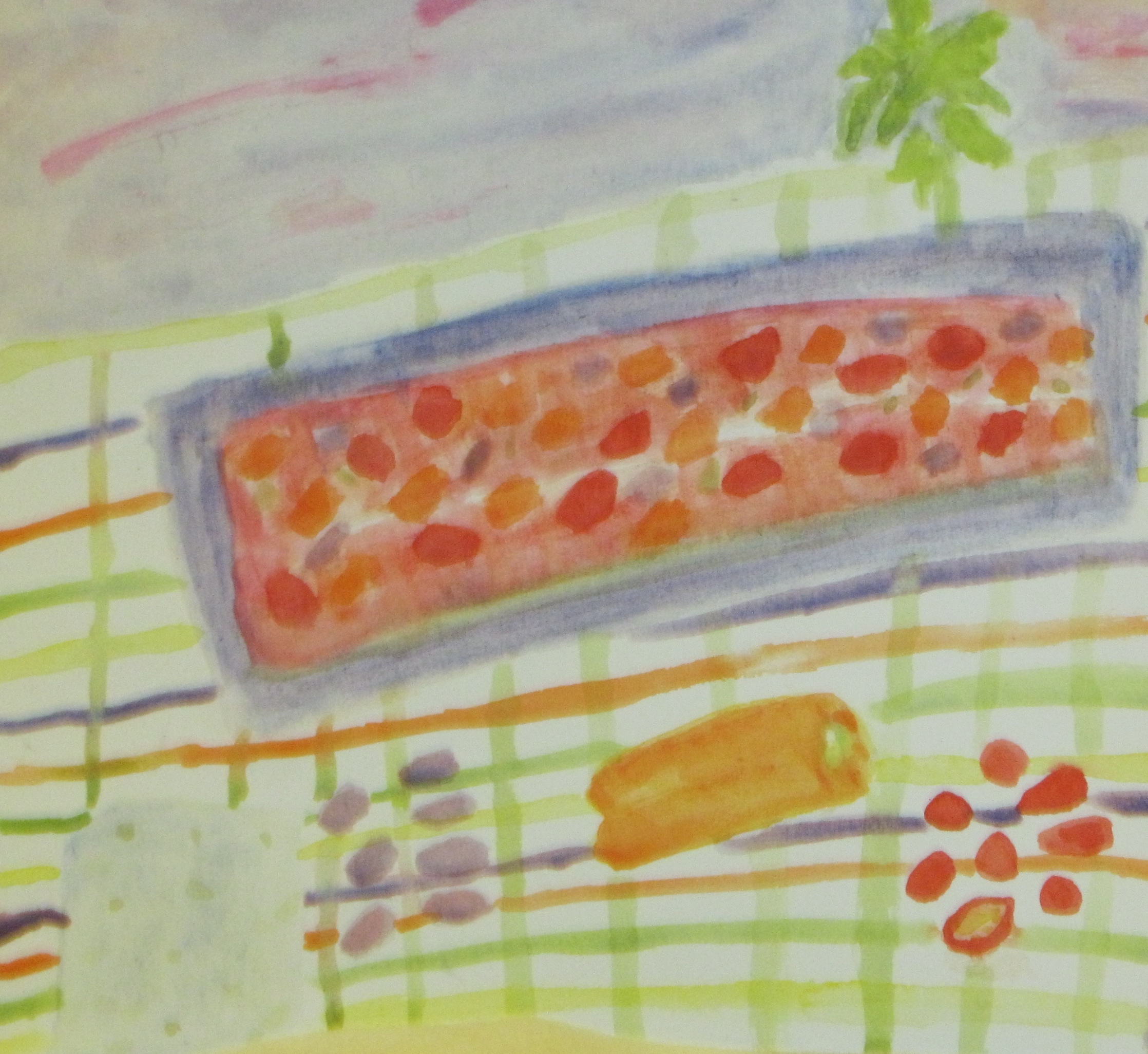
Original watercolor painting shows Muhammara and ingredients.

Muhammara. 8″ x 8″ gouache and watercolor pencil on paper. Sharyn Dimmick.

The fall food palate includes corn and tomatoes still, green beans and cucumbers. Eggplant is in, along with plenty of peppers, both hot and sweet types. Is it cheating to tell you about something I will surely cook soon? Let’s talk about Muhammara.

Muhammara is a Middle Eastern spread of roasted peppers and walnuts, thickened with bread and flavored with cumin, garlic and pomegranate molasses. I make it in the fall when peppers come in and I still have fresh walnuts. Muhammara is good with toasted pita bread, grilled lamb sandwiches, celery sticks. I’ll eat it by the spoonful and run my finger along the empty bowl.

I first ate Muhammara at Zatar restaurant in downtown Berkeley. Muhammara has a lovely red-orange color and an intriguing flavor from the molasses, essentially pomegranate juice boiled down into a thick sweet and tart syrup. I learned to make it myself from Epicurious.com, but I messed with it a little.

If you have a glut of red peppers in your kitchen, roast them in the oven, rubbed with a little olive oil. Slip the skins by putting them in a glass bowl covered with a dish towel, letting them steam in their own heat.

Otherwise, open

1 jar of roasted red peppers. Discard the liquid and put the peppers into your blender.

Add 1 slice of bread. (French bread is good for this  — don’t use rye or raisin bread).

Chop and toast 1/3 cup walnuts

Add walnuts to the blender with

juice of 1 lemon

2 tsp pomegranate molasses

1 tsp ground cumin

1/2 tsp red pepper flakes

Mash 2 to 4 cloves of garlic with 1/2 tsp salt. Add to blender

Add enough olive oil to blend. The original recipe I found on Epicurious calls for a horrifying 3/4 cup. I would use 1/3 cup max, but suit yourself.

Whirl in blender until you have a thick red paste. Try to get it out of the blender before you actually start eating it!

Friday I called my friend Margit to ask her something or other and she said, “Oh. I forgot to tell you — the pears are ready for picking.” She has a backyard tree.

After lunch I walked down the hill, borrowed a tall kitchen step stool and began to pick pears. Most were green (good pears ripen off the tree), a few were yellow. I took a large bag home and revised my plans for making a large Gravenstein apple pie for my ballad group on Saturday, deciding instead to make a Pear Tart Tatin. This time around I added a jigger of dark rum to the pears after I cut them and sprinkled a few grains of crushed cardamom over the pears and caramel before I laid on the crust.

Original watercolor shows pain perdu with carmelized pears on plate.

Pain Perdu with Pears. 6″ x 6″ Watercolor pencil on paper. Sharyn Dimmick.

When the tart tatin was in the oven I noticed that I still had rum in the pie plate where the pears had been. You know I hate to waste things, so I went fishing for the yellowest pears I had, the ones that would not keep another day. I peeled them, cut away the cores and stems and any brown, mushy spots. I plunked them into the rum. After I finished flipping the tart tatin onto a plate I poured the pears and rum into the cast iron skillet and set it in the still warm oven. I hoped the pears would start to cook from the residual heat and perhaps soak up some caramel flavor from the pan.

This morning I wrote and read and listened to music for awhile before breakfast, perhaps a bit too long. I knew I wanted coffee and I knew I needed to cook the pears, but what would I do with them? I didn’t want to take the time to make a pot of oatmeal. Ah. Pain perdu, “lost bread,” aka French toast. Because I was only feeding myself I took 1 long slice of sourdough sandwich bread, cut it in half and toasted it in the toaster oven. While it toasted I beat 1 egg in a shallow pan, added about 1 and 1/2 Tbsp of sugar and a splash of vanilla. I put the bread into the egg mixture, turning it over once.

Meanwhile I set the cast iron skillet on low heat. I heated the pears, rum and leftover caramel for a few minutes, then pushed the pears to the side to continue cooking and added just a smidgeon of butter, perhaps a teaspoon to prevent the bread from sticking. I turned the heat up to medium and cooked the bread on both sides before removing it to a plate and spooning the pears and caramel on top of it.

Food Notes: This made a lovely breakfast as is, but I could imagine adding some ricotta, quark or yogurt for the contrasting flavor.

Other Notes: The Lauren Project is cooking right along. Several people have submitted recipes to the contest. Some people have sent us more than one. But those of you who have not submitted anything yet still have some time: the contest deadline is August 31, 2012, 12 midnight, Pacific Time. After that, Lauren will review (and perhaps test cook) some of the recipes and we will begin awarding prizes. In case you have forgotten, or are new to this contest, the prizes will consist of one red chile pot holder, one signed seasonal cookbook with paintings by Sharyn Dimmick, one copy of Sharyn’s music CD “Paris,” and one Kale Chronicles’ painting of your choice. One prize per person, please. When Lauren chooses her first winner I will contact that person to ask which prize they want and then we will move to the second winner and so on until we are out of prizes. All persons in the USA or Canada who submit recipes will be eligible for free shipping on any Kale Chronicles painting they purchase through the end of 2012.

I recently had some dental work done — after I lost my job a couple of years ago it didn’t seem too important to keep up visits to the dentist. I went last week. And I paid for it because Dr. Liu found a cracked tooth, a broken tooth and a cracked filling (but no tooth decay!). Last week he set to fixing all that. He adjusted a crown while he was at it. I have to go back to have the cracked tooth fixed after I get through with jury duty, which starts today. So, following on my anniversary post about The Lauren Project, I share with you some of the things I ate  — um, drank, since I could neither bite nor chew. It does give me empathy with those on restricted diets.

The first night following surgery I had a coffee milkshake, coffee ice cream whirled up in the blender with a little one percent milk. I was feeling pretty happy that I had an excuse to have one for dinner and even forbore to put Kahlua in it. By 9 PM I was hungry, however, and had to resort to a serving of coconut yogurt.

The next morning I was determined to eat something normal, so I cooked my usual breakfast of rolled oats in milk with a pinch of kosher salt, four walnuts and two teaspoonfuls of rhubarb compote (remember the rhubarb experiments?). I found even the amount of chewing required for oatmeal and walnuts to be unpleasant so I resolved to have liquid lunches and dinners for another day.

I got hungry again before 11:00 AM — I was up at 5:30 AM and had eaten at around 7:30 and had taken a little walk at 10:00. This time I set to work on a smoothie, consisting of a fresh mango and a container of strawberry yogurt with a pinch of crushed cardamom. Delicious, but after I had had a few sips I realized I was going to get tired of sweets fast.

What to do? I put aside the mango smoothie, rinsed the blender and decided it was time to try gazpacho.

This was kind of a big deal to me because have never liked tomato juice, Snappy-Tom, bloody Mary’s, or V-8 — can you say yuck? So I didn’t look up anybody’s recipe for gazpacho. We had cold soups when I was in France: my favorite one there incorporated melon, bacon and cream: it sounds gross, but it was really good.

Original watercolor painting shows tomatoes, cucumbers, gypsy peppers and lemon.

Greek Salad Vegetables, 6″ x 6″ gouache and watercolor pencil on paper. Sharyn Dimmick.

Anyway, then I thought of the delicious liquid that hangs out at the bottom of a bowl of Greek Salad. I decided my best shot at gazpacho was to make a Greek salad and liquify it. I proceeded to chop 2 heirloom tomatoes, 2/3 of a large, peeled Armenian cucumber, 2 Gypsy peppers (ranging from yellow through orange to red). I added 1 large pressed clove of garlic and a small handful of chopped, pitted Greek olives. Then I went out to front yard and picked the ripest Meyer lemon I could find on the tree.

I blended all that up. I tasted it cautiously, with the intention of adding feta cheese. But you know what? It didn’t need the cheese. It didn’t need oil or black pepper or salt or red pepper flakes or red wine vinegar. It didn’t need a single blessed thing. I encourage you to try it, even if you are afraid of all of those red, cold, tomato-based drinks, especially if you like Greek salad.

I had a glass of Greek gazpacho for lunch, followed by the rest of my strawberry-mango smoothie. I have another glass of gazpacho left for later, waiting for me in the refrigerator. And tonight I’ll probably indulge in another coffee shake — the only thing that would make it better would be if I had a stash of malted milk powder, but we haven’t seen it lately at Grocery Outlet.

What are your favorite things to eat when you have dental work? C’mon. ‘Fess up.

Photo of Sharyn Dimmick's illustrated cookbook (aka The Kale Chronicles cookbook)

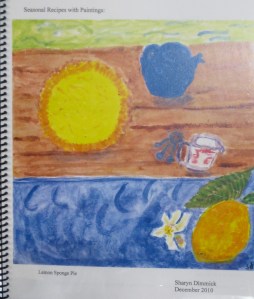
Photo shows cover of Sharyn Dimmick’s cookbook, Seasonal Recipes with Paintings, developed before the beginning of The Kale Chronicles blog.

Long before The Kale Chronicles blog began I frequently wrote about what I was cooking each week. In 2010 I assembled a limited edition cookbook called “Seasonal Recipes with Paintings,” featuring a recipe for each month of the year with an original painting. I gave these for holiday gifts. For half of 2010 and half of 2011 I lurked about on the A-List Blogging Club, learning about blogging and what I did and did not want to do with my maiden blog.

Then one night I was talking to my friend Neola on the phone and she said, “Why don’t you write about food? Everyone always likes it when you write about food — I even like it and I don’t eat vegetables.” It’s true: whenever I wrote about food my writing friends said things like “You should do a cookbook” and “I can’t read your writing when I am hungry.” Neola suggested that I write about what I got in my produce box each week and what I did with it. Then I happened upon a post called “The Kale Chronicles” on the net and I knew I had my blog title because I frequently struggled with making kale edible, despite the  fact that it had been showing up in my box regularly for the past several years. I painted a “cover painting” for the blog, now in a private collection in Florida and chose an image of it for my gravatar — that little signature picture box you will see in the Comments section. And I decided I would paint for the blog, rather than take photos because I enjoy painting more. The lurking, the phone call, the writing, the produce box, the inspiration for the title, all came together to create The Kale Chronicles, which is a year old today. I thank Neola, the A-List Blogging Club, the practice of writing as taught by Natalie Goldberg and every single one of the 106 subscribers and 15,699 visitors who have taken the time to read the essays, cook the recipes, look at the paintings, buy the music, wish me well when I was ill, encourage me to go on and be or become my friends online and in the real world. I am deeply grateful for your company and support.

One of the things that I am most grateful for in my adult life on a daily basis is that I can eat whatever I like. When I was a child I had to eat everything on every dinner plate no matter how I felt about it — I don’t mean I had to try things or taste them: I had to eat “a reasonable portion.” If I served myself a portion that my father did not deem reasonable, he would serve me twice as much. When I grew up I vowed that I would never eat a long list of foods again: mayonnaise, avocado, English peas, asparagus, tuna, liver, etc. I learned to eat some formerly despised foods, including cauliflower and eggplant by preparing them differently than my mother did. But the big deal is that I get to decide what I eat now.

Some people do not get to decide what they will eat. Some people are poor enough to eat whatever they can get. Others have restrictions due to illness or sensitivities. My friend Lauren, one of my writing pals who studies with Natalie Goldberg and was with me in France, follows a restricted diet due to a poorly understood autoimmune disease. She was happy in France, eating a wide variety of non-chemical, non-genetically modified foods, but then she came back to the United States and was finding it hard to get quick, tasty healthy meals on her table.

And then I had an idea: I had seen her food list in France and my blogging anniversary was coming up. What if I let the food blogging community see her lists of what she could and could not eat and then let bloggers send in recipes for Lauren? So, today, on The Kale Chronicles’ first anniversary I am pleased to announce The Lauren Project, a recipe contest that keeps to the foods Lauren can eat. Below you will find 1) a list of foods Lauren can eat and 2) a list of foods Lauren cannot eat. It is important that you look at both lists when designing your recipes for her because using a restricted food will mean that she cannot try your recipe.

Lauren's chile potholder prototype.

Lauren’s chile pepper pot holder in process — the real thing is way cuter.

Prizes. Yes, there will be prizes. Lauren and I conferred on this. Lauren will award a homemade chili pepper potholder for a winning recipe. I will award 1) a signed Kale Chronicles’ cookbook (made before I started the blog, featuring fourteen recipes and thirteen prints of my watercolor paintings) 2) an original painting (winners’ choice) 3) a “Paris” CD (full-length folk music CD, featuring songs by Joni Mitchell, Leonard Cohen, Richard Thompson, Shelley Posen and yours truly, which includes a booklet of original paintings and all of the lyrics to all of the songs). Also, anyone within the U.S. or Canada who enters a recipe in The Lauren Project will be eligible for free shipping for any painting he or she purchases from me in 2012.

Here are the ingredient lists. Please read them carefully.

1)”Yes” Foods:  Grains: White rice, brown rice, red rice, black rice, wild rice, quinoa, cornmeal, millet, gluten-free oats

Vegetables: broccoli, cauliflower, Brussels sprouts, spinach, lettuce, kale, collards, chard, mustard greens, sorrel, summer squash, winter squash, beans (except pinto and lima beans), peas, corn, asparagus, artichoke, fennel bulb, leek, garlic, shallot, turnip

Fruit: apples (tart varieties only), blackberries, raspberries, boysenberries, currants, lemon, lime

Dairy: eggs, cows’ milk yogurt

Meat and fish: Buffalo, lamb, game meats, beef and chicken in moderation, some fish (see exceptions on other list)

Nuts and legumes: cashews, macadamia nuts, pecans, almonds (in moderation), pumpkin seeds, sunflower seeds, garbanzo beans, black beans, mung beans, cannellini beans, lentils, adzuki beans, red beans, black-eyed peas, white beans

Seasonings: salt, ginger, cumin, coriander, turmeric, cardamom, anise, rosemary, sage, cloves, vanilla.

Other: olive oil, coconut (including coconut milk), organic non-genetically-modified sugar (must use sparingly). Maple syrup (also use sparingly — Lauren needs to limit her intake of all sugars).

2) “No” Foods: Must avoid — DO NOT USE IN YOUR RECIPES — : grains containing gluten — no wheat, rye, or products made of them. No mushrooms or fungus of any kind. Nothing containing mold — no blue cheeses, moldy cheese rinds, etc. No goat cheese or goat’s milk. No cheddar cheese. No yeast, vinegar, mayonnaise, alcohol, caffeine, honey, agave, cocoa, chocolate or artificial sweeteners. Nothing fermented. No soy or soy products. No basil, oregano, paprika, chili, sesame, cinnamon or mint. No beets, cucumber, eggplant, bell pepper, chili peppers, potato, tomato, cabbage, onion, avocado or tomatillo. No blueberries, strawberries, melon or peaches. No pork, turkey, ostrich, tilapia, shellfish or mollusks (mussels, clams, etc.). No hazelnuts, walnuts, Brazil nuts, pinto beans or lima beans.

A few words from Lauren:

i am so excited! 

one of my biggest issues is breakfast. i just can’t seem to manage cooking that early in the morning which means i usually just skip breakfast and go straight to lunch (or eat breakfast at 11:30). my favorite breakfast is beef and butternut stew – i do best with heavy protein and very few grains – but i can’t eat it every day. i’m also hungry for one-pot meals that i can cook in bulk and freeze. my last request is for a simple way to get more veggies into my diet. I don’t do well with raw, so things that i can cook quickly with minimal prep (maybe also some good pre-prep tricks for processing veggies when i buy them so they are ready to cook at a moment’s notice). oh, and one more thing… eggs are best cooked in things or scrambled really well. i don’t always do very well with whites. if anyone has questions regarding items not on the lists i’m happy to answer inquiries (mostly they are borderline foods that are okay sometimes or when prepared in certain ways.
thank you so much for doing this and for even thinking of me. it means a lot.

Because we are being kind to Lauren, we ask that you get your grains and organic sugar from reputable gluten-free and non-GMO sources. Organically grown things are less likely to cause less trouble than conventionally grown products. But you can experiment with what you have in your cupboards and then write the recipe for organic, gluten-free products.
Photo of cover of Paris CD by Sharyn Dimmick.

Photo shows front cover of Sharyn Dimmick’s music CD, “Paris.”

Deadline: You must submit your recipe(s) to The Kale Chronicles by midnight Pacific time on August 31st, 2012. You may submit them in the Comments field here, or post them in the Comments field of The Lauren Project page. (Look above and click on it). We will announce the prize winners in a September blog post. You may also post your recipes on your own blogs with the tag “The Lauren Project” and a link to this contest post, but if you don’t send them to me here as well I might miss them (and we wouldn’t want that).

I was working on a recipe for Lauren this week, but then I felt the irresistible urge to go to another music festival in Sonoma County, stay up till 2 AM, flirt with some men, sing some songs. To do that, I had to bake a Gravenstein apple pie, make a Greek salad, cough up twenty bucks, wash my hair and spiff up. I came back tired and happy with my hair full of campfire smoke. I will keep working on the recipe and post it by the deadline, hoping to inspire you to create recipes for Lauren as well, but I might inspire you to run off to folk festivals and flirt with guitar-players. Oops. C’est la vie.

Love,

Sharyn (aka The Kale Chronicler)

List update. We have just added “coriander” to the Yes list as of 8/23/12.
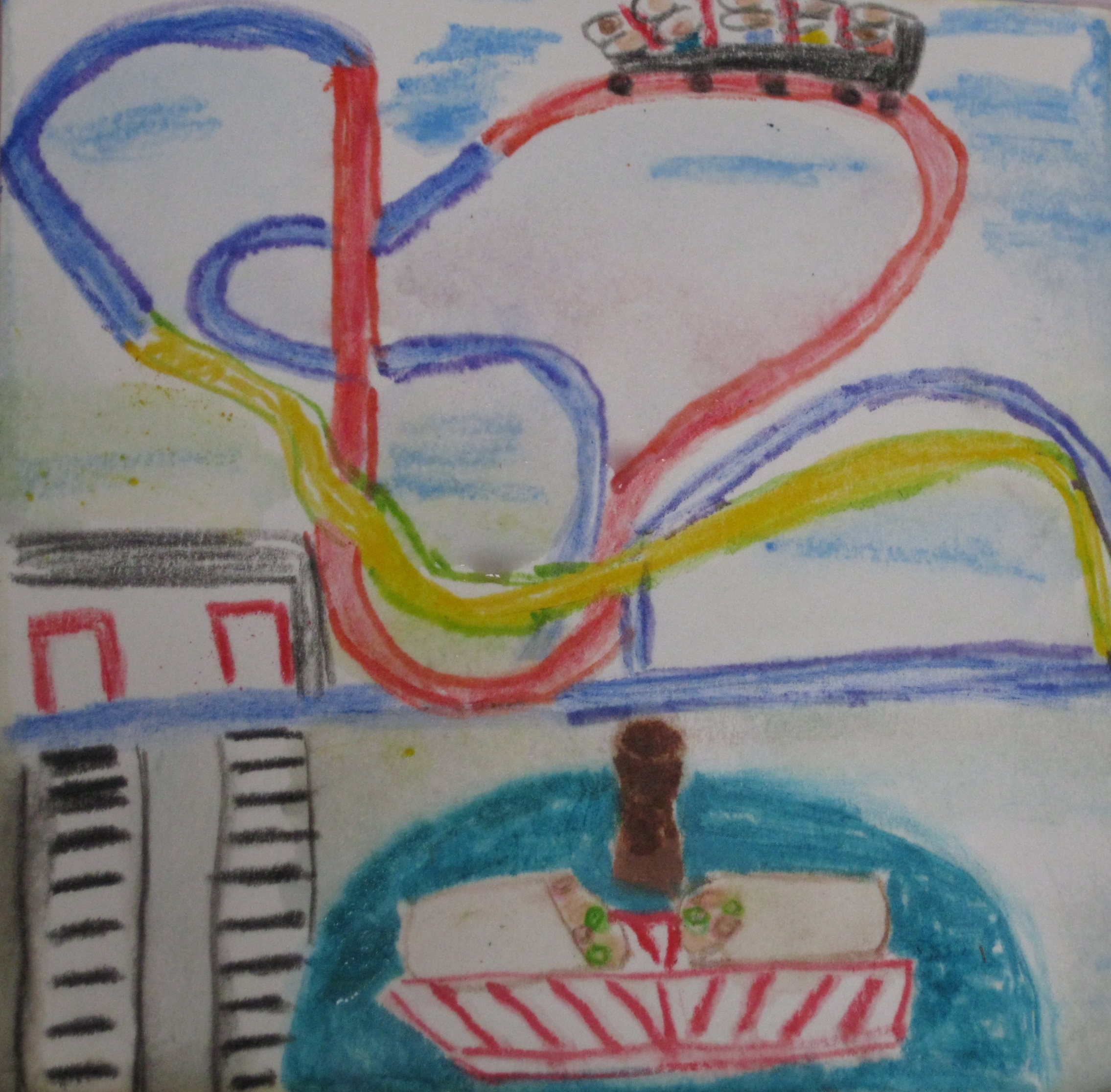
Original painting of roller coaster, park burrito in foreground.

Free-Form Roller Coaster with Burrito. 6″ x 6″ watercolor pencil on paper. Sharyn DImmick.

Yesterday my best friend and I made an impromptu excursion to the Six Flags Discovery Kingdom amusement park in Vallejo. I have loved roller coasters since my introduction to them at Bay Fair mall at age four: as soon as the ride finished, I apparently looked at my mother, eyes shining, and said “Can we go again?” Better than a merry-go-round, better than a see-saw. My daredevil brother and I would ride anything that moved at the Santa Cruz Beach Boardwalk and I have fantasized about making a roller coaster tour of the United States (Shoulda done it when I was younger though — those wooden coasters really shake up the neck these days).

Anyway, just for the record, I rode the Roar (old, wooden, jolting and large), The Boomerang (modern, turns loops, goes forward and backwards), The Medusa (pure fun: classic slope-climbing, twisting, turning, presents illusions of imminent crashes into cross-beams) and Superman, the new coaster. Superman deserves a sentence of its own: its wheels run on the outside of narrow metal tracks, allowing for straight vertical drops, twisting, turning upside down, reversing direction — it does all that at a higher speed than the other coasters, the cars roaring into and off the loading platform. Suzanne joined me on the Roar and the Boomerang. We also road water rides, The Ark, and a 48-year-old elephant. Elephant rides are a lot less smooth than horseback rides because the elephant is so wide: you lurch with each step, listing to one side, feeling the elephant muscles sliding out from under you. I  also rode something called the Voodoo, some rocking, swinging, flipping, scary thing. Not too scary — I like these kinds of rides.

For a speed-loving, gravity-defying adult (The Ark operator broke into a chorus of “When I’m Sixty-Four” when Suzanne and I got into our seats, being the poor judge of age most twenty-somethings are), the challenge of amusement park outings is not the rides or lines, but the food. Six Flags parks have a policy forbidding “outside food.” You cannot even bring in a bottle of water. What this means is that you can stash a picnic lunch in your car all day, get your hand stamped and walk half a mile to retrieve it when you get hungry, or you can bring a twenty-dollar bill and take your chances with park food.

Suzanne did food reconnaissance between rides. She settled on a Panda Express meal of Kung Pao Chicken, Broccoli Beef and noodles — she said she was trying to calculate the most vegetables per meal. I have eaten Panda Express meals at airports and, if you choose carefully, you can get something tasty and a fair amount of vegetable matter, but it will have more sugar, salt and fat than I normally eat in a given day.

I opted for the chicken burrito at Machos Nachos, hoping that I could customize it. While I stood in the long line I noted that the “lime cilantro rice” was white rice with a few green shreds in it and that the cheese was some indeterminate, bland, pale blend. I made my plan, which was to ask for a grilled chicken burrito with pinto beans, shredded lettuce, sour cream and salsa, skipping the rice and cheese. I spied some chocolate milk as I reached the service counter and nabbed it, so as not to pay $3.79 for a bottle of water or to ingest any high fructose corn syrup (aka soft drinks).

The servers accommodated my requests cheerfully, pausing only to attempt to sell me a $14.99 refillable plastic drink cup. At the last minute, I spied some pickled jalapenos and asked that the server add some. That cost me an extra dollar, even though I had forgone the cheese and rice.  My lunch was served in a cardboard carton with a plastic cup of salsa. The burrito was cut in half and wrapped in foil.  Lunch set me back $15.15, for which I could easily get two super-sized burritos and a drink at any respectable taqueria.

How did it taste? It was fine, except for the fact that the grilled chicken was cold — that was a nasty shock: warm beans, cold grilled chicken. Is there some health regulation involved here? The chocolate milk (Berkeley Farms) was sweeter and less-chocolaty than I like, but it did not have corn syrup in it, for which I am grateful.

Let me just say that California is a major agricultural state — it used to provide one-fifth of the produce consumed in the United States when I was a child — and summer crops are in full swing. Suzanne and I saw a stand for fresh roasted corn, but we did not investigate it, having had enough carbs in our lunch already. It cannot be too hard to bring in fresh, seasonal tomatoes and cucumbers for salads, to make fresh fruit cups, to offer slices of watermelon to park visitors, but, of course, it is easier to open cans of nacho cheese sauce, flip pre-made burgers served with mustard and ketchup packets. It doesn’t seem to beyond the scope of food service to operate deep-fryers, producing onion rings and French fries, but God forbid that someone would have to slice lettuce and tomatoes.

Alright. So you don’t go for the food. But you do have to eat while you are there and my days of living on SnoCones, cotton candy and pink popcorn are long over. My favorite amusement park treat is soft serve ice cream made with dried milk or frozen yogurt, but I didn’t see any — it has been replaced by the reprehensible fake food called “Dippin’ Dots,” by Dove Bar stands, and by Coldstone Creamery outlets. I would be interested to hear how any of you other roller coaster aficionados handle amusement park meals — I ate a healthy oatmeal breakfast and said to myself, “It’s just one day.”